In February I took our dog, Seamus, to the vet for his annual check up. Ever since the covid pandemic there has been a sign at the end of each parking space asking owners to call and announce their arrival, and then to wait for a return call summoning them inside. For safety reasons there was to be no loitering in the waiting area. What struck me was the assumption by the office staff that everyone carries a cell phone; certainly there was no explanation of what to do in the absence of such a device.
When did this assumption start? In 1989, four years before the end of the apartheid regime, I spent part of a sabbatical teaching in Soweto, the large township south of Johannesburg. Indeed the word Soweto stands for SOuth WEst TOwnship.) I quickly learned that I could not ask the students (the equivalent of 10th graders ranging in age from 13 to 22) to do homework because most lived in so-called ‘match box’ houses with neither electricity nor indoor plumbing; the idea of students working at home in the evening was not feasible.
Similarly, when I first taught in the US, in 1991, we could not assume that all students had access to a home computer, nor a few years later that all had access to broadband. In the space of two years I had transitioned from no electricity at all to questioning broadband access, even if in different geographical locations.
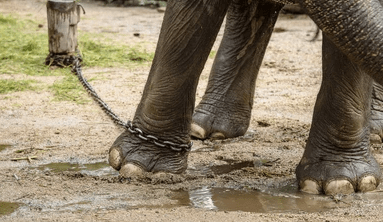
Sadly, assumptions can deputize as handcuffs. In parts of Asia for example, young elephants are trained by attaching a short chain to one of their forelegs, which is then tied to a stake that is driven into the ground. After about year, the stake alone is put in the ground and the elephants assume that they are constrained by a now-imaginary chain length.
It seems to me that we, as beekeepers, are often fettered by chains that exist only in our minds.
Two examples. Journal articles seem to assume that it is necessary to feed sugar syrup in the fall, and again in the late winter. As I understand it, feeding sugar was developed in post-war Canada, when sugar was cheap and honey expensive. The motivation was solely economic – remove and sell all of the honey and replace it with white sugar. Curiously the effects on the health of the bees were and are seldom questioned. An advertisement for HiveAlive in the August issue of Bee Culture states that “The ideal carbohydrate for bees is their own honey …” and confirms that not only is the nutritional profile of sugar not as good as honey but it lacks the antibacterial and antifungal properties naturally found in honey. It should be no surprise that research in labs such as that of Dr. Gene Robinson has shown that bees fed sugar syrup in the autumn might emerge from the winter in greater numbers but they are smaller in size, lighter in weight and, critically, their immune system has been compromised. Are we unwittingly creating a hive environment that favors the mites in that the bees are less well equipped to defend themselves?
The ad mentioned above is promoting the use of additives to the sugar syrup. That is a band aid compared to leaving more honey on the hives for the bees. And if one does need to feed , why not use honey itself, either still capped in the frame or in the same manner as one would normally feed sugar syrup?
To take this a step further. After a presentation by Dr. Dave Tarpy at EAS in 2022 on queen losses, the issue arose of the quality of royal jelly. How does the jelly from nurse bees who are fed sugar syrup differ from those who are living off their own honey, and how does this impact the larvae of not only queens but worker and drone brood? Is this an underling reason for declining queen quality and longevity? If I understood Dr. Tarpy correctly, this has not as yet been researched but might be examinable in the work done recently by a post-grad student in his laboratory.
The second example involves screened bottom boards., which were introduced in the 1980’s as a first response to the varroa invasion, on the grounds that the mites would drop off incoming bees, fall through the screen, and be unable to regain access to the colony. We know now, from the work of Dr. Sammy Ramsay in particular, that mites do not fall of incoming bees unless there are so many mites on the bee already that their normal places of attachment are not available and the mites are therefore exposed. As one researcher revealed, if one sees a mite on the back of a bee, there are probably 8 mites already securely attached under the abdomen but not visible.
Besides changing the ventilation flow in a hive (I have yet to come across a feral hive with a screened bottom,) and writing in the same issue of Bee Culture cited above (August, 2023,) Tina Sebestyen points out that a screened bottom board increases mite reproduction because it lowers the humidity, and mites do better at the lower range of humidity which the bees maintain in the hive.
Hive Mind, an article by Sam Knight in the Aug 28, 2023, issue of The New Yorker, cites Dr. Tom Seeley : “As I see it, most of the problems of honey bee health are rooted in the standard practices of beekeeping, which are used by nearly all beekeepers … In the United States, beekeepers are taught only what we might call the industrial form of beekeeping. And that’s where I would say, ‘No, there is a choice here between how you want to relate to an organism who life, in a way, you have under your control.”
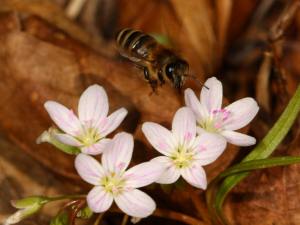
Thus I am perturbed when writers mention without qualification the use of sugar syrup and screened bottom boards. These two in combination increase the odds in favor of the mites and make a difficult position even worse for the bees. Like the elephants’ chain, there is minimal connection to reality but the illusion is kept alive in many introductory bee classes and in articles in reputable bee journals.





 Our Green Cathedral