In the country in which I grew up, Southern Rhodesia, the 6 major towns, often 200 miles or more apart, were connected by what was called strip roads. Essentially they were two macadamized strips that were built by Italian prisoners-of-war in the mid 1940’s when resources were sparse and labor was cheap. Knowing nothing else I took them for granted; it was only when doing some background reading for this article that I realized how particular they were to that part of the world, at least in terms of scale.
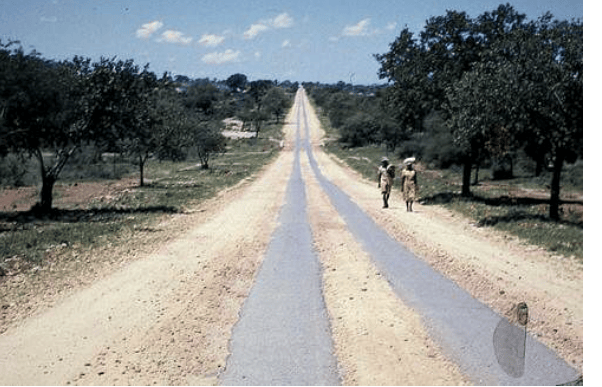
It was on these roads that I learned to drive. It was not difficult – one simply had to keep the wheels on the tarmac – until there was an on-coming vehicle or one needed to overtake a car in front, at which time a certain protocol came into play. In the event of an approaching vehicle, each driver would pull over to the right hand side, keeping the left hand wheels on the strip and the right hand wheels in the gravel, until the vehicles had passed each other. And yes, there were a few ego-challenged drivers who would play chicken, leaving it until the last minute to pull over.
If it was a matter of over-taking a vehicle in front, one had to wait until the driver ahead pulled off to the left, at which point one could move to the right so that one’s right wheels were on the left strip, and safely overtake.
(Actually, left and right were reversed in this case, because we had right-hand drive vehicles, but I have Americanized it for easier understanding.)*
But it didn’t end there. This was before the age of shatter proof glass, and the danger was that a stone from the gravel, thrown up in the over-taking process, would shatter the windscreen, leaving the driver with a lap full of glass shards. The understanding therefore, was that, after overtaking, a driver would not pull back on to both strips until he could see in his rear-view mirror the two headlights of the vehicle he had overtaken. This provided the necessary distance at which one could pull back on to the strips without danger to the vehicle behind.
I should add that, fortunately there were very few vehicles on these rural roads; the real danger came from either the occasional wild animal or from herds of cattle, especially if it was a Thursday, when the herds went to the local community yard to be dipped against tick-borne diseases. Certainly there were pedestrians, as in the picture above, and one did not pull over to give them more room; so doing would put one’s tires in the gravel which could throw up stones with serious consequences for those by the road side. It was seen as their job to stay as well away from the strips as possible in the interests of their own safety. Incidentally, when working in the garden close to a mildly-travelled road here in York County, I am invariably pleasantly surprised by just how far vehicles will move over to give me space. That was not my experience growing up and it is still not part of my expectation.
I drove on strip roads roads for some 14 years, which is only 22% of my driving experience, but the habit of delaying one’s return to the inside lane until both headlights of the car behind are visible has proved difficult, if not impossible, to break. That’s an OK habit on the freeway, when one normally has adequate space and time, but it is much more difficult to implement in an urban area when vehicles are nipping into smaller gaps. It causes me significant stress which I have yet to overcome. (I would make a terrible Formula One driver, which, fortunately, has never been even the remotest possibility.)
As an aside, when the the steering wheel is on the right hand side, the rear view mirror is on the drivers upper left, and I was conditioned to keep flicking my eyes upward and leftward to check on traffic behind. That too was a habit that was challenging to break when I found myself sitting on the left with the steering wheel in my hands.
In his book, Honeybees : a natural and a less natural history, Jacques van Alphen writes, “ How to Keep Bees books are written by established beekeepers, and beekeeping classes are taught by established beekeepers – the danger is that age-old practices are either not called into question, or re-evaluated and brought up to date. eg. all the new knowledge about bee behavior, genetics, ecology and evolution has not led to fundamental changes in beekeeping.”
When America pioneered the automobile, horse owners had to concede that, after thousands of years, the age of horses as the primary mode of transport was over. The development of the auto has never stopped, as I am reminded every time I need to update our current vehicles. There were some false moves – cars, for example, initially were powered by electricity which was soon abandoned for gasoline and diesel and which is now in the process of giving way to electrically charged batteries and possibly hydrogen – and despite this initial regression we are now at the the point of having self-driving cars on the road.

Strip roads and non-shatterproof glass, themselves things of the past, required habits that were appropriate at the time but can be detrimental if not changed. The practices of beekeeping too have changed but are not always reflected in our classes. New discoveries in what van Alphen labeled bee behavior, genetics, ecology and evolution need to be reflected early, precisely because bad habits are hard to break. More on that next month. Meanwhile, in the words of John Maynard Keynes, “The difficulty lies not so much in developing new ideas as in escaping from old ones.”
PS. Note the insect wing in the image, caught on the windscreen the car. When was the last time you saw a bug on your windscreen? My first butterfly collection came from those unfortunate insects caught in the grille of my father’s car!
*For thousands of years travel, whether on foot or horseback, was on the left hand side of a road, so that anyone approaching was on the right hand side and the traveler could use his sword arm (ie. right arm) to defend himself. Apparently it was Napoleon Bonaparte, in the late C18th, who, when he first invaded Austria, ordered his armies to move on the right hand side, partly to show who was in charge and partly to be disruptive to his opponents. Hence European countries conquered or colonized by France still tend to drive on the right, while those loyal to Napoleon’s main opponent, Britain, drive on the left (about one third globally.) This can cause conundrums. Eg. The island of St. Thomas, in the Caribbean, was a Danish colony, and still drives on the left, but the overwhelming majority of vehicles are imported from the US and thus are left hand drive. It is not difficult to imagine how tricky that can be on the narrow, mountainous roads of the island, to the point that driving by visitors is actively discouraged.