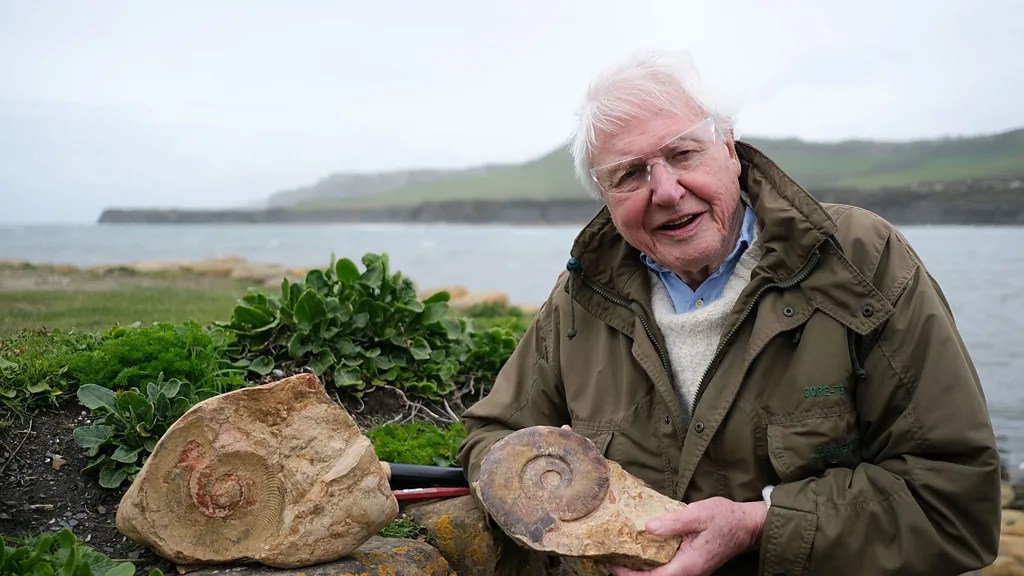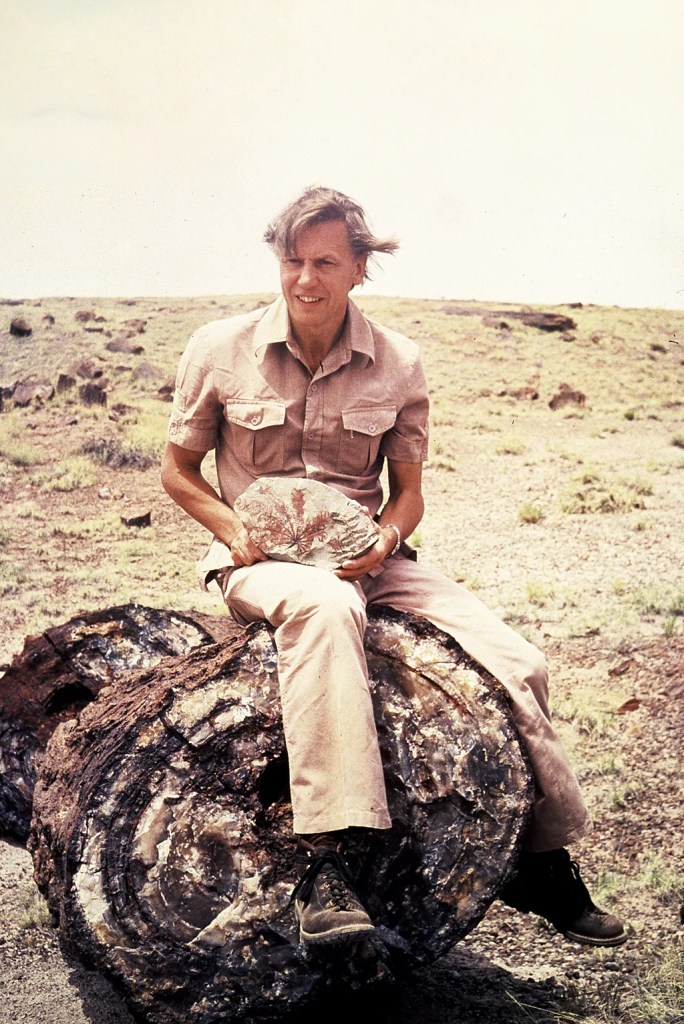
On May 8, David Attenborough celebrated his one hundredth birthday. As described by Richard Fisher of the BBC, one moment shaped his childhood – and quite possibly his entire career.
It was the late 1930s, he was about 10 years old, and had cycled into the Leicestershire countryside near his boyhood home. He began searching through the pieces that had tumbled from a rocky outcrop, and when he found a stone that looked like it might be useful, he carefully split it with his hammer.
“There, perfect in every detail, glinting as though it had just been polished, was a seashell… an object of breathtaking beauty,” he recalled. “And my eyes were the first to see it since its occupant died 200 million years ago.”
It was a fossil ammonite – a spiral-shelled creature around the size of his palm. Due to their coiled appearance the locals once believed they were snakes, but they were actually cephalopods: a marine mollusc which swam in ancient oceans.
“I suppose it’s true to say that it was one of the key moments of my life,” he recalled in a 1989 series about paleontology. “I have been repeating that moment, off and on, throughout my life and the thrill has still not worn off. … The moments of success when that rock fell apart and revealed a shell that hadn’t seen the sun for 200 million years, and that I was the first human being to see, seemed to me then – as to be truthful it still seems to me now – to be moments of magic.”
Letters written by David’s father, Frederick, in the 1930s and 1940s, hint at a boy fascinated by geology who wished to pursue the earth sciences as a career. Sir David explained that his father didn’t necessarily know much about rocks and fossils himself, but “he did say, ‘There are ways of finding out: you can go to the museum or there are some good books, you can read about that.’ And so [he] encouraged us to find out for ourselves.”
Good fortune and coincidence played a part, of course. It is a wise parent who motivates self-discovery rather than using his or her affluence and influence to bring the world to a passive child. David was living in one of the world centers of palaeontological treasure, and because in the 1870’s railway workers workers had carved into the sandstones, ironstones and clays, in what is now called the Tillton Railway Cutting, the rock faces were relatively fresh. So, while he had to step over rails and sleepers to reach the rock-face, he was rewarded with abundant ammonites, but also bivalves, brachiopods, gastropods and belemnites.
One item in particular was to spur his interest beyond merely geology. Early in the Second World War his family took in some of the many children fleeing Nazi Germany. One of them, Marianne, came from a city on the Baltic coast where her father, a doctor, had given her one small precious thing as a sign of his thanks to whoever it was who cared for his daughter – a piece of amber.
“It felt surprisingly warm and light in my hand, but what made me fall in love with amber is what I discovered inside it. I found something miraculous: there were insects preserved in astonishing detail. I burned with questions: what sort of world were they from? They must have lived a long time ago, but how long?”
According to Plato, a mind is not a vessel to be filled so much as a fire to be lit. The young David was afire! Aged 13, for example, he spent three weeks alone cycling to the Lake District in North West England, staying in youth hostels. “I doubt many parents would let children do that now,” he h reflected some 70 years later.
Tilton Railway Cutting is not the only site in Leicestershire that has yielded fossil firsts over the years. Another location nearby would become even more famous, when a fossil was found that changed our understanding of life’s origins. It was discovered by two schoolchildren, only 11 years after Sir David had left school – much to his chagrin later in life. “The rocks to the north-west of the city were of no interest to me…they didn’t contain any fossils. So I didn’t waste my time by looking there. How misguided I was,” he recalled in 2011.
One day in 1957, a schoolboy called Roger Mason cycled with two school friends to climb in a quarry in Charnwood Forest. There, they spotted something curious: a fossil with leaf-like branches that was unmistakably once alive. Mason knew that this shouldn’t have been possible – the rocks were pre-Cambrian in age, which would have made the fossil around 570-550 million years old. The geological consensus at the time was that life’s origin happened later.
Mason’s father persuaded a geologist at Leicester University to take a look, who confirmed it had indeed been a living creature, and published the find in Proceedings of the Yorkshire Geological Society. It was named Charnia mason, after Mason, and despite its appearance it was an animal, not a plant.
“It caused a geological sensation,” Sir David recalled. Reflecting on his own childhood fossil-hunting, “I couldn’t help wishing that I hadn’t paid so much attention to the accepted geological wisdom of the time, and that I had been the schoolboy who found that key fossil in the Charnwood.”
For Sir David, a boy fascination with fossils would shape a life exploring the natural world. His career, which would take him all over the globe, bringing nature’s wonders closer for us to appreciate and wonder at, started with a bicycle, a few local rock faces, and a teenager’s collection of ancient creatures. At a special centennial birthday concert at the Royal Albert Hall on May 9, 2026, host Kirsty Young told him: “Thank you David, not just for joining us here tonight, but for sharing your knowledge and love of the planet. You’ve given nature a voice, and what a voice it is.”
Is he now going to rest? Far from it. At the same centennial confront, the BBC announced that Sir David will soon narrate another new natural history series, Blue Planet III.
So the question is, was there one moment that, with the benefit of hindsight, shaped your life? And, even more specifically, what was the moment that attracted you to a life time passion? Has there been a time when you paid too much attention to conventional wisdom, considering anything beyond it a ‘waste of time’, and have you come to regret it?
A popular analogy is to imagine what our world might look like if it could be reduced to a village of 1 000 people. Not all sources agree but the population might look like this :
579 Asians
150 Africans
120 Europeans
81 North Americans
61 from South America
6 from Oceana
314 Christians
236 Muslims
143 Hindus
71 Buddhists
71 Confucians and Taoists
7 Shintoists
2 Jews
150 would be of a minor religion or atheist
6% would receive half of the village income
16% of adults would be illiterate
40% would exist on less than $2 per day
40% would be malnourished
And who provides honey for this village?
Just one beekeeper.
The final question therefore, and perhaps the most important, is how has your passion (or, in my case, honey bees,) helped you give a voice to nature for the benefit of your fellow villagers?