
If asked to describe a honey bee, you might say that is has three distinct body parts, antennae, six legs, four wings and that it flies. So if I were to gather from different sources the head, thorax and abdomen of a bee, two antenna, four wings and six legs, and threw them in the air, it would be a honey bee, right? After all, these are the component parts, and they fly, so why not?
Descriptive knowing is the way in which we typically delineate and define things – by their various parts – but thinking we know something because we can describe it is only partly true. It lacks what is called structural functional organization – the way things are structured so that the parts function as a whole or, as is commonly cited, the whole is greater than the sum of the parts. There is no adequate word for this in English, so we use the German gestalt, or less commonly, the Greek, logos.
Describing the gestalt of a honey bee is not easy, not least because our grasp is intuitive rather than explicit. We need to describe the form and at the same time identify the patterns that make up the gestalt. This is participatory knowing, meaning that our mind conforms with the shape, the form and the behavior of the honey bee; we develop the same patterns as the bee to the point that the very structure and functioning of our being can be changed. These are those rare brief moments when we feel ‘at one’ with the world.
Four famous lines from William Blake’s Auguries of Innocence best describe the feeling of gestalt :
To see a world in a grain of sand
And a heaven in a wild flower;
Hold infinity in the palm of your hand
And eternity in an hour
The left and right hemispheres of the brain are generally recognized as having differing functions. The right brain is more focused on art and creativity, on visualizing the whole picture, on seeing itself connected to the larger world, the gestalt. The left brain is more analytical, methodical, orderly and linear. We need both but Iain McGilchrist, in The Master and his Emissary : The Divided Brain and the Making of the Western World, argues that the left hemisphere with its focus on function has become so dominant that we are in danger of forgetting everything that makes us human. The left hemisphere, he argues, has grabbed more than its fair share of power resulting in a rigid and bureaucratic obsession with structure, self-interest and a mechanistic view of the world, at an enormous cost to human joy. Clearly the gestalt emanates from the right hemisphere, the one that we are using increasingly less frequently.
Why is this significant? Supposedly, honey bees are the most written about insect in the world, even as I have been unable to find independent confirmation of this. Yet the overwhelming majority of this writing is descriptive – in the journals, the scientific periodicals, the newsletters, the books. We describe the various issues that bees face and how to remedy them. We examine in detail the genome of the species with all of its implications for bee management. We describe how to get more honey from a hive, how to help the bees through winter, how to split colonies and introduce new queens …
And yes, all of this is important – it has to be mastered if one is to manage honey bees successfully – but too often we stop there.
A pervasive current topic is ‘the Meaning Crisis,’ a term devised by Dr. John Vervaeke, professor of cognitive science at the University of Toronto. In a series of podcasts, 48 hours in all, he describes how today’s mental health crisis is the consequence of a deeper cultural historical crisis. This is evidenced by the increasing numbers of people who feel disconnected from themselves, from each other, from the world, and from a viable and foreseeable future, as expressed in increases in anxiety disorders, depression, despair, and suicide rates. He argues that we need to understand and transform the meaning of our lives, our culture, and our world if we are find a way forward.
How to do it? Where and how do we find coherence, significance and purpose in our lives and our culture, these being the vital components of meaning?
For me, beekeeping is a touchstone of reality. It provides those vital times when the modern, manufactured world fades into the background and I interact with creatures who not only have a history that is beyond my ability to comprehend but who stand in defiance of the stresses of a world of greed, envy, and what Professor Vervaeke calls ‘the pornography of affirmation.” Those precious moment when time slows down, when the patterns in the hive conform with the patterns in my mind, when I am ‘in the flow,’ are not only the ultimate pleasure of beekeeping but also the moments of great awareness and insight. May every one of us have something in our lives which offer such an interaction.
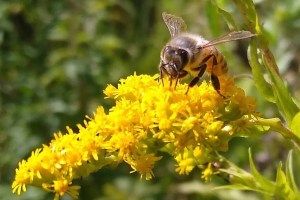
If Ian McGilchrist is correct, an experience of the gestalt, in this case with a colony of honey bees, is a vital step to recovering that critical balance between knowledge and wisdom, the first of which is factual and the second experiential. Such an experience cannot be taught but has to be discovered, and having encountered it once, the feeling of awe never ends. It is one transcendental way in which I for one can enlarge that continuing search for meaning, can feel connected to the natural world as well as my fellow like-minded beings, and as such is possibly the ultimate reason why, for some, beekeeping is a life-long passion and reward.


