I wince every time I hear that bees are responsible for one out of every three bites of food we eat. The self-focus thus displayed is destructive, penurious and hurtful.
Surely this assertion has been useful in promoting an awareness of the importance of bees to our food sources, yet I have still to find an explanation as to how that statistic was calculated. Sometimes the critical word is pollinators, or bees, or honey bees. Sometimes it expressly excludes grass-based food sources that are wind pollinated, like wheat, oats and rice; other times fruit and vegetables are specified. What are the data on which this statement is based, and who did the calculation? Even David Suzuki wrote, in 2014, “Some experts say one of every three bites of food we eat depends on them,” (my emphasis) without clarifying who these ‘experts’ are.
It is fast assuming the mythic proportions of the statement misattributed to Einstein : “If the bee disappeared off the surface of the globe then man would have only four years of life left. No more bees, no more pollination, no more plants, no more animals, no more man.” What Einstein did say is that “Only two things are infinite, the universe and human stupidity, and I’m not sure about the former.”
But there is a bigger reason why that phrase causes me to shudder. We look at the bees from our point of view only – that they exist primarily to provide us with food, and we have no obligation in return. It focuses on what we consume rather than the way the food the bees eat is toxic because of the way we grow ours.
In an essay titled Standing By Words, written in 1983, Wendell Berry describes an article in the spring 1979 issue of Perspectives in Biology and Medicine, in which the authors consider the transformation of American agriculture “from an art form into a science.” They cite the modern history of milk production, in particular the ‘entirely successful’ effort to transform the dairy cow from the original family companion ‘into an appropriate manufacturing unit of the twentieth century for the efficient transformation of unprocessed feed into food for man.’ As evidence they cite the use of ‘nutrition’ to decrease the numbers of cows while increasing the yield of milk, thus producing savings for the public. The ultimate justification, it seems, is measured in dollars.
Berry calls this ‘internal accounting,’ and suggests that there is also an ‘external accounting’ which results in a net loss. Examples include first the small family dairies that were forced out of business and the consequent break down of community forums, secondly the industrialization of agriculture with the consequent soil compaction and erosion, chemical pollution and obliteration of plant species, and thirdly the loss of any consideration of the cow as a fellow creature, a ‘companion,’ as she was once regarded.
Considering the honey bees as ‘responsible for one in three of every bites’ is an example of internal accounting. A more comprehensive view acknowledges our responsibly in maintaining, even regenerating, an environment in which they can operate successfully, as well as the essential part the bees play in pollinating plants that are not food sources for us, notably the billions of trees that re-process the excess carbon products we produce. As beekeeping assumes industrial portions in the US in particular, can we maintain our relationship with bees as ‘fellow creatures?’
In the 1980’s I would take students on three day excursions to a private game reserve which covered 6 000 acres in the north western corner of South Africa. It was called Lapalala (Place of the Leopard) and is today a thriving wilderness school. One of the exercises was to collect aquatic species (plant and animal) in the pristine Palala river and develop a diagram to show how each was dependent on the others for its existence. The final step was to erase one of the inter-species links and demonstrate how the interdependent chain quickly began to collapse.
In the same way all pollinators are a critical part of a healthy, long-term global environment and we reduce their role to food providers at our peril.
Something else that makes me shudder is receiving a mass produced letter that begins, “Dear Jeremy.” Am I supposed to think that the computer knows and cares for me, rather than operates on totally impersonal algorithms that spit out my name? If it is supposed to make me feel cared for it has the opposite effect – I feel manipulated – and such letters are quickly discarded. This is an ethical issue, one of integrity, which I cannot relate to honey bees, and having thus vented I won’t pursue it further in this chronicle …
For most of our history we have lived under an omnipresent consciousness of our mortality. Pandemics were only one cause of early deaths that haunted day-to-day life. Only in the nineteenth century, with improvements in sanitation in particular (at least for the more affluent, who could afford the flushing toilet with a ballcock invented by Thomas Crapper,) did mortal insecurity wane, barring such episodic ravages as tuberculosis and syphilis in the C19th, the Spanish Flu and AIDs in the C20th and ebola and corvid-19 in this one. To the mass deaths caused by these diseases we can add war, genocide, terrorism, opiates and guns.
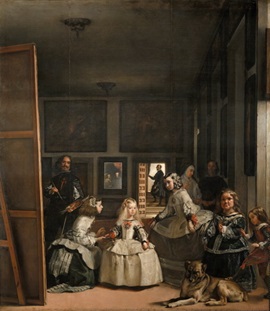
But let’s go back 364 years. In 1656 the Spanish painter, Diego Velázquez, was commissioned by the Habsburg King, Phliip IV, to paint Las Meninas (‘The Ladies-in-Waiting’) possibly the most closely analyzed painting of all time. On the surface it is an apotheosis of happiness and confidence; with the benefit of hindsight it captures the tragedy of the age. Its complex and enigmatic composition raises questions about reality and illusion and creates an uncertain relationship between the viewer and the figures depicted.
The center of the picture is the five-year-old, self-possessed Infanta, Margarita Teresa, attended by two maids, in whom rested the dynastic hopes of the Hapsburg dynasty – three of her siblings did not survive childhood and the only brother who did (the later Emperor Charles II) displayed the ruinous disabilities that resulted from the family’s inbreeding – Margarita’s father had married his niece, for example.
Meanwhile, the court of the Holy Roman Empire in Vienna wanted a dynastic marriage to strengthen the Spanish and Austrian branches of the House of Habsburg in the face of the rising French kingdom under the Bourbon King, Louis XIV (who was married to Margarita Teresa’s half-sister.)
Thus, at the age of 15, for diplomatic reasons, Margarita Teresa was married to the Holy Roman Emperor, Leopold I, who was 30 years her senior, her maternal uncle and her paternal cousin. The Viennese celebrations of the imperial marriage were among the most splendid of the Baroque era and lasted almost two years.
Thus was combined two of the most influential families in Europe and it should have been a fairy tale existence. But, despite having access to the best that medicine could offer, only one of Margarita’s four children survived infancy. The Empress believed that Jews were to blame for her children’s deaths and she persuaded her husband to expel them from Vienna and destroy their synagogue, replacing it with a cathedral.
In 1672, in a weakened state, she died from complications of bronchitis. She was 21 years old.
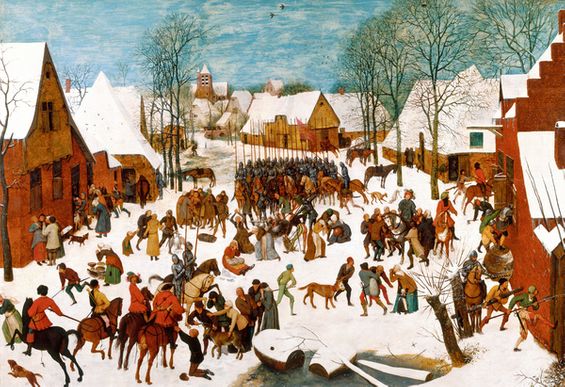
Ninety years earlier, Pieter Bruegel the Elder painted The Massacre of the Innocents, in which soldiers maraud through a village kicking in doors and raiding houses in search of, it would appear, animals and fowl that are being butchered. But x-ray photography has revealed that someone later sanitized the painting. A package on the lap of a woman was originally a dead baby; a goose dangled by the neck about to be stabbed was once a baby dangled by the arm; a flock of birds being butchered was once swaddled infants. And so it goes.
Bruegel’s world was one in which children died (60 per cent never reached the age of 16,) soldiers pillaged, sacked, burned and slaughtered, and beggars were leprous and deformed. Yet whoever redacted the painting wanted to show an artist and society of great sensibility who placed small people center stage.
At one level these masterpieces are a poignant reminder of how well we have it compared to our predecessors, which is not a bad prompt in these dreary days of the pandemic.
On August 6th, in the series To the Best of Our Knowledge on NPR, the author Heather Swan described honey bees as ‘a utopian society.’ A number of books present honey bees as ‘cute, anthropomorphic icons of busy self-sacrificing individuals,’ as Jurgen Tautz writes in the preface to the English edition of The Buzz About Bees. By contrast, David Papke loaned me his copy of The Dark Side of the Hive : The Evolution of the Imperfect Honey Bee, published two years ago by two respected researchers, Robin Moritz in Germany and Robin Crewe in South Africa. They acknowledge that while the colony is indeed a marvel of harmonious, efficient organization, it also involves conflict and failure. Like any complex social system, honey bees are prone to error, robbery, cheating and social parasitism, especially at the individual level, even as the colony gets by remarkably well as a social organism.
The complex and enigmatic composition of a colony of honey bees raises questions about reality and illusion, and creates an uncertain relationship between the informed beekeeper and the bees. As with Velázquez’s portrayal of the Infanta, one can see a sublime superorganism or a prosaic society adapting to every day pressures. . One can admire the sanitized idyll of a small village or, as Tom Seeley does so well, one can strip off the paint and get back to the original, back to basics with all of its imperfections, back to what works for the bees rather than for the beekeeper.
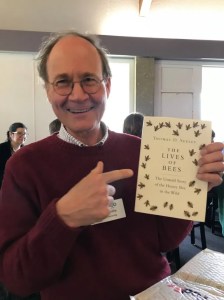
The Dark Side of the Hive is inspirational reading; for me it stands in the company of Taut’s The Buzz of the Bees or Tom Seeley’s Honey Bee Democracy. I do wish it were not quite so expensive! It needs to be read slowly, reflected upon frequently, and perhaps shared with a group of like-minded people as it explores the individual mistakes, maladaptations and evolutionary dead-ends of workers, drones and queens.
The book might have shattered my illusions of a colonial paradise but it significantly deepened both my understanding of and appreciation for these amazing creatures. I have to say that, for me, it serves the same purpose as the pandemic which has shattered many of the illusions of an omnipotent United States to reveal the shortcomings of a society in denial – the underfunding of public health, an inefficient health care system, policies that have endured since the days of colonization and slavery, leaving minorities vulnerable, the decades-long shredding of our social safety net, forcing essential workers to risk their health for livelihood, and social media platforms that sow partisanship, misinformation and conspiracy theories.
Finally, The Dark Side of the Hive caused me to reflect only own reading history. When asked to recommend a book to a new beekeeper, I tend towards one that succinctly and coherently outlines the basics. This work by Moritz and Crewe is not one I would recommend to a beginner. Yet, knowing no better, one of the first bee books I read was The Buzz About Bees, which I would never recommend to a nubee today. Yet it didn’t put me off. I know now that despite how little of it I understood, there was an instinctive realization that it was important. The intricacy of honey bee society was compelling rather than foreboding, and The Buzz went on my list of books to come back to, something I am in the middle of doing right now. As Richard Taylor writes in his remarkable The Joys of Beekeeping, “Many are called but few are chosen.” Perhaps ‘being chosen’ involves one’s acceptance of imperfection and mystery, of fallibility and deficiency, as well as of idyllic bliss.
1. Read the following instructions before doing anything.
2. Write your name on the top of this sheet.
3. If you are going to wear a suit and veil, it should be black. The bees are used to animals with black fur checking out their hive.
4. Knock on the side of the hive with a stick, then put your ear close to the entrance and listen to see how long it takes the bees to resume a gentle hum.
5. Do not use smoke. This way you test the true temperament of the colony.
6. Do not be afraid to gesticulate wildly so as to frighten off any inquisitive bees.
7. Shout out loudly, so the bees can hear you, “I am the leader in following instructions.” This will let the bees know just who is in charge.
8. Pull out the middle frame as fast as you can so as not to give the bees a chance to respond.
9. Shake the frame hard so as to knock off the bees, which will allow you to see the cells without any bees obstructing your view.
10. If you see the queen, throw her into the air to test her ability to fly in the event of a swarm.
11. Replace the frames in a different order. This prompts the bees to clean up after you more quickly.
12. Do not test for varroa : the last thing you want to do is to kill the bees which are essential to controlling the invaders.
13. After you have re-assembled the hive, give it another hit with the stick, letting the bees know that you are still the boss.
14. If the bees pursue you as you walk away from the hive, turn and face them. The last thing you want to do is to suggest to the bees that you don’t know what you are doing.
15. Now that you have finished reading all of the instructions, do only #’s 1 and 2, and sit quietly by the front of the hive enjoying the activity of the bees as they come and go.
For most of our history we have lived under an omnipresent consciousness of our mortality. Pandemics were only one cause of early deaths that haunted day-to-day life. Only in the nineteenth century, with improvements in sanitation in particular (at least for the more affluent, who could afford the flushing toilet with a ballcock invented by Thomas Crapper,) did mortal insecurity wane, barring such episodic ravages as tuberculosis and syphilis in the C19th, the Spanish Flu and AIDs in the C20th and ebola and corvid-19 in this one. To the mass deaths caused by these diseases we can add war, genocide, terrorism, opiates and guns.
But let’s go back 364 years. In 1656 the Spanish painter, Diego Velázquez, was commissioned by the Habsburg King, Phliip IV, to paint Las Meninas (‘The Ladies-in-Waiting’) possibly the most closely analyzed painting of all time. On the surface it is an apotheosis of happiness and confidence; with the benefit of hindsight it captures the tragedy of the age. Its complex and enigmatic composition raises questions about reality and illusion and creates an uncertain relationship between the viewer and the figures depicted.
The center of the picture is the five-year-old, self-possessed Infanta, Margarita Teresa, attended by two maids, in whom rested the dynastic hopes of the Hapsburg dynasty – three of her siblings did not survive childhood and the only brother who did (the later Emperor Charles II) displayed the ruinous disabilities that resulted from the family’s inbreeding – Margarita’s father had married his niece, for example.
Meanwhile, the court of the Holy Roman Empire in Vienna wanted a dynastic marriage to strengthen the Spanish and Austrian branches of the House of Habsburg in the face of the rising French kingdom under the Bourbon King, Louis XIV (who was married to Margarita Teresa’s half-sister.)
Thus, at the age of 15, for diplomatic reasons, Margarita Teresa was married to the Holy Roman Emperor, Leopold I, who was 30 years her senior, her maternal uncle and her paternal cousin. The Viennese celebrations of the imperial marriage were among the most splendid of the Baroque era and lasted almost two years.
Thus was combined two of the most influential families in Europe and it should have been a fairy tale existence. But, despite having access to the best that medicine could offer, only one of Margarita’s four children survived infancy. The Empress believed that Jews were to blame for her children’s deaths and she persuaded her husband to expel them from Vienna and destroy their synagogue, replacing it with a cathedral.
In 1672, in a weakened state, she died from complications of bronchitis. She was 21 years old.
Ninety years earlier, Pieter Bruegel the Elder painted The Massacre of the Innocents, in which soldiers maraud through a village kicking in doors and raiding houses in search of, it would appear, animals and fowl that are being butchered. But x-ray photography has revealed that someone later sanitized the painting. A package on the lap of a woman was originally a dead baby; a goose dangled by the neck about to be stabbed was once a baby dangled by the arm; a flock of birds being butchered was once swaddled infants. And so it goes.
Bruegel’s world was one in which children died (60 per cent never reached the age of 16,) soldiers pillaged, sacked, burned and slaughtered, and beggars were leprous and deformed. Yet whoever redacted the painting wanted to show an artist and society of great sensibility who placed small people center stage.
At one level these masterpieces are a poignant reminder of how well we have it compared to our predecessors, which is not a bad prompt in these dreary days of the pandemic.
On August 6th, in the series To the Best of Our Knowledge on NPR, the author Heather Swan described honey bees as ‘a utopian society.’ A number of books present honey bees as ‘cute, anthropomorphic icons of busy self-sacrificing individuals,’ as Jurgen Tautz writes in the preface to the English edition of The Buzz About Bees. By contrast, David Papke loaned me his copy of The Dark Side of the Hive : The Evolution of the Imperfect Honey Bee, published two years ago by two respected researchers, Robin Moritz in Germany and Robin Crewe in South Africa. They acknowledge that while the colony is indeed a marvel of harmonious, efficient organization, it also involves conflict and failure. Like any complex social system, honey bees are prone to error, robbery, cheating and social parasitism, especially at the individual level, even as the colony gets by remarkably well as a social organism.
The complex and enigmatic composition of a colony of honey bees raises questions about reality and illusion, and creates an uncertain relationship between the informed beekeeper and the bees. As with Velázquez’s portrayal of the Infanta, one can see a sublime superorganism or a prosaic society adapting to every day pressures. . One can admire the sanitized idyll of a small village or, as Tom Seeley does so well, one can strip off the paint and get back to the original, back to basics with all of its imperfections, back to what works for the bees rather than for the beekeeper.
The Dark Side of the Hive is inspirational reading; for me it stands in the company of Taut’s The Buzz of the Bees or Tom Seeley’s Honey Bee Democracy. I do wish it were not quite so expensive! It needs to be read slowly, reflected upon frequently, and perhaps shared with a group of like-minded people as it explores the individual mistakes, maladaptations and evolutionary dead-ends of workers, drones and queens.
The book might have shattered my illusions of a colonial paradise but it significantly deepened both my understanding of and appreciation for these amazing creatures. I have to say that, for me, it serves the same purpose as the pandemic which has shattered many of the illusions of an omnipotent United States to reveal the shortcomings of a society in denial – the underfunding of public health, an inefficient health care system, policies that have endured since the days of colonization and slavery, leaving minorities vulnerable, the decades-long shredding of our social safety net, forcing essential workers to risk their health for livelihood, and social media platforms that sow partisanship, misinformation and conspiracy theories.
Finally, The Dark Side of the Hive caused me to reflect only own reading history. When asked to recommend a book to a new beekeeper, I tend towards one that succinctly and coherently outlines the basics. This work by Moritz and Crewe is not one I would recommend to a beginner. Yet, knowing no better, one of the first bee books I read was The Buzz About Bees, which I would never recommend to a nubee today. Yet it didn’t put me off. I know now that despite how little of it I understood, there was an instinctive realization that it was important. The intricacy of honey bee society was compelling rather than foreboding, and The Buzz went on my list of books to come back to, something I am in the middle of doing right now. As Richard Taylor writes in his remarkable The Joys of Beekeeping, “Many are called but few are chosen.” Perhaps ‘being chosen’ involves one’s acceptance of imperfection and mystery, of fallibility and deficiency, as well as of idyllic bliss.
Two things caught my eye on November, 22nd, 2021. The first was a comment by Uber manager Scooty Braun, reacting to the public spat over Taylor Swift’s music : “We live in a time of toxic division and people thinking that social media is the appropriate place to air out on each other and not have conversations.” The second came in an address to the Anti Defamation League by the British comedian Sasha Baron Cohen : “Just think what Goebbels could have done with Facebook.”
Ironically, on the same day 232 years ago in Boston, James Madison published the tenth of The Federalist Papers in which he addressed the question of how to reconcile citizens whose interests were contrary to the interests of the community as a whole. The nature of man, he suggested, makes factions inevitable— as long as people hold differing opinions, have differing amounts of wealth and own differing amount of property, they will form alliances with those similar to them and will sometimes work against the public interest and infringe upon the rights of others. Recognizing that the country’s wealthiest property owners formed a minority, Madison feared that the unpropertied classes would come together to form a majority faction that gained control of the government. A century later Karl Marx was to express the same concern but offered a very different solution.
Madison’s fear, to steal a phrase from a podcast by Jonah Goldberg, was too much pluribus and not enough unum. His solution was a large and diverse republic, in part because it would be difficult to spread dissension over such a vast area. The U.S. Constitution included mechanisms to slow things down, to let passions cool and to encourage reflection and deliberation by means of elected representatives. In other words, to bring the ‘crystalized brain’ into play by deliberately and wisely examining issues from a wide variety of life experiences.
Size and distance did not curtail the passions that led to the Civil War or the resentments of the slave community in the US, to the feelings of injustice among many women or to the outbreak of war in Europe in 1914, but on the western front of the First World War the vulnerability of telegraph lines resulted in the development of wireless communications, from which emerged the radio. The success of Adolf Hitler is explained in large part by the invention of the microphone and public broadcasting, which meant that his voice and his message could reach into every home. Television followed the radio although, unlike sound movies, the production of TV sets was halted by the Second World War; nevertheless by the time President Eisenhower took office about one half of the homes in the United States had sets in their living room.
The point is that radio, television and the movies were expected to make the world more connected, thus engendering greater understanding and awareness which would in turn be good for democracy. Certainly public media played a critical role in kindling public support for the Civil Rights movement in the US, in undermining support for America’s involvement in the Vietnam War and in cementing opposition to the Soviet occupation of eastern Europe after the Second World War.
What has been labeled ‘the outrage culture’ can be tracked back to the 1980’s with the increased traction of cable television and talk radio. New levels were reached with the appearance of Friendster, Myspace and Facebook between 2002 – 4, each of which was designed to help friends connect, albeit through highly curated versions of themselves. In 2006 Twitter’s Timeline provided an unending stream of content which unwittingly provided the spark for contagious outbursts, most of them irate and accusatory. Facebook followed with the News Feed, the Like button, and in response to Twitter’s Retweet button, the Share button. The coup de grace came in 2013 with the use of algorithms to find headlines that generated the highest click-through rate.
Thus was created the metric for the popularity, rather than the validity, of content. Any post by any producer would remain at the top of the feeds as long as it generated engagement – a personal blog appeared as credible as a story from the New York Times, a car accident might appear as newsworthy as genocide in Rwanda, and Donald Trump is masterful at using his twitter feed to capture the news cycle.
Social media, besides having become a powerful accelerant for anyone who wants to start a fire, has the feel of too much communication and too little conversation; of too much connection and profound loneliness. And because we get angry before we think rationally, immediate gratification is no longer fast enough.
Certainly there have been successes, for example the #MeToo movement, but many on-line discussions, often with anonymous strangers, have been shown to be more incensed and less civil. Networks of partisans create world views that are more extreme, disinformation campaigns spread lies and bigotry, and violent ideologies lure recruits to some of the most reviled ideologies of the last century – nazism and white supremacy – which have been given a second life by young people desperate for a sense of belonging. This is the same generation, two thirds of whom have never heard of Auschwitz, which is losing faith in democracy.
The Age of Reason, Cohen argues, is ending. “Democracy, which depends on shared truths, is in trouble. Autocracy, which depends on shared lies, is on the march.”
Why is this important to us? First it feels as if we are living in a perpetual state of fluidity, without the necessary time to process relentless items in our in-boxes in the light of the accumulated and tested wisdom of humanity. The latest cat picture, scandal, political intrigue or public shaming dominates the headlines without an understanding of the longer term context to provide perspective. Politics in the US has become particularly acrimonious, the Brexit debate and lead-up to the December 12 election in the UK was acerbic, and in the last month there seems to have been a significant increase in mass shootings to the point that there is one every day somewhere in the world, many of which no longer make the headlines.
The second reason involves another synchronicity. 2006, the year of Twitter’s Timeline, was also the year in which Colony Collapse Disorder hit the headlines, and no doubt the Like and Retweet buttons account in part for the significant public interest in the plight of honey bees. Some responded by wanting to keep bees themselves, and those who continued through the initial romantic perceptions discovered, as with many other activities, opportunities for moments of quiet and reflection, of learning age-old skills, of connecting with something that has withstood the toils of time – in the case of honey bees, millions of years – as a counterpoise to the haste and confusion of the post-Reason era.
This, perhaps, is one of the many reasons why Tom Seeley titled his 1998 book, The Wisdom of the Hive. Wisdom is difficult to define because it encompasses so much – we recognize it when we encounter it – but common factors include an understanding of what is right combined with actions based on knowledge, experience, common sense and insight.
That sounds to me a whole lot like a colony of honey bees and not much like our human cyber colony. Nor are there any obvious solutions; indeed it may be easier to help the bees than it is to recover civility in the public forum.
One evening in 1967 two friends and I decided, on a whim, to attend an inaugural professorial lecture by Dr. Vernon Forbes, Head of the Geography Department at Rhodes University, Grahamstown, South Africa. Prof. Forbes was elderly and had been departmental head for some time, so my guess is that this was a requirement that was long overdue.
We sat at the back of a large, inclined lecture hall behind a distinguished audience and listened to an address which was neither spectacular nor memorable, slipping out unseen (or so we thought) as it ended.
The next morning, in the hallway of the department, Professor Forbes leaned over as he walked by and, much to my surprise, said, “Thank you for coming to my lecture last night.” 52 years later, I still remember it. Why?
It might be that, based on previous experience, my perception was that personal interaction was not his strong suit, so this acknowledgment stood out as unusual. It might be that, amid this distinguished audience, he had picked out the three of us and I was flattered to be noticed in that august company. Most likely I was impressed that, having noticed, he chose to say thank you. Not in public, not loudly, but quietly and in person.
I don’t recall so much as one word of the many lectures of his that I attended; I do remember how he behaved on that one occasion and how it made me feel.
First, how often do we notice and acknowledge those who come to our bee meetings? Not with a general announcement at the beginning of the meeting but with that personal ‘thank you’ as we pass in the corridors, or walk up the aisles, or tidy up as other leave. A meeting, by definition, cannot function without attendees, yet to what extent do we take them for granted? How do they feel as they leave to go home? Sometimes simply to notice someone, to use their name, to nod and smile, says it all.
Secondly, how often do we thank those who give of their time, skills and energy to organize meetings for our benefit? Do we notice the work that lies behind a good meeting or a satisfying workshop (the underwear that underlies the software and hardware) and do we take the time to say so, quietly, in person and with specifics?
On 14th January a man trying to go up a down escalator lost his balance, fell into my wife, Mary, at the top of the stairs, bundling her over. Fortunately she did not hit her head on the tiled floor but did break her hip – the ‘pop’ was audible. She faces a lengthy recuperation post surgery and has been fortified both by the visits and the cards she has received. Some of the latter are commercially produced with a neat little poem and are signed by the sender; others are more personalized. One she received yesterday is handwritten :
Dear Mary : You have been in my thoughts so often I feel negligent in not contacting you before this. I hope your recovery is progressing smoothly and your pain level is tolerable. How are you filling your days? Hopefully you are able to participate in some of those creative outlets and thoughts that lift your spirits. I like to picture you using this experience with an easel or sketch pad on your lap, maybe working on a knitting project that can occupy your mind and hands. I hope you are being well cared for and if I could wish your pain away I would love to think my thoughts could do that. I hope your life soon resembles the style you are accustomed to and spring around there corner renews you in its magic. Love, Lisa.
Lisa, in her own imperfect and beautiful way, acknowledges the dominant issues – pain, the challenge of filling each day and the anxiety of a lengthy recovery – and recognizes the creative spirit that drives so much of who Mary is.
It does not have to be this long. What is the difference between writing to a beekeeper office-bearer to say “Thank you for all that you do for our bee club,” and “Thank you for the thought and preparation that lay behind your effective and humorous introduction of our speaker last night” ?
My impression is that expressing gratitude is less prevalent than it was – the days of a younger generation being forced, reluctantly, to write thank you notes for gifts received have long since passed, even as it is easier to do so than ever before, using e-mail, text or face time.
We will probably never know the full significance of those few words of appreciation, and we will certainly never know who remembers them 52 years later, yet in an age of both enhanced communication and surging loneliness, they are probably more important than ever before.
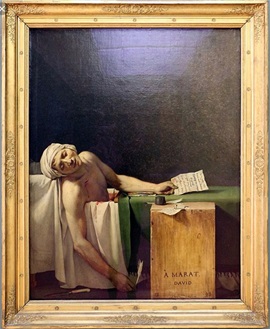
On New Year’s morning, for reasons then unknown, I woke up with a mental image of the painting by Jacques-Louis David of Jean Paul Marat, murdered in his bath tub by Charlotte Corday 227 years ago.
You may be familiar with the painting. Marat droops to one side, a green drape covers most of the tub, a quill dangles in his right hand, and a sheet of paper in his left hand lists Girondin leaders who, he had just promised his assassin, would be sent to the guillotine within the week.
David completed his work four months after the assassination and it was as he imagined or wanted it to have happened. His image, very much in the Classical Romantic style, is radically different to an etching by Domenico Pellegrini, completed at the same time, but it is the former that is best known, to the point that we accept it as the way it actually occurred, ignoring the license of the artists’ imagination and the biases that came with the commission. David and Marat knew each other well – both were members of the National Convention – but there is no hint in the painting of what is described as Marat’s ‘hideous visage’ so as not to detract from his rapidly rising heroic status. A political martyr was created and the painting stands, in the words of Albert Boime, as “a moving testimony to what can be achieved when an artist’s political convictions are directly manifested in his work.”
What was that it persuaded a young woman from the provinces, physically beautiful by all accounts, to assassinate him, and does our perception of the painting change when it is placed in a larger context?
Jean Paul Marat was born in 1743 in what is now Switzerland, with several physical deformities (he was less than 5’ tall with a head too big for his body) and scrofulosis, a skin disease that causes severe itching. Clearly he was intelligent, well educated in a variety of fields, and attracted attention not least for his fearsome temper – in one case he was rescued by the intervention of none other than Johann Goethe.
Shortly after the outbreak of the French Revolution in May, 1789, Marat published L’Ami du Peuple, a newspaper which quickly became the voice of the revolutionaries. He described real or alleged opponents of the revolution as public enemies and, by publishing their names, effectively handed them over to the people for revenge. An order was issued for his arrest in October, and after a period of hide and seek with the police, during which he aggravated his scorfulosis by occasionally hiding in the Paris sewers, he was interrogated and released in time to become a member of the Jacobin Club. One year later he was elected to the National Convention, a political body which many see as the culmination of the ideals of the Revolution.
The September Massacres of 1792, sparked by fear as the new revolutionary army suffered a series of defeats against conservative forces, introduced a violent and cruel aspect to the Revolution, for which Marat was held by many, including his future assassin, to be responsible. Masses of revolutionaries stormed the prisons and killed not only opponents of the revolution but also many politically innocent prisoners, including women, priests, and children.
Marie-Anne Charlotte de Corday d’Armont, was born in Caen, Normandy, in 1768. Descended from a minor noble family, educated in a convent and royalist by sentiment, she was familiar with the ideals of the Enlightenment after encountering the writings of Plutarch, Voltaire and Rousseau in the Abbey library attached to the convent. In 1792 Caen had become a haven for the Girondins (the prime opponents of the Jacobins) and in May, 1793, aged 24, Charlotte left for Paris, theoretically to work for the Girondin cause but in practice with only one thing on her mind.
She had given much thought as to how to kill Marat and thus, she hoped, end the violence. “I killed one man to save a hundred thousand,” she was to say at her trial. She chose July 14th, the fourth anniversary of the Storming of the Bastille, and planned to stab him in front of the National Assembly. But Marat was confined to his house by his scrofulosis, and under the pretext that she wanted to denounce some Girondists from her hometown, she talked her way into his apartment. Marat could write best in a bath, comforted by the warmth of the water, which is where she found him. After a short conversation, she stabbed him in the throat and chest with such force that a large artery ruptured and Marat died almost immediately.
Charlotte was arrested on site without resistance. She appeared before the Revolutionary Tribunal, serene and composed, and went to the guillotine three days later.
How Charlotte Corday was viewed at the time depended on party affiliation. The Jacobins were appalled and sought to denigrate her name. Royalists looked upon Corday as a naive martyr, an innocent caught up in the intense emotions of the times, while the Girondins found her deed heroic but also deprecated what they called “the useless crime.” The more immediate impact was that the Reign of Terror intensified, Marat became a martyr, his bust replaced a religious statue in Paris and a number of place names were changed to honor him.
So, how does this relate to honey bees? First, just as David’s Romantic-style painting created the lens through which many still view the event of July 14, 1793, what is the equivalent lens through which each of us views honey bees? How are our earliest impressions formed, how pervasive and how accurate are they? Are they idealized and fanciful with an element of truth woven into the poetic license, or are they sober, practical and faithful to reality? Perhaps they are as fanciful as the writings and illustrations of A.A.Milne, of Winnie the Pooh and a pot labeled “Hunny,” but I suspect that today they are from the media and that they are of dubious accuracy (the Seinfeld Bee Movie, for example.) I am struck by how afraid my 4 year old grandson is of ‘bugs’ – all bugs – which he is convinced will hurt him; his tow older siblings do not have this anxiety. Or of the mother who pulled her young son away from an observation hive saying that he would get stung if he went close. Certainly some caution is necessary in the interests of survival, but what will it take to nullify such early messages of unbounded fear?
Secondly, the names Corday and Marat are frequent occurrences in crossword puzzles, and there might be some understanding of their historical roles from various history classes, but what changes when one expands the context, even in a summary as cursory as the one above?
Sometimes it takes a tragedy to attract attention. Because of the publicity surrounding Colony Collapse Disorder, there has been an increased awareness of terms like bees (often in an alarmist sense, such as the quote misattributed to Einstein,) pollination and honey. A realization of the distance bees need to fly to collect the nectar to make one pound of honey, or the number of flowers visited, instigates an appreciation not only of the industry of the honey bee but also of the monetary value of the produce (not least if one adds that should the bees charge us minimum wage for their efforts, that same jar of honey would cost in excess of one million dollars! ) Knowledge of the ingredients of honey increase the awareness of its value as a food source and a medicinal resource rather than simply as a sweetener. A sensitivity towards the role and relative value of pollination in terms of what we eat, never mind the susceptibility of bees of all kinds to monocultures, chemicals and pathogens, helps us appreciate those things that we do not witness first-hand and which can so easily be taken for granted.
The awareness that honey bees are defensive, compared to wasps and hornets, can lead to the tolerance and appreciation that comes with understanding, never mind the ability to distinguish say between a honey bee and a yellow jacket and to respond appropriately.
But most importantly the more one delves into the world of the honey bee the more one becomes environmentally sensitive and can thus make opportune decisions as to where and how one spends one’s money, which is the real power each of us has.
Like Charlotte Corday, those who were passionate about the state of the environment were initially denigrated with terms like ‘tree huggers.’ Some viewed them as naive idealists, even trouble-mongers, and others as heroic but impractical. Meanwhile climate change (or what the late writer, Nadine Gordimer, called ‘an environmental holocaust’) has continued, with horrific results dramatically illustrated by the Australian bush fires (a billion animals are estimated to have died in those fires, and the habitat and food sources for many more have been destroyed,) while one young woman, seven years younger than was Charlotte, was named 2019 Person of the Year by Times Magazine – Greta Thurnberg. Both women are characterized as audacious and confident, both feature a personal crusade, and Greta’s words are as pointed as was Charlotte’s knife.
No Virginia, apples don’t come from aisle 8 in the supermarket. You and I are here because of a few inches of vulnerable top soil that are threatened as never before by monocultures, the agri-chemical industries, and a rather selfish life style. Life – all life – is the result of a delicate balance that has taken millions of years to create, and we destroy it at our peril. Beekeepers have witnessed these threats first hand for several decades; like a romantic painting, a small insect can encapsulate something so much more comprehensive than itself. I understand a little better the message of that mental image on January 1 : the challenge is to keep searching for the bigger context, which means peeling away the layers that others, with their own agendas and partisanship, use to distract us from the core issues.
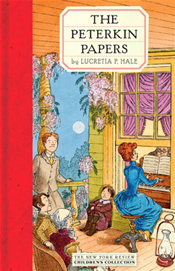
The Peterkin Papers, written by Lucretia Hale, were familiar to many of our great grandparents and are now accepted as classical children’s literature. They describe the escapades of a lovable but comically inept, citified clan that possessed ingenuity, resourcefulness and energy without much common sense. They were invariably rescued from their self-imposed dilemmas by ‘the Lady from Philadelphia,’ as indeed happens in the first installment, published in 1867 under the title, The Lady Who Put Salt in Her Coffee, and which can be summarized thus :
One morning, as Mrs. Peterkin was adding cream to her morning cup of coffee, she realized she had added salt instead of sugar. The taste was awful so the family was summoned, each of whom tasted, looked, wondered … and sat down to think.
Eventually the eldest son, Agamemnon, who had been to college, suggested that they seek the advice of the chemist, who, after some persuasion, agreed to come to the house. “First he looked at the coffee, and then stirred it. Then he put in a little chlorate of potassium, and the family tried it all round; but it tasted no better. Then he stirred in a little bichlorate of magnesia. But Mrs. Peterkin didn’t like that. Then he added some tartaric acid and some hypersulphate of lime. But no; it was no better. “I have it!” exclaimed the chemist, “a little ammonia is just the thing!” No, it wasn’t the thing at all.”
“Then he tried, each in turn, some oxalic, cyanic, acetic, phosphoric, chloric, hyperchloric, sulphuric, boracic, silicic, nitric, formic, nitrous nitric, and carbonic acids. Mrs. Peterkin tasted each, and said the flavor was pleasant, but not precisely that of coffee.” And so he continues – calcium, aluminum, a little clear bitumen and many more – each of which changed the color; but, according to Mrs. Peterkin, “tasted of anything but coffee.” (Lucretia Hale must have had a lot of fun writing this!)
After further sitting and waiting, the eldest daughter, Elizabeth Eliza, suggested they consult with the herb woman, who also agreed to come to the house where she set a pot on the fire and began to stir in the different herbs.
“First she put in a little hop for the bitter. Mrs. Peterkin said it tasted like hop-tea, and not at all like coffee. Then she tried a little flag-root and snakeroot, then some spruce gum, and some caraway and some dill, some rue and rosemary, some sweet marjoram and sour, some oppermint and sappermint, a little spearmint and peppermint, some wild thyme, and some of the other tame time, some tansy and basil, and catnip and valerian, and sassafras, ginger, and pennyroyal. The more the old woman stirred, and the more she put in, the worse it all seemed to taste.”
“So the old woman shook her head, and muttered a few words, and said she must go. She believed the coffee was bewitched.”
It was growing late in the day when Elizabeth Eliza said, “They say that the lady from Philadelphia, who is staying in town, is very wise. Suppose I go and ask her what is best to be done.” After listening very attentively, the lady from Philadelphia asked, ”Why doesn’t your mother make a fresh cup of coffee?”
In terms of how we manage honey bees, we have strayed far from the original cup of coffee, adding numerous modifications most of which are designed for the benefit of the beekeeper and few if any of which make the bees any ‘sweeter.’ An example might be the screened bottom board which was first introduced in 1853 as a solution for wax moths, but quickly fell out of favor. It was re-introduced as the first non-chemical responses to varroa, with the idea that the mites would fall off the bees as they entered the hive, drop through the screen and not be able to climb back into the heart of the colony. It was estimated to account for about one third of the mites entering a hive.
We know now, primarily as a result of the work of Dr. Samuel Ramsay, that mites do not ride on the back of honey bees; indeed if one does see a mite on the thorax of a bee, it suggests that the spaces between the ventral plates are already filled with mites feeding on the fatty lipid tissues. Normally eight mites can be thus accommodated, so one that is visible is probably the ninth entering the hive on that particular worker or forager.
The sliding tray below a screened bottom board may have value as a diagnostic tool, but at what expense? I have yet to find a feral hive with the equivalent of an open bottom board to the nest, and have to ask how the temperature and humidity of a hive are impacted when, unlike say a tree, the bottom of the nest is not airtight. I for one have gone back to a slatted rack which sits on a heavy, well insulated, fully enclosed, base.
There are many other examples of such modifications – the size of the entrance and where it is positioned in the nest, the volume of the nest cavity, the insulation value of the brood boxes, the nature of the foundation, the spacing between our hives, the role of drones, the more subtle effects of feeding sugar to bees, the use of chemicals in a hive …
When we start beekeeping, just as when we first come into this world, we accept the current situation as ’normal’, as a base line on which to build. Our Introduction to Beekeeping classes teach conventional wisdom – called anchoring in that it establishes a firm foundation on which to build – and our mentors mostly reinforce it. It takes courage or desperation to question the credibility and function of the habitual and the conventional, to challenge the very foundation of what we perceive as our knowledge but is more likely to be our assumptions. This, for me, is what Tom Seeley is suggesting with his Darwinian Beekeeping concept. We need to examine the structure and dimensions of a nest in a tree that feral bees have chosen for themselves, and ask which of the many alterations evident in our current hives have proven to be of benefit to the honey bee.
Nor is Dr. Seeley the only one thinking this way. Tim Rowe in County Cork, Ireland, and Torben Schiffer in Germany are just two of many others.
This concept is not unique to honey bees. There is an intriguing development called Regenerative Agriculture which was inspired by the study of pre-industrial agricultural methods. Instead of treating soil as in inert matter into which to pour a variety of herbicides, fungicides and chemical fertilizers, regenerative agriculture requires that we rebuild soil organic matter and restore soil biodiversity, with the associated improvements in water quality and carbon retention. Early results by a handful of practitioners are spectacular and, not coincidentally, both honey and native bees are seen as an integral part of the process.
So yes, Mrs. Peterkin. The solution lies neither with the chemist nor the herbalist, but with a little common sense and a fresh cup of coffee.
Thirty years ago I was discussing a classroom management issue with an experienced school counsellor. She pulled out her pad and outlined an interaction model which is still vivid in my memory.
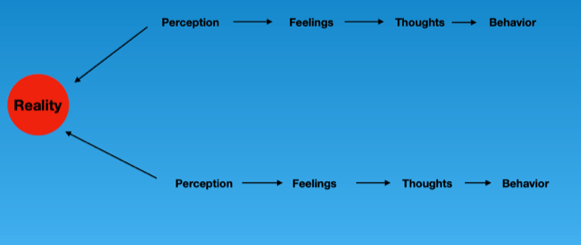
Each of us perceives reality differently based on our personal histories, and those perceptions invoke feelings, which give rise to thoughts, which become behaviors. I don’t know how this would be evaluated by psychologists today but for me there were three major lessons. First, we cannot change reality, but we can change our perception of reality. Secondly, feelings precede thoughts, not vice-versa. And thirdly, if we want to change behavior, we need to change perceptions.
Two non-honey bee examples. In the world of alcoholism, an abuser may be well and truly addicted, evident to all who interact with him or her, but as long as that person is in denial (ie. his or her perception is “I have this under control,”) long term changes in behavior are impossible. Those who speak at AA meetings open with, “Hi, I’m …. and I’m an alcoholic,” which in all probability is a radically different perception to the one they had before they entered the program.
I was late into the computer world and these machines have long been items of intimidation for me. Essentially I use mine as little more than a sophisticated typewriter, and experience real anxiety when I have to download an app, up-grade a program, or, heaven forbid, contact tech support. My perceptions were formed in the days of floppy discs when one mistake could erase everything irretrievably, or so I believed. The (mis)perception led to feelings of anxiety, which led to thoughts of loss, which still restrict my creative ventures on the computer.
My two step-sons, by comparison, use theirs for a variety of sophisticated and creative uses, and it is their first go-to tool, whereas our grandchildren, the eldest of whom is now 12, are fearless and much of what they do on the family computer is beyond my comprehension. On a recent FaceTime conversation with Nora – a way of staying connected during this time of physical isolation – she caused various icons to move across the screen as we talked (a ‘butterfly’ to settle on her nose, for example) much to my consternation and distraction but without any break in the conversation on her part.
Incidentally, I still use a flip phone and don’t posses a smart phone. My rationale is that I’ve survived for more than seven decades without having a computer on my wrist, and my telephone is specifically for communication purposes. But in my heart-of-hearts there is probably a deep seated fear of having to interact daily with a complex machine, and, I have to say, with a screen that is much too small for me to read comfortably. So even today my behavior is determined by perceptions created decades ago, and I rationalize them away. It may also be that I have witnessed far too often the consumate distraction of people on their phones; the preservation of my powers of observation are too precious for me to join their ranks.
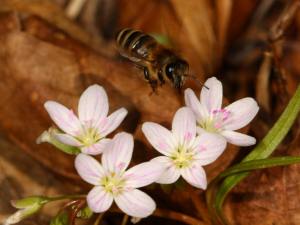
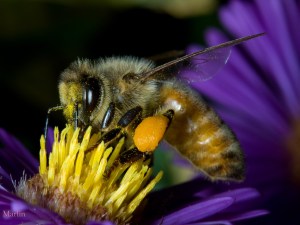
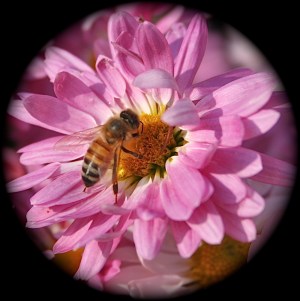
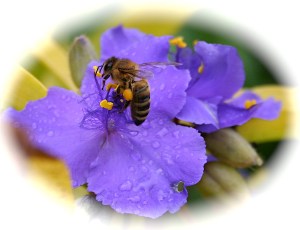
Imagine that the ‘reality’ is a honey bee working a flower for pollen or nectar. The perception of one person, based on old messages gotten from well-meaning protectors, is that the bee wants to sting her. The immediate feeling is fear, the thought is escape, and the behavior is to move away as quickly as possible.
The second person watching the same flower is acutely aware of both the defensive nature of honey bees and the process of pollination. Her feelings are of fascination and amazement, her thoughts are of the importance every bee makes to the quality of our environment, and she draws ever closer to the flower so she can see in greater detail.
The same reality and two different behaviors. We cannot change the reality of bees and pollination, but we can change how the public perceives it. There are two ways to do this, as best I can see. The first is through education, particularly of the younger generation. I am invariably delighted when, looking at an observation hive with a group of first or second graders, I hear some astute observations. “How do you know so much about honey bees?” I ask? “A beekeeper came to our classroom,” invariably is the response.
Unfortunately we are unlikely to re-educate the older generations – their paradigm is set. Going back to the same observation hive, but this time with adults, some are clearly anxious. After outlining the behaviors of the bees and describing the purpose of an observation hive, I invite those who were anxious to come closer and witness firsthand what is happening behind the glass. In most cases they laugh anxiously and decline, clearly not convinced.
There are exceptions of course. At that first bee class most of the participants are on tenterhooks about their initial interaction with the girls themselves. The instructor takes the cover off of a hive and some of the students immediately step forward – they are the ones most likely to continue in the long term. At the end of the class, when asked about their level of anxiety, most laugh and comment on how much lower it is than when they arrived.
So we cannot re-educate most of the public but we can change their perception about something else – the wisdom of the bees. One does not have to interact intimately with honey bees themselves to appreciate the fact that they don’t just build hives, they build communities, using processes that are interactive, harmonious, productive and based on the long term. This was explored by Rudolph Steiner in the 1920’s, by the social psychologist Michael O’Malley in 2010, and of course most famously by Tom Seeley in The Wisdom of the Hive in 1996. Seeley uses bees to investigate a challenge faced by all highly cooperative groups – how to allocate their members among tasks so that more urgent needs are met before less urgent ones, and of coordinating individual actions into a coherent whole.
So, what was the original classroom issue that initiated this debate? In 1991 I began teaching at a private boys high school in Baltimore. One class in particular – relatively small in size and intellectually capable – was proving difficult to manage, especially in the period immediately after the lunch break. One Friday, when I found them particularly disrespectful, I packed up my bag five minutes early and walked out of the classroom. This, I thought, would send a message, and it gave me the weekend to come up with an action plan.
The following Monday I began by commenting on my early departure the previous lesson. They hadn’t even noticed! I explained that I felt disregarded and minimized, and they were genuinely shocked. My perception of the reality was radically different to theirs. I went on to describe how this was our classroom, not mine, and challenged them to work in small groups and come up with their understanding of the ideal learning environment. I did the same.
By the end of the week we had a covenant of the desired aims and methods of our classroom, with consequences if any part of it was broken. When it appeared on the classroom wall, signed by all of us, other classes wanted one too. Overnight this class changed their behavior, I enjoyed my on-going interactions with them, and we were able to explore topics and issues that would have been unthinkable beforehand.
In the early twentieth century there was concern among some in England that the earliest traces of modern man were being found in Africa and Asia, as well as in Germany (Homo neanderthalensis, who looked so modern that it was first hypothesized to be the remains of a Russian cossack who had died pursing Napoleon’s troops on their retreat from Moscow.) This envy led to an infamous paleoanthropological fraud in which someone, presumably an amateur archaeologist named Charles Dawson, doctored and buried in a gravel bed near the village of Piltsdown in Sussex, in 1908, a human cranium together with the jaw of an ape, that was then conveniently ‘discovered’ by Dawson himself two years later. in the face of national fervor the scientific evidence of the supposed missing link was ignored until 1954, even though Professor Raymond Dart, at the University of the Witwatersrand in South Africa, 29 years earlier, had identified unequivocally the remains of the Taung Child as a young Australopithecus africanus and the legitimate antecedent of modern man.
The point is that culture affects our thinking. Even scientists are not immune, sometimes looking for what they want to find or finding what they are looking for, within the wider arc of cultural norms. Let’s ignore for a moment the denial of scientific discoveries in the light of biblical correctness, and look at the names scientists choose to christen their findings. At the time of Aristotle, worker bees were termed ”slaves” because bondage was a cultural norm, and the largest bee in the colony was seen as a ruler, both behaviorally and reproductively. Because Aristotle viewed reproduction as a primarily masculine initiative, he assumed that these bees must be kings, and even after they had been observed laying eggs the name stuck and their femininity went unacknowledged.
The British entomologist Charles Butler, sometimes called the Father of English Beekeeping, was a logician, author and priest besides being an experienced apiarist, and was among the first to assert that drones are male and the queen female, though he believed worker bees laid eggs. He was born in the thirty eighth year of the reign of Queen Elizabeth and was 32 years old when she died. In 1609, six years after her death, he published The Feminine Monarchie; having lived in the Elizabethan era for 32 years clearly influenced his recognition of the honey bee matriarchy, perceiving the queen as an Amazonian ruler of the hive, much as had been his beloved monarch.
In the same time period the microscope and its twin, the telescope, were invented. Legend has it that the principle underlying both was accidentally discovered by children playing in a lens-maker’s shop. Whatever the real story, with the microscope (literally small-look at) doors were opened to reveal veritable mazes of the minutest detail.
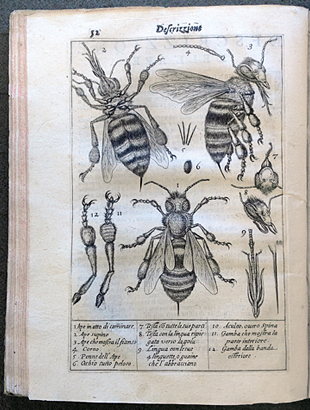
The first plate of the exoskeleton of a honey bee drawn with the aid of microscope was by Francesco Stelluti in 1625 (ie. 15 years after Galileo first looked at the night sky through a telescope.) Stelluti was one of the founders of the Accademia dei Lincei, the only academic research institute in Europe at the time. His drawings were beautifully executed, the details are accurate and the worker bee was shown in greater clarity than ever before, but even so, he had to leave Rome temporarily in the face of papal hostility to his discoveries.
40 years later Jan Swammerdam, the Dutch biologist and microscopist who had demonstrated that the various phases during the life of an insect – egg, larva, pupa and adult—are different forms of the same animal, dissected a queen bee and drew her ovaries and oviduct, confirming Butler’s assertion that a colony is a matriarchy but adding the correction that she was the egg-layer.
The science seemed incontrovertible. In France Louis Dieudonné had become king in 1643 as Louis XIV, or the Sun King. A member of his court, the Duke de Saint-Simon, one of the great memoirists of French literature, focused on the last twenty years of Louis’s reign. In his Memoires, described as “equal proportions of literary genius and insincerity,” he described Louis thus. “In the midst of other men, his figure, his courage, his grace, his beauty, his grand mien, even the tone of his voice and the majestic and natural charm of all his person, distinguished him till his death as a true King Bee.”
Despite the work of Butler, Stelluti and Swammerdam, to the French royalist a perfect civilization such as that of bees could only be ruled by a male, one of ‘majestic and natural charm.’ The telescope had put the sun at the center of the solar system but 80 years of microscopic study of the queen bee could not penetrate a social environment with deductions that seem obvious to us today.
The question is, how does culture inhibit our thinking today? For me, first is the idea that progress is linear, inevitable and necessary, and secondly that science is the key to that advance. Science is vitally important – the fight against the corvid virus is a prime example, and indeed differing public reactions to dealing with the virus illustrate graphically the culture/science conflict. I am not anti-science – far from it, even as we get to witness daily in the US how decisions of the departments of Agriculture, and of the Environment, are driven by politics as much as by science. What is critical is that, like the executive, legislature and judiciary, science is checked and balanced by, and in harmony with, the natural processes and the integrity and dignity of all living things.
Two examples come to mind.. First is the increasing presence of thousands (literally) of chemicals in our water, soil, air and food. If the first chemical doesn’t work, up the dose or try another rather than suggest a change of lifestyle or an all-natural solution. According to the composer John Cage, “Food provides nourishment: but Americans eat it fully aware that small amounts of poison have been added to improve its appearance and delay its putrefaction.” We have little idea of the long term consequences, yet somehow trust corporate science to come up with a solution that, conveniently, will also make them a lot of money. Indeed, a corporation that knowingly invests in a financially losing proposition, no matter its environmental attributes, can be sued by its shareholders.
Writing in the New Yorker of April 20, 2020, Jerome Groopman, the Recanati Professor of Immunology at Harvard Medical School and a leading cancer and AIDS researcher, describes how, unlike drugs, medical implants are not required to be tested in clinical trials before being approved by the Federal Department of Agriculture. Citing the work of David Schneider (The Invention of Surgery) and Jeanne Lenzeer (The Danger Within) he writes, “The medical-device industry has manipulated the societal need for clinical innovation in order to prematurely market products of unproven safety and benefit… The root of the problem, of course, is money. In medicine, progress is driven by innovation and, inner society, innovation is driven by profit.” The implantable-device industry is very lucrative, with operating margins of 25 per cent or higher and an over-all estimated revenue of 136 billion dollars in 2014, some of which was used to finance a powerful lobby in Washington. Accordingly the courts and legislation have made regulatory oversight mostly expedient if not perfunctory.
The economist Jeffrey Sachs has focused on the impacts of tropical diseases. Malaria, for example, keeps countries poor, and because they are poor the potential market for a vaccine in not sufficiently valuable to warrant drug companies making the huge investment in research that is necessary. Meanwhile an estimated 219 million people suffered from the disease in 2017 and about 435,000 died. More than 90 percent of the deaths were in Africa (that is almost the same number as those who have died, globally, from covid-19 as of mid-summer) and over 60 percent were among children under 5. How would this scenario be different if those 260 000 annual infant deaths were in the more developed world? Profit trumps humanity. Much of the research that is being done, and the coordination thereof, is funded largely by private enterprises such as the Bill and Melinda Gates Foundation, which has made the eradication of the disease one of its top priorities.
In terms of farming practices, a vital recent development is the concept of regenerative agriculture. Note, not sustainable agriculture, which by definition means sustaining our current level of disfunction which we know has no long term future; rather regenerating the quality and values of responsible agriculture by starting with the quality of the soil in which most everything is grown. In this sense, what Tom Seeley describes as Darwinian Beekeeping could equally be labelled Regenerative Beekeeping, in that it rejuvenates our concept of honey bee societies and their management based on processes that the bees have evolved over millions of years, rather than what our culture has imposed on them over five thousand years. Both of these scientifically based proposals are meeting resistance from those locked in older cultural norms.
The second example involves the debate about the use of mechanical drones for pollination, which presumably will allow us to sit back with a clear conscience and watch our pollinating insects go into extinction. We know that trees are arguably the greatest antidote to climate change. Without the bees and bats and butterflies, who, pray tell, is going to pollinate the 3 trillion trees world wide (that is 422 trees for each person on this planet) that are not wind pollinated? These trees cover about 30 percent of the planet’s surface and are our largest bank for carbon storage – an estimated 45 per cent of the total. We are already cutting them down at the rate of some 15 billion a year, with the highest losses in the tropics where some of the oldest and biggest trees live.
If we don’t care about the pollinators in our gardens, the creators and sustainers of life, how can we possibly care about the bigger issues beyond our immediate experience?