Home

A Model for Society

“(These insects) seem to be the perfect natural instance of a social system governed by division of labour. Most known species live in colonies consisting of one or more reproductive females, called ‘queens’, who lay the eggs. All the rest, the ones we see flying around, are sterile female ‘workers’, daughters of the queen and the males with whom she mated.

“The colony is not a monarchy. The queen merely lays the eggs. Like many natural systems without central control, these societies are in fact organized not by division of labour but by a distributed process, in which an individual’s social role is a response to interactions with her colleagues. In brief encounters, they use their antennae to smell one another, or to detect a chemical that another individual has recently deposited. Taken in the aggregate, these simple interactions allow colonies to adjust the numbers performing each task and to respond to the changing world. This social coordination occurs without any individual ant making any assessment of what needs to be done.

“For millennia, they have been held up as models for human societies, characterized by coordinated and efficient mutual regard and selfless hard work…”

We’re talking, of course, about ants, in this case as described by Deborah Gordon in Ant Encounters : Interaction Networks and Colony Behavior.   Just as we cite frequently  the occurrences of honey in the bible, or it’s use in pre-Christian Egypt,  myrmecologists have their stories.  Aesop’s fable of the ant and the grasshopper celebrates the ant’s capacity for delayed gratification, collecting food to be used later. In The Iliad, Zeus changes the ants of Thessaly to soldiers after a plague wiped out the men, creating the Murmidons, who beat back the Trojans. And when transcrypted into Latin, besides myrmecology(the study of ants,)  myrmidon is the follower of a powerful person who, typically, is unscrupulous and carries out orders  without question. 

History abounds with  the idea of division of labour as a compelling model. Plato admired it, Adam Smith explained how economies benefit from it, and Henry Ford industrialized it. In the 1970s, the biologist E O Wilson extolled the virtues of division of labour; he anthropomorphized  a colony as a ‘factory within a fortress’ in which each ant is programmed to carry out its appointed task.  Much like the traditional Hindu caste system,  an ant’s task is fixed – each worker is genetically programmed to perform a particular task. 

For millennia humans have  used arguments about intrinsic attributes to justify social roles. Some were destined by divine right, lineage, even genetics, to rule, while others were enslaved based on their race or physical attributes.  In a corporation, some people work in marketing and others in management, but since no one is born a salesman or a supervisor, these differentiated skills must be acquired related to one’s inherent abilities, something Karl Marx did not fully allow for. Plato considered these differences a matter of talent as well as preference and argued in favor of specialization. For Smith, division of labour brought the advantage of learning and improvement and argued in favor of efficiency.  Ford didn’t care about talent or learning so much as in speed –  people could work faster if they didn’t have to put down one tool and pick up another.

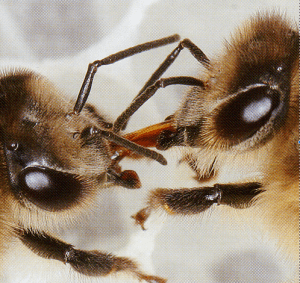
But it’s not natural.  What Dr. Gordon has found is that, in ant colonies as in bee hives, the process of task allocation is based on a network of simple interactions. We know, for example, that a returning forager bee with a load of nectar will respond to the length of time it takes to pass her cargo on to a receiver bee. This creates a simple form of feedback: if the turnaround is quick, the message is that the demand for nectar is strong. 

This is a  distributed process in that there is no central control, while in a division of labour there might be. In the latter a  leader can decide who makes what, and the extreme example is communism, at least as it was practiced.  This is one of the distinctions between communism and socialism, something that many Americans seem not to understand, an ignorance that is readily exploited in our current politically charged climate.   In a distributed process this happens through local interactions; for example, a demand is filled by an entrepreneur.

The term ‘queen bee’ implies a division of labor in a hive, with the monarch giving the orders, and for a long time that is the way it was thought to be. In reality, and in a distributed process, tasks among individuals are interchangeable, which makes the system more robust and more resilient.  If a forager bee gets lost or a worker bee becomes unfit, another will take her place.  

Robust and resilient? Yes. More predictable?  No.  With a distributed processes  it is possible to say what will happen on average but not in particular. Such uncertainty is inimical to the hearts of engineers who love things to work the same way every time, and indeed, when I travel in an airplane (whenever that might next be!) I want the process and the outcome to be predictable.  In a distributed processes the failure of one small part is not critical – local solutions are good enough most of the time.

Increasingly, distributed processes from nature are being applied to contemporary issues.  Tom Seeley, for example, has shown that there are general organizational principles demonstrated in swarming wherein groups are smarter than the smartest individuals. Other examples include ant colonies as metaphors for computer systems, or the movement of a flock of starlings or school of fish in terms of traffic flow. And biomimicry imitates the strategies found in nature to solve human design challenges  Two examples.   When Japanese engineers sought to upgrade their high-speed bullet trains they found that the massive amount of noise created by the displacement of air ahead of the trains, especially when the train entered a tunnel,  would create a shock wave that caused structural damage to the tunnel. The solution? To model the nose cap of the train on the beak of the Kingfisher bird, which has a specialized bill allowing it to dive into water with minimal splash. Utilizing this new nose, the next generation of high speed trains was 10 percent faster, consumed 15 per cent less electricity, and there was no more  noise boom.

And in Harare, Zimbabwe, architects designed an entire shopping center based on the natural convection system of a termite mound  and which uses 10 percent less energy than a traditional air-conditioned facility.

Thus the distributed processes in a honey bees might show us how to adjust to a changing environment at the local level,  whether it is building a home that is environmentally efficient,  deciding when to move, or changing from working inside to foraging outside. 

 A vision of human society ordered and improved by division of labour has distorted our understanding of nature and it can be difficult to let it go. Dr. Gorden offers  genetic determinism as an example. We say that disease, intelligence, psychosis and athletic ability are ‘genetic’;  in reality  stress, sunlight and exercise can equally determine which genes are activated.  It’s a distributed process in that what genes do depends as much on what is happening outside as well as inside the cell.

Why are the traditional images of honey bees and ants as analogous to specialized workers so compelling? First, it’s familiar: a metropolis of insects, each carrying out its assigned job, is a miniature version of a human factory. To envisage instead how a particular task arises from a pulsating network of brief interactions might prompt us to ponder what really accounts for why each of us makes the choices that we do, or why we act in a certain way.

Secondly, explanations are often easier to accept if they invoke internal properties that are invisible and do not require any further introspection. We dismiss them as “That’s the way I’m wired,” rather than struggle with the concept that each of us is a shifting amalgam of impressions and feelings, lacking a defined core.

Thirdly, it is comforting to think that some invisible force has imparted an order that makes everything as it should be. For some that force is natural selection; for others it might be God. Divine right makes one man a king, and for the subjects, all is just as it has been ordained to be.  For centuries, this was used as a form of social control and to justify the suppression and the exploitation of the many by the few. 
The recognition that natural processes work differently from our hierarchies, our corporations, our schools, allows us to see Mother Nature more clearly. After all, ant and honey bee colonies have thrived for millennia in such a way as to enhance our environment rather than plunder it as we have done in a fraction of the time. 

Cutting the Ham

While celebrating their first Christmas together, a husband noticed his beloved cutting off the ends of the ham.  When asked why, she explained that it was something she had watched her mother do.   Mom , duly consulted, replied that it was something Nana had always done.  Nana, consulted in turn, explained that the hams had been too big for her small oven.

Sometimes we do things because ‘that is the way they have always been done,’ and beekeeping is no different.  Before moving to a specific example, allow me to add one further piece of background.  Commercial beekeepers write for, and are cited by, journals and newsletters, even though their objectives may be different to hobbyists, with management strategies designed to meet those targets. Because they work with such large numbers of colonies  we assume that they know what is best for the bees and that we should imitate their methods, even though our goals might be quite different.  Two examples :  commercial beekeepers need to give their colonies a strong start in the spring if they are to meet the pollination contracts  which are vital for their financial wellbeing.  The same methods used by a smaller beekeeper run the risk of  excessive swarming.  Commercial beekeepers need to graft to maintain a strong supply of queens; there are more natural ways using splits and queen cells for smaller beekeepers to get the queens they might need. 

It’s like a mom-and-pop corner store looking uncritically to Walmart for its operational strategies. 

One of the advantages of being a hobbyist, or a mom-and-pop store, is that there is a flexibility that is denied to the larger enterprises, one example of which is the decision as to how and what to feed bees in the autumn.  Two years ago my intuition told me that feeding white refined sugar to the bees was convenient for the beekeeper rather than healthy for the bees.   I decided last fall not to feed, to leave as much capped honey on as possible, and to monitor the outcomes.  If this led to the robbing of the weak by the strong, so be it.  Does it mean not feeding even in a nectar dearth?  ‘Fraid so.   Do I second guess myself in the midst of winter?  Absolutely.   Yet sometimes, to best help the bees, we need to accept nature’s hard stance against the weak. 

The results after one year?  The winter survival rate was high and the varroa levels throughout the summer were low – an average of a little over 1 mite per 100 bees per colony throughout the year.  I’m acutely aware that by putting this in writing I am inviting retribution from the gods of beekeeping, who can be ruthless in their need for vengeance. 

It was a small sample (20 colonies) over a short period, and I intend to repeat the procedures this fall.  In the interim,  and wondering whether I was projecting concerns about the effects of sugar in my own diet, I did a quick search via Uncle Google to see if there was any supporting science.  You may have seen the correspondence between Randy Oliver and myself on this subject in Bee Culture.  The first hits were, in my opinion, from reliable sources – Diana Yates reporting on the work of Drs. May Berenbaum and Gene Robinson, James Zitting writing in Mother Earth News, and a New Zealand based beekeepers’ site, Kiwimana.

One three year study showed that bees fed with honey lived an average of 27 days, with sugar syrup 21 days, and with acid invert syrup only 12 days.  And the New Zealand report cites  Dr Michelle Taylor from Plant and Food Research who concurred that honey bees fed on sugar syrup did not live as long as those feeding off their own honey.   She argues that the minerals and proteins in honey are vital supplements to  the proteins derived from the pollen and are crucial to healthy larval development.  By contrast, white sugar may retain a residue of chemicals from the processing of cane or beet sugar to a granular form. 

A third study concluded that different food sources have differing influences on the digestive tract of bees, especially in the midgut epithelial layer – honey has no harmful effect while adding yeast or malt to sugar syrup had the worst impact.

A fourth study headed by Gene Robinson focused on gene activity in  response to feeding with honey, sucrose and HFCS.  Hundreds of genes showed differences in activity in bees consuming honey compared to sucrose or HFCS, and in particular activities linked to protein-metabolism, brain-signaling and immune defense.  “Our results parallel suggestive findings in humans,” Robinson said. “It seems that in both bees and humans sugar is not sugar – different carbohydrate sources can act differently on the body.” 

In 2013, May Berenbaum concurred  that some substances in honey increase the activity of genes that help beak down potentially toxic substances such as pesticides, substances that are missing in sugar.  

Finally sugar has a different PH to honey and lacks the enzymes of the latter.  “When you change the PH in a bee hive,” James Zitting wrote, “it affects the finely balanced world of the little bugs and weakens the colony. When they track pesticides and fungicides into the hive, the life within the bee bread is affected.” 

In summary, it appears that feeding  sugar syrup creates larger numbers of bees in the spring who are smaller in size, lighter in weight, live shorter lives and are more susceptible to disease.  I have to ask if there is a relationship between sugar syrup and the ability of bees to resist varroa mites.

The point is that hobbyists can conduct these kind of experiments, unlike commercial beekeepers who cannot afford to take such risks because of the potential financial implications. Tom Seeley, for example, begins his  presentation of Darwinian beekeeping by stressing that it is not suitable for a commercial enterprise. And when Dr. Eva Crane made her second visit to the US in 1957, during which she travelled some 18 000 miles by plane,10 000 miles by car, slept in 38 beds and met only one other traveler from Europe (in Mexico!) she observed, after giving one of her 25 lectures to a group of beekeepers in California, most of whom ran 10 000 hives or more, “I felt that the intricacies of individual bees must seem rather irrelevant to them.”  

Incidentally, Eva’s first trans-Atlantic flight in 1953 in a propeller-driven Lockheed Constellation took 18 hours, with re-fueling stops in Shannon, Reykjavik, an  army base in Newfoundland, and Boston, before arriving at New York City.  A similar flight fourteen years later, this time to Halifax, took five hours.  

So, first, why are we feeding sugar syrup?  Is it simply because ‘that is the way it has always been done?’ Secondly, I for one would like to see increased input from hobbyists in the advice columns of journals and newsletters, the majority of the readers of which are small scale operators even if they have less colonies in total compared to the bigger guys.   Bob Tatro’s articles in the electronic edition of this newsletter are a good example.  And finally, when we read articles submitted by large-scale beekeepers, do we ask what kind of operation the provider runs, what his or her  objectives might be, and whether they are pertinent to our own undertaking,  before adopting them wholesale? 

Out of necessity new beekeepers adopt wholesale the suggestions, routines and processes of their instructors and mentors.  A personal example.  In the first of my bee classes we would venture into the apiary to discuss the location of a hive.  I would point out that my hives all face south east (or they did at the time) because I wanted them to get the morning sun, and it happened to suit the layout of the bee yard.  What most new beekeepers heard, and later stoutly defended, is that a hive has to face south east … rather than that this was my decision based on local circumstances.  And I was at fault for not clarifying what is recommended versus what was a personal choice.   

After a while (five years seems to be about average) beekeepers learn to read a frame of bees and make decisions based on the evidence before them  rather than on preconceived notions and procedures.  It is soon after this, I suggest, that beekeepers need to question almost everything they initially took for granted and to make decisions based on their experience, their observations, their reading and their objectives.  

If you decide to feed sugar in the fall, I hope you do so for a clearly defined reason and not ‘because everyone else does it.’  Ask enough questions and you might find that the oven is now big enough after all. 

Gifts from the Bees

In this season of gifts, both given and received, it is appropriate to consider the bounty we receive from the  bees. The ultimate largesse is to have been chosen by the bees, a process described quite beautifully by Heidi Herman in the 2018 Beekeepers Annual.  “Should a time come when they call you, I fancy that you will heed them and invite them into your life.  They might arrive as a swarm since they are very capable of divining your soul’s inclinations, and they might change your life and you will never look back and will dwell in the joy of it.  I’d say it is probable, and wish it greatly for you.” 

Bee people are significantly more numerous than beekeepers, by which  I mean those who are aware of the presence and significance of honey bees without feeling the need to manage them directly.   History suggests such people were more numerous when agriculture was dominant and bees were sacred, offering a spiritual connection to nature, if not the cosmos.  This was most evident in the late middle Ages, when boles were built into the foundations of most monasteries to hold skeps, the monks lovingly tended to the occupants, and besides the products of the hive, and because there was no knowledge of how they reproduced, bees were symbolic of a mystifying virgin birth. As one Catholic site explains,  “Since virginity is a virtue we find exemplified to its highest capacity in Our Lady, the bee quite naturally becomes one of Her symbols.”

With the Age of Reason spirits were banished  from nature as we supposedly  took dominion over the earth, to the extent that even honey bees fell victim to the laws of industry and the production line. At 1:30 pm on September 21, the climate clock unveiled in New York City by artists Gan Golan and Andrew Boyd, warned that there were 7 years, 101 days, 17 hours, 29 minutes and 22 seconds until Earth’s carbon budget is depleted, based on current emission rates. According to the artists, a total depletion will engender even more flooding, wildfires, worsening famine, increased air pollution, greater concentrations of chemicals, and extensive human displacement.  In October a number of scientific organizations added to the predictions of Sir David Attenborough that it is now too late to stop climate change; we can only hope to mitigate the damage.   

It is my hope that, in this time of great diminishing, the bees will not give up on us in the way that we gave up on them. 

Whether you were chosen by the bees,  became  involved accidentally or made a deliberate choice, there are two significant gifts we can share with the increasing number of bee people.  In an age of rapid environmental degradation that threatens an entire planet, and in the words of the C16th French cleric, St. Francis de Sales, “the bee collects honey from flowers in such a way as to do the least damage or destruction to them, and he(sic)  leaves them whole, undamaged and fresh, just as he found them.” Secondly,  in an age of divisiveness and intolerance, the honey bee offers us a glimpse of the beauty of interdependence in which communal interests and the well being of all are aligned.

Beekeeping, at its best, is both a symbiotic relationship between humankind and the natural world and a gentle reminder of our short time on this earth.  Bee colonies are not necessarily utopian societies but they have flourished for at least four thousand times longer than have modern humans.  The honey bees are our teachers, if we allow them to be so, and in this season of hope and celebration my wish is that we re-discover the gifts that come with a healing of the communal soul and a reminder of what love means. 

One Bite in Three

I wince every time I hear that bees are responsible for one out of every three bites of food we eat.  The self-focus thus displayed is destructive, penurious and hurtful. 

Surely this assertion has been useful in promoting an awareness of the importance of bees to our food sources, yet I have still to find an explanation as to how that statistic was calculated.  Sometimes the critical word is pollinators, or bees,  or honey bees.  Sometimes it expressly excludes grass-based food sources that are wind pollinated, like wheat, oats and rice; other times fruit and vegetables are specified.  What are the data on which this statement is based, and who did the calculation?  Even David Suzuki wrote, in 2014, “Some experts say one of every three bites of food we eat depends on them,” (my emphasis) without clarifying who these ‘experts’ are. 

It is fast assuming the mythic proportions of the statement misattributed to Einstein : “If the bee disappeared off the surface of the globe then man would have only four years of life left. No more bees, no more pollination, no more plants, no more animals, no more man.” What Einstein did say is that  “Only two things are infinite, the universe and human stupidity, and I’m not sure about the former.”

But there is a bigger reason why that phrase causes me to shudder.  We look at the bees from our point of view only – that they exist primarily to provide us with food, and we have no obligation in return.  It  focuses on what we consume rather than the way the food the bees eat is toxic because of the way we grow ours.

In an essay titled Standing By Words, written in 1983, Wendell Berry describes an article in the spring 1979 issue of Perspectives in Biology and Medicine, in which the authors consider the transformation of American agriculture “from an art form into a science.” They cite the modern history of milk production, in particular the ‘entirely successful’ effort to transform the dairy cow from the original family companion ‘into an appropriate manufacturing unit of the twentieth century for the efficient transformation of unprocessed feed into food for man.’  As evidence they cite the use of ‘nutrition’ to decrease the numbers of cows while increasing the yield of milk, thus producing savings for the public.   The ultimate justification, it seems, is measured in dollars. 

Berry calls this ‘internal accounting,’ and suggests that there is also an ‘external accounting’ which results in a net loss.  Examples include first the small family dairies that were forced out of business and the consequent break down of community forums, secondly the industrialization of agriculture with the consequent soil compaction and erosion, chemical pollution and  obliteration of plant species, and thirdly the loss of any consideration of the cow as a fellow creature, a ‘companion,’ as she was once regarded. 

Considering the honey bees as ‘responsible for one in three of every bites’ is an example of internal accounting.  A more comprehensive view acknowledges our responsibly in maintaining, even regenerating, an environment in which they can operate successfully, as well as the essential part the bees play in pollinating plants that are not food sources for us, notably the  billions of trees that re-process the excess carbon products we produce.  As beekeeping assumes industrial portions in the US in particular, can we maintain our relationship with bees as ‘fellow creatures?’ 

In the 1980’s I would take students on three day excursions to a private game reserve which covered 6 000 acres in the north western corner of South Africa.  It was called Lapalala (Place of the Leopard) and is today a thriving wilderness school. One of the exercises was to collect aquatic species (plant and animal) in the pristine Palala river and develop a diagram to show how each  was dependent on the others for its existence.  The final step was to erase one of the inter-species links and  demonstrate how the interdependent chain quickly began to collapse. 

In the same way all pollinators are a critical part of a healthy, long-term global environment and we reduce their role to food providers at our peril.

Something else that makes me shudder is receiving a mass produced letter that begins, “Dear Jeremy.”   Am I supposed to think that the computer knows and cares for me, rather than operates on totally impersonal  algorithms that spit out my name?  If it is supposed to make me feel cared for it has the opposite effect – I feel manipulated – and such letters are quickly discarded.   This is an ethical issue, one of integrity, which I cannot relate to honey bees, and having thus vented I won’t pursue it further in this chronicle …

Utopia?

For most of our history we have lived under an  omnipresent  consciousness of our mortality. Pandemics  were only one cause of early deaths that haunted day-to-day life.  Only in the nineteenth century, with improvements in sanitation in particular  (at least for the more affluent, who could afford the flushing toilet with a ballcock invented by Thomas Crapper,) did mortal insecurity wane, barring such episodic ravages as tuberculosis and syphilis in the C19th, the Spanish Flu and AIDs in the C20th  and ebola and  corvid-19 in this one. To the mass deaths caused by these diseases we can add war, genocide, terrorism, opiates and guns.

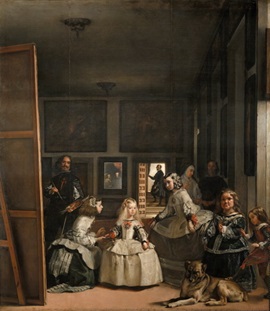
But let’s go back 364 years.  In 1656 the Spanish painter, Diego Velázquez, was commissioned by the Habsburg King, Phliip IV, to paint Las Meninas (‘The Ladies-in-Waiting’) possibly the most closely analyzed painting of all time.  On the surface it is an apotheosis of happiness and confidence; with the benefit of hindsight it captures the tragedy of the age. Its complex and enigmatic composition raises questions about reality and illusion and creates an uncertain relationship between the viewer and the figures depicted.

The center of the picture is the five-year-old, self-possessed Infanta, Margarita Teresa, attended by two maids, in whom rested the dynastic hopes of the Hapsburg dynasty –  three of her siblings did not survive childhood and the only brother who did (the later Emperor Charles II) displayed the ruinous disabilities that resulted from the family’s inbreeding – Margarita’s father had married his niece, for example. 

Meanwhile, the court of the Holy Roman Empire in Vienna wanted a dynastic marriage to strengthen the Spanish and Austrian branches of the House of Habsburg in the face of the rising French kingdom under the Bourbon King, Louis XIV (who was married to Margarita Teresa’s half-sister.)

Thus, at the age of 15, for diplomatic reasons,  Margarita Teresa was married to the Holy Roman Emperor, Leopold I, who was 30 years her senior, her maternal uncle and her paternal cousin. The Viennese celebrations of the imperial marriage were among the most splendid of the Baroque era and lasted almost two years.

Thus was combined two of the most influential families in Europe and it should have been a fairy tale existence. But, despite having access to the best that medicine could offer, only one of Margarita’s four children survived infancy. The Empress believed that Jews were to blame for her children’s deaths and she persuaded her husband to expel them from Vienna and destroy their synagogue, replacing it with a cathedral. 

In 1672, in a weakened state, she died from complications of bronchitis.  She was 21 years old. 

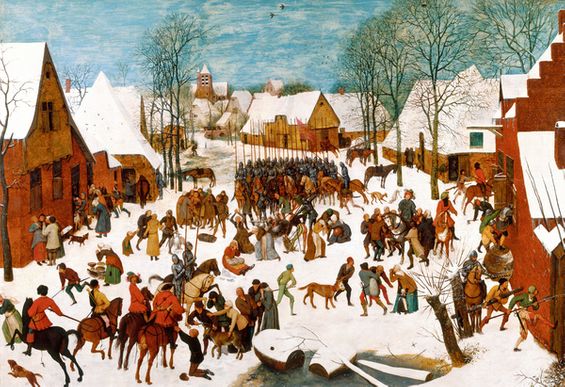
Ninety years earlier, Pieter Bruegel the Elder painted The Massacre of the Innocents, in which soldiers maraud through a village kicking in doors and raiding houses in search of, it would appear, animals and fowl that are being butchered. But x-ray photography has revealed that someone later sanitized the painting. A package on the lap of a woman was originally a dead baby; a goose dangled by the neck about to be stabbed was once a baby dangled by the arm; a flock of birds being butchered was once swaddled infants.  And so it goes. 

Bruegel’s world was one in  which children died (60 per cent never reached the  age of 16,) soldiers pillaged, sacked, burned and slaughtered, and beggars were leprous and deformed. Yet whoever redacted the painting wanted to show an artist and society of great sensibility who placed small people center stage. 

At one level these masterpieces are a poignant reminder of how well we have it compared to our predecessors, which is not a bad prompt in these dreary days of the pandemic.  

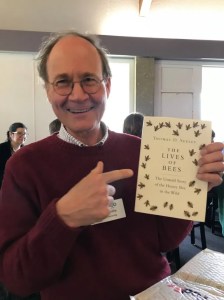
On August 6th, in the series  To the Best of Our Knowledge on NPR,  the author Heather Swan described honey bees as ‘a utopian society.’  A number of books present honey bees as ‘cute, anthropomorphic icons of busy self-sacrificing individuals,’ as Jurgen Tautz writes in the preface to the English edition of The Buzz About Bees. By contrast, David Papke loaned me his copy of The Dark Side of the Hive : The Evolution of the Imperfect Honey Bee, published two years ago by two respected researchers,  Robin Moritz in Germany  and Robin Crewe in South Africa. They acknowledge that while the colony is indeed a marvel of harmonious, efficient organization, it also involves conflict and failure. Like any complex social system, honey bees are prone to error, robbery, cheating and social parasitism, especially at the individual level,  even as the colony gets by remarkably well as a social organism.

The complex and enigmatic composition of a colony of honey bees raises questions about reality and illusion, and creates an uncertain relationship between the informed beekeeper and the bees.  As with Velázquez’s portrayal of the Infanta, one can see a sublime superorganism or  a prosaic society adapting to every day pressures. .   One can admire  the sanitized idyll of a small village or, as Tom Seeley does so well, one can strip off the paint and get back to the original, back to basics with all of its imperfections, back to what works for the bees rather than for the beekeeper. 

The Dark Side of the Hive is inspirational reading; for me it stands in the company of Taut’s The Buzz of the Bees or Tom Seeley’s Honey Bee Democracy. I do wish it were not quite so expensive!  It needs to be read slowly, reflected upon frequently, and perhaps shared with a group of like-minded people as it explores the individual mistakes, maladaptations and evolutionary dead-ends of workers, drones and queens.   

The book might have shattered my illusions of a colonial paradise but it significantly deepened both my understanding of and appreciation for these amazing creatures. I have to say that, for me, it serves the same purpose as  the pandemic which has shattered many of the illusions of an omnipotent United States to reveal the shortcomings of a society in denial – the underfunding of public health, an inefficient health care system, policies that have endured since the days of colonization and slavery, leaving minorities vulnerable, the decades-long shredding of our social safety net, forcing  essential workers to risk their health for livelihood, and social media platforms that sow partisanship, misinformation and conspiracy theories. 

Finally, The Dark Side of the Hive caused me to reflect only own reading history.  When asked to recommend a book to a new beekeeper, I tend towards one that succinctly and coherently outlines the basics. This work by Moritz and Crewe is not one I would recommend to a beginner.  Yet, knowing no better, one of the first bee books I read was The Buzz About Bees, which I would never recommend to a nubee today. Yet it didn’t put me off. I know now that despite how little of it I understood,  there was an  instinctive realization that it was important.  The intricacy of honey bee society was compelling rather than foreboding, and The Buzz went on my list of books to come back to, something I am in the middle of doing right now.  As Richard Taylor writes in his remarkable The Joys of Beekeeping, “Many are  called but few are chosen.”  Perhaps ‘being chosen’ involves one’s acceptance of imperfection and mystery, of fallibility and deficiency, as well as  of idyllic bliss. 

Latest comments

27.11 | 16:01

Moustache, wax? Of course. Now if all of the drones had mustaches …

27.11 | 12:43

One of our club members says he got into beekeeping in order to mak… 

13.08 | 05:43

Good morning Mr. Barnes, I’m so pleased to see the best of history teach… 

21.05 | 07:18

Its pleasure to read about Boy Scout here. He plays vital role to serv… 

Read the Label

Below are the directions for a hive inspection.


1. Read the following instructions before doing anything.

2. Write your name on the top of this sheet. 

3. If you are going to wear a suit and veil, it should be black.  The bees are used to animals with black fur checking out their hive. 

4.  Knock on the side of the hive with a stick, then put your ear close to the entrance and listen to see how long it takes the bees to resume a gentle hum.

 5. Do not use smoke.  This way you test the true temperament of the colony.

6. Do not be afraid to gesticulate wildly so as to frighten off any inquisitive bees.

7. Shout out loudly, so the bees can hear you, “I am the leader in following instructions.”  This will let the bees know just who is in charge. 

8. Pull out the middle frame as fast as you can so as not to give the bees a chance to respond.

9. Shake the frame hard so as to knock off the bees, which will allow you to see the cells without any bees obstructing your view. 

10. If you see the queen, throw her into the air to test her ability to fly in the event of a swarm.

11. Replace the frames in a different order.  This prompts the bees to clean up after you more quickly. 

12. Do not test for varroa : the last thing you want to do is to kill the bees which are essential to controlling the invaders.

13. After you have re-assembled the hive, give it another hit with the stick, letting the bees know that you are still the boss.

14. If the bees pursue you as you walk away from the hive, turn and face them.  The last thing you want to do is to suggest to the bees that you don’t know what you are doing. 

15. Now that you have finished reading all of the instructions, do only #’s 1 and 2, and sit quietly by the front of the hive enjoying the activity of the bees as they come and go.

Utopia?

For most of our history we have lived under an  omnipresent  consciousness of our mortality. Pandemics  were only one cause of early deaths that haunted day-to-day life.  Only in the nineteenth century, with improvements in sanitation in particular  (at least for the more affluent, who could afford the flushing toilet with a ballcock invented by Thomas Crapper,) did mortal insecurity wane, barring such episodic ravages as tuberculosis and syphilis in the C19th, the Spanish Flu and AIDs in the C20th  and ebola and  corvid-19 in this one. To the mass deaths caused by these diseases we can add war, genocide, terrorism, opiates and guns.

But let’s go back 364 years.  In 1656 the Spanish painter, Diego Velázquez, was commissioned by the Habsburg King, Phliip IV, to paint Las Meninas (‘The Ladies-in-Waiting’) possibly the most closely analyzed painting of all time.  On the surface it is an apotheosis of happiness and confidence; with the benefit of hindsight it captures the tragedy of the age. Its complex and enigmatic composition raises questions about reality and illusion and creates an uncertain relationship between the viewer and the figures depicted.

The center of the picture is the five-year-old, self-possessed Infanta, Margarita Teresa, attended by two maids, in whom rested the dynastic hopes of the Hapsburg dynasty –  three of her siblings did not survive childhood and the only brother who did (the later Emperor Charles II) displayed the ruinous disabilities that resulted from the family’s inbreeding – Margarita’s father had married his niece, for example. 

Meanwhile, the court of the Holy Roman Empire in Vienna wanted a dynastic marriage to strengthen the Spanish and Austrian branches of the House of Habsburg in the face of the rising French kingdom under the Bourbon King, Louis XIV (who was married to Margarita Teresa’s half-sister.)

Thus, at the age of 15, for diplomatic reasons,  Margarita Teresa was married to the Holy Roman Emperor, Leopold I, who was 30 years her senior, her maternal uncle and her paternal cousin. The Viennese celebrations of the imperial marriage were among the most splendid of the Baroque era and lasted almost two years.

Thus was combined two of the most influential families in Europe and it should have been a fairy tale existence. But, despite having access to the best that medicine could offer, only one of Margarita’s four children survived infancy. The Empress believed that Jews were to blame for her children’s deaths and she persuaded her husband to expel them from Vienna and destroy their synagogue, replacing it with a cathedral. 

In 1672, in a weakened state, she died from complications of bronchitis.  She was 21 years old. 

Ninety years earlier, Pieter Bruegel the Elder painted The Massacre of the Innocents, in which soldiers maraud through a village kicking in doors and raiding houses in search of, it would appear, animals and fowl that are being butchered. But x-ray photography has revealed that someone later sanitized the painting. A package on the lap of a woman was originally a dead baby; a goose dangled by the neck about to be stabbed was once a baby dangled by the arm; a flock of birds being butchered was once swaddled infants.  And so it goes. 

Bruegel’s world was one in  which children died (60 per cent never reached the  age of 16,) soldiers pillaged, sacked, burned and slaughtered, and beggars were leprous and deformed. Yet whoever redacted the painting wanted to show an artist and society of great sensibility who placed small people center stage. 

At one level these masterpieces are a poignant reminder of how well we have it compared to our predecessors, which is not a bad prompt in these dreary days of the pandemic.  

On August 6th, in the series  To the Best of Our Knowledge on NPR,  the author Heather Swan described honey bees as ‘a utopian society.’  A number of books present honey bees as ‘cute, anthropomorphic icons of busy self-sacrificing individuals,’ as Jurgen Tautz writes in the preface to the English edition of The Buzz About Bees. By contrast, David Papke loaned me his copy of The Dark Side of the Hive : The Evolution of the Imperfect Honey Bee, published two years ago by two respected researchers,  Robin Moritz in Germany  and Robin Crewe in South Africa. They acknowledge that while the colony is indeed a marvel of harmonious, efficient organization, it also involves conflict and failure. Like any complex social system, honey bees are prone to error, robbery, cheating and social parasitism, especially at the individual level,  even as the colony gets by remarkably well as a social organism.

The complex and enigmatic composition of a colony of honey bees raises questions about reality and illusion, and creates an uncertain relationship between the informed beekeeper and the bees.  As with Velázquez’s portrayal of the Infanta, one can see a sublime superorganism or  a prosaic society adapting to every day pressures. .   One can admire  the sanitized idyll of a small village or, as Tom Seeley does so well, one can strip off the paint and get back to the original, back to basics with all of its imperfections, back to what works for the bees rather than for the beekeeper. 

The Dark Side of the Hive is inspirational reading; for me it stands in the company of Taut’s The Buzz of the Bees or Tom Seeley’s Honey Bee Democracy. I do wish it were not quite so expensive!  It needs to be read slowly, reflected upon frequently, and perhaps shared with a group of like-minded people as it explores the individual mistakes, maladaptations and evolutionary dead-ends of workers, drones and queens.   

The book might have shattered my illusions of a colonial paradise but it significantly deepened both my understanding of and appreciation for these amazing creatures. I have to say that, for me, it serves the same purpose as  the pandemic which has shattered many of the illusions of an omnipotent United States to reveal the shortcomings of a society in denial – the underfunding of public health, an inefficient health care system, policies that have endured since the days of colonization and slavery, leaving minorities vulnerable, the decades-long shredding of our social safety net, forcing  essential workers to risk their health for livelihood, and social media platforms that sow partisanship, misinformation and conspiracy theories. 

Finally, The Dark Side of the Hive caused me to reflect only own reading history.  When asked to recommend a book to a new beekeeper, I tend towards one that succinctly and coherently outlines the basics. This work by Moritz and Crewe is not one I would recommend to a beginner.  Yet, knowing no better, one of the first bee books I read was The Buzz About Bees, which I would never recommend to a nubee today. Yet it didn’t put me off. I know now that despite how little of it I understood,  there was an  instinctive realization that it was important.  The intricacy of honey bee society was compelling rather than foreboding, and The Buzz went on my list of books to come back to, something I am in the middle of doing right now.  As Richard Taylor writes in his remarkable The Joys of Beekeeping, “Many are  called but few are chosen.”  Perhaps ‘being chosen’ involves one’s acceptance of imperfection and mystery, of fallibility and deficiency, as well as of idyllic bliss. 

A Toxic Division

Dr. Tom Seeley

 Two things caught my eye on November, 22nd, 2021.  The first was a comment by Uber manager Scooty Braun, reacting to the public spat over Taylor Swift’s music : “We live in a time of toxic division and people thinking that social media is the appropriate place to air out on each other and not have conversations.”  The second came  in an address to the Anti Defamation League by the British comedian Sasha Baron Cohen : “Just think what Goebbels could have done with Facebook.” 

Ironically, on the same day 232 years ago in Boston,  James Madison published the tenth of The Federalist Papers  in which he addressed  the question of how to reconcile citizens whose interests were contrary  to the interests of the community as a whole. The nature of man, he suggested, makes factions inevitable— as long as people hold differing opinions, have differing amounts of wealth and own differing amount of property, they will form alliances with those similar to them and will sometimes work against the public interest and infringe upon the rights of others.  Recognizing that the country’s wealthiest property owners formed a minority, Madison feared that the unpropertied classes would come together to form a majority faction that gained control of the government.  A century later Karl Marx was to express the same concern but offered a very different solution. 

Madison’s fear, to steal a phrase from a podcast by Jonah Goldberg,  was too much pluribus and not enough unum.   His solution was a large and diverse republic, in part because it would be difficult to spread dissension over such a vast area.  The U.S. Constitution included mechanisms to slow things down, to let passions cool and to encourage reflection and deliberation by means of elected representatives.  In other words, to bring the ‘crystalized brain’ into play by deliberately and wisely examining issues from a wide variety of life experiences. 

Size and distance did not curtail the  passions that led to the Civil War or the resentments of the slave community in the US, to the feelings of injustice among many women or to the outbreak of war in Europe in 1914,  but on the western front of the First World War the vulnerability of telegraph lines resulted in the development of wireless communications, from which emerged the radio.  The success of Adolf Hitler is explained in large part by the invention of the microphone and public broadcasting, which meant that his  voice and his message could reach into every home.   Television followed the radio although, unlike sound movies, the production  of TV sets was  halted by the Second World War; nevertheless  by the time President Eisenhower took office about one half of the homes in the United States had sets in their living room. 

The point is that radio, television and the movies were expected to make the world more connected, thus engendering greater understanding and awareness which would in turn  be good for democracy.  Certainly public media played a critical role in kindling public support for the Civil Rights movement in the US, in undermining support for America’s involvement in the Vietnam War and in cementing opposition to the Soviet occupation of eastern Europe after the Second World War. 

What has been labeled ‘the outrage culture’ can be tracked back to the 1980’s with the increased traction of  cable television and talk radio.  New levels were reached with the appearance of Friendster, Myspace and Facebook between 2002 – 4, each of which was designed to help friends connect, albeit through highly curated versions of themselves.   In 2006 Twitter’s Timeline provided an unending stream of content which unwittingly provided the  spark for contagious outbursts, most of them irate and accusatory.   Facebook followed with the News Feed, the Like button, and in response to Twitter’s Retweet button, the Share button.  The coup de grace came in 2013 with the use of algorithms to find headlines that generated the highest click-through rate. 

Thus was created the metric for the popularity, rather than the validity, of content.  Any post by any producer would remain at the top of the feeds as long as it generated engagement – a personal blog appeared  as credible as a story from the New York Times, a car  accident might appear as newsworthy as genocide in Rwanda, and Donald Trump is masterful at using his twitter feed to capture the news cycle.  

Social media, besides having become a powerful accelerant for anyone who wants to start a fire,  has the feel of too much communication and too little conversation; of too much connection and profound loneliness. And because we get angry before we think rationally, immediate gratification is no longer fast enough. 

Certainly there have been successes, for example the #MeToo movement, but many on-line discussions, often with anonymous strangers, have been shown to be more incensed and less civil.  Networks of partisans create world views that are more extreme, disinformation campaigns spread lies and bigotry,  and violent ideologies lure recruits to some of the most reviled ideologies of the last century – nazism and white supremacy – which have been  given a second life by young people desperate for a sense of belonging. This is the same generation, two thirds of whom have never heard of Auschwitz, which is losing faith in democracy.

The Age of Reason, Cohen argues, is ending.  “Democracy, which depends on shared truths, is in trouble.  Autocracy, which depends on shared lies, is on the march.”

Why is this important to us?  First it feels as if we are living in a perpetual state of fluidity, without the necessary  time to process relentless items in our in-boxes in the light of the accumulated and tested wisdom of humanity. The latest cat picture, scandal, political intrigue or public shaming dominates the headlines without an understanding of the longer term context to provide perspective.  Politics in the US has become particularly acrimonious, the Brexit debate and lead-up to the December 12 election in the UK was acerbic, and in the last month there seems to have been a significant increase in mass shootings to the point that there is one every day somewhere in the world, many of which no longer make the headlines. 

The second reason involves another synchronicity.   2006, the year of Twitter’s Timeline, was also the year in which Colony Collapse Disorder hit the headlines, and no doubt the Like and Retweet buttons account in part for the significant public interest in the plight of  honey bees.  Some responded by wanting to keep bees themselves, and those who continued through the initial romantic perceptions discovered, as with many other activities, opportunities for moments of quiet and reflection, of learning age-old skills, of connecting with something that has withstood the toils of time – in the case of honey bees, millions of years – as a counterpoise to the haste and confusion of the post-Reason era.  

This, perhaps, is one of the many reasons why Tom Seeley titled his 1998 book, The Wisdom of the Hive. Wisdom is difficult to define because it encompasses so much – we recognize it when we encounter it – but common factors include an understanding of what is right combined with actions based on knowledge, experience, common sense and insight. 

That sounds to me a whole lot like a colony of honey bees and not much like our human cyber colony.  Nor are there any obvious solutions; indeed it may be easier to help the bees than it is to recover civility in the public forum. 

Gratitude

One evening in 1967 two friends and I decided, on a whim, to attend an inaugural professorial lecture by Dr. Vernon Forbes, Head of the Geography Department at Rhodes University, Grahamstown, South Africa.   Prof. Forbes was elderly and had been departmental head for some time, so my guess is that this was a requirement that was long overdue.

We sat at the back of a large, inclined lecture hall behind a distinguished audience  and listened to an address which was neither spectacular nor memorable, slipping out unseen (or so we thought) as it ended. 

The next morning, in the hallway of the department, Professor Forbes leaned over as he walked by and, much to my surprise, said, “Thank you for coming to my lecture last night.”  52 years later, I still remember it.  Why?

It might be that, based on previous experience, my perception was that personal interaction was not his strong suit, so this acknowledgment stood out as unusual.   It might be that, amid this distinguished audience, he had picked out the three of us and I was flattered to be noticed in that august company.   Most likely I was impressed that, having noticed, he chose to say thank you.   Not in public, not loudly, but quietly and in person. 

I don’t recall so much as one word of the many lectures of his that I attended; I do remember how he behaved on that one occasion and how it made me feel. 

First, how often do we notice and acknowledge those who come to our bee meetings?   Not with a general announcement at the beginning of the meeting but with that personal ‘thank you’ as we pass in the corridors, or walk up the aisles, or tidy up as other leave.  A meeting, by definition, cannot function without attendees, yet to what extent do we take them for granted?  How do they feel as they leave to go home?  Sometimes simply to notice someone, to use their name, to nod and smile, says it all. 

Secondly, how often do we thank those who give of their time, skills and energy to organize meetings for our benefit?  Do we notice the work that lies behind a good meeting or a satisfying workshop (the underwear that underlies the software and hardware) and do we take the time to say so, quietly, in person and with specifics? 

On 14th January a man trying to go up a down escalator lost his balance, fell into my wife, Mary, at the top of the stairs, bundling her over.  Fortunately she did not hit her head on the tiled floor but did break her hip – the ‘pop’ was audible.  She faces a lengthy recuperation post surgery and has been fortified both by the visits and the cards she has received.  Some of the latter are commercially produced with a neat little poem and are signed by the sender; others are more personalized.  One she received yesterday is handwritten :

Dear Mary : You have been in my thoughts so often I feel negligent in not contacting you before this. I hope your recovery is progressing smoothly and your pain level is tolerable. How are you filling your days?  Hopefully you are able to participate in some of those creative outlets and thoughts that lift your spirits.  I like to picture you using this experience with an easel or sketch pad on your lap, maybe working on a knitting project that can occupy your mind and hands.  I hope you are being well cared for and if I could wish your pain away I would love to think my thoughts could do that.  I hope your life soon resembles the style you are accustomed to and spring around there corner renews you in its magic.  Love, Lisa. 

Lisa, in her own imperfect and beautiful way, acknowledges the dominant issues – pain, the challenge of filling each day and the anxiety of a lengthy recovery – and recognizes the creative spirit that drives so much of who Mary is. 

It does not have to be this long.  What is the difference between writing to a beekeeper office-bearer to say “Thank you for all that you do for our bee club,” and “Thank you for the thought and preparation that lay behind your effective and humorous introduction of our speaker last night” ?

 My impression is that expressing gratitude is less prevalent than it was – the days of a younger generation being forced, reluctantly, to write thank you notes for gifts received have long since passed, even as it is easier to do so than ever before, using e-mail, text or face time. 

We will probably never know the full significance of those few words of appreciation, and we will certainly never know who remembers them 52 years later, yet in an age of both enhanced communication and surging loneliness, they are probably more important than ever before.

Jean Paul Marat

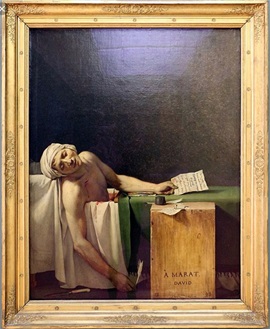
On New Year’s morning, for reasons then unknown, I woke up with a mental image of the painting by Jacques-Louis David of Jean Paul Marat, murdered in his bath tub by Charlotte Corday  227 years ago. 

You may be familiar with the painting.  Marat droops to one side, a green drape covers most of the tub, a quill dangles in his right hand, and a sheet of paper in his left hand lists Girondin leaders who, he had just promised his assassin, would be sent to the guillotine within the week. 

David completed his work four months after the assassination and it was as he imagined or wanted it to have happened. His image, very much in the Classical Romantic style,  is radically different to an etching by Domenico Pellegrini, completed at the same time, but it is the former that is best known, to the point that we accept it as the way it actually occurred, ignoring the license of the artists’ imagination and the  biases that came with the commission. David and Marat knew each other well – both were members of the National Convention –  but there is no hint in the painting of what is described as Marat’s ‘hideous visage’ so as not to detract from his rapidly rising heroic status.   A political martyr was created and the painting stands, in the words of Albert Boime, as “a moving testimony to what can be achieved when an artist’s political convictions are directly manifested in his work.”  

What was that it persuaded a young woman from the provinces,  physically beautiful by all accounts,  to assassinate him, and does our perception of the painting change when it is placed in a larger context?

Jean Paul Marat was born in 1743 in what is now Switzerland, with several physical deformities (he was less than 5’ tall with a head too big for his body) and scrofulosis, a skin disease that causes severe itching. Clearly he was intelligent, well educated in a variety of fields, and attracted attention not least for his fearsome temper – in one case he was rescued by the intervention of none other than Johann Goethe.  

Shortly after the outbreak of the French Revolution in May, 1789, Marat published L’Ami du Peuple, a newspaper which quickly became the voice of the revolutionaries. He described real or alleged opponents of the revolution as public enemies and,  by publishing their names, effectively handed them over to the people for revenge. An order was issued for his arrest in October, and after a period of hide and seek with the police, during which he aggravated his scorfulosis by occasionally hiding in the Paris sewers, he was interrogated and released in time to become a member of the Jacobin Club. One year later he was elected to the National Convention, a political body which many see as the culmination of the ideals of the Revolution. 

The September Massacres of 1792, sparked by fear as the new revolutionary army suffered a series of defeats against conservative forces, introduced a violent and cruel aspect to the Revolution, for which Marat was held by many, including his future assassin,  to be responsible.  Masses of revolutionaries stormed the prisons and killed not only opponents of the revolution but also many  politically innocent prisoners, including women, priests, and children. 

Marie-Anne Charlotte de Corday d’Armont, was born in Caen, Normandy, in 1768. Descended from a minor noble family, educated in a convent and royalist by sentiment, she was familiar with the ideals of the Enlightenment after encountering the writings of Plutarch, Voltaire and Rousseau in the Abbey library attached to the convent. In 1792 Caen had become a haven for the Girondins (the prime opponents of the Jacobins) and in May, 1793, aged 24, Charlotte left for Paris, theoretically to work for the Girondin cause but in practice with only one thing on her mind. 

She had given much thought as to how to kill Marat and thus, she hoped, end the  violence. “I killed one man to save a hundred thousand,” she was to say at her trial. She chose July 14th, the fourth anniversary of the Storming of the Bastille, and planned to stab him in front of the National Assembly.  But Marat was confined  to his house by his scrofulosis, and under the pretext that she wanted to denounce some Girondists from her hometown, she talked her way into his apartment.  Marat could write best in a bath, comforted by the warmth of the water, which is where she found him. After a short conversation, she stabbed him in the throat and chest with such force that a large artery ruptured and Marat died almost immediately.   

Charlotte was arrested on site without resistance.   She appeared before the Revolutionary Tribunal, serene and composed, and went to the guillotine three days later. 

How Charlotte Corday was viewed at the time  depended on party affiliation. The Jacobins were appalled and sought to denigrate her name. Royalists looked upon Corday as a naive martyr, an innocent caught up in the intense emotions of the times, while the Girondins found her deed heroic but also deprecated what they called “the useless crime.” The more immediate impact was that the Reign of Terror intensified, Marat became a martyr, his bust replaced a religious statue in Paris and a number of place names were changed to honor him.

So, how does this relate to honey bees?   First, just as David’s Romantic-style painting created the lens through which many still view the event of July 14, 1793, what is the equivalent lens through which each of us views honey bees?   How are our earliest impressions formed, how pervasive and how accurate are they?  Are they idealized and fanciful with an element of truth woven into the poetic license, or are they sober, practical and faithful to reality?  Perhaps they are as fanciful as the writings and illustrations of A.A.Milne, of Winnie the Pooh and a pot labeled “Hunny,” but I suspect that today they are from the media and that they are of dubious accuracy (the Seinfeld Bee Movie, for example.)   I am struck by how afraid my 4 year old grandson is of ‘bugs’ – all bugs – which he is convinced will hurt him; his tow older siblings do not have this anxiety.   Or of the mother who pulled her young son away from an observation hive saying that he would get stung if he went close.   Certainly some caution is necessary in the interests of survival, but what will it take to nullify such early messages of unbounded fear?

Secondly, the names Corday and Marat are frequent occurrences in crossword puzzles, and there might be some understanding of their historical roles from various history classes, but what changes when one expands the context, even in a summary as cursory as the one above?  

Sometimes it takes a tragedy to attract attention. Because of  the publicity surrounding Colony Collapse Disorder, there has been an increased awareness of terms like bees (often in an alarmist sense, such as the quote misattributed to Einstein,)  pollination and honey.  A realization of the distance bees need to fly to collect the nectar to make one pound of honey, or the number of flowers visited, instigates an appreciation not only of the industry of the honey bee but also of the monetary value of the produce (not least if one adds that should the bees charge us minimum wage for their efforts, that same jar of honey would cost in excess of one million dollars! )  Knowledge of the ingredients of honey increase the awareness of its value as a food source and a medicinal resource rather than simply as a sweetener.  A sensitivity towards the role and relative value of pollination in terms of what we eat, never mind the susceptibility of bees of all kinds to monocultures, chemicals and pathogens, helps us appreciate those things that we do not witness first-hand and which can so easily be taken for granted. 

The awareness that honey bees are defensive, compared to wasps and hornets, can lead to the tolerance and appreciation that comes with understanding, never mind the ability to distinguish say between a honey bee and a yellow jacket and to respond appropriately.  

But most importantly the more one delves into the world of the honey bee the more one becomes environmentally sensitive and can thus make opportune decisions as to where and how one spends one’s money, which is the real power each of us has. 

Like Charlotte Corday, those who were passionate about the state of the environment were initially  denigrated with terms like ‘tree huggers.’  Some viewed them as naive idealists, even trouble-mongers, and others as heroic but impractical. Meanwhile climate change (or what  the late writer, Nadine Gordimer, called ‘an environmental holocaust’) has continued, with horrific results dramatically illustrated by the Australian bush fires (a billion animals are estimated to have died in those fires, and the habitat and food sources for many more have been destroyed,) while one young woman, seven years younger than was Charlotte, was named 2019 Person of the Year by Times Magazine – Greta Thurnberg.   Both women are characterized as audacious and confident, both feature a personal crusade, and Greta’s words are as pointed as was Charlotte’s knife. 

No Virginia, apples don’t come from aisle 8 in the supermarket.  You and I are here because of a few inches of vulnerable top soil that are threatened as never before by  monocultures, the agri-chemical industries, and a rather selfish life style. Life – all life – is the result of a delicate balance  that has taken millions of years to create, and we destroy it at our peril.  Beekeepers have witnessed these threats first hand for several decades; like a romantic painting, a small insect  can encapsulate something so much more comprehensive than itself. I understand a little better the message of that mental image on January 1 :  the challenge is to keep searching for the bigger context, which means peeling  away the layers that others, with their own agendas and partisanship, use to distract us from the core issues.