Home

Elephants and Honey Bees

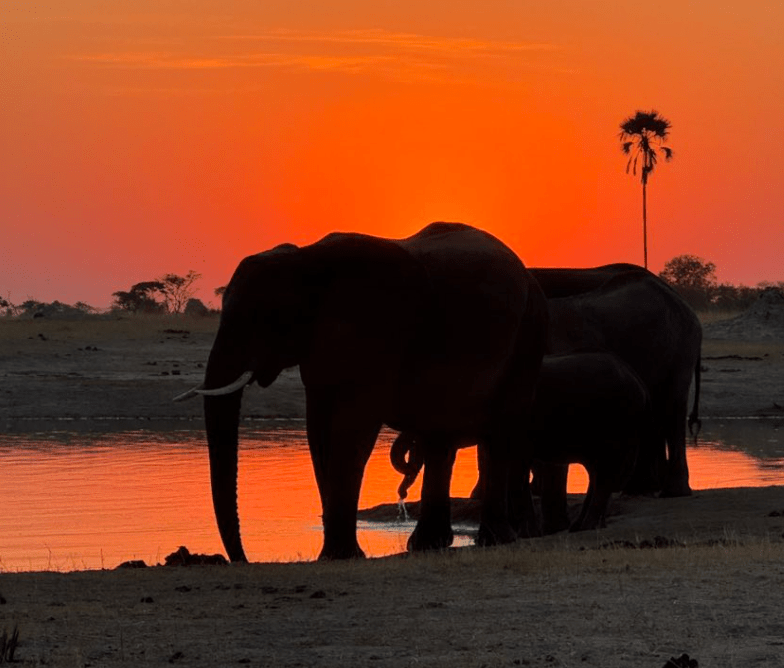
I remember  vividly how, more than  fifty years ago, a ranger at the Wankie National Park in Rhodesia (now the Hwange Park in Zimbabwe) noticed how, as a herd of elephants was moving towards a water hole in the evening, other herds, often as far as ten miles away, would abruptly  change their direction and head towards the same watering place.  Similarly, it intrigued me as I occasionally watched from a blind that, as a herd left a watering hole, there was invariably another one on the perimeter waiting to take their place. In both cases there seemed to some form of communication involved, but if so, what and how? 

The mystery was solved in 1984 by Katy Payne, an audiobiologist at the Washington Zoo in Portland, Oregon, who, while observing Asian elephants at the zoo, noticed an unusual vibration in the air when she was in their presence – infrasound.  From the Latin (infra meaning below,) infrasound is defined as sound waves with frequencies below 20Hz, and which are thus inaudible to humans. And indeed, when humans are exposed to sufficiently powerful infrasound, the stimulus may be felt in one’s body rather than heard through one’s ears. 

As air flows through the dense folds of the elephant larynx , the relationship between the length, mass, and elasticity of elephant vocal folds allows them  to produce sounds lower in frequency than any other terrestrial animal. In addition, the anatomy of the outer and inner ear of elephants is comprised of large, specialized components which allow them to detect low-frequency sound at long distances.

Infrasound offers a number off advantages when communicating over long distances – coordination of herd movements to improve resource availability (or, as in the first paragraph above, to regulate arrivals at the water source so as to avoid over-crowding,) the avoidance of rival herds and predators, and the facilitation of mate-finding for bulls in musth.

It makes sense in evolutionary terms. In the dense forests in which elephants evolved, limited vision necessitated  other forms of communication. This likely led to enhanced senses of smell and hearing as  early elephants directed their herds, located each other, and warned others of predators.  And why low frequency sound?  Because unlike high frequencies, they are are not blocked or muffled by thick vegetation.

Nor is it limited to communication. It is reported that during the 2004 Indian Ocean earthquake and tsunami, elephants in Thailand, Sri Lanka, and India displayed unsettled behavior and moved to higher ground before the tsunami reached the coasts of those countries. The supposition is that they were able to react to infrasonic sounds from the massive disturbances long before humans were aware of it.  Similarly, in both India and Kenya, traditional lore has long associated the beginning of a period of rain with the sudden appearance of elephants. Scientifically, both Asian and African elephants have been shown to predict thunderstorms at distances of up to 90 miles. The movements within cumulonimbus clouds produce strong infrasonic signals, and it is thought that elephants may be able to hear these and locate the storm.

The use of sound outside of our ability to hear is not unique to elephants – bats, alligators, giraffes, hippopotamuses, peacocks, rhinoceroses, and whales are all known to utilize infrasonic communication. Incredibly, infrasonic calls produced by blue whales have been recorded crossing the entire Atlantic Ocean, from South America to Africa. And infrasound has natural uses beyond just communication – homing pigeons and migratory bird species may use naturally occurring infrasound as a navigational tool. 

Incidentally, An Immense World by the Pulitzer-winning science journalist, Ed Yong, is a spectacular and fascinating account of the latest research as to how animals perceive the world around them. It ties in neatly with David Papke’s observation elsewhere in this newsletter that “Anthropomorphic … errors in interpreting bee behavior might not be an over-estimation of their intelligence but something entirely different – overlooking completely another form of intelligence that differs radically from our own.”

What is the connection between elephants and honey bees?  Earlier this year a team led by Yossi Yovel at the University of Tel Aviv has shown that plants ‘scream’ when under stress from drought or physical damage, emitting high frequency noises undetectable to the human ear but audible to many species of insects, bats and rodents.  In particular, they found that female moths avoided laying eggs on tomato plants that were emitting ultrasonic noises associated with stress. The researchers conjecture that the moths interpreted the sounds as a sign that the plants were unhealthy.  “This is speculation at this stage,” says Yovel, “but it could be that all sorts of animals make decisions based on the sounds they hear from plants, including about feeding, pollination and shelter.”

Seventy years ago, when Karl von Frishch interpreted the bee dance, he believed that it would lead a forager bee directly to a flowering plant.  Using von Frisch’s own data, we know now that it is not sufficiently specific to do that; it gets the forager out of the hive and flying in the right direction, but there are two further stages before she arrives at the flower, which Jurgen Tautz explores in Communication Between Honey Bees; More than Just a Dance in the Dark. The first he labeled ‘the search zone’ in which returning foragers fly with their Nasanov glands open, thus laying a chemical trail to the food source.  Tautz concedes that this needs more research.  The final stage is when the forager uses the  scent released by the original dancer in the hive to confirm  the flower source.

In the light of Yossi Yovel’s research, is it only scent that finally attracts the bees?  Could it be that plants with available pollen and nectar also emit a sound that is inaudible to us but is a trigger to the sensitive antennae of a honey bee?  After all, we know that plants that have had their supplies of nectar exhausted emit a signal to let foragers know they have closed up shop.  It seems reasonable to posit that plants also signal audibly  to foragers that they are open for business.

The Great Hunger

 In his book, The Five Invitations, Frank Ostaseski describes the different roles we play throughout our lives. Some are sequential, others might be multi-faceted.  For example, we might move through the progression of daughter, mother and grandmother.  Or we might be a husband, a father, a neighbor, a customer, a teacher and, to our doctor, a patient, all at the same time.  Essentially,  for the first half of our lives, we are concerned with creating an identity, developing a career with its personal achievements, building a family and forging the structures we need to survive and succeed in a complicated world.  These roles can be conflictual, such as a single mother who struggles to balance full-time work and parenting, or exclusive, such as the young man who may chooses to give up a traditional education and social life for the rigorous life of a professional athlete, or even reversed, when a daughter becomes the caretaker for a mother with Alzheimer’s.

For many of us, those initial skills do not alone prove fulfilling for the second part of our journey.  If we have the courage, the inspiration and a role model, we may turn inward, exploring issues like the meaning of life, what makes us happy, the rewards that come from profound relationships, the embracing of mystery and the cultivation of wisdom, all in a more relaxed form of striving.  Joseph Campbell described this as ‘the hero’s journey.’

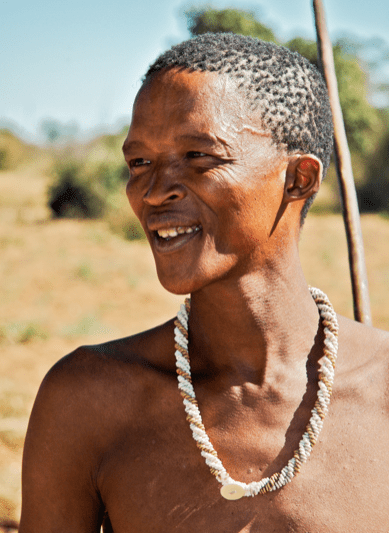
Laurence van der Post, describing his experiences among the Bushmen of southern Africa (more correctly called the Khoisan people,) wrote that they speak of two kinds of hunger.  The Little Hunger is for food, for the fire in one’s body that must be fed to stay alive. And then there is the Great Hunger, the hunger for meaning, the hunger that lives deeper than the stomach, in ‘the silence behind the eyes,’ as described by the tribesmen.  Happiness is fleeting, they argue, while meaning is enduring.  Once one is doing something that really matters to one’s soul, it doesn’t matter whether or not one feels good all of the time. Rather one feels connected to something bigger than one’s self, that we are not just bodies to be fed but spirits to be fulfilled.

Rachel Naomi Remen, a pediatrician and author who councils people with chronic and terminal illness, describing how life asks that we continually adapt, suggests that  “The ultimate purpose of every life is to grow in wisdom and to learn to love better.” 

In Buddhist lore, “when the student is ready, the teacher will appear.”  One explanation might be that the hunger for meaning was never modeled for us when we were young, neither at home nor at school, nor among our elders. The poet Robert Bly describes young men who grow  up with the model of John Wayne as the ideal male, and then, in their 40’s  suddenly find it no longer works (referring to John Wayne as a model example dates both Robert Bly and myself!)  But when one is receptive, those teachers can come from surprising sources.  Thus Novak Djokovic, interviewed during the Wimbledon Tennis Championship in July, was asked why he gives advice so freely to younger players who later may be his rival on court.  His response was even though he himself never received such encouragement from older players, it is an integral part of him and he cannot be authentic to himself by not doing so. 

His use of the word authentic struck a chord; perhaps that is what the Great Hunger is all about. I know that I enjoy spending time with others who are searching for authenticity, who want to deepen relationships, explore mystery and  cultivate wisdom in a relaxed setting.

And we used to have our grandparents, not least when extended families lived, if not together at least in the same town or village.  They would model those more quiet, more reflective values while the parents were preoccupied with the Little Hunger as they built a life for their new family.  

Several questions arise. If  education is supposed to prepare us for the ‘real’ world, should we not educate for the second half of life, as well as the first?  And is so, how do we do it?  I don’t think there is a curriculum for it (although I am reminded of the famous curriculum at Harrow in England titled “From the Sperm to the Worm,”)  but perhaps each school might include on its faculty some older men and women whose prime responsibility is to teach the regular curriculum but with the benefit of the wisdom that comes with age and experience.  Hence,  in the absence of grandparents, the power of role-modeling. The students may neither value nor recognize it as such at the time, but it would be available to them when they needed it later in their lives.

I was fortunate to have an uncle who was a RAF spitfire pilot in Britain in the 1940’s.  When the war ended he returned to his town on the south west coast of England, never again to leave.  He declined to learn to drive a car (even though he had been a fighter pilot!) and spent his leisure hours fishing in the local river. When I first met him he was in his late 50’s and I, an ambitious young educator, was in my mid 30’s, I knew immediately that here was a man who was perfectly content, and I was envious. Similarly, another uncle, a tail gunner in a Lancaster bomber in the war, spent several years in a German prison-of-war camp (he was part of the ‘Great Escape’ story from Stalag Luft III in 1944) and he too had neither need nor want for material possessions, although he was great company to be with. 

In writing this I realize how the aptly the word ‘authentic’ describes both men. 

Secondly, for those of us who do believe we are in transition – I use the present tense because, once started, it is a constant process – the question becomes, what was the trigger? Seldom is it planned, nor is it necessarily as dramatic as a world war.  In most cases it involves an unforeseen event that touches something deep within us and leads to a confrontation or a crisis. One theory is that we are reaching back to the very first years of our lives when we were authentic and before we were shaped by parental and societal into what they thought we should be.  Whatever the provocation,  only with hindsight  can we look back and realize what it was and its profound impact on our lives. As David Papke observed when I ask him to review the first draft of this essay, “It strikes me that although our eyesight and hearing diminishes with age, in many ways we see and hear things more clearly.”

That stimulus for me was the movie Dances with Wolves.  The Kevin Costner character is strongly and traditionally male – the warrior – yet in ‘the interior’ he meets both the natural world, symbolized particularly by the wolf, and the strong feminine  in the form of Stands with a Fist. Eventually, having to make a choice, he decides to ride with the Native American clan rather than return to ‘civilization’ with its more traditional expectations of the role he should play. The movie touched me deeply, and it took a little while to understand that it both characterized a deep disconnect within myself and offered a way forward. 

This in turn gives rise to two further questions.  First, are the various, sequential roles that honey bees fill in their short lives an example of this kind of adaptation?   The answer is largely no, in that these changes are genetically inspired rather than conscious choices made by each bee, even as environmental changes, such as a surplus of available nectar compared to pollen, may prompt a foraging bee to change from pollen to nectar collection. 

The second question is, does this explain why many people turn to beekeeping later rather than earlier in life?  It might.  Once one’s family obligations have essentially ended, as we are established in our careers and preparing to be grand parents (an interesting term), as retirement edges closer with its challenges and uncertainties, we might give more conscious consideration to what makes us happy, in particular deepened relationships, what our life has meant and how we intend to spend the rest of it.   There is often a sense of accumulated wisdom as we age, with which we can investigate some of the mysteries we encountered earlier in our life but didn’t have the time to probe deeply.  

Many activities can claim our attention, often with no connection to our professional selves  – gardening, wine-making, art, travel, wood working, community involvement, learning a new language – one of which is beekeeping, with its particular management challenges as well as insights into effective communal relationships in an untamed natural world. The bees, for their part, don’t care a whit as to who we are, where we sent to school or what we did to make a living.  They offer themselves up for our edification, as mysteries to be explored and as a portal  into a natural world to which we are eager to feel reconnected. As the Khoisan people knew, by so doing we feel connected to something bigger than ourselves, that beyond the Little Hunger we are spirits to be fulfilled. For some, honey bees are an integral part of the Great Hunger as we strive to grow in wisdom and learn to love better.

A Mind Of Its Own

ODTAA is a medical term describing those unfortunate  patients who recover from one problem only to be confronted immediately by another.  One Damn Thing After Another might be a beekeeping term too, in which case one of those ‘things’ is honey extraction.  When we are asked, “I’m thinking of taking up beekeeping, what do I need to know?” the first response might be, “Are you capable of dealing with one damn sticky mess after another?”  This no doubt is what Rudyard Kipling had in mind when he wrote, 

“If you can keep your head when all about you 

Are losing theirs and blaming it on you …”

We have all invited visitors to swish a finger through the stream of honey coming out of the extractor, and watched as they dealt with the drippiness and the stickiness –   a twist of the hand, a quick lick, and it’s solved. But it is deceptively simple, as we discover when a child tries the same technique.  We have spent millennia developing techniques to coerce honey from its rightful owners, but have been less effective in developing methods to coerce honey from its rightful home – capped cells – because, to state the obvious, honey has a mind of its own. 

It starts when, inspecting a hive, you remove all of the brace comb which the bees have built, even though you have provided them with nice new foundation only one frame away.  This means honey on the end of your hive tool which, unsurprisingly, the bees are trying to reclaim together with the bits of loose comb which, if you don’t act quickly, will slip between the frames and drop to the bottom of the hive.   In desperation, you grab those bits of comb – you once tried stabbing them with your hive tool before they dropped but, because of the honey already on the tool, nothing would stick to it, even though honey will stick to everything else, including Teflon non-stick pans. 

Now, besides a sticky hive tool, you also have sticky fingers, and because you grabbed your hive tool, that now has a sticky handle. 

Because you have thought ahead and have a bucket of warm water at the ready, you rinse off your fingers and resume the hive inspection, at which point you realize you should have washed your hive tool before you rinsed your fingers. In frustration, you put your hand to your mouth, meaning that your veil is now sticky as well. 

Why are you wearing a veil to extract honey?  Books are filled with instructions describing how to get the best honey crop, but little is said of the requirement that you, the beekeeper, will need to pick up heavy, sticky boxes with small handles weighing  in excess of 60 pounds.  No matter what method you used to move the bees from the frame before removing the boxes from the hive, there are always a small number of bees who refuse to leave and are now determined to take full advantage or your aching back and sticky gloves.  Banging supers on the ground to dislodge said bees does not work; the inevitable result is broken frames and angry bees, hence the veil.

As these same books describe it, extracting honey  is a straight forward process: remove the caps from sealed honey comb, spin the frames, collect the honey and pour into jars. In practice it is inviting retribution from the honey gods to so much as think that this is something that can be done quickly in between other jobs. 

Most extracting is done in the ‘honey house’ – ie. the family kitchen – and preparation is key.   First, arrange for your family to be suitably distracted for at least twice as long as you think it will take to complete the extraction. To steal from Stephen Bishop’s  column in the June issue of Bee Culture, “Be advised.  You should only attempt (honey extraction) outside of the earshot of small children because your wife will will likely erupt with words that will stunt their growth as morale right individuals when she discovers the condition of her cookware …”

Secondly, plenty of clean damp cloths is essential, as well as a source of running  water from a faucet that can be turned on either with an elbow or with sticky hands, and is easy to clean – unchanged water in a bucket, used a couple of times, becomes a weak honey solution so its continued use means spreading a thin syrup over everything in the kitchen. A word of advice – immediately you see a drip it must be wiped  up. Given half a chance even the smallest drop can attach itself to a host, eg. the family dog, in which case you have to catch and clean the offending animal before starting to clean up the sticky paw prints.  

 Some beekeepers proactively cover the floor with newspaper, but the thought of traipsing through the house with sticky bits of newspaper attached to my shoes prevents me from trying this.  I do know (and don’t ask me how I know this) that using one shoe to try to remove sticky newspaper from the other shoe, does not work.   

Before you can extract you have to uncap. According to all the videos that you watched beforehand, the  bees will produce combs packed with honey on both sides of the frame which is perfectly flat and just above the wood of the frame. The trick is to skim off the cappings by gliding a warm knife along the edge of the frame, tilting the frame at a suitable angle so that the cappings fall neatly into the uncapping tray.  Simplicity itself.   In reality the knife goes cold so that both wax and honey stick to the blade. You scrape the knife on the edge of the tray,  dip it into the now cooled water and try again. Eventually you give up trying to keep the knife hot and just slice and scrape. The uncapping tray now has globules of wax and honey around its edges which are starting to drip down the outside, which in turns acts as a magnet for bees  (the scouts were watching when you forgot to close the kitchen window. )

Nor are you finished uncapping. Rather than flat, level comb that is easy to uncap, invariably the frames have peaks and valleys reminiscent of a miniature Zion National Park with its unpredictable combination of mesas and canyons.   The mesa’s are decapitated by the knife, but what of the canyons?  First you try using the tip of the knife but quickly  resort to an uncapping fork. A bundle of sticky wax honey rolls up the tines, and although you stop frequently to scrape it off (on the edge of the tray, where else?) eventually, it reaches the fork handle.   So now your hand is a sticky mess at precisely the moment that you realize you have to scratch your nose which has become unexpectedly itchy. But there are still five supers of frames that need to be processed before nightfall, so to hell with it;  you bash on with sticky hands, sticky knife, sticky fork and itchy nose and more honey on your veil; just don’t let anything sticky get on the floor.

Faucets on honey extractors also have minds of their own.  It may be taking a long time for the honey to dribble though a filter becoming clogged with wax, but even the mere thought of  wandering off to check your e-mails is tempting fate. 

Eventually all the frames are uncapped and have to be manoeuvered into the extractor, after which all those stickies have to be dealt with, the gooey cappings have to be strained, the wax separated and all that washing-up to do, very little of  which will  fit in the sink.  The honey itself has to be bottled, jarred, labeled and eventually liquified after crystallizing.  It’s ODTAA.

One honey bee, in her life time, will collect enough nectar to make 1/12th of a teaspoon of honey.   That 1/12th of a teaspoon is enough to provoke barrels of frustration in the life of a beekeeper.  Such is the honey bee’s revenge. 

Variety is the Spice of Life

If you knew you were going to be marooned for 4 weeks, would have all the fresh water you needed, and could go to the grocery store beforehand and choose as much as you wanted of just one item to take with you, what item would you choose?  This question was put to a panel of nutritionists, and their answer … tinned cat food!  You may not be particularly healthy after 28 days, but you would survive.

I first heard the above as an explanation of the importance of a variety of pollen sources in the diet of honey bees.   They can survive on one or two sources, but it takes a variety of pollen to remain healthy, precisely  because different pollens contain different nutrients and in varying quantities.  Similarly, I believe that  bees may survive on doses of sugar syrup when they are ‘marooned’ (ie. in the dearth or over winter) but their health is impacted. 

Sugar has played a vital role in evolution because it fills an important  biological need for calories.   Psychobiologist Gary Beauchamp suggests that “the most important thing in an animal’s life is consuming enough calories to survive.”  And, for most of evolution, finding sufficient calories was a challenge but, when available, sugar provided a way to consume them in bulk.  Apes, for example, gorge on calorie-dense fruit whenever it is available as a survival technique for the next drought.  Bears and honey is another example. Children are notorious for having a sweet tooth during their developmental, high energy stages of growth, both mentally and physically. And for humans there was an added  benefit – foods that taste sweet in nature are generally not poisonous. 

So we, like most animals, are evolutionarily hardwired to consume sugar.  This presents two problems.  First, food science has advanced to the point that, calorically speaking, we no longer have those lean times.  Indeed, calorie-dense foods are almost unavoidable – think of the variety of chocolates next to the till at a gas store. Secondly, the nature of sugar in our food has changed. For most of human history, consumption of sugar in refined form was virtually zero; people used honey, sweet beans, glutinous rice, barley, or maple syrup as sweeteners. This began to change about 2,000 years ago when peasants in Bengal learned how to boil cane juice into a raw dark sweet mass. Even so, sugar remained a rare commodity, and only some 200 years ago, with an industrial refinement process, was there a sea change in both quantity and quality. Consumption by the average American went from  one spoonful per week in 1800 to almost  two and half pounds today.  And this figure does not include High Fructose Corn Syrup, a caloric sweetener widely used by the U.S. beverage industry.

Clearly there are significant differences between natural sugars such as honey and 

refined, white sugar.  The complicated nutrients found in honey – a combination of bacteria, enzymes and fungi that has taken millennia to develop – contrast with the lack of nutrients in white sugar; indeed the latter often retains a  residue of chemicals from the processing plant, one of which is arsenic!  Agreed, it is in minute quantities and is omnipresent in our food and environment (including beer!) but we measure toxicity in chemicals in parts per billion.  For example, in the Dec. 2024 issue of Bee Culture, and citing a study from Cornell, Ross Conrad states that the lowest concentrations of neonicotinoids to have an impact on bees is 0.1 ppb at the physiological level, 0.9 ppb at the behavioral level (eg. grooming) and 5 ppb at the reproductive level – queens are less likely to survive and lay fewer eggs.  So what about arsenic in sugar at 4 ppb?

These differences are outlined in greater detail in a forthcoming article in The American Bee Journal.  Suffice to say that what jolted me into action five years ago was research which showed that bees over-wintered on sugar syrup emerge greater in number, smaller in size, lighter in weight and with their immune systems compromised.

In 2020, piqued by Dr. Tom Seeley’s work on feral colonies, my colleague David Papke explored the concept of  Regenerative Beekeeping, which is the api-equivalent of Regenerative Agriculture, and invited me to join him.  We are attempting to reconstruct, within practical limitations, the environment  that honey bees have developed over millions of years, together with management techniques that are primarily  bee centric. There are three critical  aspects of Regenerative Beekeeping : using locally adapted bees, modifying the conventional Langstroth hive structure with an associated  management strategy, and not feeding sugar or sugar syrup under any circumstances. 

Does this mean we should not feed weak colonies in the fall or winter, and rather allow them to die. Far from it.   First, if you do feed sugar, know what the impact on the bees might be.  Secondly, if you do have to feed, why not give them honey?   At extraction time, put a number of honey frames uncapped in the freezer for 72 hours to kill off  any small hive beetle eggs and then set them aside in a cool, dark room.  If there is a need for emergency feeding in  the fall or late winter, replace one or two of the depleted frames in the colony with one or two of those with uncapped honey.  Or you can use the same methods you use to  feed sugar, eg.  Boardman feeders, upturned jars or plastic baggies. 

Five years later it is time to share some initial results.  My annual colony loss numbers have remained consistent – about 10 per cent.  This most recent winter I lost one hive out of 20 because of a mechanical failure – in one of the severe February storms water got into a hive (two boxes not fitting together tightly!) and the bees died. Mite counts are generally low – last year, for example, only two hives out of  20 required treatment. And honey production has remained the same – I extract one medium super of honey from each of 20 hives, leaving the rest for the bees.  In other words, not feeding sugar syrup has not affected adversely either colony losses or honey production, and appears to have impacted mite counts favorably.  

David wrote, 

“I stopped feeding sugar syrup, fondant, or sucrose in any other form beginning in 2020. Although I had already stopped practicing stimulative feeding of sugar syrup and pollen supplements in the spring, now I have also stopped fall feeding for overwintering colonies or any kind of emergency feeding using sucrose. Instead, I left on the hives sufficient stores of honey harvested by the colonies themselves, generally amounting to a full medium super in addition to whatever honey was stored in the brood nest area. And, although I have no quantifiable data, in the spring the colonies overwintering on honey appeared stronger and healthier.”

In 2022 David ceased all mite treatments and lost 22 out of 25 colonies. Those losses were replaced by splits made from the surviving colonies; since then his winter losses have been between 10 and 25 percent.

As always, one question leads to more.  For example, does the feeding of queens by workers who are raised on sugar syrup or who are consuming stored ‘honey’ that is basically processed sugar syrup, explain in any way diminishing queen longevity and productivity? 

If you are intrigued but also wary about ending sugar syrup entirely in your apiary (after all, sugar syrup is what we were told to use in those first bee classes, when we knew no different,) you might consider selecting one or two colonies from which to withhold all sugar treatments, and monitor (and share!) the results. 

Now please excuse me while I get my daily intake of honey.  I can’t help it.  It’s the bear in me. 

A Fable for Adults …

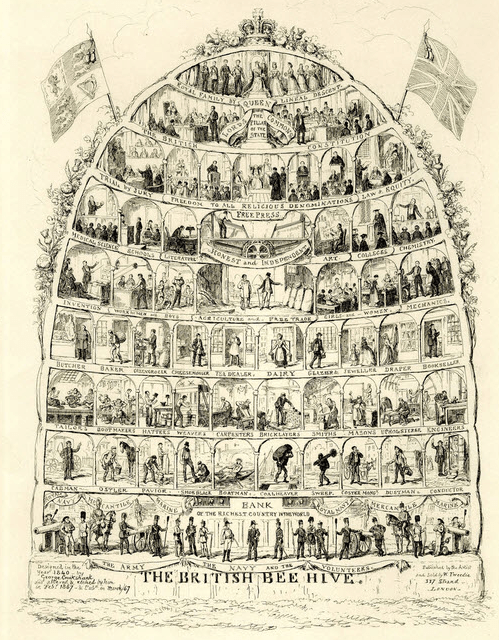
in which honey bees use humans as a model for a well run colony. 

Every day, a worker bee awoke early and started work immediately.  What she did was personally rewarding and for the benefit of the community. She was productive and she was happy. Her boss, an elderly forager bee, was surprised to see that the worker bee was so responsible without supervision. She thought if one bee can produce so much without oversight, how much more might she produce if she had an administrator.

So the boss recruited a new forager bee who had extensive experience as a supervisor and who was famous for writing excellent reports. The supervisor’s first decision was to set up a clocking-in attendance system. She also needed a secretary to help her write and type the reports, so she recruited a drone who managed the archives and monitored all phone calls.The boss was delighted with the new reports and asked the supervisor to produce graphs to describe production rates and analyze trends so that she could use them for presentations at meetings with the Queen. So the supervisor bought a new computer and a laser printer and recruited another worker bee to manage the IT department. 

The original enthusiastic worker bee, who had once been so productive, responsible  and relaxed, begrudged this new plethora of paperwork and meetings which used up most of her time.  She missed her independence and the feelings of trust that came with it. 

The boss came to the conclusion that it was high time to nominate a Person-In-Charge of the department where the bee worked. The position was given to an experienced forager whose first decision was to buy a carpet and an ergonomic chair for her office. She also needed a computer and a personal assistant, whom she brought from another colony, to help prepare budgets and a strategic optimization plan.

The department became a sad place, where nobody laughed anymore and everybody was easily upset. Everyone felt confined by all the rules and that personal initiative was neither encouraged nor rewarded. So the supervisor bee convinced the boss to start a climatic study of the office environment. Having reviewed the study, the boss found out that production had declined so she recruited a queen-in-waiting, a prestigious and renowned consultant, to carry out an audit and to suggest solutions. The QIW spent 3 months in the department and came out with an enormous report, in several volumes, that concluded “The Colony is overstaffed.”

Guess who the boss fired first ?  The original worker  bee, of course … “Because she showed lack of motivation and had a negative attitude.”

With acknowledgement to Joseph Noone.

British Society as a Bee Hive, George Cruickshank, 1840,

the year in which Queen Victoria was married.

Image v Substance

 in January Mary and I found ourselves in St. Petersburg, Florida.  With uncharacteristically cold, wet and windy weather we decided to take advantage of some of the remarkable museums in the city, starting with the one devoted to the works of the surrealist painter, Salvador Dali, which contains the largest number of his works of any museum outside of Spain. 

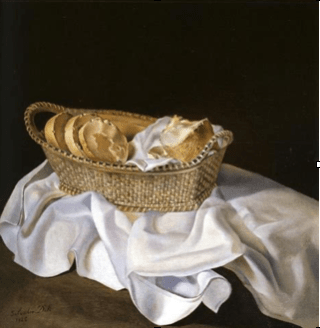
There were two pieces, diametrically opposed in style and purpose, that caught my eye.  In 1926, when he was 22 years old, Dali was required to submit a piece to the San Fernando Royal Academy of Fine Arts, the predominant art school in Madrid, to prove that he had the artistic skills worth of being accepted.  The result was a relatively small piece he titled “The Basket of Bread.”  It is a technical masterpiece; clearly, at a young age, he was already a master of his craft.  And I guess he knew it.   As part of his final exams he was required to meet with some of his professors to discuss the Renaissance maestro, Raphael.  He refused such a meeting on the grounds that, in his opinion, he knew more about Raphael than they did!  He was evicted from the Academy without ever completing those final exams. 

In 1939, when he was 35 years old, after experiencing the horrors of the Spanish Civil War and with his country again under siege, this time from Nazi Germany,  Salvador and his wife Gala,  moved first to France and then to the United States via Portugal,  where he was to spend the next eight years, dividing his time between New York and the Monterey Peninsula, California.  

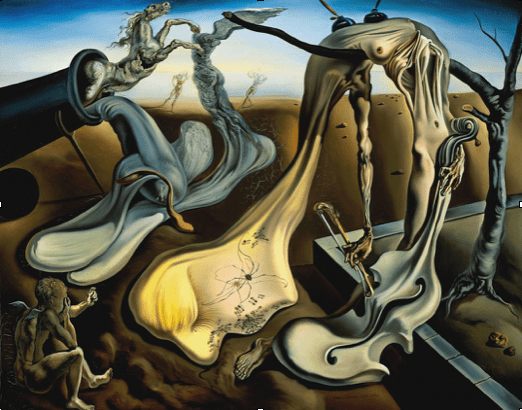
His first painting completed on American soil was titled “Daddy Longlegs of the Evening  – Hope.”   The title is a reference to a French legend to the effect that the sighting of a daddy long legs in the evening is a good omen.

It is a grotesque scene with haunting, unsettling, imagery.   In the lower left corner a winged child, possibly an angel, shields his eyes as he points to the unfolding horrors.  A canon shoots an eyeless, purifying horse, while a soft airplane oozes to the ground.  A sculpture of Nike, the Greek Winged Goddess of Victory, headless, rises in bandages from the deflated plane. The gratuitous figure in the center, eviserated and draped over a leafless, withered tree (the destruction of the feminine side that is endemic to all wars?)   holds a soft cello that is no longer capable of making music; inkwells sprout from the body, suggesting the eventual treaties that will resolve the crisis; after all the pen is more powerful than the sword.   A daddy long legs appears on the face, hence the hope amidst the chaos and destruction – witness the wasteland in the background with two humans reduced to tendrils of smoke.  The essence of humanity is vulnerable amid the carnage. 

This painting occupies the same rarified area as Picasso’s “Guernica”  which also was a response to the horrors of the Spanish Civil War three years earlier. Both are in a league of their own in terms of anti-war statements; there is no explicit violence, no bloodshed, no gore, in either, yet each is a powerful statement of the ruinous, destructive nature of war. Unlike Picasso, Dali included a semblance of hope. 

Incidentally, one of the docents at the Dali Museum asked her group how long the average museum visitor spends in front of an art work in a museum.  The answer – five seconds, and that includes reading the label! 

But that is not what struck me about these two paintings.  

In the mid-1990’s the power point program became available to school students as a means of presenting their projects.   The first, and overwhelming, response, was, and often still is, to spend the majority of the preparatory time and effort on the visual appearance, with very little time spent on the content, not realizing that that this is the old issue of image v substance, that even the most beautiful presentation is ineffective without a solid core.

At the age of 22, Dali was a highly competent artist in the accepted sense.  And it was this base which allowed him to become a highly competent artist in a non-conventional, initially disputed, style called surrealism.  Time and work  spent on the basics is never time wasted; indeed it is essential to further growth.  It is the biblical story of a house built on sand …  Similarly good educators teach an estimated 10 per cent of what they know.  The remaining 90 percent is not wasted; it is termed ‘reserve power’ and is there in case one needs it. 

Some 15 years ago, at Buckfast Abbey in Devon, England, Claire Densley told me that she strongly advises her new beekeeping students not to do anything for the first five years after the class except master the basics.  She wants them to become absolutely proficient in handling, reading and intervening in a colony, to have a foundation of stone, to have the reserve power when needed as they later start to experiment, to branch into specialist fields, to try something a little different. It was advice that came vividly to mind in the Dali Museum in St. Petersburg, Florida. 

What We Take for Granted

My father was born in an age when the lack of a formal education was not necessarily an obstacle to personal success.  He left school in Devon, England, aged 16, and  retired some 45 years later, not only responsible for the maintenance of the national roads of an entire country but well respected by his peers, all of them degreed engineers.   No doubt, four years of building roads and bridges to allow the British forces to retreat before, and then advance after, the Japanese forces in Burma, was a vital part of his education. 

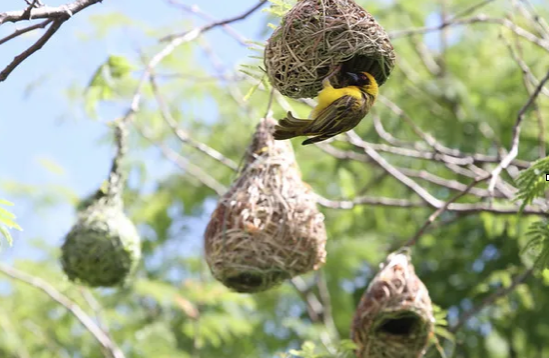
He spent week-long trips inspecting roads and visiting road crews, and over school holidays I would often accompany him.  My favorite memory is lying in the back of the station wagon parked at the Birchenough Bridge Hotel, alongside the Savi River, under a tree interlaced  with nests of masked weaver birds, watching for shooting stars in the vivid African night sky.  The masked weaver is a fascinating creature.  The males, for example,  build nests at the very ends of the branches of thorned acacia trees so as to make them inaccessible to snakes in particular.  The nest are architectural marvels, each consisting of several rooms, all but one of which are decoys.  When he is finished – some 12 to 14 hours of work in all – his partner inspects it.  Should it not meet her approval she rips it apart and he promptly builds another … until such time as she is satisfied. 

Another memory, less pleasant but probably more important, was when we were driving between road camps and my father decided to offer  some simple mental math problems involving speed and distance.  A typical example might be, if we are driving at 60 mph, how long will it take us to travel 30 miles?   I couldn’t do it. The more I tried, the more he explained, and the more frustrated I became.  Emotion superseded any ability on my part to think rationally . He could not understand why it was so difficult. The reason?  I did not understand that miles per hour meant how many miles one traveled in one hour.  It was a non-understanding of the word per.  It was a simple as that.

That was some 70 years ago, and I have not forgotten it. 

Ironically, when I was driving the 1400 miles to university twice a year, the speedometer in my car didn’t work (a broken cable, I discovered eventually.)  Thus I spent considerable time using the mile posts and a wrist watch  to calculate my speed, by which time I understood only too well what per meant! 

The point is, especially as that time of year approaches when bee classes start, we should never assume that what is obvious to us is equally obvious to those new to the craft. Beekeeping, like most things, has its own language, and there are terms  that we take for granted – larvae, pupae, comb, propolis, foundation, frames, EFB, AFB, varroa mites – which may be new to many in the class.  Some will ask; others will keep quiet and hope they can figure it out from the context.  It doesn’t help when some terms are mispronounced; for example, the first instructor I had pronounced honey bee comb as cone. 

Sometimes it doesn’t matter.  For example, I have absolutely no idea what http, or jpeg, or hrl, stand for, nor do I need to know.  If I was in a computer 101 class it might be entirely different but, as it stands, I can use my computer without having to know how to code or what the abbreviations mean.  In the same way one can drive a car without understanding how the engine works, or realize the implications of the law without having been to law school.  I recall vividly teaching European history to a group of 16 year olds in 1970.  One of the students, sitting in the back, right hand desk,  put up his hand and asked what the difference was between domestic and foreign policy.  I was stunned – these were terms we had been using all year – and essentially I did not answer, assuming he was pulling my leg.  Now I know better, and am ashamed of my callous response.

Beekeeping does not fall into the computer, vehicle and legal categories.  The essence of the beekeeping class is graduating from simply watching honey bees to being able to understand their behavior and thus to intervene appropriately and for their benefit.  It is this comprehension of which language is so important a part.  A pertinent example might be Keith Delaplane’s latest book, Honey Bee Social Evolution, not only because of his superb use of language but also because his explanations of the evolutionary processes that have led to current bee behavior enlarge my understanding of what I see in the hives and thus impact my interventions, if any.

A technique for an instructor is to acknowledge at the very outset that he/she might inadvertently use terms that are part of the beekeeping experience but which are unknown to the class.  In such an event it is important for class members to speak out; it will not only allow for clarification for the students but will provide valuable insight for the instructor as to their level of comprehension. 

The Birchenough Bridge, taken from the hotel.

The Golden Rule

This is the fourth and final episode in a series focusing on the brain on the honey bee

Honey bees are insects and have been so since their appearance in their present form some 30 million years ago.  In the mid 19th  century  Johannes Mehring, who was the first to produce wax foundation using a metal roller, equated a bee colony with a vertebrate animal.  The queen and drones, for example, represent the female and male genital organs, while the workers represent those organs necessary for maintenance and digestion. In Germany this led to the term bien, whereby a colony was seen as a single living organism in which the whole was greater than any of the parts.  It was an American biologist, William Wheeler, who, in 1911, coined the term superorganism

Of late it has become popular to compare a honey bee colony not just with vertebrates but with mammals in particular.  For example, both have very low rates of reproduction (recognizing that a colony reproduces itself annually as a swarm;) mammalian milk is compared to royal jelly as a source of nourishment, brood comb is equivalent to the uterus of a mammal, both have body temperatures of between 96 and 98 degrees F, and both have developed a high capacity for learning. 

The reason for these characteristics, as described by Jurgen Tautz in The Buzz About Bees : Biology of a Superorganism,  is that by freeing themselves from the dictates of the environment, whether it be the weather or fluctuating sources of energy and nourishment, organisms can afford to have fewer progeny who are stable in numbers, well prepared for their environment and carefully protected.

This process is carefully controlled (homeostasis) by a complex system of constant feedback loops.   Ask a member of the public who is the brains behind this, and the response invariably is ‘the queen.’  This misconception dates back 400 years when Charles Butler named her as such – hardly surprising in that it was the decade following the first Elizabethan era where one strong woman, supposedly a virgin, had ruled a burgeoning empire without much competition.  We know today, of course, that the queen bee does not rule; rather she is a superb ovipositor who is the servant of the worker bees. The one exception might be her release of the queen substance which is distribute by trophallaxis to all the bees in the hive, which prevents the ovaries of the bees from developing and gives the queen reproductive dominance. 

It seems to me that the question is not what part of a superorganism constitutes the brain; the superorganism itself is the brain. 

There are many definitions of the term brain.  The American Heritage Dictionary of the English Language, for example, defines it as “The primary center for the regulation and control of bodily activities, receiving and interpreting sensory impulses, and transmitting information to the muscles and body organs. It is also the seat of consciousness, thought, memory, and emotion.”  We have previously acknowledged, to repeat Randy Oliver from last month’s column, that honey

bees do not have  a developed capacity for deep analysis and thinking, much less human concepts of morality, but, to  paraphrase both Keith Delaplane and Tom Seeley, in both the superorganism and our own brains there are multiple evidence collecting units – call them bees or call them neurons – applying information and choosing among alternatives.  

Consider that worker bees of every age seem to know what has to be done, when to do it and where it is to be done. Colonies are not hierarchies; rather each bee behaves as though she herself has come to a decision.  The result is small, local changes in the colony which in turn act as stimulators for other bees to adjust to the new situation and make their own decisions.  Micro decisions by the individuals result in macro-behaviors for the colony, such as swarming (especially nest selection) and comb building.  Another example is what Keith Delaplane describes as progressive provisioning – nurse bees control the quantity of food given to larvae, as well as the ratio of its constituents, which together dictate a larva’s metabolic fate toward queen-like or worker-like development. 

It is a bottom up, or emergent, process, rather than top down, and is termed either collective intelligence or the hive mind.  

This is not to deny the astonishing ability of individual bees to learn and to remember in both the short and long terms – they are not mere automatons.   They can recognize and remember colors, patterns and scents. They can count, add and subtract, combine concepts they have learned, understand abstract concepts, and convert angles on a dark dance floor from gravity to the sun in relation to the horizon.   After all, whether in a hive or in a floral landscape that is constantly changing, they have to be adaptable problem solvers.

“Demonstrating how nature has converged upon similar answers for similar problems,” writes Keith Delplane in Honey Bee Social Evolution, “even across such phylogenetically distant animals as honey bees and humans, is one of the most exciting ways entomology, and the superorganism concept, is informing all of biology today.  It’s a beautiful example of the unitive quality of all nature.”

Workers, drones and their queen are members of a team that is committed to the survival of a colony over the seasonal rhythms of the year.  This community of individuals solves problems by working-sharing and communicative exchanges that single individuals could not achieve on their own. Is this the ultimate message of the bees? As long as all care for one another, each will themselves be cared for?  A society in which the Golden Rule – do unto others as you would would want them to do unto you – is a lived reality? Honey bees not only bring us joy; they also give us hope by providing a living example of cooperation in action in a world that is increasingly fractured though ever-increasing egotism, greed, self-interest and loneliness.

Thinking Like a Tree

This the third in a series of four with the brain as the focus. 

Two sentences in David Haskell’s remarkable book, The Song of Trees, invite comparisons with honey bee colonies.  “Plant architecture is not a haphazard affair but is the result of constant assessment and adjustment as conditions change … Even though it lacks a nervous system, a tree’s cells are awash  in hormones, proteins and signaling molecules whose coordination allows the plant to sense and respond to its surroundings.” 

Twigs, for examples, sense the luminosity of their particular location on the tree and grow accordingly.  The cells in the breathing spore of a fir tree integrate information about the state of the needle’s internal environment, and open or close the pores to admit either gases or release water vapor. 

When such processes run through animal nerves we call them behavior and thought. So is a tree, or a plant, despite its lack of nerve cells, a behaving and thinking creature?  Indeed the proteins that vertebrate creatures, including ourselves, use to create the electrical gradients that excite our nerves are closely related to the proteins in plant cells that create similar electrical reactions.  

Plants of course have no brain to coordinate these signals, so their thinking is diffuse, located in the connections between cells, even as those connections happen at a rate 20 000 times slower than in a mammal.

Plants, like honey bees, also remember.  When kudu antelope in southern Africa browse on trees, it was noted not only that the trees subsequent growth was heavily defended by unpalatable resins, like a nervous bee that has encountered a spider on a flower, but also that the kudu avoided browsing on adjacent trees in favor of those a little more distant.  It was as if the tree under attack had been communicating with its immediate neighbors and giving them time to mount a defense, a response which the tree can ‘remember’ for future such attacks.  

Indeed, root tips interact with bacteria (roots provide bacteria with sugars and in turn the bacteria protect the root from attack, buffer it from changes in salt concentrations, and stimulate growth,) and very much in the news of late, with fungi. Nearly ninety percent of all plant species form below-ground units with fungi in which sugars and minerals are exchanged in the form of chemical signals that travel through the fungus, carrying messages about attacking insects and animals, among other things.  “A street market” is the analogy Haskell uses to describe the soil.  

It it not difficult to substitute bee colony for forest in Haskell’s summary : “It is not just the tree that thinks but the forest. The common life has a mind. To claim that forests ‘think’ is not an anthropomorphism.  A forest’s thoughts emerge from a living network of relationships, not from a human-like brain. … A forest’s intelligence therefore emerges from many kinds of interlinked clusters of thought.  Nerves and brains are one part, but only one part, of the forest’s mind.”

Individual honey bees have a brain and a nervous system.  We talk often of their cognitive abilities – we know they can communicate, remember and change their behavior in response to the environment.   A bee hive is a veritable ‘street market.’  Indeed we take it for granted that honey bees can think.  In the November issue of ABJ, Tina Sebestyen writes that “Even subclinical levels of DWV in bees can cause impaired cognitive function …,” and Tom Seeley, describing the steps in the evolution of the buzz-run signal,  states that  “… (the bees) receive  the information it provides to improve their decision making.” (My italics.)  My guess is that most subscribers of ABJ read these descriptions without giving them a second thought (pun intended.) Indeed honey bees do have a cognitive process, even as Randy Oliver stresses in the December issue of ABJ, “their  tiny brains have limited capacity for deep analysis and thinking, much less human concepts of morality.” 

According to the American Psychological Association, the term cognition includes all forms of knowing and awareness, such as perceiving, conceiving, remembering, reasoning, judging, imagining, and problem solving, all of which the individual honey bee can do.  It is interesting that this definition  does not include the word conscious, in that the cognitive behaviors of a bee are innate rather than conscious.   Rather than thinking, in the human sense, honey bees respond to information innately in two distinct ways, as explained by Tom Seeley in Piping Hot Bees.  The first is via signals which have been refined by natural selection over evolutionary time so that one bee provides another with clear and accurate information. An example would be a bee using the waggle dance to indicate the location of a food source. 

The second, and more subtle,  is via cues, which provide information incidentally rather than intentionally. An example of a cue is how long it might take a nectar forager to find a receiver bee willing to offload her nectar, which in turn helps her decide whether or not she should perform a waggle dance. 

According to Jurgen Tautz, there are essentially three ways to obtain knowledge : instinctual knowledge, embedded in the genome, is inherited;  some learning is gained by experience, which can then be communicated. For example, a forager has an innate sense of color (preferring blue and yellow;) can learn from experience as she makes different trips to a floral source, and can then communicate what she has learned via the waggle dance. 

Or, slightly more complex, a honey bee does not have an innate knowledge of all possible flower forms; instead she has the ability to learn the visual and olfactory clues that make up a flower’s character.  A single experience with a particular odor can be learned, and subsequently used to discriminate against other odors with 90 per cent efficiency.  After two or three interactions, the efficiency becomes 100 per cent.   Shape and color take a little longer to learn, but together they form the basis of flower fidelity. 

So yes, honey bees have cognitive functions and can make decisions, not consciously but by processes honed over millions of years in a social context of cooperation and altruism, qualities that are as vital today as they have ever been as we search for  an ethos of solidarity with all organic life, as described so wonderfully by Keith Delaplane in his recent and final publication, Honey Bee Social Evolution.

If individual honey bees have a brain,  a nervous system and cognitive functions,  the question then arises, what are the equivalents in the superorganism?  More next month.

The World in a Grain of Salt

Can you imagine slicing a poppy seed into 7000 pieces, photographing each, and using artificial intelligence to extract the shapes and connections of all the neurons before digitally reassembling them?  According to a recent report in the journal Nature, this is what a team from Princeton did with the brain of a fruit fly. And because AI is not perfect, the researchers still had to fix by hand over three million mistakes, for which they recruited a global army of scientists and engineers. 

Yet even this technical tour de force was meaningless until there was a description of what each wire was supposed to do, and we’re talking about 140 000 neurons joined together by 50 million connections (compared to 86 billion neurons and trillions of connections in the human brain.) 

The images the scientists have produced show a tangle of wiring that is as beautiful as it is complex. Its shape and structure holds the key to explaining how such a tiny organ can carry out so many powerful computational tasks – fruit flies can walk, hover and the males can sing love songs to woo mates, all with a brain that’s tinier than the proverbial sesame seed.

Developing a computer of the equivalent size capable of all these tasks is way beyond the ability of modern science.

Dr Lucia Prieto Godino, a group leader in brain research at the Francis Crick Institute in London, suggests that  “Researchers had already completed the connectomes of a simple worm which has 300 wires and a maggot which has three thousand, but having a complete connectome of something with 130,000 wires is an amazing technical feat which paves the way for finding the connectomes for larger brains such as the mouse and maybe in several decades our own.”  

A neurologist suggested to me that the reason flies and bees are so difficult to swat is because the physical distance between their eyes, brains and legs are so short that the necessary neuro-signals can be carried between them more quickly than those involved in our swatting.   But using this new information, researchers have found that when the vision circuits detect which direction your rolled up newspaper or hive tool is coming from, they pass on the signal to the insect’s legs, but not to all six legs equally.  A stronger jumping signal is sent to the legs facing away from the object of their imminent demise. So in one sense they jump away without even having to think – literally faster than the speed of thought.

My hope is that, as the research sheds new light on what one scientist called “the mechanism of thought,” we will understand better how we learn, whether individually or collectively, and thus how we teach.  After all it is the latter which almost everyone on this planet experiences in some form at an age when their brains are most receptive.  The potential for good is tempered by the fact that, as has happened so often in the past, new scientific discoveries will be manipulated by bad actors for nefarious, selfish, and malicious ends.  At the individual level, and according to the 2024 report of the Global State of Scams, victims have paid $1.3 trillion to scammers worldwide in the past 12 months (which is possibly the largest financial crime in world history,) and which averages $3 520 per scam in the US.  Or Elon Musk’s stated interest in implanting computer chips in people’s brains that will enable them to control devices with their thoughts.  As George Packer writes in the December 2024 issue of The Atlantic, “We succumb to the impulse to escape our humaneness.  That urge thrives in the utopian schemes of technologists who want to upload our our minds into computers …”

At the national level, bad actors have allegedly used cyber technology, the internet and  AI to interfere in our recent election. Unlike the honey bee, the concerns of the perpetrators are totally selfish and have nothing to do with the common good. 

What will be powerful, and not only in bees,  is recognizing the interaction between the physicality of the brain and the importance of the social process.  Keith Delaplane’s Honey Bee Social Evolution : Group Formation, Behavior and Preeminence, published last month,  focuses strongly on the concepts of eusociality (eu in Greek = good.) Eusociality has four traits, whatever the animal involved – cooperative brood care, overlapping generations within a colony of adults, a division of labor into reproductive and non-reproductive groups,  and altruistic behavior (unselfish behavior focused on the welfare of the group.)  Dr. Delaplane makes the point that the only currency that matters in natural selection is the ability to pass one’s genes to the next generation.  “Whereas our species seems to have no compunction against violent enforcement of self-interest, in honey bees, natural selection has moderated the most selfish impulses of workers so that the vast majority settle for less than optimum personal reproduction in favor of supporting their queen.” Thus, along the evolutionary ladder, honey bees sacrificed their ability to raise viable progeny in favor of choosing and raising one bee to fill that role, and then devoting much of their life to caring for her progeny, all in the interests of the greater good. 

He writes that “It is social processes that drive evolution with inter-functioning themes of cooperation and altruism that are equally applicable to all eusocial species, including ourselves.”  Hopefully honey bees are  in the hierarchy of animals to have their brains analyzed,  precisely because it is a complex eusocial animal with vital lessons for ourselves.