“What you want to ignite in others must first burn inside yourself.” So wrote Charlotte Bronte almost two hundred years ago.
In designing a class that uses one’s ‘internal fire’ as a stimulant, the instructor has to demonstrate curiosity, not only about the subject matter but also about those taking the class. In this instance, what excites them about managing honey bees? What prompted them to sign up for the class? What are they fearful of? Such questions can be either sent to each student before the classes begin, asking them to respond in writing (I’m a great believer that the process of writing encourages reflection, out-dated as that may sound), or they could be asked of each student in the first class. The advantage of the latter is that each response may stimulate ideas in those who are listening.
The instructor might make brief notes of each response and come back to them in the final class, asking first to what extent those curiosities have been addressed, either directly or indirectly, and what now rouses their curiosity as they continue with their beekeeping journey.
I believe this is sufficiently important as to take up all of the first class, together with a quick walk through the apiary, because both activities set the tone for everything that follows.
Beekeeping is a contact sport. One can learn just so much in the classroom but experiencing it ‘in the raw’ is vital. For this reason I am skeptical of the two day marathon that sometimes occur; indeed we tried it 20 years ago, twice, led by Jim Bobb no less, and got the clear message from the participants that there was too much information in too short a time without not enough practical reinforcement. Now we start the classes in the early spring and schedule one a month through September, each one lasting two or more hours with the topic related to what is happening in the colonies at that time of year. This also allows adequate time for both reading and thinking between classes.
If the dominant question is to recognize the natural behaviors that honey bees have developed over millennia and utilize them for the mutual benefit of both the bees and us, in the second class, rather than explain the equipment we use (which is anthropomorphic,) have a natural bee cavity on display (I have several tree trunks from which a feral colony has been removed – surely each local bee club can keep one for instructional purposes.) The students describe the critical elements of a natural hive, – the entrance, insulation, volume and texture of the inner walls – and then, in the apiary, compare those criteria to those of a managed hive. Compare and contrast.
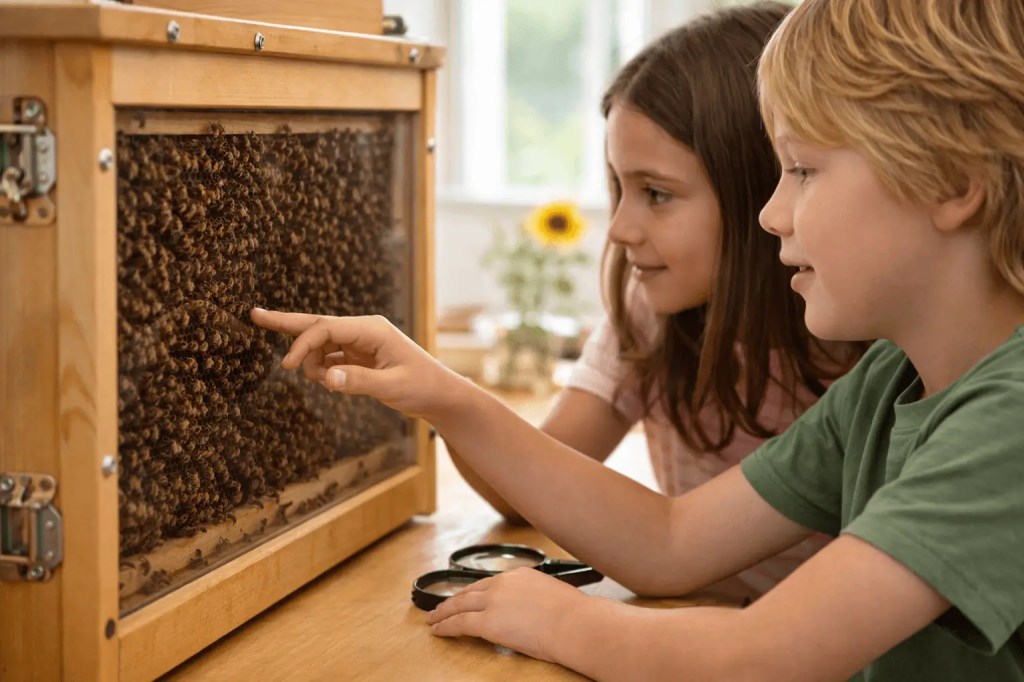
If our intent is to encourage decisions made on observation rather than a preconceived plan of action, if we want to work with, rather than impose our will on, the bees, the instructor might follow the feral hive discussion with an observation hive in which students are asked to observe the bees in action and evaluate what a particular bee, or group of bees, is doing. The instructor would use this opportunity to assuage the curiosity that is aroused.
In the remaining sessions, and after time in the classroom, we would go into the apiary where, in groups of three or four, the students would be assigned a hive, which would be theirs for the duration of the classes, and invited to open it and observe what we had discussed in the classroom. They would make notes on each such inspection, including what they might expect to see when they opened the hive a month later. My task was to circulate among the groups, doing my best to respond to questions without answering prematurely, a process I learned when visiting Credo Mutwa in Soweto in 1980, as described in a previous Corner.
I first used this process with a little trepidation, and yet not once was I disappointed, not once did a group do something in the apiary that was unreasonable or unacceptable or put the bees at risk. Their anxiety rapidly diminished and the learning was remarkable.
This process follows the seasons – the post winter build up, the reproductive state, the food storage phase and the winter preparations – in each case using observations of the natural behavior of the bees to determine management strategies, ie. bee centric. The reading between classes can set expectations, reinforced by observation, followed by a discussion of management options available to the beekeeper. By comparison, the Introduction to Beekeeping class I took 25 years ago consisted of more than 11 hours of being talked at, concluding with half an hour standing back while the instructor opened a hive. No wonder some of the participants were taking the class for the third or fourth time.
What is also important is that the instructor needs to introduce some of the more recent honey bee related discoveries, including genetics, ecology and evolution, always in the context of the observation process. For example, in the reproductive phase, the question might be, “Why does the old queen leave with a swarm? After all, this is a high risk process, especially as her successor is yet to emerge and to mate.” The obvious answer is that the new colony formed by the swarm has a proven queen ready to start laying once there is comb available, which is normally within the first two weeks. But there is another intriguing reason, explained by LeRoy et al in 2024 and cited by Clarence Collison in the October 2026 issue of Bee Culture : “Genetic diversity is a fundamental unit of biodiversity, enabling species to withstand threats such as diseases, climate changes, and other evolutionary challenges, ultimately reducing extinction risks.”
We know that the genetics of a colony is formed by the mating of a queen with a number of drones, and remains constant until she herself swarms, perhaps a year later. Initially this new biome presents a barrier to parasites, but not for long. The parasites reproduce rapidly (in the words of Zac Lamos, “varroa mites breed faster than rabbits!”) Indeed mites may go through more than 20 breeding cycles in a year, each one of which is an opportunity for an advantageous mutation to occur that allows the mites to overcome the natural resistance of the biome of the colony. This in part is why mite numbers do not rise immediately after a swarm has left a colony. It is also why Dr. Sammy Ramsay argues that it is difficult to overcome the mites by natural methods alone : they will always out-breed the bees and thus have the genetic advantage.
So the old queen leaving with a swarm is a natural part of the evolutionary and ecological survival of a colony in the presence of parasites. Which gives rise to the question for the class : if, in the interests of honey production, you are going to prevent your bees from swarming, what do you need to do in terms of the queen to offer some genetic resistance to the mites?
Is this too advanced a concept for a new beekeeper? I don’t believe so for a minute. It is an intriguing basic concept, answers a critical question of swarming, and is a vital introduction to the role genetics can play in honey bee behavior.
Does the above ignore the normal classes on diseases, swarm management, different castes of bees and their longevity, etc? Not at all, but they emerge out of real situations, out of meaningful observation; they are explained in context and in response to student curiosity.
Teaching is a conservative profession, sometimes at a cost. Those of us who grew up in a different age are used to the “I pitch, you catch” style of instruction, where the teacher felt obliged to do most of the talking. It is top-down style of instruction where the initiative is taken by the teacher irrespective of the curiosity or the prior learning of the students. In an age in which information is so readily available, such a style is surely redundant. Rather than instruct, a good teacher today stimulates the students and then provides the references by which their need to know can be answered, at a level appropriate to each student, especially in a class in which the students are self-selected and self-motivated. Gone (I hope) are those days of lengthy slide shows in which the characteristics of say, a worker bee, are listed interminably, when they can more meaningfully be observed in action and explored by the curious observer. The teacher is no longer a provider of information so much as a guide to self-discovery, the most important tool of which is the inherent curiosity of the student.


