Over the previous 16 years I have confessed at least three times to being a crossword fanatic, attempting daily a puzzle of the cryptic variety. The excuse is that it keeps my few remaining healthy brain cells active but in reality I get a surge of dopamine each time I manage to decipher an apparently obscure clue and, even more so, when the final answer falls into place and the puzzle is complete. I guess my fragile ego needs daily affirmation that I have not been outwitted by the deliberate obliqueness of the puzzle creator.
Recently, the first clue read, “It’s a little higher than the ankle, or a little lower.” There were only four letters in the answer, and I couldn’t get it. Shin? Knee? Nothing made sense. I put it aside until it was the only remaining unsolved clue, now knowing that the second letter was an A. Again, I was stumped, and this time put the whole puzzle aside to allow time for my mind to clear.
Five hours later, I got it! The solution, which required a paradigm shift of one of the words in the clue, became apparent when I was least focused on it. (The answer is at the end of this piece for those who have not yet solved it and want to ponder a little longer.). How my brain suddenly allowed for this new interpretation is a mystery but clearly time and space were requi
Sometimes being in the bee yard is no different. I will come across something unexpected in a colony for which there is no immediate understanding. The temptation is to dismiss it in the interests of finishing the inspection before the girls protest too much, using the excuse that the bees know what they are doing. Rather than discount it, an alternative is consciously to put it aside, confident that one’s brain will keep working on it even if one is not consciously aware that it is doing so. How it does so remains a mystery but clearly time and space are critical. Invariably, later, in a quiet moment, there will be a paradigm shift, a new perspective and a new understanding.
I hesitate to cite Napoleon Hill but not all he wrote was a con : “Patience, persistence, and perspiration make an unbeatable combination for success.” Perhaps when we give a problem time to resolve we are moving from a space in which the problem is immediate to a larger space in which past learning and observations become apparent; in other words, we provide for a larger context. Calvin Coolidge had a slightly different take : “Nothing in this world can take the place of persistence. Talent will not; nothing is more common than unsuccessful men with talent. Genius will not; unrewarded genius is almost a proverb. Education will not; the world is full of educated derelicts. Persistence and determination alone are omnipotent.”
When I was in Middle School in the 1950’s we were required to do a lot of writing and the teachers did a lot of correcting and guiding : no one-word multiple-question tests in those days. I would come home on a Friday with an essay to write and a plea to my mother, “What will I write about this time?” Invariably her answer was, “When you are in bed tonight, put it at the back of your mind. You’’ll have an answer in the morning.” Doubtfully but dutifully I would do so, and my recollection is that it worked : not the whole essay was there, but the germ of an idea which became the essay.
Early in June a mentee of mine had three hives, one of which was pitifully small and queenless. She had hoped that they would somehow raise a new queen but I explained that they could not keep even the small patch of brood covered, and so we created a nuc using those bees together with frames , eggs, larvae and bees from one of her strong hives. Ten days later she called to say that the nuc was empty – not so much as one dead bee. How to explain it to a disappointed new beekeeper.
We talked a little about absconding, the most common cause of which, I said, was foragers returning to the hive with something toxic to the point that the environment becomes intolerable. I wish now I had asked for some time to think before responding (especially as I am not one for thinking quickly on my feet – the bon mot in a telephone conversation, for example, comes five seconds after I have ended the call.) Because later that day, without consciously doing so, I found my mind considering more broadly the reasons for absconding, particularly in the light of this month’s weather. The possible reasons now included overheating or insufficient regulation, lack of a reliable food source, and predators or chronic disturbance.
I got back to my mentee and extended my answer.
This mental process is not confined to beekeeping; I guess we have all experienced it at some level. How often do we wake up in the morning (or worse, the middle of the night) with a new perspective on an issue that had bothered us the day before? A car failure, a plumbing issue, a recipe that didn’t work out, a relationship that is unfulfilling …. the list is endless. Mary will frequently ask if I have had any further thoughts on something we had discussed or experienced a day or two previously. Invariably I have, not that I was aware of those thoughts until specifically asked. Its this case it is the asking which makes the unconscious conscious.
The critical questions are, first, do we have the confidence to trust this unconscious process, and secondly, at a later time can we consciously make the unconscious conscious without needing an external stimulus? Can we deliberately invoke the patience and persistence to create the time and space in which our brains are free to operate at levels we neither control nor understand?
One of the teachings from the bees over time has been to trust the learning process, to observe in the moment and allow time to form the bigger context. In practical terms, this means that a hive inspection is in two distinct parts. First is the observation and the note making, which I return to 48 hours later, trusting that some 25 years of reading and talking about honey bees is stored in my mind somewhere, and that given the time and space those notes will appear in a larger context and in particular, broader patterns will become apparent.

The nature journalist, Hal Borland, expressed it this way. “Knowing trees, I understand the meaning of patience. Knowing grass, I can appreciate persistence.” There’s a crossword clue in there somewhere.
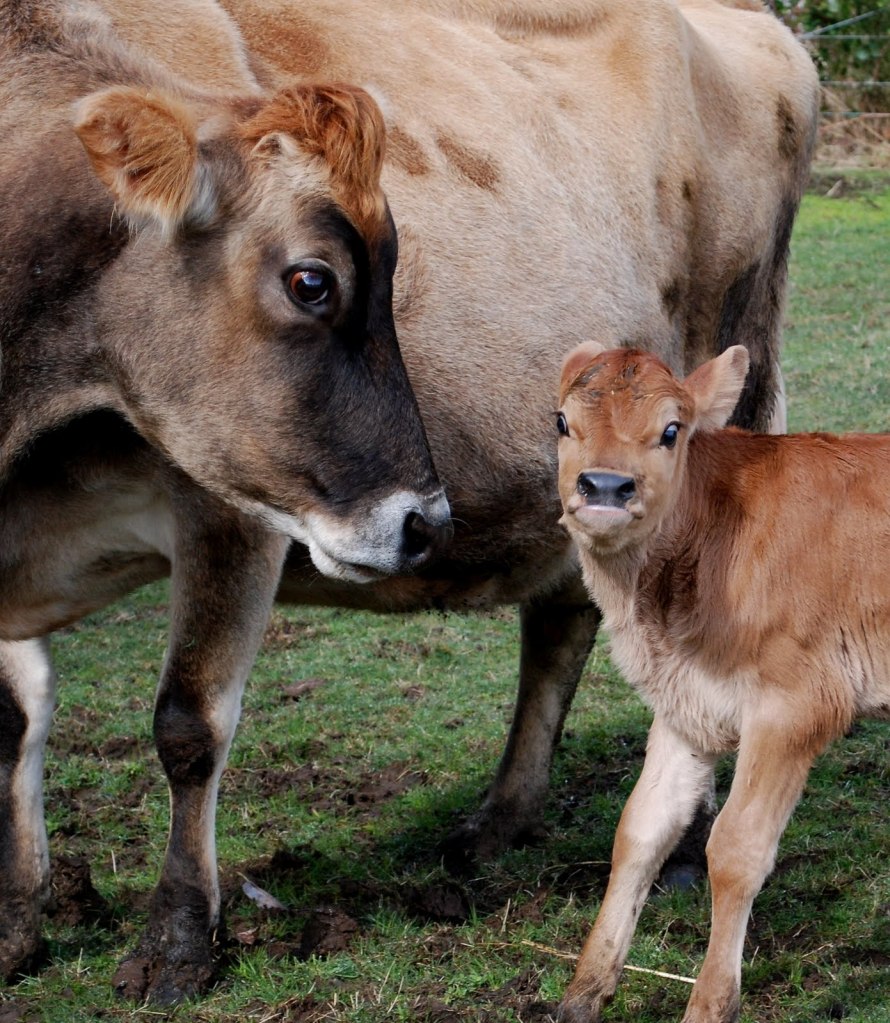
Answer : CALF. The solution required a reinterpretation of the word ‘lower’. Did the image in the top right hand corner give you a hint, or did you not make the connection?

 Our Green Cathedral