“History can be written in Paris,” said President Francois Hollande in November, 2015. Sadly he did not have in mind the terrible coordinated attacks by ISIS, which were unforeseen when he spoke; rather he was referring to the French Revolutions of 1789, 1830, 1848, 1871 and 1968, and the COP21 meeting of world leaders on climate change.
The irony is that in all of those revolutions the critical actions came not from the monarchy, or the presidency, or the Estates General, or the French parliament, but from the streets. Indeed, and in terms of COP21 in particular, one might well ask if the climate crisis can be saved by bureaucrats in long meetings using jargonistic language surrounded by piles of documents and arguing from hidden agendas, without pressure from and the support of the general public, not just in France but globally.
Many revolutions have been motivated by a populace frustrated by the refusal of officialdom to take the lead. In the twentieth century in the United States, for example, there were the Suffragette activists, the civil rights movement and the anti-tobacco campaign, to name a few. In the latter (if one can have a latter of three) just twenty years ago, the predominant wisdom was that the cigarette manufacturers had too much money and too much influence in Washington DC for there to be any real prospect of change. And yet change we did, because men and women in the street voted with their wallets and with their feet.
The move from what the Greeks called chaos (meaningless and formless) to cosmos (ordered and beautiful) is seldom straight forward. The bloodshed and violence that erupted after the calling of the Estates General at Versailles in 1789 was followed by the military ego of Napoleon Bonaparte, an autocracy far worse than the Bourbon monarchy (as were Lenin and Stalin compared to the the Romanovs) who was in turn followed by a restoration of the monarchy, three more republics and a second empire before Charles de Gaulle declared the Fifth Republic in 1958. And yet each of these steps preserved something of value from the previous regime, culminating in the moral code that President Hollande called on as the French responded to the attacks of November 13, 2015.
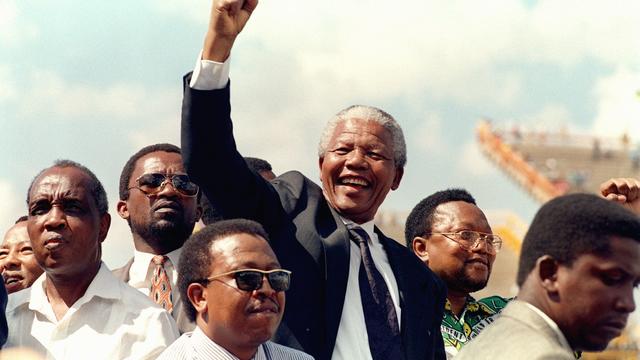
Progress, therefore, is hard to predict. Think back 26 years, to January, 1989, at which time anyone who had the temerity to suggest that the Berlin Wall would come down before the year end without opposition from the East German security forces, or that within five years Nelson Mandela would be released from his cell on Robben Island and would be elected peacefully as President of South Africa, ending officially the police state known as apartheid, would be dismissed as being an unrealistic daydreamer.
It is easy to feel overwhelmed and despondent, yet who can foresee what may might happen in the next five years in the face of persistent remonstration from below?
In terms of climate change, popular activism in this country began in earnest in 1999 when concerned people from across the world blockaded the WTO ministerial meeting in Seattle, and it culminated in the 400 000 person People’s Climate March in New York city in September of 2014 and the formation of the People’s Climate Movement. The bureaucratic response has been for summits to meet in seclusion behind closely guarded doors, which suggests an attempt by the elite to insulate themselves from the masses, and which ironically demonstrates the power that protests have.
Just as oil companies have exerted enormous global power in the climate arena so have agrichemical companies in the field of bionics. It is extraordinary to realize that they know that what they are doing is devastating the environment yet they do it anyway so long as the figures in the balance sheet can be written in black. And we allow it.
Certainly many people are working to change this paradigm through science, education and beekeeping; it’s a heroic age equivalent to those climate activists in the 90’s whose achievements are yet to be fully recognized.
Consider the state of beekeeping just ten years ago. In my experience most local meetings were small, (there were 13 people at the first county association I attended, almost all male and elderly) there was little communications between groups, and there was knowledge of varroa but not an awareness of the devastation it would cause. Certainly the publicity surrounding CCD helped to rouse the general populace to the point that today there are large national and international networked associations, the public is both informed and concerned, association meetings attract some of the best researchers in the world willing to share generously of their expertise, and the greatly expanded bee journals are filled with glossy advertisements for honey bee products.
Looking back at the climate movement there have been some important recent developments. In September, 2016, for example, the California legislature ordered the state’s pension fund, worth almost half a trillion dollars, to divest from coal companies. And the decisive victory of Justin Trudeau’s Liberal Party in Canada represents in part a repudiation of Stephen Harper’s wretched record on climate issues. Hopefully the agreement arrived at in Paris in December, 2015, is one of the biggest landmarks of all, despite the withdrawal of the US in 2017.
But these environmental changes, whether against the escalating use of fossil fuels or the threatened health of honey bees, are unlikely to be maintained by the traditional leadership in isolation. As the harmonious, predictable systems in the biosphere disintegrate, we the beekeepers must be an integral part of the forces that are driving the transition to a more equitable, wholesome world. And we have an advantage. As Clare Densely expressed it in her inspirational presentation at the Pennsylvania State Beekeepers’ Association conference in November of 2015, the public perceives us as “mysterious and magical, practical and skillful, knowledgeable and full of wisdom and inherited folklore. We are gentle, brave, fearless, protectors of the environment and saviors of the planet.”
We cannot change the decisions of the past but an informed and educated public can choose to make different choices in the future. Perhaps the next meeting in Paris to make history will be of associations that are organic in the best sense of the word; they won’t be secret or bureaucratic and they will design a world of which our children will be proud. In the interim we will continue to vote with our wallets and our feet.


