There are an estimated 20-30 million families of insects on the earth at present which is about 85% of all of the world’s species. Many have not yet been given scientific names – in a good year taxonomists describe at most 2,000 insect genera, meaning it will take 10,000 years to name the 20 million species as yet unlabelled.
The 900,000 known insect species, which is three times as many as all other animal species together, are grouped in about 30 orders, depending upon the classification used. The largest order is Coleoptera (beetles) followed by Lepidoptera (moths and butterflies) and Hymenoptera (wasps, ants and bees.)
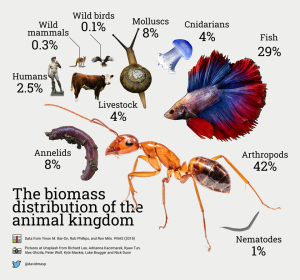
Insects have the largest biomass of the terrestrial animals – at any time there are an estimated 10 quintillion individual insects alive, which works out at more than 200 million insects for each human on the planet, or 300 pounds of insects for every pound of us. By comparison, only about 4 000 of the known animal classifications are mammals, mankind being one of them. There are more species of dragonflies than mammals and almost as many kinds of cockroaches, 9 000 species of birds and almost twice as many categories of butterflies.
Recent research on the loss of flying biomass suggests that the above numbers have reached their peak and are currently declining rapidly, for reasons discussed in a subsequent reflection. Despite this loss we step on thousands of insects every time we walk outdoors; in an oak forest, for example, the number of arthropods* in leaf litter averages 9,759 per square foot and there are more than 425 million soil and litter arthropods per acre in Pennsylvania.
Nor are they confined to the soil. The number of insects floating and flying through the air is phenomenal. P. A. Glick calculated that a cubic mile of air positioned 50 feet above the ground contains an average of 25 million insects and other arthropods. As one wag observed, “If God loves anything (S)he loves insects!”
There are at least 20 000 species of bees across the globe of which 4000 are found in North America. In the harsher northern climes most insects die in the fall, leaving either a queen or eggs to continue the species in the spring. Honey bees of European heritage however, compared to recent African imports, have learned to survive the winter by clustering around stored food sources and maintaining a steady temperature by vibrating their thorax muscles. This gives them a significant advantage in that fully developed adults emerge in the spring ready to take advantage of the first pollen and nectar sources.
I too cluster over winter, not so much physically as mentally. “Winter,” writes Gunther Hauk, “is a time to go inward, to study, reflect and contemplate, deepening our understanding of the Earth’s wonders and our mission on it. This inwardness, trained and practiced at mid-winter’s beckoning, will show its harvest in the months to come, when outward activity challenges our strengthened will, our heightened understanding.”
Strength comes in the quietness and the stillness, light is found in the darkness, renewal is nurtured in the tranquility and energy is stored ready to explode (like the bees) in the spring. It is a time to reflect back, to plan ahead and to begin to access those myriad of ideas that have yet to be named and described.
*Arthropods, which make up the overwhelming majority of insects, are defined by an exoskeleton, a body divided into distinct parts, jointed legs and appendages, and bilateral symmetry.


