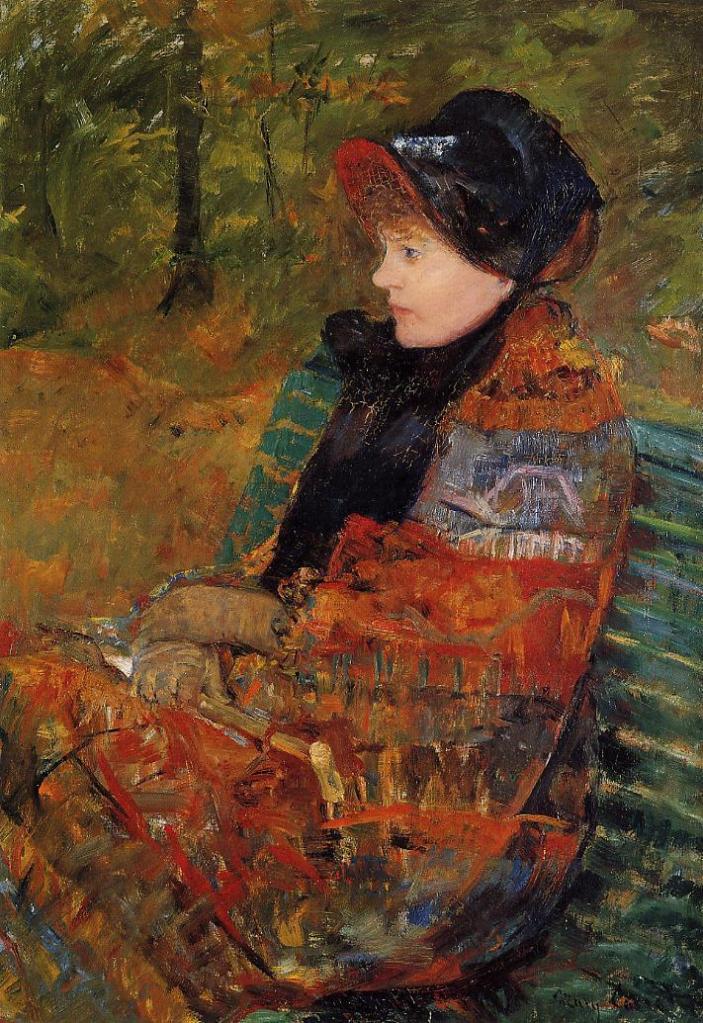
I took the August issue of the Pennsylvania State Beekeepers’ newsletter to read on the train as Mary and I travelled east to see the Mary Cassatt exhibit at the Philadelphia Museum of Art. Cici Sweeney’s highlights of the Golden Age of Beekeeping, emphasized how many innovations occurred in the generation between 1850 and 1875. Langstroth of course, but also Moses Quinby and the redesign of the smoker, Johannes Mehring and wax foundation, Franz Hruschka and the the honey extractor, and Abbé Collin and the queen excluder.
And these inventions were not confined to the US – Mehring was Austrian, Hruschka was Italian of Czech origins, and Abbé Collin was French.
The visit to the Mary Cassatt exhibit was a reminder that something similar was happening in the art world at the same time. Two developments challenged the status quo : the invention of the toothpaste tube and the development of the camera. The first enabled artists to pack their oils in tubes and paint outside in natural light, or en plein air; the second begged the question, if we can now take an instant and accurate photograph of a subject or scene, what is the role of art? These two in combination gave rise to a style characterized by relatively small, thin, yet visible brush strokes, an emphasis on the depiction of light in its changing qualities, in particular how it was reflected by water, and ordinary subject matter which was momentary rather than heroic. The name of the style derives from the title of a Claude Monet work, “Impression, Sunrise,” and was initially used disparagingly.
Mary Cassatt, who was born in Allegheny, PA, but lived most of her life in France, exhibited for the first time at the Paris Salon in 1868. Several years earlier four young painters – Monet, Renoir, Sisley and Bazille – discovered that they shared an interest in painting landscape and contemporary life rather than historical or mythological scenes. Following a practice pioneered by artists such as John Constable in England, they would venture together into the countryside to paint in the open air. By painting in sunlight directly from nature, they developed a lighter and brighter style, which quickly attracted Manet and Pissaro, as well as Cézanne.
During the 1860s, the Salon jury routinely rejected most of the works submitted by Monet and friends in favor of works by artists faithful to the approved style. Such is the typical response to innovation. As one wag said, every revolutionary idea evokes three stages of reaction: “It is completely impossible – don’t waste my time;” “It is possible but it is not worth doing,” and “I said it was a good idea all along.”
By the middle of the 1850’s, Marx and Engel’s The Communist Manifesto had been on the shelves for five years, Florence Nightingale was in the Crimea laying the foundations of modern nursing, Charles Darwin was putting the final touches to The Origins of the Species, and across the Atlantic there was a monumental division between the northern and southern states on the question of slavery that was to result in a five year civil war. Italy, Germany, the Dominion of Canada and the Austrian Hungarian Empire were created, and the Suez Canal was opened. In 1855 in central Africa, David Livingstone, in the course of exposing the horrors of the Arab slave trade, saw the waterfalls on the Zambezi River that he named after his queen, Victoria. Incidentally, a common question asked of school children in the 1950’s, myself included, was, “Who discovered the Victoria Falls?”, the required answer being David Livingstone. Somehow, the African people who had been living there for hundreds of years had managed not to see them …
Moby Dick, Uncle Tom’s Cabin, Leaves of Grass, the first edition of the New York Times, Les Miserables, War and Peace, Crime and Punishment, Alice in Wonderland, Twenty Thousand Leagues Under the Sea and Great Expectations were published. And there were remarkable advances in science and medicine – Alfred Nobel, Joseph Lister, Louis Pasteur, Gregor Mendel and Dimitri Mendeleev, for example.
Surely every era has its critical events, and one can be accused of cherry-picking to suit a preconceived hypothesis, but it seems that the period between 1850 and 1870 was particularly active, not only in the comprehensive range of events – political, social, geographic, medical, art, environmental, human rights, beekeeping – but also in the stature of the people involved and in the revolutionary nature of the issues they addressed – Langstroth, Lincoln, Nightingale, Livingston, Marx and Darwin, Harriet Beecher Stowe, Melville, Whitman, Bismarck, Cavour, Tolstoy, Lewis Carroll, Jules Verne and Charles Dickens,.
How to explain this? An introduction to the Philadelphia exhibition stated that “Cassatt’s professionalism took shape during a period of dramatic social change, driven by industrialization, urbanization, and shifting relations of race, class, gender and sex.” True enough, but why did these particular components come together at this particular time? I don’t know the answer – surely it would make for a good discussion – but it is intriguing and satisfying to realize, first, that relatively small inventions (eg. the toothpaste tube and the camera) can have such long term repercussions unforeseeable in the moment, and secondly, that far from happening in isolation, beekeeping in the mid nineteenth century was an integral part of a paradigm shift in western civilization.
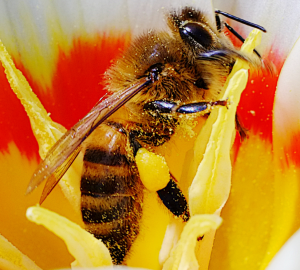
And the Impressionists? In the words of Jackson Arn in the September 28, 2024, issue of The New Yorker, they were ‘simplifying in the interest of intensifying.’ Cézanne, Cassatt, Monet and friends, in the midst of this dramatic social change, ‘discovered a kind of beauty beloved by so many that it became universal.’ Both observations apply to beekeepers : we use honey bees as a way of understanding a complex, intense natural world, the result of which is so beautiful that we cannot resist sharing it at every opportunity. In our current, complex times, where paint and light have been replaced by wi-fi and social media, we yearn for the simplicity that gives us insight, and a universal beauty that overcomes ugliness and hypocrisy. Like the Impressionists, we are able to share the serenity, excitement, symmetry and elegance that we find in honey bees. If only these values, too, could become universal.
 Our Green Cathedral