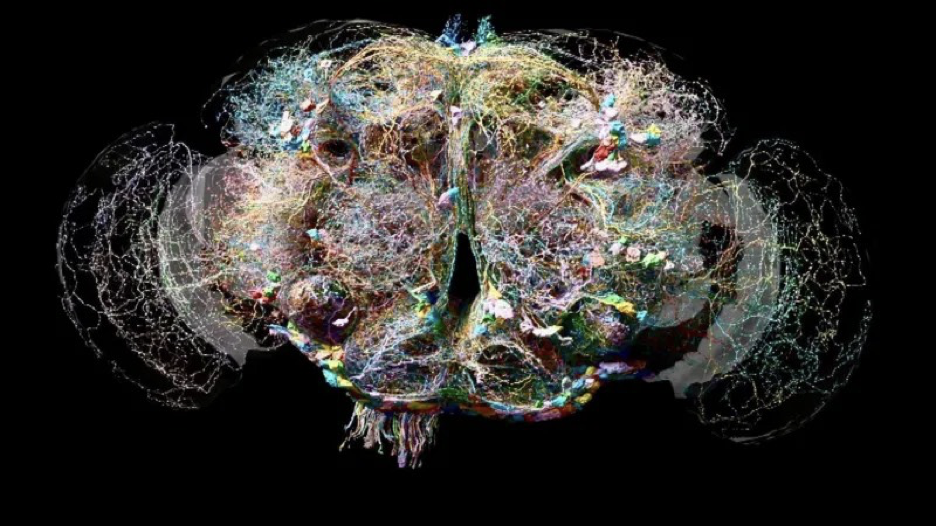
Can you imagine slicing a poppy seed into 7000 pieces, photographing each, and using artificial intelligence to extract the shapes and connections of all the neurons before digitally reassembling them? According to a recent report in the journal Nature, this is what a team from Princeton did with the brain of a fruit fly. And because AI is not perfect, the researchers still had to fix by hand over three million mistakes, for which they recruited a global army of scientists and engineers.
Yet even this technical tour de force was meaningless until there was a description of what each wire was supposed to do, and we’re talking about 140 000 neurons joined together by 50 million connections (compared to 86 billion neurons and trillions of connections in the human brain.)
The images the scientists have produced show a tangle of wiring that is as beautiful as it is complex. Its shape and structure holds the key to explaining how such a tiny organ can carry out so many powerful computational tasks – fruit flies can walk, hover and the males can sing love songs to woo mates, all with a brain that’s tinier than the proverbial sesame seed.
Developing a computer of the equivalent size capable of all these tasks is way beyond the ability of modern science.
Dr Lucia Prieto Godino, a group leader in brain research at the Francis Crick Institute in London, suggests that “Researchers had already completed the connectomes of a simple worm which has 300 wires and a maggot which has three thousand, but having a complete connectome of something with 130,000 wires is an amazing technical feat which paves the way for finding the connectomes for larger brains such as the mouse and maybe in several decades our own.”
A neurologist suggested to me that the reason flies and bees are so difficult to swat is because the physical distance between their eyes, brains and legs are so short that the necessary neuro-signals can be carried between them more quickly than those involved in our swatting. But using this new information, researchers have found that when the vision circuits detect which direction your rolled up newspaper or hive tool is coming from, they pass on the signal to the insect’s legs, but not to all six legs equally. A stronger jumping signal is sent to the legs facing away from the object of their imminent demise. So in one sense they jump away without even having to think – literally faster than the speed of thought.
My hope is that, as the research sheds new light on what one scientist called “the mechanism of thought,” we will understand better how we learn, whether individually or collectively, and thus how we teach. After all it is the latter which almost everyone on this planet experiences in some form at an age when their brains are most receptive. The potential for good is tempered by the fact that, as has happened so often in the past, new scientific discoveries will be manipulated by bad actors for nefarious, selfish, and malicious ends. At the individual level, and according to the 2024 report of the Global State of Scams, victims have paid $1.3 trillion to scammers worldwide in the past 12 months (which is possibly the largest financial crime in world history,) and which averages $3 520 per scam in the US. Or Elon Musk’s stated interest in implanting computer chips in people’s brains that will enable them to control devices with their thoughts. As George Packer writes in the December 2024 issue of The Atlantic, “We succumb to the impulse to escape our humaneness. That urge thrives in the utopian schemes of technologists who want to upload our our minds into computers …”
At the national level, bad actors have allegedly used cyber technology, the internet and AI to interfere in our recent election. Unlike the honey bee, the concerns of the perpetrators are totally selfish and have nothing to do with the common good.
What will be powerful, and not only in bees, is recognizing the interaction between the physicality of the brain and the importance of the social process. Keith Delaplane’s Honey Bee Social Evolution : Group Formation, Behavior and Preeminence, published last month, focuses strongly on the concepts of eusociality (eu in Greek = good.) Eusociality has four traits, whatever the animal involved – cooperative brood care, overlapping generations within a colony of adults, a division of labor into reproductive and non-reproductive groups, and altruistic behavior (unselfish behavior focused on the welfare of the group.) Dr. Delaplane makes the point that the only currency that matters in natural selection is the ability to pass one’s genes to the next generation. “Whereas our species seems to have no compunction against violent enforcement of self-interest, in honey bees, natural selection has moderated the most selfish impulses of workers so that the vast majority settle for less than optimum personal reproduction in favor of supporting their queen.” Thus, along the evolutionary ladder, honey bees sacrificed their ability to raise viable progeny in favor of choosing and raising one bee to fill that role, and then devoting much of their life to caring for her progeny, all in the interests of the greater good.
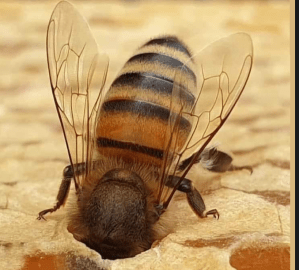
He writes that “It is social processes that drive evolution with inter-functioning themes of cooperation and altruism that are equally applicable to all eusocial species, including ourselves.” Hopefully honey bees are in the hierarchy of animals to have their brains analyzed, precisely because it is a complex eusocial animal with vital lessons for ourselves.
 Our Green Cathedral