This the third in a series of four with the brain as the focus.
Two sentences in David Haskell’s remarkable book, The Song of Trees, invite comparisons with honey bee colonies. “Plant architecture is not a haphazard affair but is the result of constant assessment and adjustment as conditions change … Even though it lacks a nervous system, a tree’s cells are awash in hormones, proteins and signaling molecules whose coordination allows the plant to sense and respond to its surroundings.”
Twigs, for examples, sense the luminosity of their particular location on the tree and grow accordingly. The cells in the breathing spore of a fir tree integrate information about the state of the needle’s internal environment, and open or close the pores to admit either gases or release water vapor.
When such processes run through animal nerves we call them behavior and thought. So is a tree, or a plant, despite its lack of nerve cells, a behaving and thinking creature? Indeed the proteins that vertebrate creatures, including ourselves, use to create the electrical gradients that excite our nerves are closely related to the proteins in plant cells that create similar electrical reactions.
Plants of course have no brain to coordinate these signals, so their thinking is diffuse, located in the connections between cells, even as those connections happen at a rate 20 000 times slower than in a mammal.
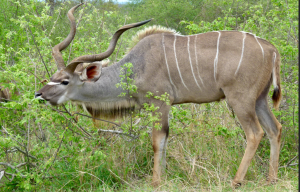
Plants, like honey bees, also remember. When kudu antelope in southern Africa browse on trees, it was noted not only that the trees subsequent growth was heavily defended by unpalatable resins, like a nervous bee that has encountered a spider on a flower, but also that the kudu avoided browsing on adjacent trees in favor of those a little more distant. It was as if the tree under attack had been communicating with its immediate neighbors and giving them time to mount a defense, a response which the tree can ‘remember’ for future such attacks.
Indeed, root tips interact with bacteria (roots provide bacteria with sugars and in turn the bacteria protect the root from attack, buffer it from changes in salt concentrations, and stimulate growth,) and very much in the news of late, with fungi. Nearly ninety percent of all plant species form below-ground units with fungi in which sugars and minerals are exchanged in the form of chemical signals that travel through the fungus, carrying messages about attacking insects and animals, among other things. “A street market” is the analogy Haskell uses to describe the soil.
It it not difficult to substitute bee colony for forest in Haskell’s summary : “It is not just the tree that thinks but the forest. The common life has a mind. To claim that forests ‘think’ is not an anthropomorphism. A forest’s thoughts emerge from a living network of relationships, not from a human-like brain. … A forest’s intelligence therefore emerges from many kinds of interlinked clusters of thought. Nerves and brains are one part, but only one part, of the forest’s mind.”
Individual honey bees have a brain and a nervous system. We talk often of their cognitive abilities – we know they can communicate, remember and change their behavior in response to the environment. A bee hive is a veritable ‘street market.’ Indeed we take it for granted that honey bees can think. In the November issue of ABJ, Tina Sebestyen writes that “Even subclinical levels of DWV in bees can cause impaired cognitive function …,” and Tom Seeley, describing the steps in the evolution of the buzz-run signal, states that “… (the bees) receive the information it provides to improve their decision making.” (My italics.) My guess is that most subscribers of ABJ read these descriptions without giving them a second thought (pun intended.) Indeed honey bees do have a cognitive process, even as Randy Oliver stresses in the December issue of ABJ, “their tiny brains have limited capacity for deep analysis and thinking, much less human concepts of morality.”
According to the American Psychological Association, the term cognition includes all forms of knowing and awareness, such as perceiving, conceiving, remembering, reasoning, judging, imagining, and problem solving, all of which the individual honey bee can do. It is interesting that this definition does not include the word conscious, in that the cognitive behaviors of a bee are innate rather than conscious. Rather than thinking, in the human sense, honey bees respond to information innately in two distinct ways, as explained by Tom Seeley in Piping Hot Bees. The first is via signals which have been refined by natural selection over evolutionary time so that one bee provides another with clear and accurate information. An example would be a bee using the waggle dance to indicate the location of a food source.
The second, and more subtle, is via cues, which provide information incidentally rather than intentionally. An example of a cue is how long it might take a nectar forager to find a receiver bee willing to offload her nectar, which in turn helps her decide whether or not she should perform a waggle dance.
According to Jurgen Tautz, there are essentially three ways to obtain knowledge : instinctual knowledge, embedded in the genome, is inherited; some learning is gained by experience, which can then be communicated. For example, a forager has an innate sense of color (preferring blue and yellow;) can learn from experience as she makes different trips to a floral source, and can then communicate what she has learned via the waggle dance.
Or, slightly more complex, a honey bee does not have an innate knowledge of all possible flower forms; instead she has the ability to learn the visual and olfactory clues that make up a flower’s character. A single experience with a particular odor can be learned, and subsequently used to discriminate against other odors with 90 per cent efficiency. After two or three interactions, the efficiency becomes 100 per cent. Shape and color take a little longer to learn, but together they form the basis of flower fidelity.

So yes, honey bees have cognitive functions and can make decisions, not consciously but by processes honed over millions of years in a social context of cooperation and altruism, qualities that are as vital today as they have ever been as we search for an ethos of solidarity with all organic life, as described so wonderfully by Keith Delaplane in his recent and final publication, Honey Bee Social Evolution.
If individual honey bees have a brain, a nervous system and cognitive functions, the question then arises, what are the equivalents in the superorganism? More next month.
 Our Green Cathedral