Home

That’s the Way I Am

An estimated 50% of new beekeepers discontinue within their first year and a further 25% within the next two years.  Many suggestions have been proffered to reduce this attrition, including mentoring programs and more beginner courses, and yet I wonder if there is something more involved.

We all begin this wonderful pursuit for a variety of reasons, each of them valid, and most who choose not to continue do so in the spring, disillusioned by the loss of the colony or the stress of over-wintering.   Discussions with disenchanted nu-bees suggest a pattern related to Howard Gardner’s Theory of Multiple Intelligences.  Gardner postulates that not only do we have different ways of learning and processing information but these methods are relatively independent of one another, leading to multiple intelligences as opposed to one general intelligence factor, traditionally expressed as IQ, or Intelligence Quotient. 

Traditionally we measure intelligence very narrowly and label people accordingly.  The limitations  of ‘verbal and non-verbal’ intelligence were brought home to me some fifteen years ago by a non-traditional student in a college class.   ‘Joe’ was in his early 30’s and had been advised by his high school that he was not college material because he did not write easily and was not good at mathematics.  He sat in the front of the class, asked if he could record each lesson, and arrived each morning armed with some perceptive and penetrating questions, the like of which I was not used to receiving.   Joe was an audio learner, and as he listened several times to each class after he returned home, these questions would emerge.

I discovered eventually that Joe is a superb guitarist who composes, plays and teaches jazz guitar.   This is a man with superb musical intelligence which had not been recognized at high school.    He discovered and nurtured them by himself, and coming back to college with it’s more traditional emphases was an immense act of courage. I guess we all know stories like this – people who have succeeded in life despite poor performances at school.  We also know those, sadly, who have never  recovered from being labeled at school as ‘failures.’

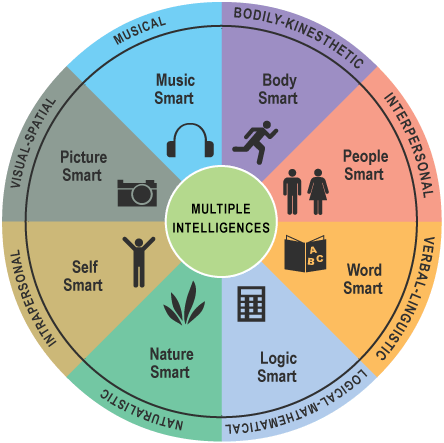
Howard Gardiner has to date identified nine possible modes of intelligence and believes there are many others.  We all have them with one or two being more dominant. 

The first three are the bases of traditional intelligence testing. Logical-mathematical intelligence has to do with numbers and reasoning and is expressed in  recognizing abstract patterns, scientific thinking and investigation and the ability to perform complex calculations.    Linguistic intelligence involves words, spoken or written, and is seen in those who learn best by reading, taking notes, listening to lectures, and by discussing and debating about what they have learned, whereas  spatial intelligence is the ability to visualize with the mind’s eye. Artists, designers and architects come to mind, as do those with a love for jig-saw puzzles. 

The core elements of bodily kinesthetic intelligence are control of one’s physical motions and the capacity to handle objects skillfully.  Such  people learn better by hands on, practical applications and are generally good at physical activities such as sports or dance. 

Musical intelligence has to do with sensitivity to sounds, rhythms and tones, whereas Interpersonal intelligence is one’s empathy with others, in particular a sensitivity to others’ moods, feelings, temperaments and motivations, and the ability to cooperate in order to work as part of a group. Helen Lang, for example, from Baltimore, had no more than a third grade education yet she was a much-loved wise woman who seldom left a grocery store without gently enquiring after the well being, if not the life history, of the lady at the register.  Apparently, before Mary and I were married, she expressed her approval of me by observing that “He has his soul on straight.”

Intrapersonal intelligence, by comparison with interpersonal,  reflects one’s introspective and self-reflective capacities. This refers to having a deep understanding of the self and is conveyed in philosophical and critical thinking. 

Some proponents of multiple intelligence theory proposed spiritual or religious intelligence as a possible additional type. Gardner suggested instead the term existential intelligence, ie. the ability to contemplate phenomena or questions beyond sensory data, such as the infinite and infinitesimal.

Which brings us to naturalistic intelligence, or the nurturing and relating of information to one’s natural surroundings, such as by gardening and farming, and of course keeping honey bees.  Naturalistic intelligence can be observed as much as it can be measured.  Larry Connors has described how, when he first introduces new beekeepers to a working hive, some lean in and others lean away.  It is the former, he suggests, who will succeed long term.   The intimation is that this latter group has a dominant naturalistic intelligence which  is unfailingly curious to anything involving the natural world. When people come to visit Mary and I, most walk into the house and settle around the kitchen table.  There are a few, a distinct minority, who insist on going outside, walking around the garden, even asking if they can see the hives.   Only then can they relax and come inside.  They have a naturalistic intelligence that needs to be satisfied.

Schools focus primarily on linguistic and logical-mathematical intelligence and as a culture we esteem those who are highly articulate or logical. Dr. Gardner maintains that we need to give equal recognition to those who show gifts in the other intelligences: the artists, architects, musicians, naturalists, designers, dancers, therapists and entrepreneurs who enrich our world. Unfortunately, many children who have these gifts do not receive much validation in school and,  when their ways of thinking and learning are not addressed in a linguistic or logical-mathematical classroom,  are labeled “learning disabled”.

Is this perhaps why so few children appear to be interested in beekeeping, that they do not feel it is acknowledged or rewarded in schools as important?  Certainly several attempts to place observation hives in the science rooms of local schools have not been successful whereas several families who have installed a honey bee colony have made it  an integral part of their home school program, wherein the curriculum is broader and more individualized than that of most public schools.  I think in particular of one family who, studying Russia when the bees arrived, invited the three children to name the queens after different Czarinas and to research both the historical and apian rulers.

It might also explain why many people come to beekeeping at a time in life when they realized for themselves their specific interests and talents, as well as what brings joy and fulfillment to their lives, especially when that enjoyment comes outside of the mainstream of ’normal’ life styles. 

My guess is that we can each see in ourselves combinations of these nine traits. I have  various degrees of linguistic, bodily kinesthetic, intrapersonal, existential and naturalistic intelligences, but poor logical-mathematical, interpersonal and spatial intelligences, and Van Gogh’s ear for music. Try as I might I cannot learn a musical instrument, cannot read music, and if given the choice, would rather listen to a talk show on the car radio, no matter how bad, than a musical program, no matter how good.  For a long time I blamed myself as somehow incompetent; now I accept that it’s the way I am wired, and I focus on what I can do  rather than bemoan what I cannot. Thus I’m OK with the fact that I would rather send e-mails than make telephone calls, and if it has to be the latter, to keep them as short as possible.  Mary is the exact opposite, and the monthly statements of our respective cell phones reflect it.  

I have used previously the image of an expanding jigsaw puzzle with an apparently limitless number of pieces that will never quite come together completely.  Glimpsing the bigger picture is a challenge to, and a reward for, my specific combination of traits;   it brings joy, which in turn stimulates motivation and perseverance. In the equation promoted by Harrison Owen, the creator of Open Space Technology, motivation = passion + responsibility.

The frustrations of those wannabees who decide not to continue with keeping bees are understandable.  Like me with the piano and guitar, they began with the best of intentions, they dearly want it to work, but what to others are challenges that lead to a sense of achievement are to them obstacles that prove frustrating and debilitating, and beekeeping becomes a trial to be endured rather than a source of constant delight.  I keep leaning in, and respect those who need to pull away. 
The Powers of Imagination

To paraphrase the preamble in the March/April, 2015, issue of Orion, written by H. Emerson Blake, we cannot fly like honey bees. We cannot sense or savor the world as they do; we kill other species, and our own, more indiscriminately than do bees; we foul and savage the planet more than does any order of insects.  Pollinators of all species are rearing their next generations to continue their genome as extensively as possible while, at the same time, creating the succeeding crop of plants that will provide the resources for the new wave of their extended family.

Yet we have one thing, one incredible gift, that, as far as we know, they do not – imagination.  

Call it what you will – creativity,  vision, inspiration, inventiveness, resourcefulness, ingenuity; originality, innovation – imagination is associated primarily with, but not confined to, the arts, using storytelling, literature, painting, sculpting, music, dance, theater and craft as means of both expression and renewal.  Where do most bee books begin?  With pictures of neolithic paintings on rock walls in caves in India and Spain of men collecting honey using ladders and baskets high off the ground.  Life 10 000 years ago was hard – very hard – and existence uncertain, yet it was important for these Iron Age souls to express themselves artistically in an attempt to make sense of what it meant to be in the world. 

Today almost every fact a child needs to know can be found  on the internet.  So what do we teach at school?   Certainly there is a knowledge base that is important, but do we assess critically just what facts need to be part of that base?   In the early 1950’s a committee of educators, chaired by Benjamin Bloom, devised what has become known as Bloom’s Taxonomy, which emphasized the importance of being able to analyze, synthesize, evaluate and apply information, rather than merely understand and regurgitate it.  And the indication of a good education is when innovation, inspiration and vision happen instinctively.   “Creativity is just connecting things,” argued the late Steve Jobs.   “When you ask creative people how they did something, they feel a little guilty because they didn’t really do it, they just saw something. It seemed obvious to them after a while. That’s because they were able to connect experiences they’ve had and synthesize new things.”  That last sentence is also not a bad description of the scientific process, with the proviso that the synthesis be tested, retested and proven according to accepted norms.

Creativity is more than an outlet for emotion, important as that is.    It is also the way that we attune ourselves to our surroundings,  that we realize our potential to adapt and change as required by our environment. “Poetry is all about freedom,” writes the British poet, David Whyte.  “Not the freedom from things but the freedom to be completely in the experience, and therefore to change your perspectives on that experience completely, and to actually allow yourself to be somebody new in that discovery. Poetry is the art of letting yourself say things you didn’t know you knew.”

Read those last two  sentences from David White again, this time with your honey bee activities in mind.  And then do the same with these words from Deepak Chokra : “Enlightened leadership is spiritual if we understand spirituality not as some kind of religious dogma or ideology but as the domain of awareness where we experience values like truth, goodness, beauty, love and compassion, and also intuition, creativity, insight and focused attention.”

The Eastern Apicultural Society  meeting in Guelph, Ontario, in 2015 was a thought-provoking experience. After hours of research-based lectures, each with imposing power point slides, my notes covered less than two pages.  Perhaps I am at the point in my growth as a beekeeper where extensive listening is needed to unearth those vital nuggets that enlarge or change my perception.   Each one of those gems comes in a larger context, connects with what I already know, and creates a larger truth with enhanced compassion and love for the amazing world of the honey bee.

The second gift from those four days in Guelph was the discussions around the breakfast table, or on the bus, or at the book-signing table, with people like Les Eccles, Phil Craft and Mark Winston, when the language and the topics were more personal, more directly relevant to my needs in my apiary.

The key to managing honey bees is to have the imagination  to make the connections between our observations and our reading, our senses and our knowledge, and to “…experience values like truth, goodness, beauty, love and compassion, and also intuition, creativity, insight and focused attention.”  Indeed everything one finds in a  great work of art. 

/

Go to your fields and gardens

And you shall learn it is the pleasure of the bee

To gather honey of the flower.

But it is the pleasure of the flower

To yield its honey to the bee.

For to the bee a flower is the fountain of life.

And to the flower, a bee is a messenger of love.

                                                                Kahil Gibran, The Prophet, 1923.

Bee v Beetle

At Frankfurt Motor Show in 2009 Volkswagen unveiled its L1 model with an  estimated 170 miles per gallon.  The light chassis (it weighed 837 lbs) with a one cylinder yet surprisingly powerful diesel engine could cover 416 miles on one fill-up of its 2.6-gallon fuel tank “if the driver has a foot as light as a moonbeam,”  one of the reviewers wrote.    German engineers were justly proud of what they alleged to be a level of fuel efficiency never seen before in the auto world.  

The ordinary honey bee, by comparison, can convert fuel with an efficiency that might humble the wizards at Volkswagen.  In 1957, Brian Hocking, an English entomologist who was an associate professor at the University of Alberta in Canada, set out to calculate Bee Miles Per Gallon. He gave a beeall the honey she could eat before tethering her to a pole which, he alleged, neither harmed nor seemed to disturb her. She flew round and round until she ran out of fuel. It was not difficult to calculate how far the bee traveled on a belly of fuel and then to scale up to an imagined gallon-sized fuel tank.

Hocking died in 1974 but his experiment was repeated by the entomologist, Stephen Buchmann, at the University of Arizona.  Buchmann, who is the author of eleven books including The Forgotten Pollinators and The Reason for Flowers, has called bees “the ultimate hybrid mini-vehicles.” Millions of years of evolution have produced muscles across the animal kingdom that are consistently more energy efficient than even the best human-built machines, he suggests,  but until he came across Hocking’s data, he did not realize how much more efficient.

Buchmann concluded that on one sip of honey, our bee could fly continuously for approximately 5 miles; on a full stomach of honey, 50 miles.  And when he scaled up bee fuel intake to a gallon, he came up with an astonishing number – almost 5 000 000 miles.

In all transparency one has to point out differences of size, weight and durability but, said Buchmann, “that does not negate the fact that honeybees are super, super efficient, far more efficient than any kind of internal combustion engine that human engineers have ever devised. So yes, we’re cheating a little bit, but if you want to think in terms of miles per gallon, no denying it: She got almost 5 million miles per gallon. Pretty darn impressive.”

Meanwhile what happened to the Volkswagen LI, later the XLI?  As best I could find out, the last limited production of 200 cars was in 2014 and they were primarily electric, but the mileage was no better (they were two seaters with a bigger engine) and the price was in excess of $120 000. 

I think I will stick with the Honey Bee over the VW Beetle.  

Slovenia, Cebeljnaks and the Carniolan Bee

Western Slovenia

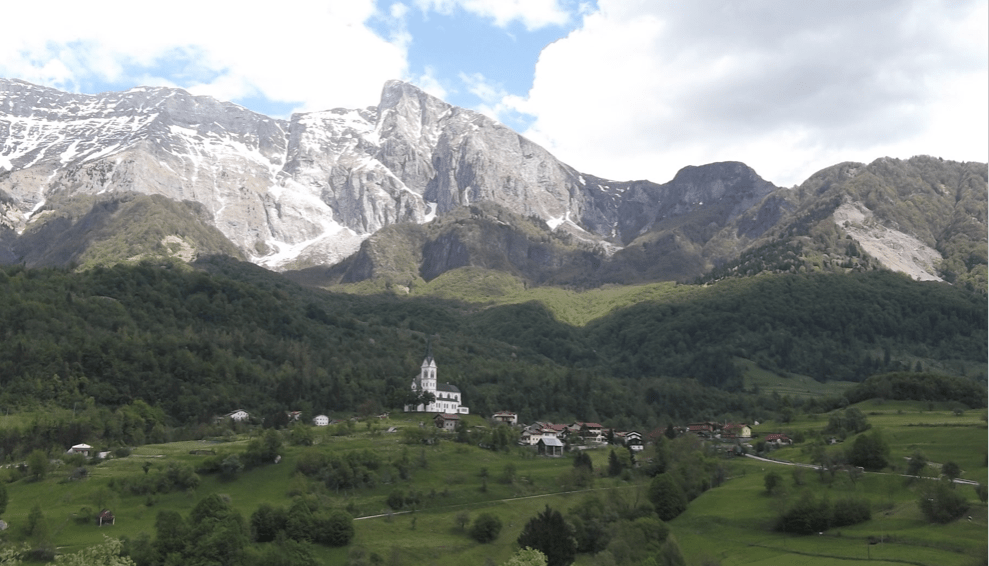
For my 70th birthday I got to choose where we would vacation and decided on Slovenia, in part because it has an ancient tradition of beekeeping and in part because it has the highest ratio of beekeepers per population of any county in the world. One out of every 210 Slovenians is a beekeeper, compared to 1:3250  in the US and  1:4100 in Pennsylvania. In other words the density of beekeepers is almost sixteen times greater in Slovenia than in the US, and beekeeping is an integral part of both the landscape and the culture. This was made evident by an area map at a bus stop in a small village in the foothills of the Alps, the legend of which included a symbol to show where local beekeepers and their products could be found within a twenty kilometer radius of the hamlet.  One of the reasons offered as explanation is that the Austro-Hungarian Empire, of which Slovenia was a part (or the Duchy of Carniola as it was then known) was never a colonial power, never had sugar plantations nor a cheap supply of sugar, and so preserved a long relationship with honey.

We spent a morning with Marija Sivez and her husband Dusan Zunke who, between them, run 500 colonies (or ‘families’ as they are called in Slovenia.) Over a delightful lunch that she had prepared for us, Marija explained a little of the country’s recent history in the following way : her grandparents were born in the Austro-Hungarian Empire and her parents in the new Yugoslavia that was created after the First World War.  She and Dusan were born in the Second World War when Yugoslavia was occupied by the Axis powers, and because she was born in the western region, and he in the east, she had to learn Italian and acquire an Italian name, and he similarly but in German.  Her children were born in communist Yugoslavia, ruled by Josep Tito, and her grandchildren in the new independent republic of Slovenia created in 1993 which, in 2004, became part of the European Union. 

So it is not all that rare for an elderly Slovenian to have lived in six different countries in his or her lifetime without every having to leave the village of his or her birth.

Incidentally, at the Slovenian Beekeeping Center, the Secretary General, Anton Tometz,  described with much pride how, despite the turmoil of the past century, beekeepers had kept in constant contact with their colleagues throughout Europe. 

Two of the intriguing concepts were bee-air therapy and apitourism. The first is the belief that the environment produced in a bee hive is therapeutic and can be accessed via a variety of devices by which one can inhale the emissions of a colony.  Certainly, one of our traveling companions, after only a few minutes of such intake, awoke next morning to find that, for the first time on the trip,  her sinuses were clear. One of the missions of Franz Sivic, perhaps the leading apitherapist researcher in both Italy and Slovenia, is to find scientific support for these phenomena, beginning with having all experiments and operations monitored by medical doctors who administer both pre and post tests. 

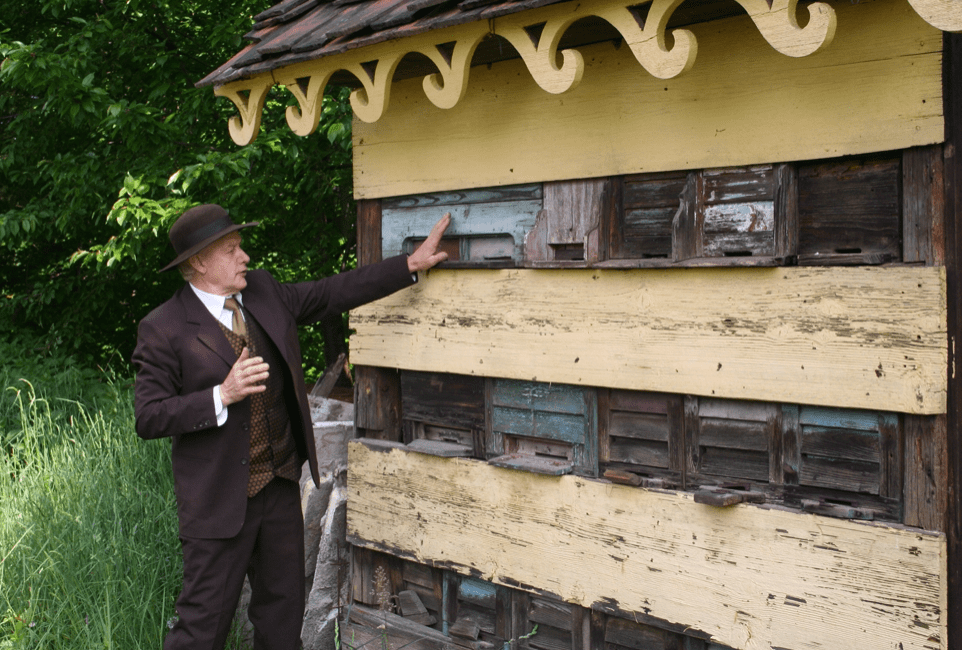
The second involves using beekeeping and the products of the hive to promote tourism.  The beautiful painted bee houses (cebeljnaks, pronounced chebelnyaks) ) were omnipresent, as were road side signs selling med (ie. honey) and attractive displays in stores promoting honey bee products, including medica (fortified mead, pronounced medusa.) 

The Slovenian Honey Bee Center

The focus of much of this activity is the Čebelarska zveza Slovenije, or Slovenian Beekeeping Association, a comprehensive organization centered in an impressive four story building alongside one of the major highways east of the capital, Ljubjlana. There are 16 employees, three of whom are full time – the President, Vice-President and Secretary General.  It was the latter, Anton Tometz, who gave up his morning for us, sharing his knowledge and passion for Carniolan bees through the good auspices of our guide and translator, Janez (pronounced Janie) Strasizar.

The first records of beekeeping in the Duchy of Carniola, now Slovenia, go back to the 10th century, the national current organization was founded in 1873 and the new headquarters were opened in 2008.     The 5000 square meter, three story building sits on the hilltop of a large acreage with gardens that demonstrate active hives as well as bee forage.  The library, with its 3500 books and journals, all of which were donated and most are digitalized, as well as the restaurant, beekeeping shop, reception area and office space, were 80% self-funded, primarily by dues from membership – annual dues are 40€ per annum, which is about $45.  To put this in perspective, the average annual income in Slovenia is the equivalent of $20 000, less than half of that of the USA.  The state helps with maintenance and running costs of the property in return for a share of the nectar flow information which comes from the more than 40 stations based in apiaries throughout the country.

The objectives, as described by Secretary General Tometz, (and I’m relying on Mary’s notes here because the web page is not available in English) are to advise and educate Slovenian beekeepers and to promote positive public relations for beekeeping, not least through apitourism and apitherapy.  The challenges facing the association are no different to those in the US : declining natural resources as the number of bees increase, varroa and it’s associated pathogens and diseases, and the effect of toxic sprays on honey bees. 

There are 400 native bees and 325 bumble bee species in Slovenia, and the emphasis is on preserving the integrity of  Kranjska Cebela – the Carniolan, or grey, or silver honey bee, which is native to the area and is the second most popular bee in the world, second to Italians.  It is the only bee that Slovenian beekeepers are allowed to keep, nor is any other type of bee allowed into the country.  This leads to interesting dilemmas.  One beekeeper we visited has a major apiary in the foothills of the Alps, very close to the Italian border.  Her queens are open-mated and she cannot control where they fly, nor are they respectful of international borders.  So progeny that have a light appearance are sold in Italy, and those with the Carniolan darker features go to Slovenian or German beekeepers!

The Carniolan Honey Bee

The average age of a beekeeper in Slovenia is 58, compared to a national average age of 51, but Anton stressed that a number of younger Slovenians were getting involved in leadership roles.  And there are plenty of such roles available with 207 local beekeeping organizations (literally one per town) in a country the size of New Jersey and a total population of only 2.1 million.  There are about ten commercial beekeepers, two of whom are women  (‘commercial’ meaning having more than 150 hives) and  the largest operation is some 2500 hives.  These figures might be misleading in that the registration of hives is mandatory but free, and there is a tax of  2.50€ on every colony after the first 40, so beekeepers register any colonies over 40 with neighbors and family so as to avoid the taxes. 

The cost of a Carniolan queen is similar to the price of a queen in Pennsylvania, the average honey production is about 40 pounds per colony,  but the price of honey is only about half of what we get in the US.

Franz Hauser in the traditoinal beekeeper’s costume with an old Cebeljnak

Also impressive was the strong focus on children.  The  Beekeeping Association offers three day beekeeping camps throughout the summer, which attract some 2500 children every year. Over those three days they study pollinator plants, paint the attractive front boards that distinguish each hive, and make products from wax and propolis. 

The energy and enthusiasm in that building was evident and contagious, as was the professional level of leadership, and my recurring thought was, how can a country that is so relatively small, with a population equivalent to that of New Hampshire, think so big?  And this is despite the traumatic, unsettled history of the last century.  It is no coincidence that a study out of Yale placed Slovenia in the top five environmentally successful countries in the world, and the capital, Ljubjlana, was the green capital of Europe in 2016.  

If they can do it – apitherapy,  apitourism, extensive beekeeping, professional organization, education of the young – with relatively limited resources, why can’t we, who have so much by comparison? Perhaps it says something about the priority they place on the environment, the bees, and honey as a food source, as well as their pride in their agricultural traditions and in being self-sufficient (almost every urban home we walked past had a vegetable garden and chickens.) 

Perhaps their philosophy is summed up in one delightful tradition.  Slovenia is home of the famous Lippizaner horses, and every time a foal is born a tree is planted. In this modest way the cycles and interdependence of life are honored. 

Despite this turbulent past, or perhaps because of it, we found the people of this beautiful country to be proud, gentle, kind and generous to a fault.  It is almost as if the present age of peace and relative prosperity is appreciated all the more because of the tumultuous times that preceded it.  And this is expressed in the absolute cleanliness and quietness of the countryside,  qualities that were reinforced on a walk along a gravel path to a waterfall when I saw a discarded cigarette butt and found myself feeling outraged, even violated. 

Like many millions of people I have had my fair share of pain, failure and losses in my life.  As a twenty year old I imagined working, retiring, and eventually dying, in the country in which I had grown up.  I did not anticipate, for example, having to leave in the middle of a civil war and eventually working in five countries on three different continents.  But I did, and in retrospect I see it as a rare opportunity.   Like many Slovenians, I now treasure and seek kindness, gentility and generosity in contrast to the turmoil and upheaval of earlier life events. 

In his book, Second Wind : Navigating the Passage to a Slower, Deeper and More Connected Life,  Dr. Bill Thomas draws a distinction between adulthood and elderhood.  In contrast to “the mania for adultish independence and achievement,” elders have a life experience and an awareness of their own mortality that provides wisdom, serenity and an ability not only to be at peace with themselves but also the skill to be peacemakers among others. 

Thomas suggests there are three perspectives as one approaches the end of adulthood. The first, and most vociferous, are the Deniers who proudly reject the changes that come with aging and posit a future where one can be forever young. Secondly are the Realists who admit they are changing but dislike the process and are committed to resisting them.  The third and smallest group are the Enthusiasts who openly acknowledge the difficulties that lie ahead but are eager to explore the new opportunities for growth that the passage of time provides. 

Can this perspectives apply to a country and to honey bees?   If so, perhaps what Mary and I experienced in Slovenia was a culture of Enthusiasm in which the painful past is accepted, current difficulties are accepted and there is an excitement about the future.  And without wanting to be overly anthropomorphic, my guess is that most animals, insects and birds, including honey bees, live fully in the present (it has been suggested, for example, that for a dog there is no such thing as a good or a bad walk) and in so doing nourish the longevity of the species. 

Certainly the three perspectives – Denial, Realism and Enthusiasm – provide the necessary paradigms as I start my eighth decade of life, together with a determination to be consciously more of a grateful Enthusiast.  The honey bees  are an essential part of that determination, whether as an example, a comfort or an inspiration.

Our Patron Saints

Most of mankind’s noble endeavors have a patron saint, a man or woman who lived a long time ago and achieved notoriety often by torture and death.  St. Barbara, for example, lived in Egypt in the fourth century AD  and was decapitated by her father when she refused to denounce Christianity, after which daddy, sword and all, was laid waste by a bolt of lightening.  Barbara, naturally, became the patron saint of explosions involving gun powder, of which, in the early days of firearms, there were many, presumably keeping her very busy.

A century earlier, also in Egypt, a mob seized Apollonia because of her position as a Christian Deaconess. She was tortured, had all her teeth pulled out one by one with pincers, and when given the choice of renouncing her faith or being burned alive, leapt into the fire and was burnt to death.  Predictably she is the patron saint of dentistry.

I will never be a candidate for sainthood, either willingly or unwillingly, even if bees are frequently associated with such posthumous honors.   In C15th Italy, for example, the day after baby Rita was baptized, her family noticed a swarm of white bees flying around her as she slept in her crib. The  bees peacefully entered and exited her mouth without causing either harm or injury, which left her family understandably mystified.  This did not prevent them for arranging her marriage to an abusive nobleman when she was twelve years old.  St. Rita is the  patron saint of impossible causes.

Beekeepers have several saints to watch over us and to whom we can appeal. The legend in Milan, Italy, is that in the 3rd century, when Ambrose was an infant, a swarm of bees settled on his face while he was lying in his cradle and rather than stinging him, they left behind a drop of honey. His father declared this to be a sign that Ambrose would become a sweet-tongued preacher of great significance; indeed he was to gain the title “Honey Tongued Doctor” because of his speaking and preaching ability, and bees and a beehive became his symbols.  Perhaps it was from this that bees are often associated with wisdom and learning.

The Catholic Encyclopedia describes him as having an “enthusiastic love of virginity which became his distinguishing trait.”  Indeed he wrote, ” Let, then, your work be as it were a honeycomb, for virginity is fit to be compared to bees, so laborious is it, so modest, so continent. The bee feeds on dew, it knows no marriage couch, it makes honey….”  

This was at a time when the mating procedure of the ‘king bee’ (as the queen was known)  was unknown.  For some,  bees were the smallest of birds, born either from the bodies of oxen or from the decaying flesh of slaughtered calves in the form of worms which formed in the flesh and turned into bees. For others, baby bees were the result  of some form of mysterious virgin birth, which gave them both a purity and a spiritual significance, hence in part the use of bees wax for candles in Christian church services.   St. Ambrose is the patron of candle makers, chandlers, domestic animals, learning, school children, wax melters, wax refiners, but not virgins,  and unlike many of his fellow saints, died peacefully in his old age.

There are many beautifully carved life sized hives in the shape of St. Ambrose in eastern Europe, with a cavity in the middle for the bees, entrances via a small hole in the front, and access via a door in the back.  Brightly painted, they formed an inviting avenue as one approached the conference center in Montpellier, France, where Apimondia  was held in 2009.

Gobnait, by comparison,  was born in County Clare, Ireland, sometime in the 5th or 6th century. Gobnait is Irish for Abigail (meaning “Brings Joy”) and has been anglicized as Deborah, meaning “Honey Bee.”

One of the miracles attributed to Saint Gobnait was that she protected a parish by unleashing a swarm of bees, and she was known for her care of the sick, using the properties of honey in the treatment of illness and the healing of wounds.  She founded a convent and was reputed to be a skilled bee-keeper and,  according to local tradition and history, she cured the ailments of her own monastic community and the people of West Cork. Reputedly she kept a terrible plague away from Coolea and Ballyvourney and changed a colony of bees into an army to drive away a local marauding chieftain.  Now there’s a talent I could use.

Interestingly, on the island of  Mont St. Michel off of the west coast of Ireland,  the small stone huts in which monks lived for several hundreds of years while vandals invaded Britain, were build in the shape of skeps.   Mary and I were able to visit them some years ago and it is one of those places that makes the hairs on the nape of one’s neck stand on end.

Other saints are well represented. In France, Saint Bernard of Clairveaux, a 12th century abbot,  is listed as a patron of beekeeping and workers of wax, again for no apparent reason. Maybe he just wanted a candle discount.  St. Gregory was responsible for opening the flowers on March 12th and nine days  later, on March 21st, St. Benedict summoned the bees to search for nectar. According to legend, St. Bartholomew was martyred by being flayed alive and because of this fate he became the patron saint of tanners. But for many in the UK  he is also the patron saint of beekeepers, probably because his feast day, August 24th , coincides with the gathering of the honey crop. Indeed, until the 1950s, the village of Gulval in Cornwall celebrated St. Bartholomew’s Day with a ceremony for Blessing the Mead, while the annual St. Bartholomew’s Fair in London was famous for its honey-coated apples.

The Catholic Church has strong links with bees. The monks were fine beekeepers, providing honey for sweetening, not least to make herbal remedies more palatable, producing wax for the alter that burned without smoke, making mead for communion wine, and providing propoplis for use in the sanatorium. The late Brother Adam of Buckfast Abbey is renown for his work in selecting traits from global resources for a better bee. 

And bees were believed to be the souls of the dead returning to earth or on their way to the next world. This probably led to the widespread custom of “telling the bees” when the beekeeper died, a tradition that was prevalent in Pennsylvania. If the bees were not asked to stay with their new master or mistress it was believed they would abscond.

Beekeepers seem to have as many patron saints as they do answers to questions concerning the bees.

Glacier National Park

The power and the majesty of Glacier National Park were both invigorating and exhilarating  when Mary and I were fortunate to visit for two days in July, 2012.   In part the amazement came from the preconception created by the term ‘glacier’, which suggests icy, frigid, arctic-like.  Instead the Park in summer is warm, green, verdant and inviting, rich with waterfalls and colors, hidden lakes and enchanting trails, magnificent vistas and feats of human engineering.  Rather than chilling the spirit, Glacier National Park warms the soul.

You know that I looked for honey bees throughout the park, without success.  I also googled beekeeping associations in the nearby towns of Whitefish and Kalispell, equally unsuccessfully.

Timothy Egan‘s book, The Big Burn, which describes the first major wild fire involving a national park, presented itself instead.  As in 2012, the summer of 1910 was excessively hot and dry, resulting in dry vegetation which was set alight by lightening and by hot cinders flung from locomotives.  By mid-August there were 1,000 to 3,000 fires burning in Idaho, Montana, Washington and British Columbia, covering some three million acres which burned over two days and led to the deaths of 87 people, including 78 firefighters. It is believed to be the largest, although not the deadliest, fire in recorded U.S. history.  By comparison, the California wild fires of 2017 destroyed just over one million acres.

A system of national parks had been the dream of President Theodore Roosevelt, supported by his chief forester, Gifford Pinchot.   The national forests, they argued, belonged to the ages. The proposal inspired immense opposition from the mining and agricultural industries in particular, castigated by Roosevelt as ‘robber barons and plunderers of the public domain’  who used their considerable influences to solicit support in Washington.  By the time of the great fire the forestry budget had been squeezed so tight that on average a single ranger was responsible for more than three hundred thousand acres of forest. 

The creation of the National Parks Service in 1905 attracted some of the best young minds in the country, fresh out of the Yale School of Forestry (derisively called ‘Teddy’s Boy Scouts’) but no one had anticipated or experienced a fire such as that of 1910 and neither the rangers nor anyone else knew how to control it, which in turn gave further fuel to the mining and agricultural industries who argued that academia was no preparation for the realities of  environmental conservation and preservation.  To the enemies of the Forest Service the fire was a chance to kill the crusade of conservation, made easier by the fact that the previous year Roosevelt had left office to go to Africa and Europe, leaving the presidency in the hands of the befuddled William Taft. 

The battle seemed to be won, but fast forward to July, 2012, and the lines of vehicles waiting at the gate to pay $25 to enter Glacier National Park.   The occupants of those cars, trucks, motor bikes and camper vans presumably took the existence of the park for granted, not realizing that this magnificence exists only because a handful of men and women persevered with their passion in the face of significant hostility which thought in terms of dollars rather than of nature, which measured short term financial gains at the expense of long term environmental losses. 

Fast forward another 100 years to 2112 and I wonder what ideas that appear radical today will seem obvious in retrospect because a small handful of people believed in them sufficiently to fight and persevere.   Hopefully honey bees will be on that list. 

The Pursuit of Sustainable Happiness

March 20 is the United Nations International Day of Happiness.   UN Secretary-General, Ban Ki-moon, observed that “The pursuit of sustainable happiness (a term I equate with Archbishop Desmond Tutu’s use of the word joy) is serious business.”Keshav Shiwakoti is more explicit.  A former communist revolutionary from a small village in the high mountains of eastern Nepal, he was one of seven children who grew up in stark poverty. He moved to Kathmandu in search of employment, learned English and became a high-end cook specializing in European cuisine. “The small, fleeting moments make me happy,” he said, “like the child I just saw on the street being breast-fed by her mother, or watching my baby goats play. It’s the joy in sunshine or rain. Sometimes I cry because I feel such great happiness.”

Sarah van Gelder, writing  in Sustainable Happiness : Live Simply, Live Well, Make A Difference, stresses that there is confusion as to what sustainable happiness looks like, sounds like and feels like, at least here in the USA.  In the 1920’s business leaders worried that Americans had all the appliances and consumer goods they wanted and that if they spent time enjoying life rather than working more and buying more, the economy would stagnate.  Thus the advertising industry joined forces with Freudian psychologists to link our universal desires for status, love and self esteem with the new gospel of consumerism.  

The postwar period was considered an economic success – growth as measured by GDP rose steadily and the gap between rich and poor diminished.  But in the 1970’s wages stagnated and purchasing power diminished.  The result was the inception of credit cards so that consumers could spend money they did not have to keep the economy  moving.  But buying ‘stuff’ has consequences. There is the burden of debt that goes with a bigger house or a new car, the ‘buyer’s high’ (that initial exuberance that follows a big purchase, spikes and then disappears, but which can be addictive) and the extra work hours needed to pay off the debt with less time for friends and family. 

Advertisers tell us unrelentingly that shangri-la is one purchase way – plastic surgery, anti-depressants, a holiday home.  Yet for the majority of the population, on limited incomes, the implication is that happiness is out of reach, that they are falling short of the good life, and that somehow it is their fault.  

It needs to be stressed that the internet has created a historically unique situation. Never before has there been such easy, uncontrolled, unlimited access to so many different products and opinions; never before have marketeers, as well as zealots, had access to such an audience.   And as the story of Facebook and Cambridge Analytica demonstrate, never before has there been such an opportunity for massive abuse of personal data.  Perhaps the greatest challenge facing the West, in combination with potentially catastrophic climate change, is the recovery of enlightened values in the face of rampant technological advances driven more by profit than by civility. Ironically one of the most eloquent spokesperson for such a recovery is Monica Lewinsky in a TED talk titled The Price of Shame.

“Through our scientific and technological genius,” argued Martin Luther King Jr,  “we have made of this world a neighborhood and yet we have not had the ethical commitment to make of it a brotherhood. But somehow, and in some way, we have got to do this. We must all learn to live together as brothers or we will all perish together as fools.” 

Van Gelder suggests that sustainable happiness is built on two pillars – a vibrant and fair society and a healthy natural world. It endures through good times and bad because it starts with the fundamental aspirations of being human.  It cannot come from a quick fix and it cannot be achieved at the expense of others.  It is available to everyone and because it begins by assuring that each of us can obtain a basic level of material security, after which more ‘stuff’ is not the key,  it does not have to cost the planet. 

And let’s understand that Facebook does not build community; indeed a 2014 study of American college students showed that their level of empathy was on average 40% lower than their peers of the previous generation. Instead joy, ie. sustainable happiness,  comes from loving relationships, thriving communities and meaningful work, which in turn stimulate positive emotions like love, gratitude, respect and appreciation.  These are hardly new objectives; they have been the focus of most of the world’s major religions for a thousand years or more, and I would suggest that they can be found in the process of managing honey bees.  

 Nikiah Seeds, as cited in Mark Winston’s book, Bee Time, relates three messages from the bees.  First, the need to pay more attention to the environment in which they, and we, live; secondly, to be calm, to be still, to take a breath and slow down (what Dennis Vanengelsdorp has called ‘the zen of beekeeping’) and thirdly, a hive is not a set of individuals so much as the consciousness of one collective group or superorganism.  Without wanting to anthropomorphize honey bees by describing them as happy, clearly they exist best in a vibrant, shared community, and their work is life-creating – by the act of pollination bees literally connect one generation of plants to the next and enhance the continuation of a healthy ecology.  We too need to consider ourselves as connectors, part of a chain that passes on civil values and a sense of belonging both to each other and to the generations to come. 

We need consciously to become civilians again rather than consumers. First, we can choose to do no harm, which might mean choosing not to produce, look at, read, support anything that demeans the inherent worth and dignity of other people.  We can work to re-build meaningful communities within a more equitable society – more equitable both in an economic sense and in terms of the empowerment we each have to determine our own lives.  We can protect the integrity of the natural world; it is an illusion to pretend that humans are separate and apart from the living world.  Rather our future is tied to the fate of the planet : a healthy earth means clean water, wholesome food, a stable climate and the possibility of sustainable happiness and, dare I say it, thriving honey bees, for generations to come. 

We can speak out against abuse in all of its forms,  welcome the gifts of everyone in our community and develop a mindset that cultivates basic human qualities like gratitude, appreciation, compassion and love while refusing to be controlled by fear and power. 

Is it easy?  Absolutely not.  Is it likely to happen?  The cynic will quickly say no, but it is more likely to succeed if these behaviors were modeled by our current authorities, not least the politicians and the media. And if they refuse to lead from above we can lead from below, with individuals making decisions that collectively will change the world … after all that is the way honey bees do it.   We did it with tobacco and cigarettes and we can do it again. 

How different it would be if children were to witness countless acts of loving kindness every day rather than the tirade of random acts of violence, verbal abuse and endless advertisements? As one of the placards said in the March Against Gun Violence in Washington, DC, in March, 2018, “When leaders behave like children it is time for children to become leaders.”

Honey bees remind us that only by working together with nature can we guarantee our prosperity and survival, and yes, our sustained happiness, in humanity’s largest hive, our planet. 

A Matter of Fact …

 Here are some little known facts about beekeeping; the reason that they are little known will quickly become apparent. 

The term ‘beekeeper’ was invented by Mr. Bernard Edward Erasmus Keeper in 1782 in England 

The best way to get wild flower honey is to fill an empty super with dried flowers and put it on the hive – the ‘potpourri principle’

A forager who grows strong from all her dancing is bearing waltz fitness

Next year the Supreme Court will finally rule on ‘Honeybee’ v ‘Honey bee’

The hive at 1600 Pennsylvania Ave is known as Bee Force One

A super is so-called because of what the beekeeper says when it is full of honey 

In his/her lifetime, the average American will eat 1/12th of a teaspoon of honey 

The largest hive every assembled contained it’s own Starbucks

Because honey is sterile no calories can survive in it 

  CCD is caused by cell phones –  when bees use their cell phones while flying they have accidents 

A Double Edged Sword

Wendell Berry

Progress is a double-edged sword.  On the one hand we have made tremendous advances in combatting the things that hurt us, damage our crops and blight our environment; on the other hand we have invented painful ways to harm ourselves and our surrounds, the ultimate of which is global climate change. 

This dichotomy is evident in many spheres, not least agriculture.  Modern agribusiness depends on extensive inputs : chemical fertilizers, pesticides, herbicides and fungicides are applied to the seeds, to the soil and to the plants themselves, and undeniably affect the food we eat, the air we breath and the water we drink at levels that we do not fully understand.  An oft-remarked irony is that these chemicals, together with extensive monocultures,  are killing the insects that the farmers rely on to pollinate many of their crops. 

Similarly we hear ad nauseam that honey bees pollinate one third of what we eat.  It’s a misleading statistic in that our diet is based largely on grasses (corn, wheat and rice in particular) which are not bee-pollinated.  Remove those three and the percentage of our foods that are honey bee dependent rises significantly.   Secondly, what the bees do pollinate is most of our commercially produced fruits and vegetables, which are top of the food pyramid.  Without the bees these products become scarce and the cost rises considerably.  Less fruits and veggies means reduced rates of wellness with incalculable increases in health care. And thirdly, bees, together with other species, pollinate the millions of acres of flora that extract carbon dioxide from the air and reprocess it as oxygen.  It is estimated that one mature tree may reclaim as much as twenty tons of carbon dioxide per year. That is not insignificant in an age of dramatically increasing levels of a gas that threatens our very existence.

It requires a certain humility to recognize that sometimes the natural way is better than what we deem as progress.  For example, nature is a self organizing and adaptive network of complex relationships. As with a colony of honey bees, disrupt one part and we disturb a system that has been finessed over millions of years.    But when she is recognized and honored mother nature creates yet more life, more relationships that are both competitive and cooperative and are unimaginably diverse. 

We live in a culture in which it is easy to accept that we have the right to conquer, displace, drain our natural resources; to believe without question that human acumen, together with modern technology, will take us on a guilt-free trip to a brighter future. But as we approach the limits of what life on earth can tolerate we are compelled to realize that there are other ways of being on this earth.  Fortunately there are an escalating number of resources which offer humility rather than hubris, which provide inspiration as to how, together with like-minded citizens of this planet we call home,  we can re-connect with the natural world in a way this is respectful and mutually beneficial. Honey bees are such a resource, and the more we interact with them the more we realize that they are our teachers and we are the students.  

In a recent and rather rare interview, Bill Moyers asked Wendell Berry (farmer, philosopher, poet and novelist) what he has come to understand as ‘the natural logic of capitalism.‘   Wendell replied, “That you have a right to as much as you want of anything you want and by extension, the right to use any means available to get it. I’ve been talking for a long time about leadership from the bottom and I’m convinced perfectly that it’s happening…. The world is full of people now who see something that needs to be done and start to do it, without the government’s permission, or official advice, or expert advice, or applying for grants or anything else. They just start doing it.”  

That sounds like most of the beekeepers I know. 

Kaizen

Rumor has it that an Englishman, flying to Australia, was asked by an Australian immigration official if he had any felonies or convictions.   “I didn’t know it was still a requirement,” he replied. 

Many seventeenth and eighteenth century emigrants to Australia did not go by choice, compared with many Europeans (not Africans) who chose to cross the Atlantic to the New World.   One hypothesis is that those who made this choice were the risk takers; those who were more cautious stayed behind believing they could accommodate to or co-exist with the dominant religious or governmental paradigms that were causing others to depart.    And the current American society reflects this in that the pace of life is quicker and more finite.  Thus checkers replaced chess as the most popular board game, poker v bridge, baseball v cricket.   A cricket match at the traditional international level lasts for five seven-hour days and often ends in a draw.  Indeed, in some circumstances, it is honorable to play for a draw and there is no means of forcing a result – no overtime or sudden death. 

I do not have an intimate knowledge of baseball, football or basketball but I am intrigued by the skills of the athletes.  As Mark McClusky documents in Faster, Higher, Stronger, the old presumption was that good athletes had the basic skills, and practice was about getting to work with your teammates. Today, innate athletic ability is the base from which one has to ascend, and with the help of science and technology we are witnessing some of the best athletes in history. McClusky argues that it is not that the best are so much better as that so many people are so extraordinarily good to the point that the performance curve at the top is flattening out, possibly because we are nearing our biological limits. 

There is specific technology for every sport, an example being Nike’s Vapor Strobe goggles  which periodically cloud over for 1/10th of a second intervals  so as to train footballers’ eyes to focus in the midst of chaos. Add to this the use of biometric sensors. Chris Hoy, who won two gold medals as a cyclist in the 2012 Olympics, was followed by a team of scientists, nutritionists and engineers who monitored what he ate and how he trained (an $80 000 carbon fibre bike helped too!) and because his competitors were doing the same, he won in both cases by only a fraction of a second.  Novak Djokovic, for many months the top ranked male on the professional tennis circuit, has a retinue of coaches to cover every skill, Ben Hogan was the first golfer to practice regularly while Tiger Woods introduced a physical training regime which most professional golfers now follow rigorously.  Using computers, chess players today can practice consistently against the grandmasters, and classical musicians routinely play pieces that once were regarded as too difficult for all but a few. 

In the decades after the Second World War American manufacturers faced little competition; they were profitable but complacent about quality until Japanese products began to mount a significant challenge.  In 1969 one third of people who purchased a new American vehicle found it to be unsatisfactory on delivery, and growing up in Rhodesia the first vehicles I knew were European – Citroens, Peugeots, and Renaults – which were considered more reliable. Even today, turn on a safari documentary and the chances are the vehicles will be made by Toyota, never mind the Tacomas driven by ISIS and Taliban fighters in Syria and Afghanistan!

Similarly in the 1970’s service calls for American-made TV’s were five times greater than for Japanese-made sets, and the production time in American factories was three times as long. 


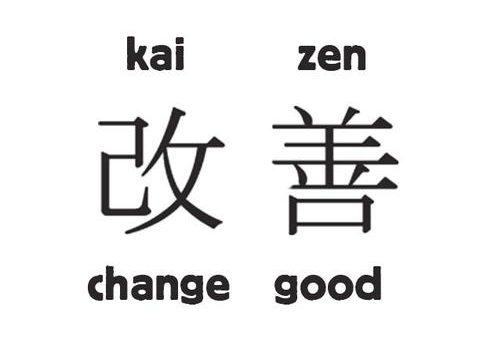
The Japanese emphasized quality control as part of the process rather than a response to customer complaints, an ethos captured by the term kaizen or ‘continuous improvement.   The forces of competition as well as an increasing global market compelled American companies to adapt quickly to the point where although products are more complex today they are also more reliable.  Before I could own my first car (a Peugeot 203) my father insisted that I knew how to strip and re-build the engine.  Today I wouldn’t know where to begin, but the average age of a vehicle on the road is double that of my 1959 Peugeot.

Playing catch-up is neither easy nor fast.  Of the ten vehicles that head the list of most reliable in the November 2014 Consumer Report, only one is US based (Buick) and this is in 6th place.  There are other fields that are equally lagging.  In an article in the New Yorker of Nov 10, 2014, James Surowiecki suggested that they include customer service (poorly trained workers,) medicine (high levels of medical errors and wasted spending,) and education (our teacher training programs lag behind  those of the rest of the developed world.)

And I would add beekeeping to that list, in two respects.  First, reading the Lancaster Farmer every week I am struck by the professionalism of the dairy, beef, chicken, sheep and goat industries; they have a professional staff, a coherent policy and an effective marketing campaign. Yes, I know that most of their members are full time producers with larger financial resources, but their industry relies on ours.  Without honey bees they could not effectively feed much of their stock.  In Pennsylvania we rely on volunteer beekeepers for our common good and in effect the state organization is as strong as the President who is giving of his or her spare time in any one year. This was brought home when I visited Wales and was forcibly struck by the professionalism and presence of advertisements and displays for bees and honey in almost every town we visited; it was no surprise to stumble on a center from which it was coordinated by full time, professional staff.

The second is that beekeeping as a whole has not changed much in recent years, despite the challenges of pesticides, diseases, viruses and monocultures. 96% of us are hobbyists, doing the best we can, which is not always good enough for the survival of the bees. For many beekeeping is still the preserve of a quirky, quaint, mildly eccentric minority and, as one wag put it, if pilots were allowed to start flying with the same amount of skill that beekeepers start keeping bees, no one would step onto a plane. 

Most beekeeping conferences are rewarding and gratifying – there is a sense of kaizen, of self improvement.  Disappointing is the turnout.  Certainly here in Pennsylvania, the annual conference in November attracts less than 5% of registered beekeepers in the state over the two days the conference is held. Many reasons are offered for this, but ultimately we have to show up, no excuses offered.  Local mentors are vital yet there is nothing quite like the energy generated by 10 000 people from across the world, with different languages, different customs, but one unifying passion – honey bees.  This is what happened at Apimondia in Montpellier, France, in 2009 and occurs every second year with Europe and somewhere else in the world taking turns as host. Not all of us can go to Apimondia but we can support the many state and county conferences where nationally respected  researchers and beekeepers share so generously. The speakers are  normally excellent and on point, the information is relevant and based on current data, the presentations professional and accomplished, the vendors increasingly diverse, and the informal conversations are sparkling and informative.  It’s a veritable hive of information and fellowship where very beekeeper, like every athlete,  is given the means to build on his or her innate ability.  Unlike athletes, even the best apiarists don’t yet see a flattening out of the performance curve.