Home

Bees and Boats

Oxford Cambridge Boat Race, 2022

In his 2013 book, The Boys in the Boat, Daniel Brown describes the epic quest of nine Americans for an olympic gold medal at the 1936 Berlin Olympics.  Each chapter begins with a citation from George Yeomans Pocock who, besides being a skilled builder of wooden racing shells and an innovative oarsman, was also a significant influence on the promotion and philosophy of rowing as a sport. 

George came from a long line of boatbuilders.  Born at Kingston Upon Thames in 1891, his father built racing shells for Eton College where, at the age of 15, he and his brother apprenticed, laboring with hand  tools to maintain and add to the school’s prodigious fleet of boats.

In 1910, George’s father abruptly lost his job at Eton because “… he had developed a reputation for being too easy on the men who worked for him,” and began casting around on the London waterfront for boat building opportunities.  His two sons, not wanting to be a burden on their father, abruptly emigrated to western Canada where, in circumstances of significant hardship, they gradually developed a reputation, first in Washington State and then on the west coast, and eventually nationally, for their craftsmanship and the quality of their product. 

In the early twentieth century the Intercollegiate Rowing Association’s regatta at Poughkeepsie, NY, was a storied institution with up to 100 000 spectators and radio coverage that rivaled the Kentucky Derby, the Rose Bowl and the World Series.   Indeed, in the 1950’s in Southern Rhodesia, I recall vividly my father sitting in front of the old valve radio one weekend each March, listening to the Oxford/Cambridge Boat Race on the Thames.  I had no visual images to refer to but his passion was contagious, and my heart would swell with pride when the boats went under Barnes Bridge!

Much of what George Pocock wrote about rowing applies equally to beekeeping, especially if one replaces words like shell, oarsman and crew with hive, beekeeper and colony, viz : 

Having kept bees myself since a tender age and having been around bees ever since, I believe I can speak authoritatively on what we may call the unseen values of beekeeping –  the social, moral and spiritual values of this oldest of chronicled activities in the world.  No didactic teaching will place these values in a young man’s soul.  He  has to get them by how own observation and lessons. 

These giants of the insect world are something to behold. Some have been in existence for a thousand years, and each colony contains its own story of the centuries’ long struggle for survival. 

Every good mentor, in his/her own way, imparts the kind of self-discipline required to achieve the ultimate from mind, heart and body.  Which is why most beekeepers will tell you they learned more fundamentally important lessons in the apiary than in the classroom. 

Keeping bees is an art, not a frantic scramble.  They must be managed with head power as well as hand power … Your thoughts must be directed to you and the bees, always positive, never negative. 

A colony is a sensitive thing … and if it isn’t let go free, it doesn’t work for you.

Just as the skilled rider is said to become part of his horse, the skilled beekeeper must become part of the bees. 

Why are the two disciplines so readily transferable?  Surely there are many reasons but two come to mind immediately.  The first is dedication.  Just as the oarsmen, coach and boat builder were fully dedicated to an ultimate goal, in this case an Olympic gold medal, so are the bees dedicated to one paramount objective : the long term survival of the colony, and thus the species, in as healthy a form as possible. 

The second is trust.   A critical turning point for the main character in the story, Joe Rantz, is when he learns to trust his team mates utterly and completely.  Only then can the team row in complete harmony, as one unit, perhaps as a superorganism.  George wrote that “When you get the rhythm in an eight (ie. eight man boat)  it is pure pleasure to be in it. It’s not hard work when the rhythm comes.” Joe remembered it as the boat literally flying across the water and at the end feeling energized rather than exhausted.  Bees too seem to trust each other as well as the greater whole.  They trust each bee to fulfill her designated function, and they trust the needs and consensus of the colony as communicated through pheromones. 

Daniel Brown, paraphrasing a conversation between George Pocock and Joe Rantz, describes the craft of boat building as like a religion. It is not enough to master the technical details; one has to give oneself up to it spiritually, to surrender completely.  When one is done there is a feeling that one has left a piece of oneself behind, a bit of one’s heart. “Rowing is like that,” George said. “A  lot of life is like that too, the parts that really matter anyway.” 
The Chilean Mine Disaster

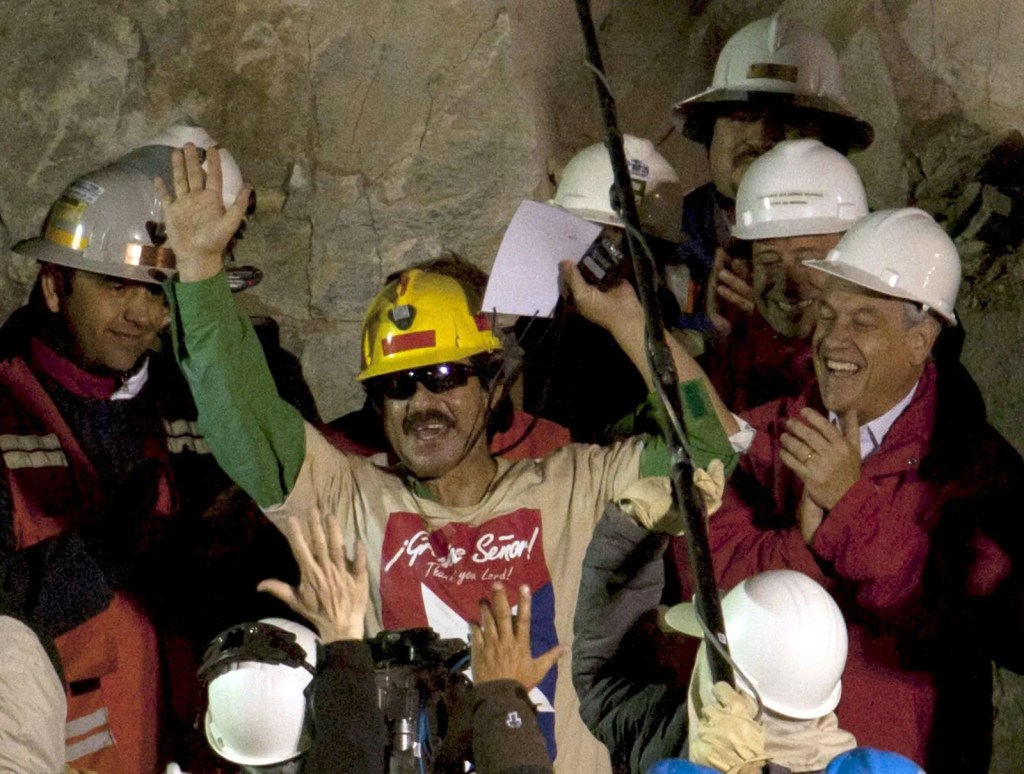
On Wednesday, October 13, 2010, much of the world was riveted to the TV screen watching the amazing, tearful, joyful  scene as one Bolivian  and thirty two Chilean miners were brought to the surface after 69 days entombed in the bowels of the earth. Each miner climbing out of the capsule was mindful of a young worker bee emerging from her cell after twelve days as a pupa, except of course that the fuzzy bees emerge into the darkness of a hive.

Why was that scene in Chile so captivating?  Perhaps we are desperate for good news, for success stories.  Perhaps we enjoy seeing technology used for such dramatic and humane ends, or global expertise joining hands for the common good. And perhaps this was an authentic reality show in which everyone won because it was based on cooperation rather than ruthless competition, on partnership and trust in the face of fear, on power with rather than power over and on team work and creativity.

Is that what we secretly yearn for?

A bee hive is just that – cooperation in the interests of community and survival, interdependence rather than competition and independence, benefits for all rather than for a few, the nurturing of all, interconnectedness as part of a larger universe, a living organism in which every bee has an  important role to play.

There was another aspect to the rescue mission.  How often do we give more than a passing thought as to where the metals that we use every day come from?  And yet on that dramatic day in October these forgotten people, the miners,  were given human faces, with families and dreams, hopes and fears, wives and girl friends (in one case, both of the latter at the same time!)

Similarly I suspect that few Americans give much thought as to where the food they eat comes from, or to the many processes that have to happen, from soil preparation to pollination to irrigation to harvesting and transporting, before they can take it off the shelf in the super market or buy it over the counter at a fast food store.  The oft-told story may be apocryphal but it contains a germ of truth.  “Where do green beans come from?” “From aisle 8 at the grocery store.”

Successful beekeeping requires that one becomes more observant, more aware, of the seasonal changes, of temperatures, of nectar flows and what’s in bloom and what pesticides and herbicides are being sprayed where.  Perhaps it is the way that people were before mass urbanization followed the industrial revolution, when most of us lived close to the land and were more interactive with the world beyond our doorstep.  

The myriad of tunnels in that disastrous mine below Camp Hope was mindful of looking into a hive, filled with wonder as to what the bees do to create a working environment in which they can prosper, procreate and progress.  Comb in a natural space is a marvelous combination of fluidity and precision. There is a hypothesis that bees use bee-chains to measure a space before building comb, that they can start on different walls of a cavity and meet perfectly in the middle without so much as a seam in the wax.   Similarly at Camp Hope computers on the surface were used to direct the drills with amazing precision deep into the earth.

The Constitution of 1776 was a landmark document of the Enlightenment.  It was devised at a time when individuals were subservient to a privileged elite based on birth, to superstition and to the dictates of a monolithic religion.  Perhaps, ten generations later, it is time to take a page  from the play book of the bee hive and recognize that with independence comes an inherent self-centeredness and a preoccupation with individual rights that can be damaging.   Maybe it is time for a Declaration of Interdependence and a Bill of Responsibilities.

The Top 10 Reasons to Be a Beekeeper

 (with apologies to David Letterman)

10. There is no winter time work with bees. No feeding, watering, shoveling, milking, de-horning, brushing, and no litter tray to be cleaned. 

9. Honey bees make ideal pets. They don’t bury bones in the flowers, jump up on guests or crawl under the fence and dig up your neighbor’s plants.  

8. There are no complicated chemical formulae to memorize. They turn nectar into honey without the the use of chemicals or steroids and they share any surplus with the beekeeper. 

7. There are no labor unions,  no Honey Bee Trade Union with a “less flowers, more honey” picket line.

6. Bees do not contribute to global warming. A hive does not require oil, gasoline or diesel from the Middle East to run.

5. Bees are worry-free tenants. They are not particular about the space you provide – no rents, no leases, no prime mortgages, no foreclosures.

4. Honey bees are hygenic. It’s like having a horse that collects is own hay and then cleans out the barn in the evening, or a child that cleans his or her room without being told.

3. They do not disturb you at night.  There is no having to get up at 2 o’clock in the morning to check if they are calving or to get them a glass of water.

2. Everything you do as a beekeeper is shared with your neighbors, whether they are gardeners or not.

1. You don’t have to be perfect to be a beekeeper. 

The Groan Zone

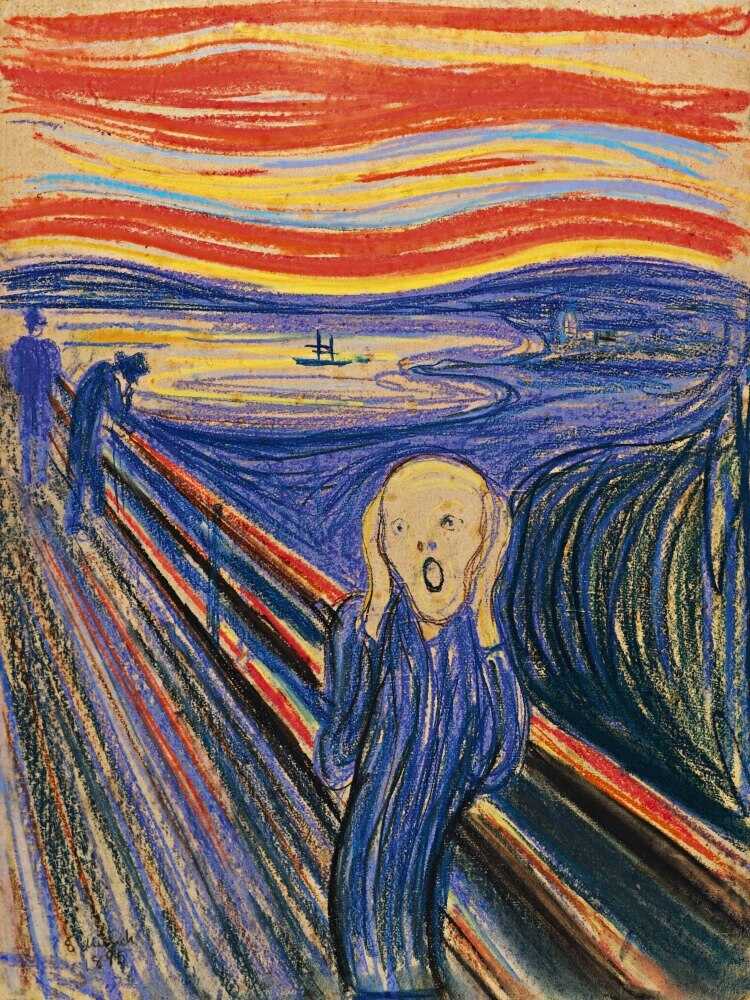
I was walking along the road with two friends – the sun was setting – suddenly the sky turned blood red – I paused, feeling exhausted, and leaned on the fence – there was blood and tongues of fire above the blue-black fjord and the city – my friends walked on, and I stood there trembling with anxiety – and I sensed an infinite scream passing through nature.Edvard Munch

Sara George’s historical novel, The Beekeeper’s Pupil, is the story of the remarkable relationship between the blind naturalist, Francois Huber, and his manservant and ‘eyes’, Francois Brunens,  as they investigate the behavior of the honeybee against the backdrop of the Scientific and French Revolutions. 

The story is presented as the fictionalized diary of the latter from the date of his appointment in 1785 to his departure from the household nine years later.  On October 10, 1789, the entry reads in part, “We feel as though we’re living in uncertain times, as though what has always seemed the natural order is beginning to turn upside down.   The Paris mob dictating to the King of France.  It would have seemed unthinkable even a week ago.”

In the study of Group Dynamics there is a concept called the Groan Zone.   In essence it says that an essential part of the creative process is the ability to let go of preconceived notions and expected outcomes and to be truly open and available to the possibilities based on the questions asked and the data available.   It is uncomfortable – one has to set aside one’s comfort zones and agendas – hence the term Groan Zone.  It’s proponents argue that despite the discomfort it is important to stay present, to stay involved, until a new paradigm emerges from what feels like chaos. 

It seems ironic, for example, that the turmoil of the late C18th in both American and France is now called ‘The Enlightenment.” 

Today there is an argument that the world, rather than any one single country,  is in a state of transition which is both a threat and an opportunity that rarely occurs.  There is a sense that the global economic system is not working, the political system is no longer democratic or representative, society is dysfunctional and religious systems are honored more in word than in action. These systems worked well once upon a time but today they are corrupt and broken. We find witness in the Arab Spring, the economic plight in Greece, the rise of the extreme right wing in Europe, the increasing political divides in the US, the on-going turmoil in much of Africa, the drug wars in Mexico, the chaos in the Middle East … 

A significant percentage of the population yearns for security, for a return to the perceived stability and comforts of the past, for the predictability of the known with an emphasis on what worked best in earlier times.  I use the word ‘perceived’ because it is easy to romanticize both the past and the future.

 Such yearnings are understandable and very human.

There are others who see this as an opportunity.   They argue these systems worked before but times have changed and rather than try to resurrect them we need to let go of preconceived notions and expected outcomes and avail ourselves of new possibilities.

This too  is an understandable and human condition.   

Perhaps we are in a global groan zone,  the  dichotomy and tension of which is uncomfortable but vitally important whatever the result.  How felicitous that Edvard Munch’s painting, The Scream, which for me symbolizes the intense feelings and tensions that preceded the First World War, sold in 2012 for $120 million, until then  the most ever paid for a single painting. (In October, 2017, after 19 minutes of dueling between  five bidders. a disputed and much restored Leonardo da Vinci portrait,  Salvator Mundi, sold for $450 million.)

Honey bees have a role to play as we navigate these tricky waters. Thomas Seeley defines a ‘smart swarm’ as “A group of individuals who respond to one another and to their environment in ways that give them power, as a group, to cope with uncertainty, complexity and change.”  He is describing more than just honey bees.  “It is from controlled messiness that the wisdom of the hive emerges”  writes Peter Miller in his book,  Smart Swarm, which includes fish, birds and ants together with honey bees. 

With increased frequency bees are referred to as our ‘canaries in the coal mine.’ To counteract the lack of ventilation in early coal mines, miners would routinely bring a caged canary, a bird that is super sensitive to carbon monoxide,  into new coal seams. As long as the bird kept singing the miners knew their air supply was safe. A dead canary signaled an immediate evacuation, which was too little too late for the poor bird but good for the men.  The implication is that the current difficulties experienced by honey bees are symptomatic of an increasingly  toxic environment.  Unlike the miners, however,  we cannot simply evacuate our environs as the bees die. 

The bees also offer us solutions. In Honey Bee Democracy, Thomas Seeley draws lessons for effective group behavior from the way honey bees make decisions when swarming – decisions made under pressure that are vital to the survival of the colony – and if the bees are indeed our modern canary equivalents, decisions that might be  vital for the future quality of life as we know it.  For example, how would the current political debate in this country change if, like the bees, we chose to put our egos aside, check the accuracy of information for ourselves, utilize the power of positive feedback, value diversity in terms of effective decision making, debate respectfully in an atmosphere of open enquiry, and champion fresh ideas? What would change if these traits could be modeled in the public sphere and encouraged in our schools? 

For environmentalist Bill McKibben, the solution lies in working with nature rather than against it.  “Past a certain point, we can’t make nature conform to our industrial model. The collapse of beehives is a warning – and the cleverness of a few beekeepers in figuring out how to work with bees not as masters but as partners offers a clear-eyed kind of hope for many of our (ecological) dilemmas.”

Partnership rather than opposition, cooperation rather than competition, and above all a focus on the long term survival and health of the community, are qualities that we witness in the hive and which most of us practice at our beekeeper meetings.  They might also be touchstones as we navigate through the global Groan Zone.  

Honey Bee Addiction Disorder

The ‘bee czar’ – Walter Schumacher

If 5 or more of the criteria below apply, you definitely have HBAD.  And if my experience is anything to go by, you can talk to the girls all you like but it won’t make a bit of difference – this condition is beyond redemption.

You have stacks of beekeeping catalogs lurking in a corner of your home with page corners turned down  and sticky notes protruding from the pages.

You subscribe to more beekeeping web pages and blog sites than you have time to read.

You lose sleep over that new piece of beekeeping equipment that you absolutely must have.

You spend more time with your bees than you do with your friends.

You veer off of the road when you see a hive in someone’s yard.

You keep working a hive even though you really have to go to the bathroom.

When in the apiary you forget to plan dinner, cook dinner, eat dinner.

You miss social gathering because there’s too much happening in the apiary.

You secretly order beekeeping supplies over the internet and hope your spouse won’t notice the charges on the credit card bill.

Instead of having propolis under your finger nails, you no longer have fingernails. 

Intellect, Emotion and Spirit

Sitting at our kitchen table one morning in March, 2011, replete with breakfast, Jerry Hayes observed that beekeeping is not so much a hobby as a journey – an intellectual, emotional and spiritual journey.  Intellectual in that increasingly one has to be a well informed, well read apiarist for a colony to survive; emotional in that honey bees tolerate us participating in their lives, which is amazing for an insect species; and spiritual in terms of the sense of wonder that arise as one begins to understand the interactions and complexity of a living hive. 

Dr. Wayne Esaias, with his work on nectar flows and climate change, points out that the honey bee was introduced from Europe, where it was superbly adapted, to the Americas in the 17th century.  The 400 years since that introduction are but a drop in the bucket of evolutionary time.  Apis mellifera has not yet fully acclimatized to our conditions and is thus reliant on the beekeeper for resources  in a  dearth in return for the precious gifts of honey and pollination.  Increasingly the successful  management of honey bees requires an intellectual commitment, an emotional connection with their predicament and a sense of awe at how they function and what they achieve. 

“Age-old wisdom and beauty,” writes Gunther Hauk, “come together in the honey bee.”  We talk easily about compassion and love but they are more difficult to find in action; instead our egotistical selves  lead to the exploitation of nature as we stumble from one calamity to the other, whether in Tripoli in Libya, Fukushima Daiichi in Japan, the BP oil spill in the Gulf of Mexico or the dramatic hurricanes typhoons and wild fires of 2017.  In the face of our successes and failures to create man-made wisdom and beauty,  the bees offer an inspiration  as to how we can solve the problems facing both them and ourselves. 

A colony of honey bees has a long term view on life despite the short life of the worker and drone bees.   Everything is designed to assure the survival of the colony.  If some Native Americans require that we consider the impact of our actions for the next seven generations,  the actions of honey bees impact directly at least two consequent  generations  They swarm, for example, because two colonies have a better chance of allowing for survival than just one (a kind of prehistoric insurance policy;) they zealously protect and tend to the queen, knowing that their future literally rests in her hands (or her ovipositor.) 

So the question arises, what is our ‘queen’?   What is it that we must protect at all costs if we are to survive as a healthy, prosperous society?  What is it that lives longer than any of us as individuals, that gives birth to new life and without which we shall all surely perish?   Our planet earth is the obvious answer,  and I would add ‘beauty,’ those qualities that please our intellectual, emotional and spiritual senses, those attributes that fill us with awe, a state in which love, compassion, empathy, brotherhood and peace combine with industry and commitment to enable us to find joy both in the chores of daily life and in the challenges of long term survival.

Paulann Petersen captures these sentiments in her poem, A Sacrament, if one ignores her reference to a drone in a biological sense.   

Become that high priest,

the bee. Drone your way

from one fragrant

temple to another, nosing

into each altar. Drink

what's divine—

and while you're there,

let some of the sacred

cling to your limbs.

Wherever you go

leave a small trail

of its golden crumbs.

In your wake

the world unfolds

its rapture, the fruit

of its blooming.

Rooms in your house

fill with that sweetness

your body both

makes and eats.

Sleepy Hollow

“A series of psychological studies over the past twenty years,” Nicholas Carr writes In his book, The Shallows : What the Internet is Doing to our Brains, “has revealed that after spending time in a quiet rural setting, close to nature, people exhibit greater attentiveness, stronger memory and generally improved cognition.”   The reason, he argues, is that when our brains are not being bombarded by external stimuli, not least in the form of rapid sound bytes from electronic media, they can relax.

In 2008 a team of University of Michigan researchers subjected some three dozen people to a rigorous series of tests designed to measure memory and the ability to stay focused.  Half of the testees then spent an hour walking through a woodland park while the rest walked through a busy downtown street after which both groups were re-tested.  The first group significantly improved their performance in both areas – recall and attentiveness – while the second group showed no change. The experiment was repeated with a second group of subjects using photographs of either calm rural scenes or busy urban ones, with the same results.  “Spending time in the natural world,” wrote the researchers, “seems to be of vital importance … to effective cognitive functioning.”

And it’s not only deep thinking that requires a calm, attentive mind. It’s also empathy and compassion.  As Antonio Damasio, the director of USC’s Brain and Creativity Institute explains, our higher emotions emerge from  processes that are inherently slow.  Our brains react quickly to physical pain  but the more sophisticated mental processes of empathizing with physical suffering unfold much more slowly.  The price we pay for the power of technology is alienation, and the more distracted we become the less we are able to experience the more noble emotions like empathy and compassion.  Everything happens so fast that there is no time for reflection.

A biology professor at the University of Vermont at Burlington was renown for his emphasis on the importance of observation in the scientific process.  Apparently, for the first class of a semester, he would bring  into the lecture hall a large container of yellow liquid.   “This looks like urine,” he said, “but we won’t really know until we have observed it closely,”  after which he made a great show first, of smelling the liquid and secondly, of dipping a finger into it and tasting it.  The class was aghast, but even more so when he insisted that they all do the same before rendering a verdict. After some pressure (“This is pass/fail” he insisted) they trooped down, and after the last one had returned to her seat, the professor said, “If you had observed closely, you would have noticed that I put my second finger into the liquid but put my third finger into my mouth.” 

Lesson learned. 

There have been some great observers of honey bees.  The Swiss naturalist, François Huber, was only fifteen years old when he began to suffer from a disease which gradually resulted in total blindness; but, with the aid of his wife, Marie Aimée Lullin, and his servant, François Burrens, he carried out investigations that laid the scientific foundations of the life history of the honey bee.  

Karl von Frisch was an Austrian ethologist who received the Nobel Prize in Physiology or Medicine in 1973 for his investigation of the sensory perceptions of the honey bee and in particular his decoding of the  meaning of the waggle dance.

And then there is Dr. Tom Seeley of Cornell University whose prime  focus has been on  understanding the phenomenon of swarm intelligence, culminating in the superb publication, Honey Bee Democracy.  More recently he has been the inspiration for and part of the team that developed,  the Honey Bee Algorithm  which uses observations of honey bee foraging behavior to allocate shared web servers to internet traffic.

Dr. Seeley has commented that with the emphasis on molecular biology and genetic-based research we are in danger of losing the focus on observation, which for centuries has been the basis of scientific discovery and of which, of course, he is a spectacular example.  Observation takes time, not only to survey but also to reflect, and the collection of data is onerous.  Behavior, a vital aspect of any life form (think waggle dance, swarming, the queen’s retinue) cannot be measured in the DNA.   This is not to deride molecular biology; it is a plea for balance and in particular the peacefulness and restfulness that sophisticated mental processes require.

I was fortunate to attend the Third International Conference on Pollinator Biology, Health and Policy, held at State College in July of 2016, and it was noticeable how the honey bee genome featured in almost all of the presentations.  My scientific background is limited at best, and what I do know is dated.  Much of what I heard was over my head, and certainly it was challenging to decipher and understand the different graphs that were flashed on the screen.  The culminating key note was by Gene Robinson, someone I have long wanted to hear, and although I understood very little of his key-note address (“Understanding the Relationship Between Genes and Social Behavior”) I was caught up by the quality of the presentation. By contrast, I was fascinated by Lucy King’s observations of elephant behavior when confronted with log hives suspended by wires around a crop field. 

In the early nineteenth century the German philosopher, Georg Hegel, developed his dialectic. He argued that an idea or proposition (later called a thesis) invokes a response in the form of  its contradiction (antithesis.)  The dialogue between the two results in a higher level of truth (synthesis) which in turn becomes a new proposition (thesis.)  Thus we progress by compromising between apparent opposites or contradictions.It is one of the bases for democracy : in Britain the party out of power is called “Her Majesty’s Loyal Opposition” in that it is their duty to oppose anything that the governing party proposes, in the belief that out of that dialogue a synthesis of the best of both sides will emerge.

So the question is what will result from the synthesis of observation and genomics?  Genomics is clearly a fast moving development and its easy to feel overwhelmed by the technology and the associated terminology. Observation takes considerable time and patience, and the results cannot always be objectively proven, yet there is frequently a relationship that develops during that long process between the observer and the bees, and even between observers as they analyze the results of their surveillance with all of the subjectivity that is missing when working with genes from bees mashed in a petri dish. 

Increasingly cyber technology is making it’s way into the apiary.  An example is the Beetight system which involves an app for an iPhone, iPod and Android by which one can upload photos, view apiaries on a map and identify hives by scanning barcodes, all while working in the apiary. It works even without a network connection, synchronizing when one is next online. Jim Bobb’s response was that the result of using an app in an apiary is a smart phone covered with propolis.

Clearly there are few if any tranquil spots on the internet where observation and contemplation can work their magic.   If we are not to become the victims of frenzied technology we need to preserve those ‘sleepy hollows’ which  provoke the meditative thinking which Martin Heidegger describes as ‘the very essence of our humanity.’  For me that place is the  apiary.  It is where time stands still.  I can get lost among the bees, observing, thinking, meditating and, most importantly, finding the peace and quiet to balance the clamor of a tumultuous world.  The last thing I want to do is to bring electronic technology into the apiary.  Hopefully I provide something of value to the bees; they in turn give me more than they will ever know.

Searching for Something More

Arguably the prime focus of the first half of the twentieth century was physics, beginning in 1903 with Einstein’s publication of the Theory of Relativity and ending in 1945 with the atomic bombs dropped on Hiroshima and Nagaski.  The hub of the second half of that century was molecular biology, initiated by Watson and Crick’s publication of the structure of  DNA in  1953 and ending in Scotland with Dolly the Sheep in 1998. 

The projection is that the initial part of our current century will be dominated by neurology, particularly as it affects brain function.  And as a retired educator I have to add that hopefully it will impact the way we teach.  If my grandfather came back to life he would be amazed to walk into a modern shopping mall or to fly in a commercial jet; if he walked into a school he would know immediately where he was.   Methods of teaching have changed very little and are essentially ineffectual, despite inventions that were expected to revolutionize it – the wireless, the overhead projector and the personal computer, as outlined in an earlier reflection. .  As a rule we still teach what to think rather than how to think.  

If in the current global market the rewards for the highly skilled and well educated are increasing then top priority for our prosperity as a nation must be our schools. We all know this.  And yet the subject was notably absent in the 2012, 2016 and 2020 Presidential debates aside from some posturing about shutting down the Department of Education as a federal entity. 

But I digress.   The latter half of the twentieth century was also consumed with consumerism.  The result, according to Nicholas Carr in The Shallows, is that the average American now spends at least eight and a half hours a day in front of a screen, in part because the number of hours adults spend online has doubled between 2005 and 2009. The average American teenager sends or receives 75 text messages a day, though one girl in Sacramento somehow managed to handle an average of 10,000 every 24 hours for a month.  That’s one text message every eight and a half seconds. 

Already there are Americans expressing a craving for relief, if only briefly, from all the blinking machines, streaming videos and scrolling headlines that leave us feeling too empty and too full all at once.

Is there something more?  Something that underlies and unifies life, including the bits and pieces of our own?  Something that can sustain us through both promise and peril? Something that leads us into a world that exists over and above the everyday chaos, that is rooted in the everlasting and which allows us to experience it in a way that only each of us can? 

And is this why people flock to Farm and Agricultural Shows every year?   At one level it might be seen simply as curiosity  but  might it also be a craving for a life, a connection, that many have lost without knowing it?  A deep yearning, almost at a cellular level, for a way of life that consumed the  majority of this world’s population for at least 8 000 years (and for many people in developing countries, still does.)

For several years I met with a college  English Literature class that was reading The Silent Life of Bees;  the final requirement was for the students to develop a project comparing the analogies in the book to the realities of beekeeping.   Normally we gathered in front of an observation hive at a local county park but two winters ago that colony died and I proposed that I should come to the class instead.    The instructor responded thus by e-mail : 

“I really don’t want to do this in the classroom. Seeing the hive (even if it’s not active), walking through the park and seeing the displays give my students an opportunity to do things that they have never done before.  Most of my students are city kids who have never visited a state or county park.  They don’t even know anyone who has visited a park.  They zip right by on their way to the excitement of an amusement park or urban event.  If I don’t take them there, they will probably never consider attending any events at the parks and their children will never know the enjoyment of a quiet walk in the woods.  Urban kids don’t just go to the quiet woods – someone they know has to invite them, and go with them.”

The irony of the agricultural shows is that most drive there in an automobile which isolates them from their surrounds, pay to park on an impervious surface and then jostle with the crowds to see the exhibits, yearning to find some peace, inspiration, serenity amid the chaos, to make that connection again, however briefly and superficially, with the natural world.  

Finding both tranquility and inspiration in front of a honey bee exhibit at any of these shows might, for some,  be the first step on a whole new journey.

An Ecological v an Industrial Model

When Pieter Bruegelsketched The Beekeeper in 1568, the dogma of religion and mythic systems that had characterized the Middle Ages was beginning  to give way to what we have come to call the Scientific Revolution, with the ascendancy of observation and experimentation.  Intellectual authority as presented by giants like Galileo, Descartes and Newton with their assertion that truth can be weighed and measured, replaced revelation as the source of knowledge, and with it came a new view of the world. 

The assumption was (and often still is) that the universe is a vast machine with interacting parts, much like a clock.   Each part, viewed as separated and isolated, has a few properties and movements determined by its mass and the forces acting on it.   In the event of a break down the apparent solution is to identify the malfunctioning part and repair it.  And if we know how the parts work then the world is not only predictable but controllable.  The universe is to be conquered and exploited and in so doing we have become increasingly detached from the natural world. 

We have extended this image of a machine to the social system;  human behavior too can be broken down into separate parts which are measurable, predictable and controllable. 

Clearly there are those few who supposedly can predict and control, a learned elite who determine this capitalist-industrial paradigm.   Industry produces goods which need to be sold, so progress is measured in material terms and a self-serving consumer society is lauded; we are encouraged to buy our way out of a depression, or shop our way out of the feelings that followed the attack on the Twin Towers of New York City on September 11th,  2001.

In a competitive, dominant  culture that rewards power and control and promotes obedience and compliance, we are defined by our possessions, not least our houses, clothes and vehicles. 

Ironically though, the scientific and industrial revolutions, which were expected to save mankind from the instabilities  of the environment, improve the quality of life and enhance one’s freedom, have also engendered disability, condoned suffering and promoted divisions in society.   Thus we have a population explosion, urban gridlock, increased incidences of diseases related to pollution and fast food diets, the obesity of a couch potato society, mental stress and depression caused by materialism,  the imperialism of agri-business companies and  an environmental crisis that threatens our very existence. Future generations may well call the nineteenth and twentieth centuries “The Age of Emissions.” 

Watching a colony of honey bees at work suggests an alternative way of being.  A colony is communal.  Each worker bee has different tasks that change during her short life, the purpose of which is the well being and survival of the community.  The satisfaction comes from contributing vitally to the greater whole.  Indeed, if one essential part of the colony dies then all die, so there is a vested interest in the health of all.

Over millions of years honey bees have learned to adapt to the environment without needing to control it. A colony displays complex social and organizational behaviors which, without the need for any ruling body, is the result of cooperation among the bees  correlated to available materials and energy. The whole is more than the sum of the parts while at the same time determining the behavior of those parts.

It is an ecological rather than an industrial paradigm.  The universe is seen as a living organism with which we interact, just as every bee is unique yet inseparable. It is a partnership that involves cooperation, nurturing, mutual benefits, team work, openness, accountability and, believe it or not, peace.   Honey bees are defensive rather than aggressive; they will defend their home if they feel it is being threatened, as would we all.   Remarkably, no life form is harmed as the bees go about their work.  They take only what they need and in so doing enable the reproduction and continuation of many other species. 

That’s not a bad set of objectives as we set about moving from a mind set of sustainability, which implies accepting our current level of degradation, to one of regeneration, which involves recovering what we have lost.  It is a matter less of ‘accepting the things I cannot change’ and more of ‘changing the things I can no longer accept.”

Intelligence, Learning and Beekeeping

In the past sixty years there have been two significant publications related to learning, both which are mentioned elsewhere in these reflections.   One is Howard Gardener’s  Theory of Multiple Intelligences, published in 1983 as described previously. 

The second study is The Taxonomy of Learning Domains, published in 1956 by a committee chaired by Dr. Benjamin Bloom. The cognitive domain, which  involves knowledge and the development of intellectual skills, consists of six categories normally  presented in the form of a pyramid,  with the more complex skills standing atop the more simple ones in that the first one must be mastered before the next one can take place. 

Paraphrasing Bloom’s terminology, the first two levels (often referred to as lower order  thinking skills) are a familiarity with and comprehension of the basic knowledge or data.  The four upper levels relate to the ability to apply that information by means of analyzing a situation,  blending and utilizing different options, evaluating the results and possibly creating something that is specifically relevant if not new. 

Bloom’s Taxonomy is not to be confused with Maslow’s Hierarchy, the latter referring mainly, but not exclusively, to personal growth, although there are intriguing similarities between the two. 

Our school systems, including colleges, are often primarily concerned with the lower order skills, not least because they can be easily and quickly measured in standardized tests.  I have not yet seen a multiple choice test that measures higher order thinking skills, although they might exist.   An acquaintance who is studying to be a nurse broke the radius bone in her right arm in two places.  When I asked how she would cope with school (she is taking night classes) she replied that fortunately the professor hands out notes at the beginning of each class and the students have only to highlight those parts that will be on the test.  No higher order thinking required.

Too often the unspoken game that students play in school is “What Does Teacher Want?”  Work out what the teacher expects, give it back to him/her, and a good grade is assured.  The skills are lower level (understand the data) and validation is external; we rely on others to tell us what is right, what is good, what is important.

A conversation with Jim Bobb, a doyen of Pennsylvania beekeepers, clarified that Bloom’s Taxonomy has relevance for beekeeping.  Yes, it is important that one knows the basic data and understands it.  No meaningful analysis can take place without that knowledge and a major responsibility of any beekeeper is to be well informed.   But the only way to learn how to apply knowledge is to get one’s hands dirty, to get into a hive as often as possible and to make decisions that are particular to that colony based on a combination of the evidence on the frames and the theory from the literature. Randy Oliver, in his frequent presentations, concurs. 

There is no single recipe for beekeeping.  A good spring management class or  winter preparation article is not a prescription so much as a set of principles based on honey bee biology and behavior that offer choices.  Increasingly, when asked “What do I do now with my hive?” my response is not to be directive (tempting as it is) but to  describe possible  courses of action based on the particular state of the bees.

Ultimately each successful beekeeper develops a particular style of management that is creative and unique to their objectives, their location and their bees.   That’s the higher order thinking skills at work.  Anything less is like trying to understand Mozart as no more than a series of sound waves caused by the disturbance of molecules in the atmosphere.