Dandelions

Part of the fascination of managing honey bees is the process of becoming more aware, more observant of the natural world, its rhythms and flows, its strengths and weaknesses. 

Different cultures know dandelions by different names :  Pee in the Bed, Lions Teeth, Fairy Clock, Clocks and Watches, Farmers Clocks, Wetweed, Blowball, Cankerwort, Priests Crown, Puffball, Swinesnout, White Endive and Wild Endive, The name we know it by comes from Dents Lioness (medieval Latin) or Dent de Lion (French,) both meaning ‘tooth of the lion.’  A look at a leaf explains why.

The dandelion’s use as a medicinal herb was recorded by the ancient Chinese and later by  Arabs, who, via the cultural cross-pollination enabled by the Crusades,  taught Europeans about its benefits. Modern analysis reveals that dandelions are a good source of calcium, potassium, vitamin A, and vitamin C. The calcium content alone is impressive; a serving of dandelion greens has as much calcium as half a cup of milk. The long taproot of the dandelion reaches down to the rich subsoil which other plants can’t reach, hence the rich mineral and vitamin content. But there is a downside :  ‘Pee in the bed’ is a direct translation of the French pissant en lit, so named because the high calcium content activates one’s kidneys, and if one is a deep sleeper …

When the Mayflower arrived there were no dandelions in North America. Fifty years later they were everywhere, having been introduced by European immigrants whose cultures used dandelions as part of their regular diet and who wanted a reliable source of greens early in the spring.  In return the Algonquian Indians sent the British a bag of crab grass (just kidding.)  Today, if they were not so widely available and considered ‘weeds’ to be chemically removed, we would probably be farming them as a valued leaf and root vegetable and a dietary supplement.  

Many plants are specialists, attracting specific insects, but the dandelion, like Burger King, is a generalist – open to everyone, affordable to all with no long lines, and although it might not be the most exciting food, almost everyone likes it.  Thus dandelions open at 9 in the morning and shutter down in the evening; they  close up shop on rainy days because of a shortage of customers and the danger of the nectar and pollen getting diluted; the yellow flower is in the middle of the color spectrum and the short tubular flowers ensure that nectar is available to  all visitors. But there isn’t much of it, so those who can get something better somewhere else probably will. 

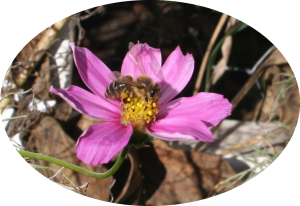
Besides offering a veritable smorgasbord to most pollinators, for the beekeeper  the first dandelion flower (which in York County normally appears in the last week of March)  provides a good indication of the future strength of the honey bee colonies in four weeks time when the prime nectar flow begins.

Here’s how it works.  A female (ie. worker) honey bee spends three days as an egg, six days as a larva, and then pupates for twelve days before emerging as an adult.  For the next four weeks she does household duties until,  for the last two weeks of her life, she leaves the hive to forage for pollen, nectar, water and propolis. Thus a worker who emerges from her cell in the last week of March, when the first daffodils are in bloom,  will start foraging in the last week of April, which is when the main nectar flow normally starts here in York.    Consequently the greater the amount of capped pupae (called brood) in the hive when the first dandelion is in flower, the greater the potential for the colony to build up stores of nectar and pollen during the main nectar flow, which in turn stimulates the queen to increase her laying, the nurse bees to feed the subsequent larvae, and the foragers to collect nectar,  store the excess and cap it, at which point we call it  honey.  

People often ask what they can do to ‘save the bees.’  The answers don’t necessarily involve keeping honey bees themselves so much as creating an environment in which all pollinators can flourish, because it is more than honey bees that are at risk.   One such way is to allow the dandelions to bloom, and if this is somehow intolerable, at least don’t spray them with chemicals – the foragers can take those chemicals back into the hive as they collect nectar and pollen, and that closed environment thereby becomes toxic, and probably fatal,  to the entire colony.

When it comes to dandelions, some see a weed, some see a wish, and beekeepers see the future. 


The Jigsaw Analogy

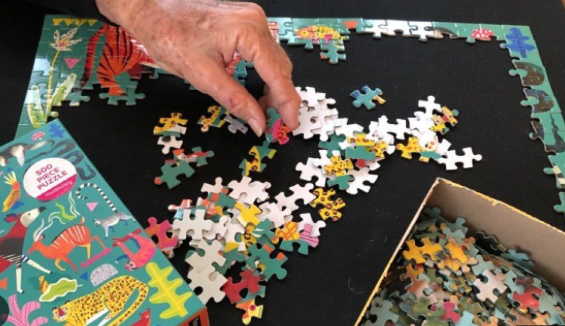
In my younger days I enjoyed doing jigsaws puzzles.  Indeed, in moments of supreme but misplaced self–confidence I would ask my mother to remove the lid of the box so that I could not see the big picture before starting to assemble the pieces. 

The assembly process is revealing.  First, identify the four corner pieces followed by the straight edges, and then find similarities and patterns in the individual  pieces as they began to fit together. And finally that wonderful moment of sitting back and admiring the completed puzzle, hoping it will remain undamaged and unbroken for at least a little while.

Generally speaking we don’t teach this way, either in the classroom or to new beekeepers.  We tend to work through the syllabus, which is a conglomerate of little pieces, and assume that each student  will find for him/herself the ‘corner’ pieces and will eventually stumble on the big picture.  I suspect that many never do, especially when we add the stressors of tests, quizzes and exams with an emphasis on short term  memory rather than long term learning.

For example, how long would it take you to memorize the following, and for how long could you retain it?

JmFtMwAtMfJsJsAmStOwNtDf 

My guess is that some considerable effort is required to memorize this apparently senseless jumble of letters,  nor would you retain it for long unless you used it regularly. But what if there is a pattern to the above?  What if you could understand the reasoning behind it and recall it at will? *

There are inspirational examples of starting with the big picture.  Typically, the first year of medical school begins with classes in anatomy, with students being introduced to patients only in year 3.  But at McGill University in Montreal students are introduced to patients on day one, in the belief that they should see them first and foremost as functional human beings, a superorganism if you will, rather than as a conglomeration of anatomical organs. 

For a second example, I think back to the ‘O’ level history syllabus we taught in Rhodesia, in the 60’s and 70’s, that began with the French Revolution.  We examined the causes, followed by each event from the meeting of the States General in May, 1789, to the Whiff of Grapeshot in October 1795, and then moved on to Napoleon Bonaparte. In retrospect, it is only too clear that Rhodesia at the time, and many countries today,  are mirroring those same causes and events (an elite minority imposing it’s will on a majority for personal benefit) but few realized or acknowledged it at the time.  It took me years to stand back and see those events in France in a bigger context, and if I couldn’t do it certainly generations of students are unlikely to have done so, immersed as they were in memorizing the details of events that might appear on a test.

So what if we started with the big beekeeping picture and asked questions such as, what are the corner pieces of beekeeping,?  ie. the fundamentals that hold everything else in place and that are vital to seeing where the pieces fall together?  What are the parameters, and, if we’ve seen a ‘picture’ of keeping honey bees before we start, how realistic is that image? Indeed, are we all making the same jigsaw? 

In terms of the bees, Randy Oliver stresses that they need three essential corner pieces :   a dry, safe cavity, reliable resources (nectar, pollen, propolis and water) and defense against diseases, viruses and parasites. 

In terms of new beekeepers,  the corner pieces might be

  1. the biology of the honey bee; 
  2. the differing flows of nectar and pollen throughout the year; 
  3. parasites and pathogens to which the bees are exposed;
  4. the functions of the beekeeper.

Every day, as I inspect the hives, read the journals and talk to colleagues, more pieces of the puzzle fall into place, more connections are made and patterns are  continued, making the bigger picture more intricate, more complete, more fascinating than initially imagined.  For example, I recall vividly the realization that honey bees are one of the very few species of insects that survive the winter as a community, and they can do this because millions of years ago they ‘realized’ that if they reduce the moisture content of nectar it will survive in near perfect condition as honey which not only is a winter food source but also a vital stimulant early in the spring.

How did this ‘realization occur?  I have no idea (does anyone?) but an associated piece of the puzzle is a bee’s brain which is the size of a sesame seed yet is packed with more than one million neurons, a density equivalent to our human brains.

What are your corner stones as a beekeeper?   Sometimes they can be revealed in an AHA! moment when you say “Now I get it.  I wish someone had explained this to me earlier.”  I recall coming to the understanding that honey bees are defensive rather than aggressive, that they will protect their home and children against attack, as will we all, but beyond that they are gentle and pre-occupied.  This realization radically changed the way in which I relate to each colony.

And what are your corner stones as an individual?  Mine include authenticity, fellowship, beauty, empathy and curiosity (my jigsaw has five corners!) and  certainly they have changed over time. 

My current bee puzzle has 1000 pieces and counting, and there are still large empty spaces. But the big picture, both of honey bees and of life, even if incomplete, is beautiful, amazing and awe inspiring, every time I care to step back and take a look. 

* It is the initial letter of each month of the year followed by the initial letter of the days of the week.   Ie. January monday February tuesday … etc. 

A Green Cathedral

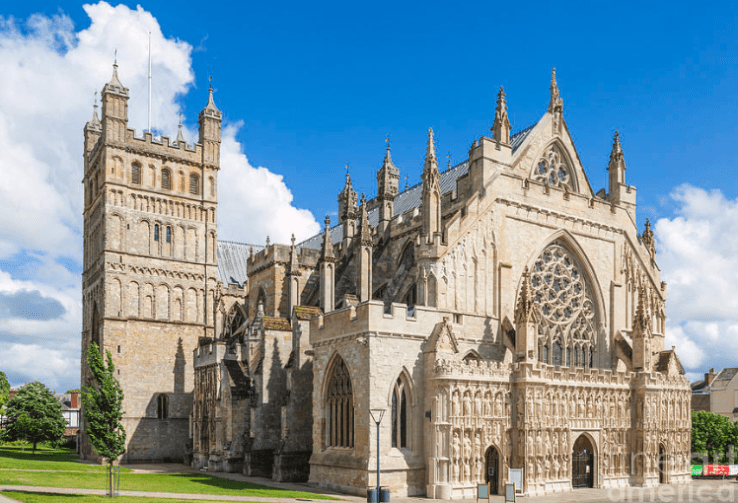
Exeter Cathedral, Devon, England

Some personal background.  My father was born and raised in Exmouth, England; my mother was a London girl and I was born in Cornwall.  When I was three years old my father moved his young family to a British colony then called Southern Rhodesia and the next 60 years of my life was divided between the continents of Africa and North America with occasional sojourns in Europe.  I have been fortunate to make a number of trips (pilgrimages?) back ‘home’, including one in 2014 when Mary and I, after a wonderful visit to Buckfast Abbey courtesy of Glyn Davies and Clare Densely, were fortunate to experience Exeter Cathedral. 

Like many other cathedrals of its era it is described as ‘Gothic’, a term conferred by the succeeding era, the Renaissance, which saw these architectural behemoths as ugly and barbaric whereas to us they are  imposing, spectacular and awe-inspiring – literally, as they were meant to be.

These sacred structures are rich with allegory.   For example, they face generally eastwards so that the rising sun shines through the magnificent  rose window high on the eastern facade, the center of which is the Christ figure itself.  Entering from the west, from darkness, the  supplicant is suddenly blinded by the light.  The message is obvious. 

Similarly, in a population that was essentially illiterate, the stained glass windows, art work on the walls and sculptures told a story – the Christian story.  It was the classroom of the masses. 

In his book, The Cathedral Within, Bill Shore uses cathedral building as a metaphor for how society can martial resources to face modern challenges.  Certainly there were some critical architectural inventions in the medieval period (pillars and vaults supporting the roof so that the wall space could be filled with stained glass windows, for example) but more important was an understanding of the human spirit that allowed traditional materials to be used with new designs to create something lasting and magnificent.

For the architects and builders the cathedral was not a fringe benefit of their work; rather it was the core purpose.  Faith and inspiration were the essential ingredients of the whole design. Those who began the project knew they would not see the final product; rather they believed in it so deeply, so resolutely , with such authenticity, that it continues to resonate in our hearts. 

The building itself required a sharing of strengths and resources of materials, skills, labor and finances drawn from across Europe.  “Somehow,” writes Bill Shore, “it had been both communicated and understood that it wasn’t just that building a truly great cathedral would require that everyone share their strengths, but  rather that everyone sharing their strength would result in a truly great cathedral.

Just as the Gothic cathedrals were an analogy for the Christian journey and the human spirit, as well as visions of hope and comfort for the late medieval people who lived in such overwhelming, harrowing conditions, so are they an analogy for our current times and the choices we face.  The debate on climate change, for example, carries the underlying message that our modern life style is unsustainable. We need to redefine our expectations and our definition of ‘progress’; we need to combine traditional materials with new designs drawing on the strengths of all, knowing that we will not live to see the ultimate benefits. 

The future cannot be a fringe benefit of our work; rather it has to be the core purpose.  We need faith in sustainable practices and the human spirit, we need  a conviction so deep, so resolute, so authentic, that it drives all of our daily actions and choices. And we need to share our strengths and resources so that we can build ‘a truly great cathedral,’  our planet. 

At one level, this is what honey bees do every day and it is interesting to read the above with a colony in mind.  They have a vision that is constant and has lasted for millions of years.  Tom Seeley has shown that given choices of potential homes the bees will invariably choose the most suitable habitat, which means that they must have an ideal against which to measure each home that they investigate.  He describes too how, operating under pressure of time,  they report back to each other on the surface of the swarm, investigate what others enthuse over, and use a quorum to make a decision that will determine their future survival. 

I doubt that any individual bee measures her work rate against that of her sisters; it is her contribution to the greater whole, the over-riding vision, that is vital. And the final result of that combination of inspiration and intuition is the green cathedral that we call a  hive. 

Honey bees realize too that diverse resources need to be integrated into an architecture if it is to function and survive, and that all of the materials are needed, whether it be nectar, pollen, propolis and water, or the various house duties of the young worker bees integrated with the bounties of the older foragers.  There is a recognition that everyone has value to add, everyone has a strength to share, even the drones. 

My guess is that the same attributes apply to a successful beekeeping association. And just as the public too often takes the gifts of the honey bee for granted, so too we can easily assume that a good meeting or rewarding council somehow just happens. 

Whether it is the architects and laborers of the Middle Ages, the honey bees or each of us who has responsibility for the quality of this planet, the task might seem over-whelming.  Regardless, our devotion must  span an entire career because the challenge cannot be properly accomplished in less than that time.

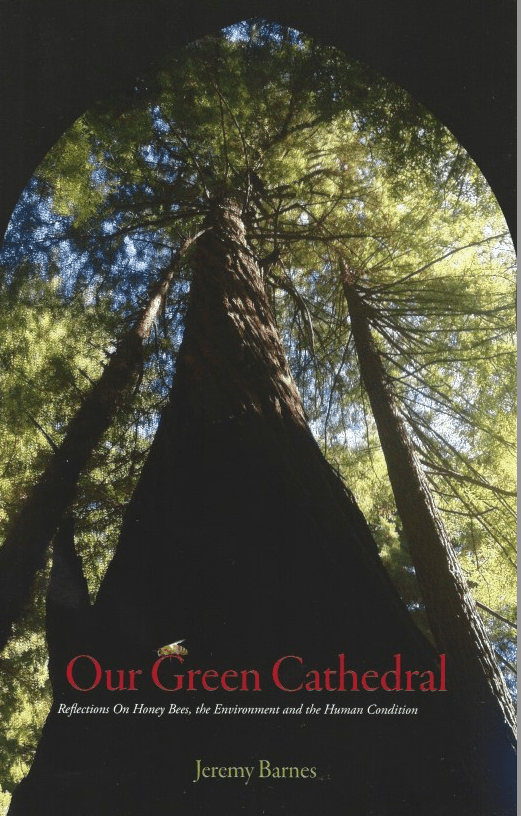
Our Green Cathedral : A Blog

Welcome to this revised version of the honeybeewhisperer.simplesite blog. For this old drone it is a work in progress and has been an exercise in risk and reward, requiring new skills, lots of patience, and a willingness to ask for help.

An Introduction

I am not a scientist in any form nor by any description, even if I have a deep-seated fascination with the natural world caused, in part, by the circumstances of my early life.  My  formative years as a privileged white youth were spent in the Eastern Highlands of Southern Rhodesia, now Zimbabwe – the reflection titled  Muhrawa’s Hill  describes one aspect of that environment.   I was fortunate to teach (although I think of it more as educating than teaching ) in Rhodesia, South Africa and the United States with occasional sojourns to England and France, with a particular interest in European and African history.  Over time this interest  evolved into the larger educational process and culminated in group dynamics in the classroom, the latter coincidentally paralleling much of what happens in a colony of honey bees.  The ultimate of this collusion is Tom Seeley’s chapter in Honey Bee Democracy in which he considers the “(L)essons we humans can learn from honey bees about how to structure a decision-making group so that the knowledge and brainpower of its members is effectively marshaled to produce good collective choices.”  Amen, I say. 

This is not a how-to-keep-bees blog. Those looking for a manual on good beekeeping will find plenty available that are of high quality, never mind the multitude of videos and chat sites in the cyber world.  The thoughts reflected herein were stimulated by different occasions, for example my mind wandering in the bee yards as I watched the ‘girls’ (I am all-too-easily distracted,) or reading a news journal and realizing how the topic under review related as much to honey bees as it did to say societal growth or the environment writ large.  

When we speak of bees, honey is the first thing that normally comes to mind – that tonic, health food and medicine that the bees arduously create from nectar.  They also produce propolis, wax, royal jelly and bee venom, and, in the process of the vital act of pollination,  bring back compacted pellets of protein-rich pollen to the colony.  But there is a larger aspect to their life, one that is less well known but is equally as vital. In the later nineteen century the German pioneer in organic beekeeping, Ferdinand Gerstung, coined the term bien (as compared to biene, which refers to the individual bee) which he described as “an organism made up of various parts and members, all acting together harmoniously and purposefully; it is a body in which every part presupposes the existence of the whole from which the parts derive their origin and support.” 

The English equivalent, superorganism, was first used by James Hutton, a geologist, in 1789, and later was the basis of the gaia hypothesiss, which suggests that the biosphere itself is a superorganism. 

There is wisdom in the bien if we choose to look for it. The cosmos of a bee hive, with its organization, behaviors, interdependence and long term mission,  offers an example and an inspiration as we work to reestablish our connection with the natural world and to  heal the increasing divisiveness and loneliness which characterizes so much of our current society.  The following essays reflect my own increasing awareness of that wisdom and the feelings of connection that come with it. 

Some of the reflections are light hearted, others are more serious; some might provoke amusement, others indignation.  Hopefully each in its own way will provoke a thought or renew an awareness, and might even lead to action. 

The essays are organized in such a way as to flow easily – this is not the order in which they were written and my hope is that rather than feel obliged  start at the beginning and read through to the end,  the reader will enjoy dipping into this book at random, that each of the compositions will offer something in itself and, like a jigsaw, a bigger picture will emerge as you read. 

Bee well, and do good work. 

Jeremy

honeybeewhisperer@gmail.com

Meadowsong Apiary, where the Queen is strong,  the drones are good looking and the workers are above average.

Comments from readers of Our Green Cathedral

ANALOGIES AND WISDOM PLANT A SEED

Jeremy is brilliant in the clever ways in which he utilizes the beeloved Honey Bee to incite a riot in your mind initially, simmering down to a firmer understanding of the gravity of the State of Our Garden Cathedral, laden with patina. 

What a glorious day for all on the Planet Earth when Honey Bees found Jeremy;  the resultant union will sharpen the readers awareness. Jeremy’s weaving will lubricate your gating channels as you view familial subjects through radical perspectives. 

Awareness beeing the first step in any challenge, the analogies and wisdom contained within “Our Green Cathedral” may not dictate the steps which follow, yet, in true educating fashion, you will bee led down a path of your design with beeloved Honey Bees as thy guide.  A splendid approach to displaying the darkness, yet, offering light through the canopy, seeding paths to bee involved!

– Walt Broughton

A GIFT FOR TELLING STORIES

Some of the stories are a couple of pages long, some much shorter, but each is a work that stands alone … and each is truly a work of literature art, and each is story worth telling… each is a gem worth the few minutes it takes to read, some longer some shorter.

Kim Flottum, Bee Culture, Jan 2019  

METAPHOR OR TEACHER?

These essays are connected by a hum of history, insights, challenge and wisdom. Is this a book about life with bees as metaphor? Or are the bees simply our teachers? I encourage you to read the book and decide for yourself. 

Meg Wheeler

A KINDRED SPIRIT

Thank you for everything you are and all that you do. Your insights are everything the world need to hear, especially now.  I was delighted to be able to shake your hand at the TriCounty meeting and let you know your writing is cherished.

Deb Shepler

QUIET REFLECTIONS AND INSPIRATIONS

This morning, with my first cup of coffee, I sat in the den by the big window  and started reading. I discovered what a gift this is.  To be able to hear your quiet reflections and inspirations from many years of life’s experiences.   Even if I didn’t know you and how deeply you care about life (big and small) – I would say this is a special and wonderful book.  I look forward to  sharing it with some of my closest friends.  

Deb Gogniat

MODELS AND METAPHORS

At first glance, Our Green Cathedral may appear to be simply a compilation of articles written by Jeremy Barnes for various beekeeping journals and newsletters. But, look again. This is not yet another manual on how to keep bees or even what’s the problem with bees these days – not directly. Thankfully. Rather, these are concise personal essays (95 in all) addressing the current state of our natural world and humanity’s place in it as seen through the eyes of a practiced beekeeper. Indeed, though his passion for apiculture is often the impetus for his reflections, an innate curiosity compels him to look beyond the mere surface of things to discover the histories, the symbioses, the connections underlying the big picture. He challenges our assumptions and conventional thinking, not with the power of his reasoning or the weight of his arguments; he is more subtle than that. His conversational style, his humor and honesty, his masterly employment of quotation and anecdote convincingly win the day. For Jeremy, the bee yard is a place of contemplation and insight, a refuge from the anxiety and divisiveness of the modern world, and like a green cathedral, a home for mystery and beauty. In the end, we are left with a clear impression of a man who cares deeply for the future of our planet and human-kind’s existence in it. This thought-provoking volume of essays belongs to that long history of literature which reflects on the hive and the honey bee as models and metaphors for society and the ways of the world.

David Papke

A POSTER CHILD OF BIGGER THINGS

Jeremy, I received your book about a week ago in my office inbox. My wife has immediately begun to read it. Thank you so much for this gracious gift and for the honor of being quoted in your frontispiece. We are clearly like-minded on the biospiritual unity of life and honey bees as a poster child of Bigger Things. 

Dr. Keith Delaplane, Univ of Georgia

WISDOM AND ELEGANCE

Our Green Cathedral has a home on the bookshelf beside my bed, and for a long time I have enjoyed reading a piece or two as I settle in for some rest, for I find your writing thoughtful, sensible, and reassuring.   Also, It has been a treat to find mention of me here and there, sometimes in connection with one of my scientific “heros”, Karl von Frisch.  I thank you deeply for sending me a copy of your book.

I admire your wisdom and your range of experiences with both bees and beekeepers, all of which are expressed so elegantly in your book.  One point that you make  that resonates especially strongly with my own experience is your observation that when biologists give talks on genomic studies of honey bees, they express little joy in or excitement with their work.  I have noticed this, too.  (I think that this lack of excitement tends to be true for the audience as well as the speaker.)  Probably this lack of excitement reflects the fact that when a biologist does behavioral genomics (or any kind of genomics work), he or she is investigating something abstract, hence out of sight.  In contrast, when I or somebody else does a study that involves watching bees do what they do, it is almost always a strongly engaging experience.  Maybe this is because this kind of work involves the parts of our brains that originally functioned to make us good hunters.  

Dr. Tom Seeley 

A WORLD VIEW

Your view of the world around is something I wish to emulate.  UMWELT!

Jeff Berta