What We Take for Granted

My father was born in an age when the lack of a formal education was not necessarily an obstacle to personal success.  He left school in Devon, England, aged 16, and  retired some 45 years later, not only responsible for the maintenance of the national roads of an entire country but well respected by his peers, all of them degreed engineers.   No doubt, four years of building roads and bridges to allow the British forces to retreat before, and then advance after, the Japanese forces in Burma, was a vital part of his education. 

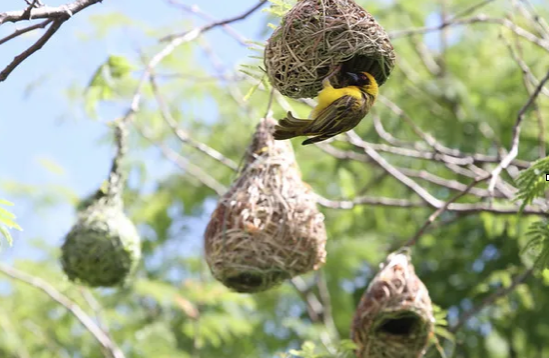
He spent week-long trips inspecting roads and visiting road crews, and over school holidays I would often accompany him.  My favorite memory is lying in the back of the station wagon parked at the Birchenough Bridge Hotel, alongside the Savi River, under a tree interlaced  with nests of masked weaver birds, watching for shooting stars in the vivid African night sky.  The masked weaver is a fascinating creature.  The males, for example,  build nests at the very ends of the branches of thorned acacia trees so as to make them inaccessible to snakes in particular.  The nest are architectural marvels, each consisting of several rooms, all but one of which are decoys.  When he is finished – some 12 to 14 hours of work in all – his partner inspects it.  Should it not meet her approval she rips it apart and he promptly builds another … until such time as she is satisfied. 

Another memory, less pleasant but probably more important, was when we were driving between road camps and my father decided to offer  some simple mental math problems involving speed and distance.  A typical example might be, if we are driving at 60 mph, how long will it take us to travel 30 miles?   I couldn’t do it. The more I tried, the more he explained, and the more frustrated I became.  Emotion superseded any ability on my part to think rationally . He could not understand why it was so difficult. The reason?  I did not understand that miles per hour meant how many miles one traveled in one hour.  It was a non-understanding of the word per.  It was a simple as that.

That was some 70 years ago, and I have not forgotten it. 

Ironically, when I was driving the 1400 miles to university twice a year, the speedometer in my car didn’t work (a broken cable, I discovered eventually.)  Thus I spent considerable time using the mile posts and a wrist watch  to calculate my speed, by which time I understood only too well what per meant! 

The point is, especially as that time of year approaches when bee classes start, we should never assume that what is obvious to us is equally obvious to those new to the craft. Beekeeping, like most things, has its own language, and there are terms  that we take for granted – larvae, pupae, comb, propolis, foundation, frames, EFB, AFB, varroa mites – which may be new to many in the class.  Some will ask; others will keep quiet and hope they can figure it out from the context.  It doesn’t help when some terms are mispronounced; for example, the first instructor I had pronounced honey bee comb as cone. 

Sometimes it doesn’t matter.  For example, I have absolutely no idea what http, or jpeg, or hrl, stand for, nor do I need to know.  If I was in a computer 101 class it might be entirely different but, as it stands, I can use my computer without having to know how to code or what the abbreviations mean.  In the same way one can drive a car without understanding how the engine works, or realize the implications of the law without having been to law school.  I recall vividly teaching European history to a group of 16 year olds in 1970.  One of the students, sitting in the back, right hand desk,  put up his hand and asked what the difference was between domestic and foreign policy.  I was stunned – these were terms we had been using all year – and essentially I did not answer, assuming he was pulling my leg.  Now I know better, and am ashamed of my callous response.

Beekeeping does not fall into the computer, vehicle and legal categories.  The essence of the beekeeping class is graduating from simply watching honey bees to being able to understand their behavior and thus to intervene appropriately and for their benefit.  It is this comprehension of which language is so important a part.  A pertinent example might be Keith Delaplane’s latest book, Honey Bee Social Evolution, not only because of his superb use of language but also because his explanations of the evolutionary processes that have led to current bee behavior enlarge my understanding of what I see in the hives and thus impact my interventions, if any.

A technique for an instructor is to acknowledge at the very outset that he/she might inadvertently use terms that are part of the beekeeping experience but which are unknown to the class.  In such an event it is important for class members to speak out; it will not only allow for clarification for the students but will provide valuable insight for the instructor as to their level of comprehension. 

The Birchenough Bridge, taken from the hotel.

The Golden Rule

This is the fourth and final episode in a series focusing on the brain on the honey bee

Honey bees are insects and have been so since their appearance in their present form some 30 million years ago.  In the mid 19th  century  Johannes Mehring, who was the first to produce wax foundation using a metal roller, equated a bee colony with a vertebrate animal.  The queen and drones, for example, represent the female and male genital organs, while the workers represent those organs necessary for maintenance and digestion. In Germany this led to the term bien, whereby a colony was seen as a single living organism in which the whole was greater than any of the parts.  It was an American biologist, William Wheeler, who, in 1911, coined the term superorganism

Of late it has become popular to compare a honey bee colony not just with vertebrates but with mammals in particular.  For example, both have very low rates of reproduction (recognizing that a colony reproduces itself annually as a swarm;) mammalian milk is compared to royal jelly as a source of nourishment, brood comb is equivalent to the uterus of a mammal, both have body temperatures of between 96 and 98 degrees F, and both have developed a high capacity for learning. 

The reason for these characteristics, as described by Jurgen Tautz in The Buzz About Bees : Biology of a Superorganism,  is that by freeing themselves from the dictates of the environment, whether it be the weather or fluctuating sources of energy and nourishment, organisms can afford to have fewer progeny who are stable in numbers, well prepared for their environment and carefully protected.

This process is carefully controlled (homeostasis) by a complex system of constant feedback loops.   Ask a member of the public who is the brains behind this, and the response invariably is ‘the queen.’  This misconception dates back 400 years when Charles Butler named her as such – hardly surprising in that it was the decade following the first Elizabethan era where one strong woman, supposedly a virgin, had ruled a burgeoning empire without much competition.  We know today, of course, that the queen bee does not rule; rather she is a superb ovipositor who is the servant of the worker bees. The one exception might be her release of the queen substance which is distribute by trophallaxis to all the bees in the hive, which prevents the ovaries of the bees from developing and gives the queen reproductive dominance. 

It seems to me that the question is not what part of a superorganism constitutes the brain; the superorganism itself is the brain. 

There are many definitions of the term brain.  The American Heritage Dictionary of the English Language, for example, defines it as “The primary center for the regulation and control of bodily activities, receiving and interpreting sensory impulses, and transmitting information to the muscles and body organs. It is also the seat of consciousness, thought, memory, and emotion.”  We have previously acknowledged, to repeat Randy Oliver from last month’s column, that honey

bees do not have  a developed capacity for deep analysis and thinking, much less human concepts of morality, but, to  paraphrase both Keith Delaplane and Tom Seeley, in both the superorganism and our own brains there are multiple evidence collecting units – call them bees or call them neurons – applying information and choosing among alternatives.  

Consider that worker bees of every age seem to know what has to be done, when to do it and where it is to be done. Colonies are not hierarchies; rather each bee behaves as though she herself has come to a decision.  The result is small, local changes in the colony which in turn act as stimulators for other bees to adjust to the new situation and make their own decisions.  Micro decisions by the individuals result in macro-behaviors for the colony, such as swarming (especially nest selection) and comb building.  Another example is what Keith Delaplane describes as progressive provisioning – nurse bees control the quantity of food given to larvae, as well as the ratio of its constituents, which together dictate a larva’s metabolic fate toward queen-like or worker-like development. 

It is a bottom up, or emergent, process, rather than top down, and is termed either collective intelligence or the hive mind.  

This is not to deny the astonishing ability of individual bees to learn and to remember in both the short and long terms – they are not mere automatons.   They can recognize and remember colors, patterns and scents. They can count, add and subtract, combine concepts they have learned, understand abstract concepts, and convert angles on a dark dance floor from gravity to the sun in relation to the horizon.   After all, whether in a hive or in a floral landscape that is constantly changing, they have to be adaptable problem solvers.

“Demonstrating how nature has converged upon similar answers for similar problems,” writes Keith Delplane in Honey Bee Social Evolution, “even across such phylogenetically distant animals as honey bees and humans, is one of the most exciting ways entomology, and the superorganism concept, is informing all of biology today.  It’s a beautiful example of the unitive quality of all nature.”

Workers, drones and their queen are members of a team that is committed to the survival of a colony over the seasonal rhythms of the year.  This community of individuals solves problems by working-sharing and communicative exchanges that single individuals could not achieve on their own. Is this the ultimate message of the bees? As long as all care for one another, each will themselves be cared for?  A society in which the Golden Rule – do unto others as you would would want them to do unto you – is a lived reality? Honey bees not only bring us joy; they also give us hope by providing a living example of cooperation in action in a world that is increasingly fractured though ever-increasing egotism, greed, self-interest and loneliness.

Thinking Like a Tree

This the third in a series of four with the brain as the focus. 

Two sentences in David Haskell’s remarkable book, The Song of Trees, invite comparisons with honey bee colonies.  “Plant architecture is not a haphazard affair but is the result of constant assessment and adjustment as conditions change … Even though it lacks a nervous system, a tree’s cells are awash  in hormones, proteins and signaling molecules whose coordination allows the plant to sense and respond to its surroundings.” 

Twigs, for examples, sense the luminosity of their particular location on the tree and grow accordingly.  The cells in the breathing spore of a fir tree integrate information about the state of the needle’s internal environment, and open or close the pores to admit either gases or release water vapor. 

When such processes run through animal nerves we call them behavior and thought. So is a tree, or a plant, despite its lack of nerve cells, a behaving and thinking creature?  Indeed the proteins that vertebrate creatures, including ourselves, use to create the electrical gradients that excite our nerves are closely related to the proteins in plant cells that create similar electrical reactions.  

Plants of course have no brain to coordinate these signals, so their thinking is diffuse, located in the connections between cells, even as those connections happen at a rate 20 000 times slower than in a mammal.

Plants, like honey bees, also remember.  When kudu antelope in southern Africa browse on trees, it was noted not only that the trees subsequent growth was heavily defended by unpalatable resins, like a nervous bee that has encountered a spider on a flower, but also that the kudu avoided browsing on adjacent trees in favor of those a little more distant.  It was as if the tree under attack had been communicating with its immediate neighbors and giving them time to mount a defense, a response which the tree can ‘remember’ for future such attacks.  

Indeed, root tips interact with bacteria (roots provide bacteria with sugars and in turn the bacteria protect the root from attack, buffer it from changes in salt concentrations, and stimulate growth,) and very much in the news of late, with fungi. Nearly ninety percent of all plant species form below-ground units with fungi in which sugars and minerals are exchanged in the form of chemical signals that travel through the fungus, carrying messages about attacking insects and animals, among other things.  “A street market” is the analogy Haskell uses to describe the soil.  

It it not difficult to substitute bee colony for forest in Haskell’s summary : “It is not just the tree that thinks but the forest. The common life has a mind. To claim that forests ‘think’ is not an anthropomorphism.  A forest’s thoughts emerge from a living network of relationships, not from a human-like brain. … A forest’s intelligence therefore emerges from many kinds of interlinked clusters of thought.  Nerves and brains are one part, but only one part, of the forest’s mind.”

Individual honey bees have a brain and a nervous system.  We talk often of their cognitive abilities – we know they can communicate, remember and change their behavior in response to the environment.   A bee hive is a veritable ‘street market.’  Indeed we take it for granted that honey bees can think.  In the November issue of ABJ, Tina Sebestyen writes that “Even subclinical levels of DWV in bees can cause impaired cognitive function …,” and Tom Seeley, describing the steps in the evolution of the buzz-run signal,  states that  “… (the bees) receive  the information it provides to improve their decision making.” (My italics.)  My guess is that most subscribers of ABJ read these descriptions without giving them a second thought (pun intended.) Indeed honey bees do have a cognitive process, even as Randy Oliver stresses in the December issue of ABJ, “their  tiny brains have limited capacity for deep analysis and thinking, much less human concepts of morality.” 

According to the American Psychological Association, the term cognition includes all forms of knowing and awareness, such as perceiving, conceiving, remembering, reasoning, judging, imagining, and problem solving, all of which the individual honey bee can do.  It is interesting that this definition  does not include the word conscious, in that the cognitive behaviors of a bee are innate rather than conscious.   Rather than thinking, in the human sense, honey bees respond to information innately in two distinct ways, as explained by Tom Seeley in Piping Hot Bees.  The first is via signals which have been refined by natural selection over evolutionary time so that one bee provides another with clear and accurate information. An example would be a bee using the waggle dance to indicate the location of a food source. 

The second, and more subtle,  is via cues, which provide information incidentally rather than intentionally. An example of a cue is how long it might take a nectar forager to find a receiver bee willing to offload her nectar, which in turn helps her decide whether or not she should perform a waggle dance. 

According to Jurgen Tautz, there are essentially three ways to obtain knowledge : instinctual knowledge, embedded in the genome, is inherited;  some learning is gained by experience, which can then be communicated. For example, a forager has an innate sense of color (preferring blue and yellow;) can learn from experience as she makes different trips to a floral source, and can then communicate what she has learned via the waggle dance. 

Or, slightly more complex, a honey bee does not have an innate knowledge of all possible flower forms; instead she has the ability to learn the visual and olfactory clues that make up a flower’s character.  A single experience with a particular odor can be learned, and subsequently used to discriminate against other odors with 90 per cent efficiency.  After two or three interactions, the efficiency becomes 100 per cent.   Shape and color take a little longer to learn, but together they form the basis of flower fidelity. 

So yes, honey bees have cognitive functions and can make decisions, not consciously but by processes honed over millions of years in a social context of cooperation and altruism, qualities that are as vital today as they have ever been as we search for  an ethos of solidarity with all organic life, as described so wonderfully by Keith Delaplane in his recent and final publication, Honey Bee Social Evolution.

If individual honey bees have a brain,  a nervous system and cognitive functions,  the question then arises, what are the equivalents in the superorganism?  More next month.

The World in a Grain of Salt

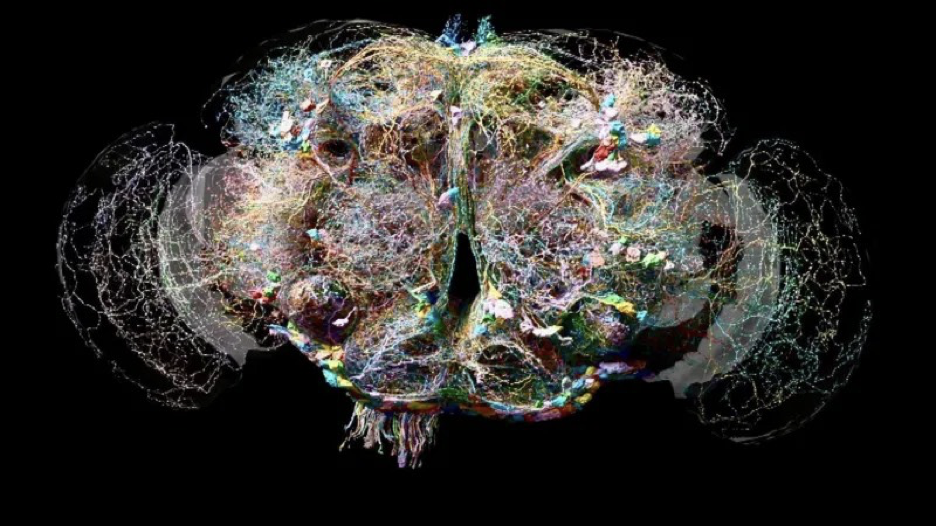
Can you imagine slicing a poppy seed into 7000 pieces, photographing each, and using artificial intelligence to extract the shapes and connections of all the neurons before digitally reassembling them?  According to a recent report in the journal Nature, this is what a team from Princeton did with the brain of a fruit fly. And because AI is not perfect, the researchers still had to fix by hand over three million mistakes, for which they recruited a global army of scientists and engineers. 

Yet even this technical tour de force was meaningless until there was a description of what each wire was supposed to do, and we’re talking about 140 000 neurons joined together by 50 million connections (compared to 86 billion neurons and trillions of connections in the human brain.) 

The images the scientists have produced show a tangle of wiring that is as beautiful as it is complex. Its shape and structure holds the key to explaining how such a tiny organ can carry out so many powerful computational tasks – fruit flies can walk, hover and the males can sing love songs to woo mates, all with a brain that’s tinier than the proverbial sesame seed.

Developing a computer of the equivalent size capable of all these tasks is way beyond the ability of modern science.

Dr Lucia Prieto Godino, a group leader in brain research at the Francis Crick Institute in London, suggests that  “Researchers had already completed the connectomes of a simple worm which has 300 wires and a maggot which has three thousand, but having a complete connectome of something with 130,000 wires is an amazing technical feat which paves the way for finding the connectomes for larger brains such as the mouse and maybe in several decades our own.”  

A neurologist suggested to me that the reason flies and bees are so difficult to swat is because the physical distance between their eyes, brains and legs are so short that the necessary neuro-signals can be carried between them more quickly than those involved in our swatting.   But using this new information, researchers have found that when the vision circuits detect which direction your rolled up newspaper or hive tool is coming from, they pass on the signal to the insect’s legs, but not to all six legs equally.  A stronger jumping signal is sent to the legs facing away from the object of their imminent demise. So in one sense they jump away without even having to think – literally faster than the speed of thought.

My hope is that, as the research sheds new light on what one scientist called “the mechanism of thought,” we will understand better how we learn, whether individually or collectively, and thus how we teach.  After all it is the latter which almost everyone on this planet experiences in some form at an age when their brains are most receptive.  The potential for good is tempered by the fact that, as has happened so often in the past, new scientific discoveries will be manipulated by bad actors for nefarious, selfish, and malicious ends.  At the individual level, and according to the 2024 report of the Global State of Scams, victims have paid $1.3 trillion to scammers worldwide in the past 12 months (which is possibly the largest financial crime in world history,) and which averages $3 520 per scam in the US.  Or Elon Musk’s stated interest in implanting computer chips in people’s brains that will enable them to control devices with their thoughts.  As George Packer writes in the December 2024 issue of The Atlantic, “We succumb to the impulse to escape our humaneness.  That urge thrives in the utopian schemes of technologists who want to upload our our minds into computers …”

At the national level, bad actors have allegedly used cyber technology, the internet and  AI to interfere in our recent election. Unlike the honey bee, the concerns of the perpetrators are totally selfish and have nothing to do with the common good. 

What will be powerful, and not only in bees,  is recognizing the interaction between the physicality of the brain and the importance of the social process.  Keith Delaplane’s Honey Bee Social Evolution : Group Formation, Behavior and Preeminence, published last month,  focuses strongly on the concepts of eusociality (eu in Greek = good.) Eusociality has four traits, whatever the animal involved – cooperative brood care, overlapping generations within a colony of adults, a division of labor into reproductive and non-reproductive groups,  and altruistic behavior (unselfish behavior focused on the welfare of the group.)  Dr. Delaplane makes the point that the only currency that matters in natural selection is the ability to pass one’s genes to the next generation.  “Whereas our species seems to have no compunction against violent enforcement of self-interest, in honey bees, natural selection has moderated the most selfish impulses of workers so that the vast majority settle for less than optimum personal reproduction in favor of supporting their queen.” Thus, along the evolutionary ladder, honey bees sacrificed their ability to raise viable progeny in favor of choosing and raising one bee to fill that role, and then devoting much of their life to caring for her progeny, all in the interests of the greater good. 

He writes that “It is social processes that drive evolution with inter-functioning themes of cooperation and altruism that are equally applicable to all eusocial species, including ourselves.”  Hopefully honey bees are  in the hierarchy of animals to have their brains analyzed,  precisely because it is a complex eusocial animal with vital lessons for ourselves. 

Confine Not Your Children …

All five of my grandchildren have social media devices of some kind, varying in capacity and complexity.  What is striking  is how the three eldest, ranging from ages 10 to 16, are quick to pull out their ‘phone’ to confirm a fact, look up an image, check a spelling, or find an answer to an issue being discussed.  The world is at their fingertips, literally, and they know how to access it.  All five are more competent on their devices than am I on my cell phone.   And yet at school they are required to relinquish their phones on arrival and listen to different people talking at them as the day progresses.

In his marvelous book,  Honeybees, A natural and a Less Natural History, recently translated from the Dutch, Jacques van Alphen describes how “There is a tradition of passing on knowledge through courses and conferences, and meetings between beekeepers often give rise to lively exchanges on all aspects of the profession.  The danger, however, is that age-old practices are not called into question, or re-evaluated and brought up to date…  As a biologist and an outsider, I was amazed at what beekeepers take for granted. …all the new knowledge about bee behavior, genetics and evolution has not led to fundamental changes in beekeeping.” 

The first beekeeping class I took, for example, was run by an elderly, competent beekeeper who was also the state inspector, and who talked at us for all but half an hour of the six classes. Looking back on the notes I took during those twelve hours, frankly I am not surprised that I lost both of my hives in the first year, nor that some were taking the class for the third, fourth or fifth time.

Challenging the status quo  is not comfortable.  I wrote two months ago about how  Cézanne’s art, misunderstood and discredited by the public during most of his life, challenged all the conventional values of C19th painting because of his insistence on personal expression and on the integrity of the painting itself, regardless of subject matter.  Personal expression and the integrity of the painting would seem to us to  be basic, yet his works were mostly rejected in his lifetime, even as, five years after his death, he was recognized by Manet and Picasso as ‘the father of modern art.’

If the first half of the C20th was the age of physics, starting with Einstein’s Theory of Relativity and ending with the atom bomb, and the second half was the age of molecular biology, starting with the discovery of the DNA helix and ending with Dolly the sheep, then it was predicted that the first half of the C21 would be the age of the brain, and, with particular relevance to education, how we process information.  Scientific journals bear testimony to the fact that the work is being done,  yet it is seldom evidenced in classrooms.  Indeed, if my grandfather could come back to life he would be confused by  much of modern life, yet if he walked into a school he would know immediately where he was. 

I would think that beekeeping classes are ideal situations for a different approach. The ‘students’ are mature, self-motivated, set their own standards, take responsibility for their own learning and, if their needs are not met or the realities of beekeeping is contrary to their expectations, are free to leave. They bring their life experiences to each class at the end of which they have a new, practical, useful, life-long skill.

Most teachers would give an arm and a leg to have students like this.  And what do we do?  In most cases, talk at them in a way in which, as Jacques van Alphen says, “age-old practices are not called into question, or re-evaluated and brought up to date…”  It is more training than education, the difference between which was explained to me early in my career, when I was asked if I would want my daughter to have classes in sex education or in sex training.

We know that talking at people is, for most students, an ineffective way of learning.  In words attributed to Mother Theresa, “There should be less talking.  A preaching point is not a meeting point.”  So, in a technological age, how might it be different, particularly in adult education with motivated students such as described above?  There are four steps involved. 

First, even before the first class meets, the task of the facilitator is to guide the participants  to the literary and internet sources that are relevant and appropriate for the upcoming classes.  I use the term ‘facilitator’ deliberately, in that his or her task is to facilitate the learning process, to make each participant (a term I prefer to student) responsible for his or her own learning, rather than feeling the need to teach it to them.  Indeed, my favorite definition of education is by Parker Palmer – creating the community in which truth may occur. 

Hence participants arrive at the first class with the basic knowledge  that the facilitator would otherwise have to spell out for them, which would have consumed most of the time allocated to each class.   

Secondly, the classroom seats are in a circle, with the facilitator as part of that circle. In this way the questions raised by the based on their class preparation are what they really need to know, rather than what the instructor thinks they should know.  Rather than  a  one-way flow of information, it’s a mutual interchange of questions and responses.   Again, in my experience, the process of discussing previously processed material is not familiar to many students – we have been conditioned to sit and listen to the expert – and initially the facilitator has to take more of the lead than he or she might like.  But very quickly the circle takes on a life of its own, and the facilitator becomes as much a gatekeeper of the process.  After all, we’re dealing with mature people, and I mean ’mature’ not in terms of age but in terms of a willingness and an ability to get the task done.

To repeat the above, “Challenging the status quo  is not comfortable.”  Some twenty years ago I was invited to run some classes for experienced teachers working towards their masters degrees.  Thinking that I was dealing with mature, motivated students, I planned to facilitate a mutually interactive environment.  It did not work – the teachers came unprepared, waited to be told what they needed to know, and were anxious to know how they would be graded. Indeed I had misread the level of maturity of the majority of the class. One of the significant advantages of the beekeeping classes is that there is no grade, no necessary affirmation from an exterior ‘authority.’ Each participant is the determiner of their own level of success. 

As an aside, many teachers are notoriously resistant to change.  It is not surprising; after all they chose the profession in part because of the positive, comforting, supportive feelings they themselves experienced at school – certainly I did – and  want to recreate those, even though as adults they might be a generation advanced from experiencing them.  They see change as a threat rather than as a way of enhancing those feelings; hence it is even more important that we have data from the neuroscientific field to combat decisions based primarily on emotions.  More about that next month. 

Thirdly, the latter part of the class would be in the apiary for practical application of the material discussed.  My preference is to allocate three participants to a hive, to ask them to take notes using a prescribed format of what they observe as they work through it, and with each following class the triad returns to the same hive, thus following its development as the season progresses. 

I can imagine the counter-argument that, at least in the first classes, a basic core of knowledge has to be created.  I agree.  We’re not talking about the what so much as about the how.  This requires trust from the instructor-turned-facilitator; trust that self motivated students, given the tools and the responsibility, will learn more, and more efficiently, in a way that is appropriate to their own needs.  

Finally, the content has to be adapted from the conventional syllabus, not least because of the increased time made available by the work  done by students before classes. For example,  the reading done for the final classes needs to be oriented to some of the newer discoveries about honey bees, to include bee behavior, genetics, the influence of chemicals in our environment, and the challenges of a warming climate. 

“The complexity of our present trouble suggests as never before that we need to change our present concept of education,” argues Wendell Berry.  “Education is not properly an industry, and its proper use is not to serve industries, either by job-training or by industry-subsidized research. It’s proper use is to enable citizens to live lives that are economically, politically, socially, and culturally responsible.” 

Or, in terms of the Hebrew proverb, “Confine not your children to your own learning, for they are of a different generation.” 
A Period of Dramatic Social Change

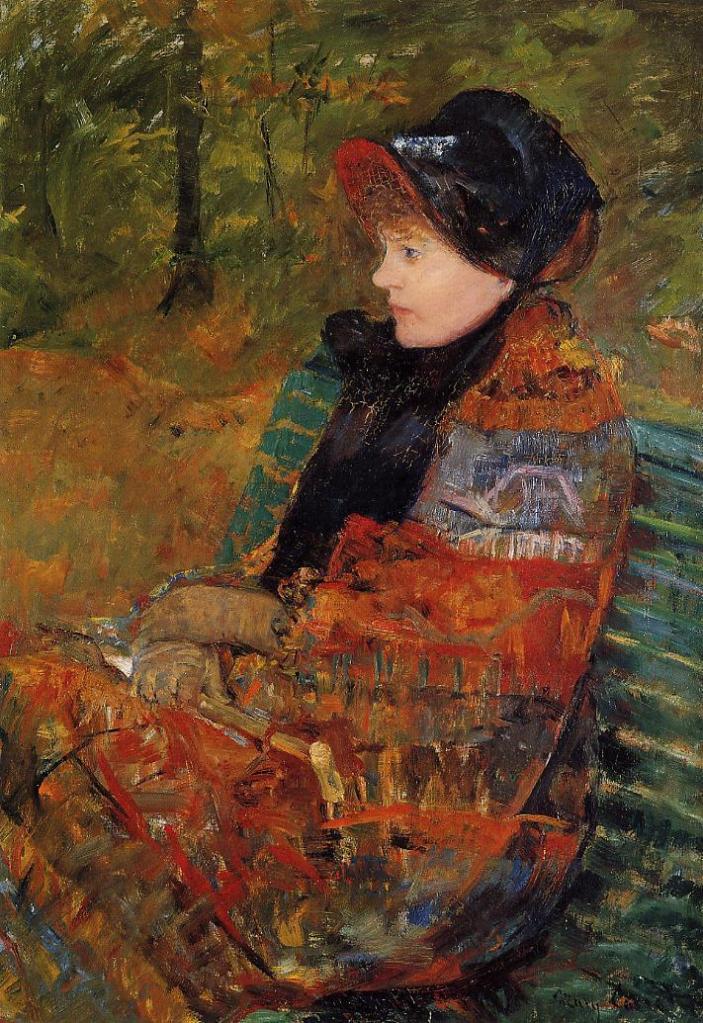
Autumn, by Mary Cassatt

I took the August issue of the Pennsylvania State Beekeepers’ newsletter to read on the train as Mary and I travelled east to see the  Mary Cassatt exhibit at the Philadelphia Museum of Art.     Cici  Sweeney’s highlights of the Golden Age of Beekeeping, emphasized  how many innovations  occurred in the generation between 1850 and 1875.  Langstroth of course, but also Moses Quinby and the  redesign of the smoker, Johannes Mehring and wax foundation, Franz Hruschka and the the honey extractor, and Abbé Collin and the queen excluder.  

And these inventions were not confined to the US – Mehring was Austrian, Hruschka was Italian of Czech origins, and Abbé Collin was French. 

The visit to the Mary Cassatt exhibit was a reminder that something similar was happening in the art world at the same time. Two developments challenged the status quo : the invention of the toothpaste tube and the development of the camera. The first enabled artists to pack their oils in tubes and paint outside in natural light, or en plein air; the second begged the question, if we can now take an instant and accurate photograph of a subject or scene, what is the role of art?  These two in combination gave rise to a style characterized by relatively small, thin, yet visible brush strokes, an emphasis on the depiction of light in its changing qualities, in particular how it was reflected by water, and ordinary subject matter which was momentary rather than heroic.  The name of the style derives from the title of a Claude Monet work,  “Impression, Sunrise,” and was initially used disparagingly. 

Mary Cassatt, who was born in Allegheny, PA, but lived most of her life in France,  exhibited for the first time at the Paris Salon in 1868.  Several years earlier four young painters – Monet, Renoir, Sisley and Bazille – discovered that they shared an interest in painting landscape and contemporary life rather than historical or mythological scenes. Following a practice pioneered by artists such as John Constable in England, they would venture together  into the countryside to paint in the open air.  By painting in sunlight directly from nature, they developed a lighter and brighter style, which quickly attracted Manet and Pissaro, as well as Cézanne.   

During the 1860s, the Salon jury routinely rejected most of the works submitted by Monet and friends in favor of works by artists faithful to the approved style.  Such is the typical response to innovation.  As one wag said, every revolutionary idea evokes three stages of reaction:  “It is completely impossible – don’t waste my time;” “It is possible but it is not worth doing,” and “I said it was a good idea all along.”

By the middle of the 1850’s, Marx and Engel’s The Communist Manifesto had been on the shelves for five years, Florence Nightingale was in the Crimea laying the foundations of modern nursing, Charles Darwin was putting the final touches to The Origins of the Species, and across the Atlantic there was a monumental division between the northern and southern states on the question of slavery that was to result in a five year civil war. Italy, Germany, the Dominion of Canada and the Austrian Hungarian Empire were created, and the Suez Canal was opened. In 1855 in central Africa, David Livingstone, in the course of exposing the horrors of the Arab slave trade, saw the waterfalls on the Zambezi River that he named after his queen, Victoria. Incidentally, a common question asked of school children in the 1950’s, myself included, was, “Who discovered the Victoria Falls?”, the required answer being David Livingstone.  Somehow, the African people who had been living there for hundreds of years had managed not to see them …

Moby Dick, Uncle Tom’s Cabin, Leaves of Grass, the first edition of the New York Times, Les Miserables, War and Peace, Crime and Punishment, Alice in Wonderland, Twenty Thousand Leagues Under the Sea and Great Expectations were published.  And there were remarkable advances in science and medicine – Alfred Nobel, Joseph Lister, Louis Pasteur, Gregor Mendel and Dimitri Mendeleev, for example. 

Surely every era has its critical events, and one can be accused of cherry-picking to suit a preconceived hypothesis, but it seems that the period between 1850 and 1870 was particularly active, not only in the comprehensive range of events – political, social, geographic, medical, art, environmental, human rights, beekeeping – but also in the stature of the people involved and in the revolutionary nature of the issues they addressed – Langstroth, Lincoln, Nightingale, Livingston, Marx and Darwin, Harriet Beecher Stowe, Melville, Whitman,  Bismarck, Cavour, Tolstoy, Lewis Carroll, Jules Verne and Charles Dickens,.

How to explain this? An introduction to the Philadelphia exhibition stated that “Cassatt’s professionalism took shape during a period of dramatic social change, driven by industrialization, urbanization, and shifting relations of race, class, gender and sex.”  True enough, but why did these particular components come together at this particular time? I don’t know the answer – surely it would make for a good discussion –  but it is intriguing and satisfying to realize, first, that relatively small inventions (eg. the toothpaste tube and the camera) can have such long term repercussions unforeseeable in the moment, and secondly,  that far from happening in isolation, beekeeping in the mid nineteenth century was an integral part of a paradigm shift in western civilization.

And the Impressionists? In the words of Jackson Arn in the September 28, 2024, issue of The New Yorker, they were ‘simplifying in the interest of intensifying.’  Cézanne, Cassatt, Monet and friends, in the midst of this dramatic social change, ‘discovered a kind of beauty beloved by so many that it became universal.’   Both observations apply to beekeepers : we use honey bees as a way of understanding a complex, intense natural world, the result of which is so beautiful that we cannot resist sharing it at every opportunity. In our current, complex times, where paint and light have been replaced by wi-fi and social media, we yearn for the simplicity that gives us insight, and a universal beauty that overcomes ugliness and hypocrisy.   Like the Impressionists, we are able to share the serenity, excitement, symmetry and elegance that we find in honey bees. If only these values, too, could become universal.

Late Bloomers

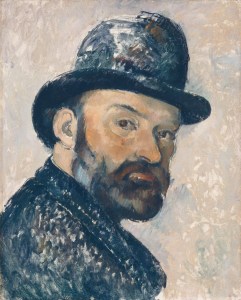
Paul Cézanne always knew he wanted to be an artist.  At his father’s urgings, he entered law  school in his home town of Aix-en-Provence in the south of France, but after two years, aged 22, he withdrew and went to Paris to pursue his artistic dreams. Rejected by the École des Beaux-Arts, he returned home to work as a clerk in his father’s bank. 

He returned to Paris the next year, was rejected yet again by the École, and his paintings were turned down every year by the Salon de Paris until 1882, when he was 43 years of age.  None of his work was put on display until he was 56, when he had his first one man show. Two years later, 1897, a piece was bought by a museum in Berlin, and in 1899, when he was 60 years old, his work finally started to sell.  He died seven years later. 

A year after his death a retrospective of his work was mounted in Paris and he was recognized as one of the founders of modern art. “Cézanne is the father of  us all,” Matisse and Picasso declared.  

Cézanne’s art, misunderstood and discredited by the public during most of his life, challenged all the conventional values of painting in the 19th century because of his insistence on personal expression and on the integrity of the painting itself, regardless of subject matter.

This story is told by David Brooks in a recent article in The Atlantic in which he seeks to understand those who make their mark later in life, whether it be Copernicus, Morgan Freeman, Isak Dinesen, Julia Childs, Charles Darwin, Winston Churchill, Alfred Hitchcock, Colonel Sanders and a host of others. Space does not allow elaboration of each one; suffice to say that Churchill was mistrusted as a political rebel and outlier until 1940, when he became Prime Minister at the age of 66, Juliet Childs enrolled in a French cooking school aged 37, and Colonel Sanders invented the recipe for Kentucky Fried Chicken aged 62.

Society today is structured to promote and reward early bloomers. By the age of 18 most of us have been pigeon-holed by grades and SAT scores, some zoom to prestigious academic launching plans and some, such as  Bill Gates, Marl Zuckerberg, Elon Musk, Taylor Swift, Michael Jordan and Lebron James, take other routes.

But there are also successful late bloomers; indeed the average age at which Nobel Prize winners made their crucial discoveries is 44, which means that approximately half of them did so well into the second act of their lives.  In essence, they focus not on the finished product so much as on the process of learning itself.  They see their lives as a process of trial and error so that the quality of their work peaks as they age. 

In Late Bloomers, Rich Karlgaard teases out the traits that distinguish early from late bloomers. Most of our schools and work places, for example,  are based on extrinsic motivation  – work hard and you will be rewarded with good grades, higher salaries and performance bonuses.  Early bloomers are good at meeting external standards, at following other people’s methods and at pursing goals determined by others.  Late bloomers, by comparison, are bad at being what has been called ‘excellent sheep.’  They often feel unfulfilled at school or work and can be contrary if not rebellious.  Winston Churchill  reflected that “Where my reason, imagination or interest were not engaged, I would not or I could not learn.”

Our culture encourages people to specialize early – concentrate on one thing and get really good, really fast. Late bloomers, by comparison, need a variety of experiences even if it means frequently changing jobs and developing a reputation for inconsistency or unreliability.  But this is when they are developing what has been labeled ‘diverse curiosity,’ the benefits of which become evident once he or she draws on the breadth of their knowledge to put discordant ideas together in new ways.

Late bloomers teach themselves – they enjoy the cognitive process (Leonardo da Vinci is the poster child) and being too old for the traditional educational system, nor wanting the restrictions built into it, they become fascinated and absorbed by the pleasures of concentrated, voluntary efforts in which they are free to plot their own course and to change their minds and their objectives without recrimination.   And to this they bring their life experience, otherwise called wisdom, in particular the ability to see things from multiple points of view and to sustain the tension that often exists between them. 

Finally, late bloomers never cross the finish line and relax. Age does not diminish their curiosity; “They are seeking.  They are striving.  They are in it with all their heart,” to cite David Brooks.

Honey bees clearly are not late bloomers!   Each bee follows a genetically driven master plan that determines their development and their role in the bigger society,   Similarly, in the African society with which I grew up, the social norm was ‘to keep down with the Jones’s.”  As one tribal elder said to me, “If one blade of grass grows higher than the others, we cut it down.” With significant credibility given to the power of spiritual forces, the credo was each individual is born with a talent with which to serve society, but to exceed that is a sign of a malevolent force.   Initially this presented a significant challenge for European-trained teachers in some African countries.  I recall a District Commissioner describing the traditional belief that tribal people accumulate knowledge as they age, that they do so at the same rate, hence the significant respect given to elders who, because of their age, were also the most knowledgable.  Recognizing differences in students, or trying to stimulate them through grades, initially proved counter-cultural and unsuccessful.  

And a thousand years of western civilization was not much different.  From the fall of Rome to the Renaissance was a millennia of remarkable conformity.  The life of the common man in 500 AD was little different to that of his successors one thousand years later. The purpose of art, for example, was to glorify God, and works consisted almost entirely either of moral pieces warning of the dangers of sin, or of depictions of biblical figures and events invariably set in contemporary times. For me, this is why Leonardo’s Mona Lisa is so revolutionary  For the first time in a millennium, a major artist had painted a woman in her natural beauty and enchantment, without traditional Christian artifacts.  It was a celebration of humanity set in the harshness of  the natural world.  And in terms of late bloomers, the exact date  of the painting is unknown, but Leonardo seems to have started work on the Mona Lisa when he was in his early 50’s, and continued work on it or various editing of it, until he was in his mid 60’s.  Late bloomers are seldom fully satisfied “”They are seeking.  They are striving.”

None of this is to denigrate those (and there are many) who focus on one issue, for example keeping honey bees, and find satisfaction in a particular method that works well for them without any need to deviate from that.   One of my uncles was a spitfire pilot in the Second World War,  after which he returned to the town and house in which he grew up, never learned to drive a car, and spent his vacations working on his allotment or fishing in the river Exe.  When I first met him, in 1980, he impressed immediately with what is often described as ‘serenity’; he was deeply content and wanted for nothing … and I was a little envious.   

Looking back at my career, I changed schools every seven or eight years whereas many of my colleagues remained (and maybe still are) at the same school for all of their teaching career.  Two things are clear in retrospect.  First, that after seven years I felt I had gained, and offered, all I could from that particular system and needed a change if I was to remain vital.  Secondly, the wide variety of extra-curricular activities that I organized, ranging from evening clubs like Toastmasters or a History Society to three week bike tours in Europe, were not so much stimulating the students, as I thought, but were providing me with the challenges, the inspiration and the fulfillment that I needed.  

As a beekeeper, I am restless, always seeking  stimulation, and enjoying the process a much as the product.  Which brings me to my hypotheses – that many beekeepers are late bloomers whose life experiences have brought them to this hobby.   They are extrinsically motivated, set their own standards, take responsibility for their own enlightenment, enjoy the learning process and the feelings of accomplishment that come with it, and are surprised by the unexpected exposure to a variety of associated issues such as plants and pollination, chemicals in agriculture and their impact on animal life, the amazing society that is the world of a honey bee hive with its relevance to our own community, whether local or national, and indeed, the local impacts and challenges of a changing environment. 

Perhaps it is the constant provocation and challenge provoked by such questions that cause some to stay involved, with the comfortable realization that every answer leads to yet more questions. 

The Paradigm of Separation

“Americans of all ages, all stages in life, and all types of disposition, are forever forming associations.”  Thus wrote Alexis de Tocqueville after he had traveled around the United States almost two hundred years ago, even as his main mission was to study the prisons and penitentiaries on the other side of the Atlantic.  “There are not only commercial and industrial associations in which all take part, but others of a thousand different types  – religious, moral, serious, futile, very general and very limited, immensely large and very minute.”

160 years after de Tocqueville published Democracy in America, Robert Putnam, Professor of Public Policy at the Harvard University John F. Kennedy School of Government, released an essay which he later enlarged into book form – Bowling Alone : The Collapse and Revival of American Community. Many traditional civic, social and fraternal organizations, typified by bowling leagues , he argued, had undergone a massive decline in membership even as the number of people bowling had increased dramatically. It was the leagues that brought together different peoples from different backgrounds and cultures to share in a common purpose.  As Beau Breslin wrote recently in an article in The Fulcrum, “There is commonality in beer, frames and ugly shoes.” 

In 1967, 2% of Americans admitted to no religious affiliation; now that number is 30%.  It was places of worship that grounded Americans in a collective morality.  No longer. Union membership is down (10 per cent across the nation in 2024) as is involvement in professional associations like the American Medical Association and the American Bar Association. Increasingly, Americans no longer believe that ‘associations’ merit their time.  

Curiously, voter participation has remained steady, actually increasing in presidential elections in this century.  But there is a twist : polarized electors are galvanized by hatred. They are energized not so much by the appeal of a candidate so much as by a deep dislike of the other. Anger at your partisan enemy might get you to the ballot box, but it will not get you to the bowling alley, nor to a beekeepers’ meeting. 

The first county beekeepers meeting I attended in 2002 was poorly attended, and records show that was the norm. But with all the the public attention consigned to the plight of the honey bee by Colony Collapse Disorder, enrollment in beekeeping classes soared as did attendance at meetings.  That trend was, in my observation, already in decline five years ago, made worse by COVID and which has continued since the pandemic.  It is one of the ways in which we have not yet recovered from the forced isolation of 2020 and 2021.  It distresses me that, for the last two years if not longer, our local beekeeping association has organized some good meetings with prominent speakers, and the attendance has been minimal – perhaps 20 per cent of the total  membership.  That was not the case ten years ago, when we had to change venues because the turnout regularly exceeded the limit imposed by the fire code. 

Talking to PSBA President, Mark Gingrich, he suggested that during COVID many associations held their meetings via Zoom, and many who continued to offer that option after the pandemic are re-thinking the practice precisely because it encourages the isolation that denies the meaning of our collective lives.  

It has further implications.  As John Miller explains in the July issue of the American Bee Journal, the Bee Informed Project has ceased to operate because its research and the immense data trove that it accumulated was not supported by sufficient paying beekeepers who valued their services.  

In You Are The Happiness You Seek, published two years ago, the English philosopher and author, Robert Spira, argues that there are essentially two models for civilization.  “The first  is one in which the ideas and attitudes of individuals are informed by an understanding of the relationship to the whole, and their activities and relationships are the means by which this understanding is expressed in society.

“The second model is one in which individuals overlook their relationship to the whole and, as a result, believe and feel themselves to be discrete, independently existing entities. This is a paradigm of separation that inevitably leads to unhappiness on the inside, conflict on the outside between individuals, communities and nations, and the exploitation and degradation of the earth.”  

As is invariably the case, it is not difficult to determine which of the above is modeled by honey bees. 

History is replete with examples of collapsed civilizations in which individuals neglected their relationship with the whole. We too show signs of disintegration without embracing the remedies to rectify it.  It is like a sick parent who defies, even sabotages, the attempts of caring children who want to help, or the patient diagnosed with a potentially terminal illness who obstinately refuses to take the medicine. 

What is the solution?  Do we wait for an external event to force us back together, like CCD in the case of beekeepers, or do we become proactive?  It is not difficult and there are two things  that each of us can do.  First, there are many times when I have been tempted not to support an activity organized by an association I care about, to stay home rather than go out to an evening meeting.  And yet every time, almost without exception, I am glad afterwards that I went, often for reasons that I could not anticipate. 

Secondly, value those who are willing to give of their time and energy to organize those occasions when community comes together – meetings, picnics, cook outs, presentations, discussion groups – despite the disappointing turn outs. Those numbers too are declining and it is easy for volunteers to get disheartened, even as they are the heart beat of a successful organization. 

So, when offered the choice, not only welcome the opportunity to attend those forums which provide the opportunity to understand others and calibrate our collective moral compass, but make a point of recognizing and honoring those who made it possible.   Show up and give thanks – that is the solution.  We may not be teammates, but we are committed to our league.

Golden Handcuffs

In February I took our dog, Seamus, to the vet for his annual check up.  Ever since the covid pandemic  there has been a sign at the end of each parking space asking owners to call and announce their arrival, and then to wait for a return call summoning them inside.  For safety reasons there was to be no loitering in the waiting area.  What struck me was the assumption by the office staff that everyone carries a cell phone; certainly there was no explanation of what to do in the absence of such a device.  

When did this assumption start?  In 1989, four years before the end of the apartheid regime,  I spent part of a sabbatical teaching in Soweto, the large township south of Johannesburg.  Indeed the word Soweto stands for SOuth WEst TOwnship.) I quickly learned that I could not ask the students (the equivalent of 10th graders ranging in age from 13 to 22) to do homework because most lived in so-called ‘match box’ houses with neither electricity nor indoor plumbing; the idea of students working at home in the evening was not feasible.  

Similarly, when I first taught in the US, in 1991, we could not assume that all students had access to a home computer, nor a few years later that all had access to broadband.  In the space of two years I had transitioned from no electricity at all to questioning broadband access, even if in different geographical locations.  

Sadly,  assumptions can deputize as handcuffs.    In parts of Asia for example, young elephants are trained by attaching a short chain to one of their forelegs, which is then tied to a stake that is driven into the ground.  After about year,  the stake alone is put in the ground and the elephants assume that they are constrained by a now-imaginary chain length. 

 It seems to me that we, as beekeepers, are often fettered by chains that exist only in our minds. 

Two examples.  Journal articles seem to assume that it is necessary to feed sugar syrup in the fall, and again in the late winter.  As I understand it, feeding sugar was developed in post-war Canada, when sugar was cheap and honey expensive.  The motivation was solely economic – remove and sell all of the honey and replace it with white sugar. Curiously the effects on the health of the bees were and are seldom questioned.  An advertisement for HiveAlive in the August issue of Bee Culture states that “The ideal  carbohydrate for bees is their own honey …” and confirms that not only is the nutritional profile of sugar not as good as honey but it lacks the antibacterial and antifungal properties naturally found in honey.   It should be no surprise that research in labs such as that of Dr. Gene Robinson has shown that bees fed sugar syrup in the autumn  might emerge from the winter in greater numbers but they are smaller in size, lighter in weight and, critically, their immune system has been compromised.    Are we unwittingly creating a hive environment that favors the mites in that the bees are less well equipped to defend themselves?

The ad mentioned above is promoting the use of additives to the sugar syrup.  That is a band aid compared to leaving more honey on the hives for the bees.  And if one does need to feed , why not use honey itself, either still capped in the frame or in the same manner as one would normally feed sugar syrup?  

To  take this a step further.  After a presentation by Dr. Dave Tarpy at EAS in 2022 on queen losses, the issue arose of the quality of royal jelly.   How does the jelly from nurse bees who are fed sugar syrup differ from those who are  living off their own honey, and how does this impact the larvae of not only queens but  worker and drone brood?  Is this an underling reason for declining queen quality and longevity?  If I understood Dr. Tarpy correctly, this has not as yet been researched but might be examinable in the work done recently by a post-grad student in his laboratory. 

The second example involves screened bottom boards., which were introduced in the 1980’s as a first response to the varroa invasion, on the grounds that the mites would drop off incoming bees, fall through the screen, and be unable to regain access to the colony. We know now, from the work of Dr. Sammy Ramsay in particular, that mites do not fall of incoming bees unless there are so many mites on the bee already that their normal places of attachment are not available and the mites are therefore exposed.   As one researcher revealed,  if one sees a mite on the back of a bee, there are probably 8 mites already securely attached under the abdomen but not visible. 

Besides changing the ventilation flow in a hive (I have yet to come across a feral hive with a screened bottom,) and writing in the same issue of Bee Culture cited above (August, 2023,) Tina Sebestyen points out that a screened bottom board increases mite reproduction because it lowers the humidity,  and mites do better at the lower range of humidity which the bees maintain in the hive.  

Hive Mind, an article by Sam Knight in the Aug 28, 2023, issue of The New Yorker, cites Dr. Tom Seeley : “As I see it, most of the problems of honey bee health are rooted in the standard practices of beekeeping, which are used by nearly all beekeepers … In the United States, beekeepers are taught only what we might call the industrial form of beekeeping.  And that’s where I would say, ‘No, there is a choice here between how you want to relate to an organism who life, in a way, you have under your control.” 

Thus I am perturbed when writers mention without qualification the use of sugar syrup and screened bottom boards. These two in combination increase the odds in favor of the mites and make a difficult position even worse for the bees.   Like the elephants’ chain, there is minimal connection to  reality but the illusion is kept alive in many introductory bee classes and in articles in reputable bee journals. 

A Richness of Heart

In a tribute to the late T.J.Carr, published in the ABJ of May, 2024,  Amy  Owen cites him as saying that “The best part of beekeeping is the people you meet.”

Consider two scenarios.  In the first, eyes are clouded by smoke and a veil, ears are awash with the complex sounds produced by thousands of little bodies in action, nostrils flood with complex odors and pheromones, and limbs and neck wrestle with boxes and frames glued together by propolis, not to mention the sheer weight of a super of honey. 

In the second,  eyes are blinded  by a blend of floodlights and blurry bodywork,  eardrums are drenched in the whirring noise of 1,000 mechanical horses, nostrils are stained with the stench of burning brake ducts, and limbs and neck wrestle relentlessly with immense gravitational force.

The first is obvious; the second describes a  Formula 1 car driver at full throttle,  an  intense sensory experience during which a driver can suffer motion sickness, light-headedness, vision glitches, and  can lose up to 6 pounds in two hours of split- making decision making behind the  wheel.  Both experiences are physically draining and emotionally; both are intense in their own particular ways. 

Unlike many beekeepers, a F1 driver never races alone.  He or she is constantly  accompanied by the guidance of a softly-spoken ally at the other end of the team radio system, aiming to maximize the team’s final outcome. 

That voice belongs to the race engineer.

Weather changes, tyre wear, gear shift advice and details about rivals’ tactics – such are the technical information passed from the race engineer to the driver. But most important are the human-centered skills by which the engineer quells the driver’s concerns and emotions so that both  are free to operate entirely in the present, to the point that their faith and trust in each other develops into one the most intimate relationships in professional sport. 

There is almost always at least one generation between a driver and his race engineer; they often come from completely different parts of the world and do not share a first language. A big effort to understand each other’s backgrounds, personalities and motivations is key to building a successful relationship.  Usually this mutuality  develops in a series of meetings in a non-professional environment in which each shares the normal things in life  – hobbies, family, education – so as to better understand each other’s lives, values and culture, and thus develop  elevated levels of empathy and emotional intelligence.  After all, drivers literally put their lives in the hands of their race engineers whenever they take to the track.  

Yet they don’t always have the luxury of a full winter of interaction and preparation. When now-triple world champion Max Verstappen was first promoted to the Red Bull team mid-season in 2016, race engineer Gianpiero Lambiase had only a few days notice to mould an 18-year-old who combined  supreme talent with a blunt disposition.   Their relationship was an immediate success (the fact that Lambiase had experience working with multiple drivers before Max was a critical factor) and  Verstappen became the youngest race winner in Formula 1 history, finishing first on his debut at the Spanish Grand Prix. 

The role of the race engineer is one of mentor, with high stakes in times of incredible pressure, all under public scrutiny.   The stakes of mentoring are not normally so high, nor the scrutiny so public.  The five year old granddaughter of a friend, for example, spent five days at home with her teacher-to-be before she started her first year at a local Montessori school, such was the school’s recognition that understanding “each other’s backgrounds, personalities and motivations is key to building a successful relationship.”  In the Montessori system, because the teacher had class advance together, that relationship stretched over eight years. 

Over some 42 years in the classroom I learned that time spent developing relationships was never wasted.  With experience and confidence, I spent the first week getting to know the students a little better, and encouraging them to get to know me.   My colleagues often felt that a busy curriculum did not allow them such a luxury; in my experience, the quality of the learning that followed more than compensated for the loss of formal teaching time.   Curiously it is something that teachers of younger grades do really well, yet decreases as students age, even though the latter are dealing desperately with issues of identity and are searching, even if unconsciously, for some kind of mentorship. 

Clearly there are different ways of mentoring a new beekeeper.  Some may choose consciously to develop a relationship early in the process, perhaps by initiating an e-mail conversation enquiring as to how the mentee became interested in managing honey bees, what his or her objectives are, are there any other related hobbies or interests, is there a spouse or children who might be interested, what is he or she most fearful of and most excited about? Others may recognize and celebrate the relationship as it develops, or even suggest a different mentor if one feels that the absence of affinity is hindering the learning process.  In the words of the 13th century Persian poet, Rumi, “The amount of light in a room depends on the number of windows.” 

And clearly one can survive without such a relationship – neither the instructor of the first bee class I took nor my first mentor would list either communication or empathy among their strong suits – yet I survived, partly because I had both passion and persistence and took responsibility for my own learning.  I have also been a mentor to a few beekeepers in which we  developed a relationship that went beyond the how’s and to’s of bee management; it became a mutually beneficial interaction, despite the generation gap, and I got as much out of it as I was able to offer. 

Besides our name, our personal story is the most individual thing we possess.  Both symbolize our uniqueness and our humanity, and we are more open and vulnerable to those who recognize this, whether by listening or by asking the right questions. In the words of one successful race engineer : “Increasingly you realize that it is the human side where most of the competitive edges come from in Formula 1. You realize it is all about the people.”  And as expressed by another engineer, “In Formula 1, as in all our lives, the magic of the most special relationships will always remain unique.”

In the July, 2024, issue of Bee Culture, Diane Wellons describes how bees and beekeepers helped her though several years of major health challenges.  “Each season presents a new circle of friends to mix with the old circle,” she writes, “and my circle just keeps growing. There is a richness of heart to this hobby, this association, that I did not anticipate.” 

Surely T.J. Carr would have agreed.