Musings on Honey Bees, the Environment and Ourselves
Author: Jeremy
I have spent some 75 years living and working in England,Rhodesia/Zimbabwe, South Africa and the USA, with many opportunities to learn from beekeepers in a v variety of African and European countries in between . An educator by profession, with a focus on history and group dynamics, the honey bees chose me in 2002, despite which, like many beekeepers, I lost my first two hives over winter. In 2009 I was asked by the editor of the PSBA to write a column for the monthly newsletter, which she labelled "Jeremy's Corner"; 14 years later is still continues. A rather eclectic style of content and vision developed, and these posts are based mostly on those essays. Meanwhile I was fortunate to be honored as York County's Beekeeper of there Year in 2013, and similarly for Pennsylvania in 2018.
We call on you, o winged spirit of sweetnesss.

         Teach us the ways of transformation and renewal,

                  the path from nectar to honey,

                           from pollen to paternity.

Teach us to taste the essence of each place at which we alight

      as we continue the cycle of creation and delight.

Teach us the ways of hope, reminding us

     that what seems impossible may not yet be in sight.

Dance us ever closer to the wisdom hidden within beauty

      and the beauty hidden within wisdom.

Grant us passion and productivity,

      flight and sunlight,

            cooperation with our fellow hive mates

                  and sharpened strength to defend our home.

May we ever spiral outward from our hearts,

      searching for what we need

            and return home once again

                  bringing the bounty of nature and the blessings of life.

We ask this in the name of all species on this planet we call home.
/In his book Lost Child in the Woods Richard Louv uses the term ‘nature deficit disorder’ to describe how children today are increasingly disconnected from the natural world. Beekeeping seems to be an interest which most of us discover in our later years and the question becomes are we yearning for something that we know intuitively we have lost or are we using the bees to re-connect with a childhood memory of the natural world? Certainly the concept of nature can be romanticized and perhaps many new beekeepers discontinue their interest when those idyllic impressions are disturbed by reality.
In my case, as a white boy growing up in a British colony at the height of the imperial experience, I had immense freedom together with race-based privileges which I took for granted. There were no restrictions as to where I could go, where I could walk or climb or ride. And many weekends were spent clambering over the rocks and slopes of Murahwa’s Hill. I had no fear of the troops of vervet monkeys and chacma baboons which roamed the hill named after Chief Murahwa of the Manyika people, nor of the leopard which my father would hear at night with it’s characteristic cough.
“Did you hear the leopard last night?” he would ask occasionally. I never did.
I remember only getting a rush of adrenalin as the rufus colored nightjars, which lay superbly camouflaged in the granite outcrops until the last possible moment, would fly up from under my feet in a flurry of feathers.
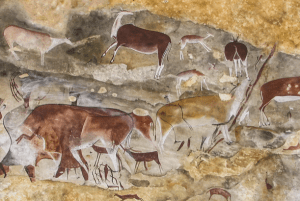
One day I climbed down a short fissure below the summit to a small, precarious ledge and found a faint but definite Bushman rock painting. I sat in wonderment, gazing over the valley in which the town nestled, awe struck at the thought of perhaps being the first person for more than a thousand years to see this beautiful example of Khoisan stone age art. On later visits I would stand on the summit, waving to the houses below trying to attract my parents’ attention, or, sitting on the ledge, I would use a mirror to reflect the sunlight on to our house in the hope that someone would notice, much as we did in class when we used the glass on our watches to flash onto the ceiling, or more daringly, into the teacher’s eyes, wondering whether he would notice (and we were taught almost exclusively by men.)
It became a ritual to sit on that ledge at noon, eating the sandwiches my mother had prepared, looking over the town.
On another visit, and not far from the ledge but on the east side of the summit, facing towards the BaVumba mountains and the Portuguese colony of Mocambique, I stumbled across an old wall of stone between two huge granite boulders that seemed to block the entrance to a cave. Over the next few weeks, enlisting the help of some friends, I tore away some of the rocks, rolling them carelessly down the mountainside, a dangerous and senseless act of destruction for which we were later, and quite correctly, chastised by the local representative of the Historical Monuments Commission when a small group of museum authorities inspected the find.
Several weeks of such despoliation uncovered a hole large enough to squirm into, encountering the strong odor of either a leopard and/or of dassie guano. Dassie was the local name for rock rabbit, or hyrax, which lived in the crevices and was the favorite food of a pair of black eagles who nested on the adjacent hill. Dassie droppings were thick and rich in the cave and on one occasion I filled a jute bag and took it back for my father’s compost heap, a gift he much appreciated,.
Confident that the noise and activity would have long frightened away the leopard (and confident too of the animal’s notorious shyness and secretiveness) I wriggled forward. Later came the realization that the leopard did occasionally occupy the cave, gaining access though a small opening in the jumble of collapsed rocks in the roof.
It is difficult today, more than 50 years later, to recall the feelings of a young man entering a dark, dry space; I suspect I was intent on discovering the main purpose of the vault behind the wall. I had convinced myself that it was a burial site and that the vague shapes which were semi-lit by the peripheries of the beam of the flashlight were skulls resting on a ledge in the cave wall. Digging away the compacted soil behind the stone wall had exposed small, tunneled smoothen passages that left ridges and curves much like old bones; they were probably the passages of white ants which had long since departed.
I remember too being struck by how smooth the walls were, convinced that this was the result of thousands of pairs of human hands brushing past; it was more likely to have been the result of water erosion over thousands of years.
What I did find were the remnants of old, clay pots, typical of the Bantu, Shona-speaking, Iron-age people indigenous to the area. This was evidence enough that this was a refuge site to which the local Manyika would flee when they were attacked by the stronger Ndebele; the pots were used to store grain for such desperate times of need.
On one occasion, and it is no longer clear exactly which part of the chronology this fits into, I had come down from the hill in the late afternoon. My father confirmed that I had indeed eaten my lunch on the ledge as usual and asked if I realized that the leopard had, for a short moment, been standing on the summit above me as I ate. Apparently he had noticed the distinctive cat-like silhouette, particularly the long, upward curing tail as it appeared briefly above me, looked out over the valley, and disappeared.
On reflection that was a monumental moment in my life. Sitting on a rock that had attracted a man from prehistory, marveling at the pictorial dimensions of his spirit and unknowingly sharing the view with one of the wild’s most noble, most untamed creatures, I was an integral part of the natural world. It is at such moments that a young man gets his first glimpse of the holy grail and which can later be rekindled in passions such as beekeeping.
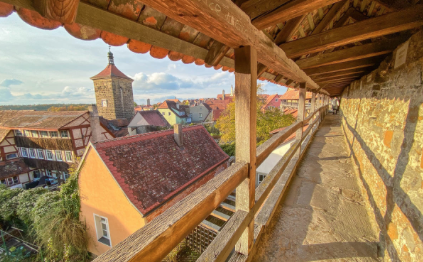
In 1986, while with a group of high school students in the beautiful, romantic medieval town of Rothenburg ob der Tauber, in Bavaria, one of my colleagues suggested to some students that they should “Stay close to Mr. Barnes so he can tell you what he is seeing.” We were walking atop the wall that surrounds the town, much of which was laboriously and lovingly reconstructed after the Second World War, and no doubt my colleague meant well but I realized I didn’t want to talk. It was only much later that I understood that what I did want to do was to feel, to absorb the atmosphere of what had happened there over the past millennia, to imagine and empathize with those generations of villagers whose lives and experiences were very real even if they will never be recorded in the history books. To talk would have been to release and minimize and curtail those emotions and, as I recall, I did indeed keep quiet. Doubtfully very few, if any, of the students understood.
I get the same feelings in a Gothic cathedral, not least as happened at Chartres when a lone guitarist was playing gently at the back of the nave, the remarkable acoustics wafting his gentle melody throughout the sanctuary. And I think now, in retrospect, that underlying my teaching was an unconscious attempt to encourage each student in the classroom to find a sense of awe within some aspect of the curriculum, some feature that I could not predict or anticipate. I suspect that too did not happen as much as I would have liked.
Edmund Burke used the word sublime, for Sigmund Freud it was oceanic feelings and Abraham Maslow talked about peak experiences, but each refers to the experience of encountering something so vast in size, skill, beauty, intensity or significance that we struggle to comprehend it; indeed we may have to adjust our world view to accommodate it.
In the seventeenth century on the southern coast of Africa, the survivors of a people then known as the Hottentots were asked of their impressions when they saw the first Dutch caravels rounding the Cape of Good Hope. “They were so big,” responded one, “that we could not see them.” It was an awesome sighting, too big to understand initially, but their worldview would be changed forever.
At roughly the same time Francis Bacon suggested that “The job of the artist is always to deepen the mystery.” Beekeeping is an art as well as a science, and invariably the more one gets acquainted with honey bees not only does the sense of wonder and mystery deepen but our worldview expands and our egos shrink by comparison. Psychologists Patty Van Cappellen and Vassilis Saroglou verified that awe makes people feel a greater sense of oneness with others, while Paul Piff and his colleagues describe how putting people in an awe-inducing situation increased their feelings of generosity. Peter Suedfeld, in an analysis of the memoirs of 56 astronauts, showed that their awesome experience increased their belief in an interconnected humanity.
Practical application, as Randy Oliver might say. Is this why new beekeepers invariably comment on how friendly, welcoming and helpful beekeepers are? That the awe that develops as one becomes increasingly familiar with honey bees encourages feelings of oneness, generosity and interconnection that extend beyond the hive?
The observations of some significant beekeeper/scientists enhance that sense of awe. The Swiss naturalist, François Huber, was only fifteen years old when he began to suffer from a disease which gradually resulted in total blindness; but, with the aid of his wife, Marie Aimée Lullin, and his servant, François Burrens, he carried out investigations that laid the scientific foundations of the life history of the honey bee.
Karl von Frisch was an Austrian ethologist who received the Nobel Prize in Physiology or Medicine in 1973 for his investigation of the sensory perceptions of the honey bee and in particular his decoding of the meaning of the waggle dance.
And then there is Dr. Tom Seeley of Cornell University whose prime focus has been on understanding the phenomenon of swarm intelligence, culminating in the superb publication, Honey Bee Democracy. More recently he has been the inspiration for, and part of the team that developed, the Honey Bee Algorithm which uses observations of honey bee foraging behavior to allocate shared web servers to internet traffic.
The current trend in honey bee research is genomics. At the Third International Conference on Pollinator Biology, Health and Policy, held here in Pennsylvania in 2016, it was noticeable how the honey bee genome featured in almost all of the presentations. It may be a reflection of my limited understanding but I did not feel the same sense of reverence and esteem as when listening to Lucy King’s explanation of the behavior of elephants that were confronted with log hives suspended by wires around a corn field.
In a speech at Georgetown University on May 4, 2011, focused on our loss of connection with the land and the sense of awe that that connection evokes, Wendell Berry argued that we need a change in the teaching of biology in schools K – 12 with an emphasis on what used to be called ‘natural history.’ We need field biologists, practical naturalists, who will take their students outdoors for more than just the occasional field trip, teaching them to read their local landscape so that economic and ecological responsibility become a single practice and they realize “… that the habitat of every creature in our home countryside is also our habitat, and to make it less inhabitable for other creatures makes it less inhabitable as well for us.” Because in nature everything is connected.
Barbara Hagerty, writing in the Jan/Feb 2017 edition of The Atlantic, and citing George H. Bush as the poster child of a happy second act, describes what midlife research suggests is the secret to fulfillment : shifting away from ambition and acquisition and toward activities that have lasting and intrinsic worth, such as investing in important relationships and causes or hobbies that give joy and meaning to one’s life.” For me that hobby is beekeeping, not only for the awe that it evokes but equally the human relationships that develop because of it.
We cannot all go to space to experience that sense of interconnectivity, or perhaps witness at first hand the miracle of childbirth, but we can go for a walk in the woods, enjoy a waterfall, marvel at a colony of honey bees, or spend time with special friends, thus finding the generosity, the sense of oneness, even the awe, that brings meaning to life and may even change our world view.
“Where do bees come from?” the fuzzy bee asked as she ate through the last bit of wax that was holding her in the crib. A passing worker, whom the fuzzy bee had mistaken for her mother, thought quickly. She recalled what she had overheard from foragers as they used their heads to pack pollen into the cells in the pantry right next to the labor ward.
Big Mama, whom she had occasionally sensed with her antennae as the distinguished persona passed by in the dark in search of clean cribs in which to dip her royal abdomen, determined whether to give birth to boys or girls, although the nurse bees knew that the decision was based on the size of the basinets built by the ladies of the community. The latter was a carefully guarded secret among the ladies, not wanting to hurt the royal ego.
Big Mama goes into labor as often as 2000 times a day and the young darlings are fed so often by their foster-moms and grow so fast that after a week they have increased 500 times in size.*
Fortunately Big Mama does not have to conjure up names for her progeny; indeed she does little for herself but is fed and cleansed by a retinue of women who hover around her day and night, tending to her every need. They know that should she fail they can choose several of her youngest daughters, feed them a special baby formula and they will become Big-Mamas-in-Waiting.
Every day, for about two hours, the young men of the community take off in search of a Big Mama (not their own, that would be incestuous) with whom to frolic. They run around recklessly, blinded by passion, and if they spot one they pursue her ruthlessly, often falling exhausted by the wayside until one of the four hundred lovelorn romeos finally reaches her and in an act of explosive mating … dies. The rest of the guys go home to mama where the women folk tend to their every household need so that they can return to the fray the next day. Most will perish with their one purpose in life unfulfilled, bachelors to the very end.
Sadly there is no love involved. It’s shameless, selfish procreation both from the men and from Big Mama who shows no interest in her children once they are ensconced in their basinets.
Meanwhile the ladies of the neighborhood, who outnumber the men 30:1, go through a series of activities ranging from preparing the basinets for new offerings from Super Mom to going to the store thirty times a day and returning with baby formula strapped to their legs in baskets. In emergencies these ladies can produce boy babies which they lay in profusion in single basinets, but eventually the village will die because of the lack of co-dependent ladies to tend to their menfolk unless, by some kind of divine influence, a new Big Mama mysteriously appears in the village, literally dropped from the heavens, ready to get to work.
No, she thought, that can’t be true. Not only is it ridiculous it’s enough to turn boys off of sex for the rest of their lives and for little girls like this fuzzy bee to give up any hope of successfully becoming pregnant. So let me tell her how it really is. “In England,” she said, “the stork brings baby bees, which is why we talk about the birds and the bees. In France they are found under a cabbage leaf. But this is America, and so you can find out more about it on the internet.”
* For human readers, if we developed at the same rate, a child with a birth weight of 8 lbs would weigh 2 tons after 6 days and be the size of an elephant.
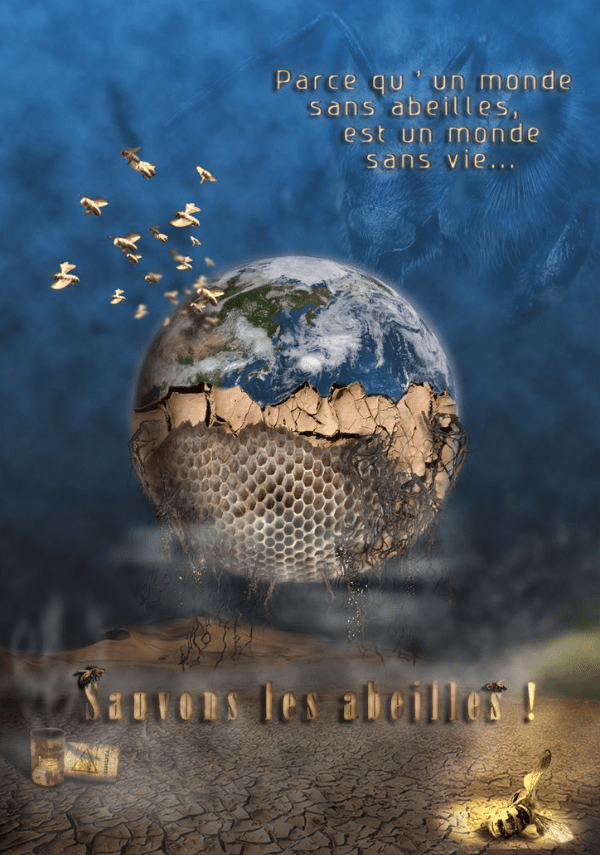
Because a world without bees is a world without life. Save the Bees!
Beekeepers are frequently asked why native bees alone cannot provide the necessary pollination services, with the implication that honey bees, as an imported species, are trespassers on American soil and that if they should die out their native cousins will quickly replace them. The same argument applies to plants : that we need to replace all ‘exotics’ or invasives‘ with native species.
Lets ignore for a moment the fact that many of the 4000 species of bees native to north America also appear to be in decline, which is troubling in itself, and extend this question further. If we need to replace exotics with natives then horses, domesticated pigs, cattle and even chickens must go, which means no beef, veal, bacon, pork, but also no dairy products – milk, cheese, yoghurt Most of our fruit trees were originally imported at the same time as the bees, so oranges, apples, pear, plums, peaches and apricots would no longer grace our tables, neither would potatoes, tomatoes, avocados, sweet potatoes, strawberries, carrots, radish, spinach, beets, cabbage, cauliflower, dates, figs, olives, pineapples, grapes, legumes, watermelon, rhubarb – you get the picture. Even dandelions were imported by the New England settlers to provide leafy greens early in the year. An interesting exercise, say at dinner, is to remove first from one’s plate everything that was pollinated by a honey bee, followed by all of the non-native foods. That would include coffee, regular tea and chocolate, and anything that included wheat or rice. With a hamburger, for example, one is left with the tomato.
Surprisingly, even our lawn grasses, including Kentucky Blue Grass, are not indigenous to the US.
To go even further, much of our life style is not ‘native’ but based on European culture – our houses, language, much of our music, educational system – the same culture that provided us with honey bees which are themselves not native to Europe but are ‘exotics’ from Africa and Asia. The chances are good that the substantial majority of people reading this, were they plants, would be labeled as ‘invasive.’
So where would that leave us? Protein would not be difficult to find – venison, bison, alligator, bear, wild boar, possum, groundhog, raccoon, squirrel, wild turkey, rabbit, prairie dog – but the side-dishes might be a little more sparse. The staples would be corn, squash and beans, with pumpkin, wild onions, cactus and wild rice in support. To drink there might be a variety of herbal teas, for example peppermint, spearmint, clover sage and rosehips.
Berries would be plentiful – blueberries, raspberries, huckleberry, cranberries, – and some fruits – black cherries, chokecherries, mayapples, concord grapes, crabapples, black walnuts and prickly pear.
It’s a ridiculous notion of course. The point is that we have developed an industrial commercial agricultural system that, apart from agricultural grasses like wheat, rice and corn which are wind pollinated, is strongly reliant on honey bees because of the behavioral traits that make them particularly effective as pollinators. Honey bees over-winter as colonies, compared to most other bees which leave a queen or eggs to hatch in the spring based on warmth or daylight hours, enabling them to build up quickly in the spring to the point that they are at peak capacity when the main nectar flow starts. And their unique dance language allows bees to focus their pollination activities and act collectively, compared say to the size of the bumble bee which makes him the best single pollinator but he works alone and is not plant loyal, thus making the fertilization process less efficient.
We know that the latest generation of insecticides is systemic; ie. the toxins will appear in every cell of the plant as it grows and every insect that feeds from those cells will die, whether it be bee, ladybug or aphid, beneficial or not. We have some control over honey bees in that we can move colonies in and out of fields before spraying, but we have no control over native bees which are totally susceptible to man’s use of chemicals.
As with so many things the answer lies in a balance. A Xerces Society publication, Organic Farming for Bees – Conservation of Native Crop Pollinators in Organic Farming Systems, which promotes the use of native bees, says in part that “Wild native bees improve the pollination efficiency of honey bees in hybrid sunflower seed crops by causing the honey bees to move between male and female rows more often. The only fields that had 100% field set were those with both abundant native bees and honey bees.” (My emphasis)
The United States is big enough to provide a home for people of many origins and ethnicities in what I imagine to be a salad bowl rather than the more conventional melting pot. Just as lettuce is lettuce and a carrot is a carrot, so do they combine to form a different and greater whole. One does not have to lose one’s identity to be an American. It’s like individual honey bees working in equilibrium as a superorganism, or native and exotic plants interacting to develop a more expansive landscape. Mother Nature has done this for literally millions of years. The trouble comes when we try to manipulate and control nature for our own particular benefit in the form of vast expanses of monolithic crops and orchards, or genetically altered plants that allow us to kill everything else that is considered a ‘weed’ or ‘wild’ or ‘invasive’ that grows between the rows. We interrupt the natural order of things, often unaware of the consequences, and instead of healthy competition between species we tip the playing field and one species becomes dominant.
It is capitalism without a conscience.
Honey bees are our touchstones. Yes, they can ‘disappear’, or more accurately diminish, and we can delude ourselves into thinking that other countries will supply us with the fruits and vegetables we can no longer grow in sufficient quantities ourselves, which assumes that they will be more responsible or effective in maintaining agricultural production with the requisite pollination services. But that assumption is like hanging out the washing as a hurricane approaches. We are denying the main issue : why are bees, birds, frogs, toads, bats and many other species diminishing at ever increasing rates? What has our role been and what do we need to do to change this pattern?
The solutions require action rather than words, perhaps sacrifices and change, even a redefinition of what we have long accepted as quality of life and standard of living, not to mention ‘progress.’ It’s easy to find excuses and blame and more onerous to take the initiative, which is what beekeepers do every day.
Nature is awesome : sometimes ruthless, sometimes fragile, sometimes cruel but always wondrous and intriguing.

The importance of balance and harmony.

The all cannot exist without the one …

   … and the one cannot exist without the all.

The  rewards of being truly present.

To relax and breath.

What is transformed when fear disappears.

The power of observation.

The need to commit and to persevere.

The ability of a group to achieve a common objective …

… and to do so without elected leadership.

How a myriad of small contributions can build something big and beautiful.

When you find a good source of nourishment, share it.

Defend your home and family - everything else can be achieved without threats or aggression.

Through the act of pollination bees continue the cycle of life in such a way that not so much as a flower or a leaf is destroyed.

Bees don’t care about my gender, race, political persuasion, ethnicity, level of education .. they do care how respectful and gently they are treated.
In his landmark publication, Honeybee Ecology : A Study of Adaptation in Social Life, published in 1985, Thomas Seeley, writes, “ (I)t appears that the evolutionary history of honeybees (sic) comprises an initial period of rapid morphological change, which lasted some 10 million years … followed by an approximately 30 million year period of relevant stasis in morphological evolution. … This pattern suggests, assuming that honeybee social behavior and worker morphology have evolved in tandem, that the social organization found today in the genus Apis has a history of some 30 million years.”
How does this relate to the history of the evolution of the hominids, of which we are the heirs? One means of comparison is to reduce the 40 million years of honey bee evolution to a 24 hour day, so that each second of that 24 hour period represents 463 years of evolution.
Lets assume that midnight represents the time when the earliest known bees were fossilized in amber or shale. Whether they formed societies or were solitary is presently unknown although some signs point to eusociality in at least one of those species. Incidentally this is at least 20 million years after the death of the last dinosaur – one would have to go back to noon on the previous day to catch a glimpse of these magnificent creatures. And the first primate, a creature about the size of a squirrel and our ancestor, developed sometime during the afternoon of that day, some 15 million years before the first bee.
If Thomas Seeley is correct, and the honey bee spent 10 million years developing it’s present morphology and social organization, the animal as we know it would have been established just before 6:00 o’clock on the morning of our 24 hour day, which coincides with the evolution of the predecessor of the modern monkey.
Incidentally, E.O.Wilson, writing in The Social Conquest of Earth, (2012) suggests that the appearance of the first bee may have occurred as long as 70 – 80 million years ago, some 30 – 40 million years before Tom Seeley’s estimate, which makes our analogy even more dramatic, but we’ll stick with the more conservative of the two figures. Whichever estimate is correct, one cannot hide the fact that, quite literally, a new day was dawning.
More than 20 hours pass until, at 8.14 in the evening, the primate genus splits into the chimpanzee line and what was to become the hominid species. And at 9.36 pm in East Africa, there are signs of the first bipedal primate, called australopithecine, or ‘southern ape,’ of which the famed ‘Lucy’ is a prime example. Why that name for a primate who is estimated to have lived some 3.2 million years ago? Because when the first bag of fossilized bones was brought back to the camp in Ethiopia in 1974, the Beatles song Lucy in the Sky with Diamonds was playing on the radio. The locals call her Dinkinesh which means ‘you are marvelous.’
From 10.30 to 11.06 pm Africa experiences a dry period that lasted one million years, at the end of which emerges the first hominid, called Homo habilis, or ‘handy man,’ because of the use of early stone tools, soon to be followed by Homo erectus who, at about 11.34 pm, controls the use of fire.
By 11.58 pm the mass migration out of Africa has begun, first into Europe and very quickly across Asia to Indonesia and Australia; in Europe what is now called Homo sapiens (or ‘wise man’) replaces the Neanderthals, a different genus. 32 seconds before midnight there are signs of hominids having crossed the ice bridge that spanned the Bering Sea, and at the same time, in Europe and the Middle East, the first signs of mankind collecting honey.
The last stage happened in seven different parts of the world simultaneously. With 22 seconds left on the clock, Homo sapiens sapiens discovered and developed agriculture (the Neolithic revolution) which lead to a more settled life and ultimately an urban culture and civilization.
To summarize, for 23 hours, 59 minutes and 38 seconds, the honey bees existed relatively successfully without any management from us. Or to express it another way, only for 3/1000 of the honey bees’ existence have we been working with them directly.
To look at this yet another way. If we go back to the analogy of our planet and a 24 hour clock, the first honey bee appears 13 minutes before midnight, Homo habilis appears 32 seconds to midnight and civilized mankind appears 0.18 seconds before the day ends. Blink and you miss that last event.
In The Social Conquest of Earth, which is the basis for the dates for hominid evolution used above, Edward Wilson writes, “Overall, the pace of evolution of ants and termites was slow enough to be balanced by counterrevolution in the rest of life. As a result, these insects were not able to tear down the rest of the terrestrial biosphere by force of numbers, but became vital elements of it. The ecosystems they dominate today are not only sustainable but dependent of them.”
“In sharp contrast, human beings of the single species Homo sapiens emerged in the last several hundred thousand years and spread around the world only in the last sixty thousand years. There was no time for us to coevolve with the rest of the biosphere. Other species were not prepared for the onslaught. This shortfall soon had dire consequences for the rest of life.”
If ants, termites and honey bees disappear we, the human species, will be in serious trouble. If mankind should disappear from the earth, the insects will be just fine.
I am blessed with beautiful and inquisitive grandchildren, as no doubt are many of you, and fortunately they live close enough that we often get to spend time with them. Shortly before Christmas, 2011, I was babysitting my eldest granddaughter in the play area of her home, watching as she drew on the chalkboard (her grandmother has been determined to introduce Nora to art from the very outset) when she drew my attention to a gap between the board and the easel and explained that that is where she swipes her credit card, which she duly demonstrated using a sheet of paper.
Two weeks later I watched as, with supreme confidence, she manipulated the photographs on her father’s cell phone. When I or my children were 3 years old neither cell phones nor credit cards existed, and now both are integrated into the play of a pre-schooler.
Grand-parenting does not make me feel old; it does make me feel special. I feel responsible for introducing Nora and her siblings to a love of and respect for the environment and cannot wait to introduce them to the honey bees. Is a fourth birthday too early to gift a bee suit?
Joel Salatin, in his book Folks, This Ain’t Normal, argues that no civilization has been in our current state of environmental ignorance. In previous eras survival meant that one had to be intimately aware of one’s surroundings and viscerally involved in the rearing and preparing of food for the table. But in recent decades putting food on the table does not require any knowledge of or involvement in the agricultural process, except how to scan a credit card, open a plastic bag and nuke it in the microwave. No previous civilization has been able to be this disconnected from its ecological umbilical cord and survive.
Today we can live a lifetime without thinking about air, soil, water, lumber and energy. If we do think about them it is often in the abstract – we don’t have a deep-rooted relationship with these vital resources. Most indigenous cultures believed that the landscape was alive, that it was sacred. The Irish writer, the late John O’Donohue, suggests first, that when you bring your body into the natural world you are bringing it home, where it belongs. Secondly, the outer landscape is a metaphor for the unknown inner landscape. By implication, as we loose contact with the outer world so too does the inner world feel empty and deserted, a hole we vainly try to fill with ‘things,’ which may include alcohol, drugs and sex, which become addictive as we realize the more we imbibe the greater the hole expands and so does the feeling of emptiness.
For most of my life I have been an educator, which has been both immensely rewarding and deeply frustrating. Teaching is a huge exercise in trust in that one never really knows what is happening in the minds of one’s students. Perhaps only in prayer is there less direct connection between input and output than in teaching! One has to trust that if one is truly present, with passion and integrity, the right things will happen for each student, and any wisdom in the lesson will be available to the student when he or she needs it later in their life time.
Teachers seldom get to experience the tangible, long term outcomes of their commitment whereas, after spending time with the bees, I feel that something has changed because of my involvement – I can witness it, even measure it – and it is deeply satisfying. I am not in control (we are dealing with insects after all,) but I have been working in rhythm and harmony with the natural world, and what we have done together has hopefully improved not only the bee’s world but mine as well.
A copy of the following is posted on each of my hives, just above the entrance, in very small letters, with Italian and Russian translations.
Dear Bees:
The swimming pool is just that, a pool for swimming. It is not a gigantic watering hole for bees. Go and find your own muddy puddle and leave my guests alone.
I know that you can fly faster than I can run; you don’t have to keep on proving it to me.
And no, I cannot keep on buying more hives. I am very sorry about this. If you feel crowded, then go ahead and swarm. See if I care. Has anyone ever told the queen where little bees come from? It’s her fault for those moments of gay abandon with those dandy drones.
A little secret for you : I know that sticking your butts in the air and fanning with your wings when I walk in front of the hive is nothing but sarcasm.
If, at some time in the future, I manage to close up the hive without squashing some of your sisters between the hive bodies, I expect some expression of appreciation, perhaps applause. Meanwhile, before you come rushing at me bass ackwards, I expect some kind of warning, you little bug(ger)s.
As a Boy Scout I was exposed to a lot of first aid theory and practice and last week it came back to me in a flash. Walking down a main street in town I heard a horrendous thump, turned around and realized that an elderly man had been hit by a car. He was clearly in a bad way – broken leg, fractured skull, lots of blood … but fortunately from my first aid training I knew exactly what to do. I bent over and put my head between my knees to stop myself from fainting.
Only the Boy Scout bit is true but hopefully the rest provided a chuckle. What is humor? Why do we laugh? In most cases it is when we are taken by surprise, when an outcome is contrary to our expectations. It’s like the environmental scientists experimenting with a vehicle fueled by peanut butter. Apparently the gas consumption is excellent but the car sticks to the roof of the garage.
That ‘surprise’ is called a paradigm shift. A paradigm is similar to a pair of glasses through which we see the world, glasses which are put there by our life experiences with our parents, schooling and friends and by our culture. And these glasses have limitations. Sometimes our view is unexpectedly expanded, we gain a new insight, a new realization, see a new and vital piece of the puzzle … and our paradigm is said to have shifted.
Clearly the extent to which your archetypal preconceptions change depends in part on the extent to which you are exposed (or expose yourself) to new and different stimuli. Thus Diana Sammatro wrote in the April, 2011, edition of American Bee Journal, “The bees really open a lot of doors in very interesting ways. I would never have imagined just where they would take me.”
The rationalism of the Enlightenment liberated the western world from the controls of superstition and the industrial revolution began the modern age of wealth and economic progress. The downside has been resultant materialism and environmental destruction : more people died violent deaths in the twentieth century than in the rest of history combined and for the first time the majority of those deaths were civilians. It was also the century of holocaust and genocide, of climate change and global poverty in the face of plenty, of moral collapse and social indifference. For the first time we have the power to destroy the planet that is our home, our colony, our nest.
Americans today are essentially an urban/suburban people both in residence and culture. Less than 2% of the population produces the majority of the food we consume and, if projections by the USDA are correct, we will soon be a nation that not only imports all of our fruits and vegetables but most of our staples as well – corn, wheat and soya beans. Such a scenario was inconceivable one hundred years ago. The reduction in the presence of honey bees is one sign of this decline, although it is in itself a symptom of much larger issues.
Not surprisingly few of our urbanites know much about the food they eat, least of all the processes that are involved in its production. Looking at a plateful of food can be an awe-inspiring experience if one realizes it is the end product of a process that began millions of years ago with the formation of the soil and the microbiotic elements that give it life and nutrition.
We live in larger homes, drive larger cars, consume more gas and food per capita than any nation on this planet. Americans compose 4.4% of the world’s population and, by some estimates, consume 40% of the earth’s resources. That is a non-sustainable equation, a self-defeating paradigm. And this is also the only country in the world where the total debt of the average family (mortgage, car and college loans, credit card payments etc.) is greater than their total assets.
And in the midst of this cornucopia many Americans have a mystical reverence for nature based on dramatic TV footage or occasional visits to unspoiled nature parks. Not only do they oppose any proposal that threatens this idyll but they don’t make the transfer from pristine nature to their own urban habitats and behaviors.
Rather than being based on sound ecology or reasoned understanding, our perceptions of the natural world are grounded in nineteenth century Romanticism which was a reaction to the exploitation and industrialization that followed the Scientific Revolution. Emerson, Thoreau, Longfellow, Cooper and Muir expressed it in writing; Homer, Cole and Bierstadt put it on canvas, and National Geographic placed carefully staged photographs of majestic nature on our coffee tables. And because so few of us have kith and kin living on the land we uncritically accept such Romantic portrayals and verify them in cruises to Alaska or coach tours to the fall colors in New England.
Writing in the March/April 2011 edition of Tree Farmer, Steve Arno and Carl Fiedler describe how Walt Disney’s 1942 animated feature film Bambi captured viewers emotions and had a huge influence on our view of wild life. Similarly Jerry Seinfeld’s Bee Movie with its anatomically and behaviorally incorrect portrayal of bees may well influence a younger generation’s perception of these vital insects. A recent poll showed that more than 40% of Americans believe that mankind co-existed with the dinosaurs. The source of this perception? – The Flintstones. And a film version of Dr. Seuss’s story The Lorax, in which a forest of mythical trees is cut down by a greedy industrialist, is another example of the rush to the extremes without any consideration of the middle ground, the reality in which we live, eat and survive.
Hence the populace is influenced by the advocacy of the extremes, those who idolize nature or demonize technology in short sound bytes. But somewhere between the extremes of Yosemite and Los Angeles there is a gap and perhaps we are on the cusp, the tipping point, of a new paradigm in which managing honey bees is symbolic of one way of filling it.
The values of the old paradigm based on competition and fear, on a win/lose, control mindset using secrecy, conformity and obedience with benefits and arbitrary freedom for a select few. Those who are different are seen as inferior and the earth is seen as an object to be exploited. It is a traditionally ‘masculine’ paradigm in which most American teens can identify over one thousand company logos but cannot identify ten plants in their own back yards.
Several years ago, for example, I took an observation hive to the Arts and Science evening at a local elementary school. One of the worker bees was nearing the end of her six weeks of life and some of the children asked if they could hold her. The girls couldn’t wait to put out their hands while the boys pulled away in fear. What have we done to distance our young men from the innocence of nature?
The new paradigm is one of cooperation based on openness and trust, on a win/win, nurturing mind set emphasizing team work, peace and creativity. Benefits are mutual and diversity is a strength to be celebrated. The earth is seen as a living organism of which we are a part, perhaps even a superorganism.. The tipping point affects not just western civilization but global existence as we understand it. Some are still in denial, continuing to believe in the old paradigm of separation and exploitation; certainly it is very easy to do. Others feel a deep need to live sustainably on this earth, in harmony with one another, feeling connected and alive rather than fragmented and alone.
So the paradigm shift is from attempting to control the world by any means possible to one of respecting, caring for and nurturing all beings. For an increasing number of people this search can be witnessed in the groundswell of care for a threatened aspect of nature, which in this case is the honey bee. And, in the bigger picture, it reflects a deep yearning for an understanding of the natural world and all the beings that populate it.
Our modern world is here to stay; we are not going to return voluntarily to the frugal life styles of the nineteenth century. We have inherited a post war world, even a post 9/11 world, with a deliberate emphasis on consumerism which continues to increase materially despite the environmental damage and pollution which are inconsistent with our romantic ideals of nature. In public we advocate protecting the environment while in private we contribute to its decline.
Just as a good beekeeper works with the bees so we must work with the world. Control has to give way to a more loving, more ‘feminine’ approach, like the girls at the elementary school who reached out to that dying bee. Once again we need to understand, respect, rely on and trust the deep wisdom inherent in all of nature; coincidentally they are the qualities that allow a colony of bees to survive and to be successful : cooperation, interdependence, communal decision making and a society that balances individual needs with those of the colony.
Many beekeepers, once perceived as mildly eccentric old geezers, are part of this paradigm shift, and this time it is no laughing matter.




 Our Green Cathedral