Musings on Honey Bees, the Environment and Ourselves
Author: Jeremy
I have spent some 75 years living and working in England,Rhodesia/Zimbabwe, South Africa and the USA, with many opportunities to learn from beekeepers in a v variety of African and European countries in between . An educator by profession, with a focus on history and group dynamics, the honey bees chose me in 2002, despite which, like many beekeepers, I lost my first two hives over winter. In 2009 I was asked by the editor of the PSBA to write a column for the monthly newsletter, which she labelled "Jeremy's Corner"; 14 years later is still continues. A rather eclectic style of content and vision developed, and these posts are based mostly on those essays. Meanwhile I was fortunate to be honored as York County's Beekeeper of there Year in 2013, and similarly for Pennsylvania in 2018.
My stroke box contains a cutting from the local newspaper of a column written by Leonard Pitts in 1997 in which he describes a television commercial featuring a man arriving for a basketball game. The stride of the latter is easy as he walks the gauntlet of fans, his smile secretive and knowing. He walks like a winner. Yet in the voice-over he says, “I’ve missed more than 9 000 shots in my career. I’ve lost more than 300 games. 26 times I’ve been trusted to take the winning shot – and missed. I’ve failed over and over and over again in my life. And that is why I succeed.”
The man is Michael Jordan who, in the words of Pitts, “shackled gravity and courted flight, who made the impossible seem routine and the merely difficult look easy.” And, ignoring for a moment the fact that the commercial was for over-priced athletic shoes, Jordan was arguing that failure is why he succeeded. Failure is the price of excellence.
This is the time of year when, with our hearts in our mouths and with feelings of apprehension, we open the hives after a long winter. Most of us are going to find that some of the girls have not survived and I for one never quite get over the feelings of sadness that come with the sight of those little motionless, fuzzy butts sticking out of the cells in unison, often with a frame of capped honey only inches away, and the pile of blackened dead bees on the bottom board.
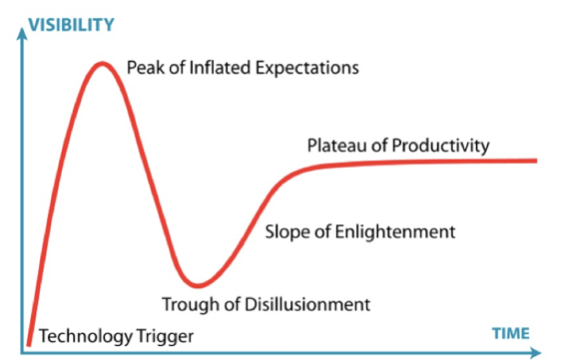
The truth is it happens to us all, and some would argue that it is an essential weeding-out process by mother nature. But often it is the first major obstacle faced by a new beekeeper. In terms of the Gartner-Hype Cycle, after our ’peak of inflated expectations.’ (the bees who came with the package survived, the queen laid in a good pattern, the girls took all of the sugar syrup we fed in the fall) many of the colonies die. This ‘trough of disillusionment’ is where as many as 50% of new beekeepers decide not to continue. The heartbreak, the disappointment, is too much.
Those who continue cite two things for their decision to do so. The first is a mentor, a fellow beekeeper, who assures them this is the norm, that they are not ‘bad people’ because their charges died. It is striking how Jim Tew, writing in Bee Culture, describes his failures without being shamed by them, as if to give us permission to fail as well. The second is a local bee association where new beekeepers can hear stories from experienced pros about winter losses, told without rancor or guilt. The message is “Welcome to our club – having lost a colony you are now truly one of us” and there is support for the self-doubt that can understandably accompany these losses.
I would add a third – an ability to see failure as an integral part of success – and rather than become despondent, to see this as motivation for a revitalized effort with the renewed confidence that comes from a challenging experience. Those who make this transition move on to ‘the slope of enlightenment’ which is when the real learning begins. It is gradual, it is real and it is experiential.
Pitts describes a scene from a Michael Jordan clip : “He fakes left, goes right, elevates to the hoop, finds a man in his path, spins in midair, throws the ball backwards over his head and scores.” The crowd roars, the announcers are breathless, and the viewer wonders … how? I don’t know the beekeeping equivalents of faking, blocking, spinning and shooting, but I do know that better beekeeping practice comes from constant work – reading the newsletters, the journals and the books, talking with one’s peers, going to conferences, reflecting on the notes one makes in the bee yard… all good winter tasks. We talk about talent, we nod our heads to luck, but so often we ignore the most important things – the hard work, the unceasing push to be a little better than the day before … and the many failures.
In Michael Jordan’s case that moment was built on thousands of others that only he can know, those moments in which he paid his dues away from the cameras so that he can walk like a winner on his way to the locker room.
In the February, 2014, issue of Harper’s Magazine entitled Tunnel Vision : Will the Air Force Kill its Most Effective Weapon? an Air Force colonel describes a conflict in Afghanistan involving predator drones. “If you want to know what the world looks like from a drone feed, walk around for a day with one eye closed and the other looking through a soda straw. It gives you a pretty narrow view of the world.” Experienced A-10 pilots use the soda straw analogy in describing the video images from their targeting pods. “You can find people with the targeting pod,” said one such pilot, “but when it’s zoomed in I’m looking at a single house, not anything else… If you’re looking only through the soda straw you don’t know everything else that’s going on around it.”
Once upon a time our learning started with the narrow and became increasingly broad – the typical Classical education of the nineteenth century, for example. Today the tendency is to start with the generic after which we become increasingly focused on minutiae.
New beekeepers begin with a narrow focus, understandably and rightly so. They focus on basic management skills, ask rudimentary questions, learn the terminology. There is normally a romantic reason for getting involved – doing one’s part to save the bees, wanting an individual source of honey, wanting to increase pollination in one’s garden …Nothing wrong with any of those motivations.
And then typically there is a major obstacle, a disillusionment. The bees swarm, the queen is poorly mated and the bees wither, the colony does not survive the winter, varroa mites and wax moths take over the hive. In the face of what Gartner and Hype call ‘the trough of disillusionment’ many new beekeepers, perhaps as many as half, decide not to continue.
Those who those who persist do so partly because they had realistic expectations and knew in advance that all beekeepers, no matter how good, lose colonies, heart wrenching as such l oss always is, and partly because they have a good
mentor who can encourage them despite the disappointment. These survivors enter the ‘slope of enlightenment’ where gradually they open themselves to the complexity of this fascinating hobby, and with that enhanced, deepened and broadened awareness comes the real fascination and wonder that the intricate world of honey bees can provoke. This gradual slope leads eventually to the ‘plateau of productivity’ which is when the most profound learning occurs, when meaningful interpretations and predictions of colony behavior can be discerned, and when the beekeeper interacts with the larger environment in which the bees exist.
There is no shortcut. It’s a hands-on learning process with trial and error as a demanding teacher.
Successful beekeeping, as with so many other things in life, is the gradual process of moving from simplicity to complexity. I suspect that effective beekeeping classes and good mentoring follow the same pattern. Yet ultimately it is up to the individual student to embrace complexity, to open himself or herself to the variety and apparent confusion of the different worlds behind the book covers, and to resist the temptation to accept the quick and easy solution. “The test of a first-rate intelligence,’ said F. Scott Fitzgerald, “is the ability to hold two opposing ideas in mind at the same time and still retain the ability to function.”
A colony can be viewed in the same way. At one level the life progress of a worker bee is relatively simple – her cycle from egg to maturity and the tasks she completes in a hive are easy to comprehend. But when one begins to ask what stimulates her to change activities from say collecting nectar to collecting water, or how she responds to the pheromones emanating from a larva in an uncapped cell, it gets a little more complex, and even more so when one looks at the colony as an entity with the numerous individual interactions that make up the superorganism and the complex social and behavioral organization that enables the effective use of available material and energy.
For me, the greater the complexity the greater the sense of wonder, even more so as I see honey bees as metaphors and teachers for the Gordian Knot that is our current world. The constant challenge, whether talking over the phone to a nu-bee or addressing queries at an open forum, is how to convey both the necessary simplicity and the amazement of the complex without confusing or dampening the enthusiasm of the listener. Typically the decision as to whether to move to more complex answers is determined by the questions from the audience, which disclose their level of interest and comprehension and determine whether the rejoinder invites them to open a book of self-discovery or is a more direct googlesque response.
For the first 25 years of my teaching career a student assignment came with the assumption that it would involve time spent in the school library; indeed I would work closely with the librarian in preparing the assignment. In more recent years, with a laptop or even a smart phone, students can comfortably complete an assignment without having to leave their dorm rooms. And when I get to visit the college library today the majority of the students are sitting at computer terminals rather than looking at books on the shelves. (Those not at the computer are asleep on chairs in the corners!)
Those books on the shelves, like bee hives, can appear at a casual glance to have a ‘sameness’; one has to look behind the covers to realize how different each one is.
My concern is that as one searches for a book in a library, as one pages through the index or flips through the chapters, knowledge is found in a larger context. A Google search, by comparison, takes one straight to the requested page or paragraph; it’s a direct but narrow search. The student is taken to the precise phrase or word he or she is searching for without any reference to background or theme or context. The result, all too often, is a good final paper with minimal understanding of the bigger picture.
This came to mind reading an article in the February, 2014, issue of Harper’s Magazine entitled Tunnel Vision : Will the Air Force Kill its Most Effective Weapon? Describing a conflict in Afghanistan involving predator drones, an Air Force colonel is quoted as saying, “If you want to know what the world looks like from a drone feed, walk around for a day with one eye closed and the other looking through a soda straw. It gives you a pretty narrow view of the world.” Experienced A-10 pilots use the soda straw analogy in describing the video images from their targeting pods. “You can find people with the targeting pod,” said one such pilot, “but when it’s zoomed in I’m looking at a single house, not anything else… If you’re looking only through the soda straw you don’t know everything else that’s going on around it.”
Once upon a time our learning started with the narrow and became increasingly broad – the typical Classical education of the nineteenth century, for example. Today the tendency is to start with the generic after which we become increasingly focused on minutiae.
New beekeepers begin with a narrow focus, understandably and rightly so. They focus on basic management skills, ask rudimentary questions, learn the terminology. There is normally a romantic reason for getting involved – doing one’s part to save the bees, wanting an individual source of honey, wanting to increase pollination in one’s garden …Nothing wrong with any of those motivations.
And then typically there is a major obstacle, a disillusionment. The bees swarm, the queen is poorly mated and the bees wither, the colony does not survive the winter, varroa mites and wax moths take over the hive. In the face of what Gartner and Hype call ‘the trough of disillusionment’ many new beekeepers, perhaps as many as half, decide not to continue.
Those who those who persist do so partly because they had realistic expectations and knew in advance that all beekeepers, no matter how good, lose colonies, heart wrenching as such l oss always is, and partly because they have a good mentor who can encourage them despite the disappointment. These survivors enter the ‘slope of enlightenment’ where gradually they open themselves to the complexity of this fascinating hobby, and with that enhanced, deepened and broadened awareness comes the real fascination and wonder that the intricate world of honey bees can provoke. This gradual slope leads eventually to the ‘plateau of productivity’ which is when the most profound learning occurs, when meaningful interpretations and predictions of colony behavior can be discerned, and when the beekeeper interacts with the larger environment in which the bees exist.
There is no shortcut. It’s a hands-on learning process with trial and error as a demanding teacher.
Successful beekeeping, as with so many other things in life, is the gradual process of moving from simplicity to complexity. I suspect that effective beekeeping classes and good mentoring follow the same pattern. Yet ultimately it is up to the individual student to embrace complexity, to open himself or herself to the variety and apparent confusion of the different worlds behind the book covers, and to resist the temptation to accept the quick and easy solution. “The test of a first-rate intelligence,’ said F. Scott Fitzgerald, “is the ability to hold two opposing ideas in mind at the same time and still retain the ability to function.”
A colony can be viewed in the same way. At one level the life progress of a worker bee is relatively simple – her cycle from egg to maturity and the tasks she completes in a hive are easy to comprehend. But when one begins to ask what stimulates her to change activities from say collecting nectar to collecting water, or how she responds to the pheromones emanating from a larva in an uncapped cell, it gets a little more complex, and even more so when one looks at the colony as an entity with the numerous individual interactions that make up the superorganism and the complex social and behavioral organization that enables the effective use of available material and energy.
For me, the greater the complexity the greater the sense of wonder, even more so as I see honey bees as metaphors and teachers for the Gordian Knot that is our current world. The constant challenge, whether talking over the phone to a nu-bee or addressing queries at an open forum, is how to convey both the necessary simplicity and the amazement of the complex without confusing or dampening the enthusiasm of the listener. Typically the decision as to whether to move to more complex answers is determined by the questions from the audience, which disclose their level of interest and comprehension and determine whether the rejoinder invites them to open a book of self-discovery or is a more direct googlesque response.
It’s hard to say exactly when beekeeping moved from being a healthy pastime to an all-consuming passion. One day I’m inspecting a few frames in my only hive and the next thing I know I’m frantically making splits to populate an entire apiary.
So how does one know if one has crossed the line into this treacherous, precarious territory?
For example, a sane beekeeper won’t leave town in the first week of the nectar flow; an obsessive compulsive beekeeper won’t leave town in the second, third, fourth, fifth or sixth week of the flow.
Do you have a credit account with a beekeeping provider, and does your spouse use if for all of your Christmas, anniversary and birthday shopping?
Do you use one hive tool, or do you have spares in the garage, the honey house (ie kitchen) and the car in case of emergencies?
Do you value all living things or did you cheer when the robin that was pestering a few of your bees got pounced on by a hawk?
Do you watch the bees going and coming every day, or do you hourly measure the internal temperature of each hive?
Are you surprised by how much hive equipment you ordered this winter, or do you feel that it isn’t enough?
Can you recite the Latin names for the various genuses of bees, and do you use them in conversation with the girls in the hive?
Would you like to plant more bee friendly plants? Gardening? Who has time to plant a garden?
Are you proud of your newly hatched bees, and do you replace the pictures of your children in your wallet with photos of each new bee?
Can you crush a small hive beetle with your hive tool and love the sound it makes as you do so?
Do all of your friends, all of your neighbors and your extended family know that you don’t use chemicals in your apiary?
When you had the wax from the comb in your hives tested, did you study for the test?
In anticipation of feeding the girls with sugar syrup, did you plant your own sugar cane and beets?
When you want to preach to your children about the virtues of beekeeping, do you suddenly recall your decision that 60 000 kids in each hive was more than enough to have to look after, and that you passed on having children? Besides, having to come up with 60 000 new names every six weeks is challenge enough.
And when you spouse accuses you of loving your bees more than anything, is your immediate response “What’s wrong with that?”
If the above doesn’t clarify your status, be mindful of the medical research group that recently advertised for participants in a study of obsessive-compulsive disorder. The response was gratifying; they got 3,879 responses, all of which came from one person – a beekeeper.
Talking of which, excuse me why I go and check on the girls … I haven’t looked at them for at least an hour.
It was two o’clock in the afternoon, late May. The sun was shining as I stood on the steps of a high rise, studying the blue blue sky. I was neat, clean and gassed up with fuel stored by my sisters (half-sisters, actually – same mother who chose not to share the proceeds of her sugar daddies with me.) I was a cool dude and I didn’t care who knew it.
It was time to go. I flexed my muscular, toned thorax and stretched my lustrous wings so that the sun reflected off the sheen, dazzling the sisters, foolish slaves to their genes, who were returning home from a shopping expedition. With one kick I was airborne and back in the hunt.
I headed south west; previous jaunts had showed that was where the best dames hang out. Cruising at 65’ with the speed control set at 15 mph, it took only 12 minutes to arrive at my destination.
I recognized it as soon as I saw it. It was big, the ceiling was high, and the carpet was as rich and deep as the blood of a wounded deer seeping into snow. Once again I regretted not being able to see red.
I circled the room, casing the joint. Rivals, petty and inadequate as they were, circled and spiraled; clearly I had no competition to speak of. I sat back, watching and waiting for the right opportunity.
And then I saw her. She was trouble but she was worth a stare. Her six legs streamed behind her – they seemed to be arranged to attract attention. They were visible well above the knee and one of them to the abdomen, which itself was small and compact and capable of expansion. The legs were dimpled and clean, not like the hairy corbicula of my half-sisters, dappled with carelessly strewn bits of pollen. Ms Regina was slim with enough melodic line for a tone poem. She was rangy and strong-looking. Her 2500 eyes were open and alert. She had a good proboscis and a sulky droop to her lower maxilla.
She was worthy of being the mother of my two million children, her lack of maternal instinct notwithstanding.
I made my move. With an alluring RAM (rapid antennae movement) I launched myself in her direction. I’m discrete – as tight as a vault with a busted lock. Valor is the better part of discretion. As a suitor, better never than late. She was coy, turned her back and flew higher, abdomen waggling suggestively. I followed, rival suitors falling by the wayside. Her conditioned proboscis response was increasing; I knew she was interested. At 80’ she slowed and I circled. She spiraled upward and I trailed behind. At 100’ she leveled out and not being one to mince words or waste time, I moved in.
There was evidence of a previous suitor blocking my final approach. I cursed silently, a gentleman to the core (so to speak.) Ms Regina clearly was not one to limit her favors. Deftly I removed it, backed up, re-set my sights and approached again. This was the moment I lived for, the culmination of my mission in life, my gift to eternity, the reason I was born, and the first of many sorties vindicating my superiority as a male.
I twisted over, flying upside down, made contact and …
I have long been proud of my sense of direction. It is probably a guy thing but I am confident that I can find my way most anywhere, especially if I have had a chance to glance at a map beforehand. Having to stop and ask someone for directions feels like a personal failure; Mary is the one who has to get out of the car and ask the appropriate questions. The only exception, or so I thought until recently, was riding the underground, or subway, or tube. Here I lose all sense of direction and, emerging at the surface after a couple of stops, I struggle mightily to get reoriented, which had led me to believe that, like a honey bee, my sense of direction is tied to the sun. Once above ground I will look for clues to figure out the next step forward.
In August, 2014, Mary and I were in England for a family wedding and took the opportunity to visit Buckfast Abbey, home of Brother Adam and the Buckfast bee. I hadn’t realized until recently that my father’s village of origin (now almost a city) is less than half an hour’s drive from the abbey. After a wonderful visit we made our way cross-county via Glastonbury, planning to stay overnight in Oxford.
England has a major traffic and parking problem and as we approached Oxford the traffic slowed up significantly. I was driving, concentrating on staying on the right (ie. left) side of the road. Mary was navigating, using a large AAA atlas and finding a route to take us away from the worst of the back-ups. Eventually we crawled into the outskirts, found a hotel, parked our bags and set off to walk into the town center to find somewhere suitable to eat.
I began walking the wrong way. Totally the wrong way. Going west when I needed to go east. I could not get myself oriented. Something was wrong. I contested Mary’s gentle coercion but sure enough, she was right – the town center appeared exactly where I least expected it.
Looking at a map in a store window the reason became apparent. We had planned to enter Oxford from the south, which was the route I had looked at on the map beforehand, but in our attempts to avoid the traffic we had entered from the west. Mary knew this because she had the atlas on her lap as we twisted and turned.
That one factor, that one unknown, had thrown me completely.
The question therefore is, when we start beekeeping, what is the route map we have in our heads? What gets us disoriented, and what leads to that sudden realization when we can distinguish ‘west’ from ‘east,’ when the center appears suddenly but delightfully in front of us?
The emphasis of the Buckfast Abbey apiary has moved from queen breeding to education, and the head beekeeper, Clare Densely, who offers a number of classes, suggests that a nu-bee maintains his or her hives for five years before taking a more advanced level class. In part this is so that the beekeeper understands the many inter-relationships and nuances of the amazing lives and behaviors of honey bees. But it also provides the time and space in which one can find a definite direction, a route map with a clear goal in mind, amid what initially appears as a chaotic bevy of bees.
No doubt everyone has a different story but for me it was three years into my beekeeping career when someone, and I can no longer recall who or where, said that honey bees, unlike wasps, are passive not aggressive. That they will defend their home and their kids if they feel threatened, but in most instances they are too busy, too focused, to worry about the likes of me. It was the proverbial light bulb, a paradigm shift, a turning around in the right direction. The way I managed bees shifted, any residues of fear dropped away, and I like to think that the girls know that, even as they feel the need to remind me when I get over-confident.
What was that moment for you? What was your Oxford moment? Or to ask it another way, what did you have to find out for yourself which, if someone had told you early in your career, might have made the art and skill of beekeeping a whole lot more rational a whole lot earlier? In 2014, having set out in the wrong direction, gotten reoriented, knowing again where I was going, I was relaxed, ready to explore, ready for another adventure, and this city in particular, like beekeeping, was well worth the journey.
Twenty years ago, when a college class was given an essay to research and write, the presumption was that the students would go to the library and, by searching among the index cards and shelves of books, get to see the topic in a larger context. Who knows, they might even be positively side tracked by something unexpected. In more recent years the presumption is that the student will go back to his or her dorm room, open a lap top or smart phone, google the topic and be taken straight to the material without any awareness of (and often not any curiosity for) the larger surrounds.
Students are getting better at writing good papers on specific topics without an awareness of the larger context. Or in terms of the old adage, they know more and more about less and less until they know everything about nothing.
Something similar happens with maps v GPS. Maps present the larger view, the bigger surrounds, with the potential to discover a lake that lies just over the hill, or a spectacular view at the end of an unmarked lane. Because maps have to be read in conjunction with the surrounding physical environment, whether it is as simple as reading a sign or as challenging as looking at the contours to determine the degree of a slope, we are engaged with the environment, with the habitat, which creates both memories and knowledge.
This became clear when talking with a recent visitor about his journey from Philadelphia. He asked where York County began and I mentioned the Susquehanna River, once a frontier with ‘Indian country’ in the days of the thirteen colonies, crossed today by a bridge that is almost a mile long. “Yes,” he said, “I do seem to remember crossing a bridge somewhere.” Because it was not mentioned by the GPS voice, it made little impression on him.
Some years ago Mary and I were driving up Rte 1 in Oregon State and Mary noticed on the map a potentially interesting monument only a short distance off of the highway. It led us to a redwood tree and a beautiful story. In 1944 a Japanese submarine surfaced at night off of the Pacific coast, a sea plane was assembled in the water and a young Japanese pilot strapped his family’s samurai sword around his waist, tied a Japanese flag around his head, and flew over the Oregon forests, dropping two fire bombs. The intent was obvious. One of the bombs was ineffective and the fire caused by the second was quickly extinguished.
Fifty years later an elderly Japanese man walked into the museum at Portland, Oregon, to donate his family’s samurai sword, where it is presently on display, and then drove into the forest to the site where his second bomb had fallen and planted a redwood tree.
He died shortly thereafter.
The point is that this little side adventure would have been unlikely were we following directions on GPS. Maps open the world, they engage us, whereas GPS narrows our view, removes our choices and often misdirects us without our knowledge. A GPS system is a dictator; a map is a guide. The former is a partner to our intellect, not a replacement for it.
For all of the above reasons I like maps and have declined to get a GPS for my vehicle. I will concede that for some it is very useful, those undertaking frequent deliveries, for example, but I want to keep thinking, rather than have technology do the thinking for me. And as a curmudgeony admission, I’ll acknowledge not having a smart phone. Perhaps I’m intimidated by the rapid advances of technology but people who would never dream of coming to one’s house unannounced think nothing of calling or sending a text and expecting it to be picked up or read immediately.
The May, 2015, edition of Orion listed some of the words that were removed from the Oxford Junior Dictionary. They include acorn, bluebell, cowslip, fern, hazel, heather, dandelion, heron, ivy, mistletoe, nectar, newt, otter and pasture – all words concerned with nature. The words introduced included attachment, blog, broadband, bullet-point, chatroom, cut-and-paste and voice-mail. Are these latter words important in a technological society? Absolutely yes. The tragedy is that they replace, rather than interact with, words from nature.
I received a phone call earlier this year from a person who had purchased a queen bee on Craig’s List and wanted to know what she had to do to start beekeeping. Numerous e-mails from ‘wannabees’ state they have decided to keep honey bees and ask where they can buy the necessary equipment. How is it that we have come to believe that working with nature is so easy, requires so little knowledge or preparation? Yes, sites on YouTube have good (and bad) visual examples of techniques like installing a package but beekeeping is an art as much as a science, it requires perseverance, commitment and patience, and false expectations created by technology in isolation explain in part why more than half of new beekeepers give up within the first year.
Consider the new Flow Hive, hyped as the biggest technological breakthrough in hive design in the last 150 years. The impression created is that one sets it up in the backyard, installs bees, waits a few weeks, and then turns the tap to get honey straight from the colony. Many don’t realize that one still has to do brood inspections, deal with mites and diseases and hive moths and small hive beetle and swarming, remove it for successful over-wintering, and know how to ‘read‘ a colony, not least the health of the queen. No doubt the Flow Hive has value in the right hands; my fear is that many potential new beekeepers will spend a lot of money to purchase one and the heightened expectations will quickly lead to the trough of disillusionment.
As we become more detached from our surroundings, the honey bee remains intimately connected to the environment; indeed, her survival and those of the colony depend on it. Ours does too, but we are still at the stage of paying lip service to that interdependence rather than demonstrating the actions and behaviors that are the root cause of meaningful change.
On October 12, 2016, I underwent robotic laproscopic sigmoidectomy surgery as the result of increasing bouts of diverticulitis, which means, in effect, removing part of the lower colon.
After 48 hours of pain and discomfort I became more aware of the regimen of pills I was being given. One to prevent infection; another to promote bowel movement; another to stabilize heart rate; potassium because of a .2 deficiency in one of the blood samples; another to stabilize pain, and so on. By the third evening my blood pressure had risen to a systolic reading in excess of 180.
Mary is a retired family physician. She was at my side for the full 78 hours of the hospitalization, not least as my advocate. Each time one of these medicines was introduced orally or by IV she enquired as to the thinking behind it and their purpose, sometimes to the irritation of the nurses. One quipped “You cannot be both a visitor and a doctor,” and instead of replying “Yes I can!” Mary spent time building a relationship of trust by asking him questions about his life; we were stuck with him whether we liked it or not, and needed him on our side. I can empathize with the position many nurses find themselves in, caught between the orders of a resident (who may not have much training in internal medicine) and the emotional demands of family members.
Mary and I had a conversation early on the morning of day 4 and agreed that, although each medicine had worth in its own right, a probable cause of the increased blood pressure was the synergy between them, in which case the solution was to go back to the medicine that I take daily and which we know works for me.
The overall result? By 9:00 am, three hours without the new meds, the blood pressure level had dropped significantly and my discharge was signed.
Soon after getting home I realized that I was recovering from a multilevel traumatic experience. I felt I had a fever but the thermometer denied it; my writing was filled with typographical errors which suggested a fine motor dysfunction; there was a sensitivity to bright lights; my dreams were disturbing and vivid between which my mind was over-active; and my mouth was filled with a chemical after-taste which not even Manuka honey could over-ride. It felt more than only a physical invasion of my body; I felt like I was swimming in a toxic soup.
So, what are the lessons of this and how do they relate to honey bees?
First is the importance of a support system. The bees have it and so did I, whether it was the e-mails, the visits and calls, the empathy of the nurses and their assistants or the skills of the doctors. We know that one honey bee cannot exist for more than 24 hours in isolation; I could not have survived this successfully alone.
Secondly, Mary was an informed advocate. If she had not been there my guess is that I would have been in the hospital for several more days, who knows with what results. Yet few patients are privileged to have such a champion and it is easy to feel overwhelmed by the language and status of the various medical specialists. Presumably the family doctor should be the patient’s strong proponent but it is easy to see the practical reasons why that is seldom going to happen. New beekeepers easily feel overwhelmed by the mass of information at their disposal and the practicalities of working a hive; they too need an advocate, or in this case mentor, who can help them navigate the morass.
Thirdly, we know that honey bees are exposed to a multi-chemical environment, some of it created by the beekeeper but much of it omnipresent in our environment. If there is any merit to the thesis proposed above, then perhaps I got to experience for a short while what the bees encounter every day. If so, it’s a miserable existence.
Fourthly, once the option of leaving the hospital was offered I could not wait to get out of there. Mentally, if not physically, I was gone. Is this what honey bees experience when they abscond from a hive, with every one of them leaving en masse, even though their chances of survival are minimal?
Finally, my step-son, Andrew, suggested that when a patient is the subject of conflicting conversations by medical personnel, often as a side-bar conversation in the presence of the patient, he or she is entitled to say, “I am the center of my world right now, and I need you to focus on me and include me in the conversation.”
The length of time that honey bees have been in the United States represents about .00001% of their evolutionary history. Not only is that a drop in the transformative ocean, but evolution occurs when random genetic mutation or gene transfer gives rise to heritable differences that become more common or rare in a population, thus enhancing their chances of survival in a changing environment. When Darwin first described this he imagined it in a relatively pristine environment, like the Galapagos Islands, unaffected by the detritus of mankind. We have not only soiled the environment but through modern globalization in particular we have exposed species to threats that were inconceivable in 1859 when On the Origin of the Species was published. We cannot expect the slow, random process of evolution to compensate for, or keep pace with, the dramatic effects of modernization.
The exposure of honey bees to varroa mites introduced directly from Asia in the 1970’s is one of many such examples. Some argue that bees are best left alone to conquer this through natural processes. I would argue that, as the creators of this conflict with potentially fatal consequences for the bees, we are responsible for the solution and have a moral and ethical obligation to speak and act on their behalf.
We are the only champions the bees have and we need to be loud and clear in our advocacy. As beekeepers, there are times to see honey bees as the center of our world, in desperate need of our focus and support, rather than abandoning them to an environment that is not of their making.
Arguably there have been four major upheavals in the western world in the preceding five hundred years with another one underway. The first four did not specifically involve beekeepers but the fifth most definitely does.
The first was a challenge to the religious order which began in October, 1517, when Martin Luther nailed his 95 Theses on the door of the church at Wittenburg. He was not the first to protest against the Catholic Church, nor did he want to start a revolution so much as a reformation, but his remonstration coincided with the invention of movable type, the development of better quality paper and ink and the growth of a body of experienced craftsmen, which meant that pamphlets, and thus ideas, could be produced quickly, in quantity and cheaply. Luther translated the Bible into German in the belief that if people read it for themselves (which they could not do as long as it was in Latin) they would understand the significance of his ideas. The Bible thus moved from the pulpit into the home where, for hundreds of years, it served as the source for family records, family prayers, grace before meals and readings before sleep, and thus a center for ideas that were common to most western people. Today it has been replaced by the Smart Phone!
There were other consequences as well. The diversity of faith and opinions increased as Luther was followed by Calvin and Zwingli in central Europe and Henry VIII in England, even if the latter was for personal rather than doctrinal reasons. New feelings of nationhood were aroused as countries identified either with the Catholic faith or those of the new Protestants (ie. those who protested) and the west lost it’s ancestral feelings of unity and common descent.
The second insurgence, which challenged the right of divine kings and thus the right of government by an elite, witnessed the Civil War in England, notably the execution of Charles I in 1649, the American revolution in 1776 which was followed six years later by the French Revolution, notably the execution of Louis XVIII in 1793, and in the early twentieth century, the Russian Revolution and the execution of Tsar Nicholas and his family.
The Catholic Church responded to Lutheranism with the Counter Reformation, which battened down the hatches, while the Protestant off-shoot continued to divide to the point where there are an estimated 39 000 Christian sects today. In France the democratic uprising was followed by the austere Napoleonic regime, which in turn was followed by an interlude of three monarchies until the brief four year Second Republic in 1848. In Russia the revolution was followed by a communist regime more stark than anything the Tsarist regimes could invent. By contrast to these republics the British system lurched towards a constitutional monarchy, perhaps the biggest single step being the succession of the Hanoverian King, George I, in 1714 who spoke only German which provided considerable latitude to his ministers.
The pendulum, it seems, needed to swing to the other extreme before it could settle somewhere in the middle.
The third metamorphosis, beginning in France in the 1840’s, was a social uprising focused on the relationship between the needs of the individual and the role of government and in particular the movement towards economic and social equality. Known originally as social democracy, it argued that the means of production, distribution, and exchange should be owned or regulated by the community as a whole, with the proceeds being returned to the community in the form of subsidized housing, education, elderly care and health benefits. A country where this innovation never took hold is the United States and one result is that the discrepancy between the so-called haves and the have-nots in the USA is greater than in any other country in the western world. Americans chose to equate free enterprise with freedom and it was unusual to have an avowed socialist as one of the candidates in the 2016 Presidential election.
A cousin of socialism is communalism, defined as communal ownership in localized independent communities, and which was evident in many traditional societies, not least native American and unpretentious African tribal groups.
The fourth upheaval was one of social engineering, whether it was Nazism, which argued that one race had the right to set the rules based on genetic purity; Communism, not least in Russia and China, in which a supposedly temporary elite ruthlessly set the rules for the eventual benefit of all; or Fascism in Italy and Spain which lacked the theoretical component of the first two and were more exercises in personal power and ego. All argued that society needed to be forced into a new order for which it would later be grateful. The guards at the various Nazi prison camps, for example, kept meticulous records of the atrocities they committed, in the belief that later generations would see them in heroic terms for having pruned and created a more perfect society.
The fifth sea change (both literally and figuratively) is global in impact and may be labeled environmental. As Diane Ackerman writes in The Human Age, “… our world dramatically changed around the year 1800. That’s when the Industrial Revolution, powered by an over-arching use of fossil fuels, led to rising carbon dioxide levels.” Other effects include massive urbanization, the conversion of ecosystems from mostly wild to mostly human centered, and the mechanization of agriculture and mining giants with extensive use of chemical fertilizers and the production of air born pollution. “That is when,” according to Ackerman, “we first began adapting the planet to us on a large scale – changing the climate, changing the oceans, changing the evolution of plants and animals.”
Every six years the United Nations Panel on Climate Change issues a report. In September, 2013, the panel of 209 lead scientists and 600 contributing scientists from 39 nations citing 9200 scientific publications concluded that global warming is unequivocal but we can slow the process of change if we begin at once.
Honey bees and beekeepers have been an integral if unwitting part in giving environmental change the public face that is necessary if the process of change is to be effective. CCD caught the collective imagination – how many times are we asked at public demonstrations, “Is it true that the bees are disappearing, and what is the cause”? How many of our hobbyists began keeping bees as a response to this publicity and the perceived need for their involvement? How many honey bee related news programs, videos and DVD’s have been produced in the last eight years compared to the preceding decades?
Honey bees represent the traditional canary in the coal mine, and now the canary is dying before it so much as gets to the mine. For the last few years, here in Pennsylvania, there has been a significant increase in the number of colonies absconding in the fall. The current explanation is that they are finding conditions in the hive so toxic, including high varroa numbers, that they risk everything and leave rather than stay and face certain death. Meanwhile we think we can give the canary a gas mask, find a better canary, or move the canary further from the mine … anything but deal with the actual cause. Europeans in general tend to to work with nature rather than fight it, as evidenced by the actions taken against potentially synergistic pesticides, fungicides and herbicides. Our belief, that we can continue to manage nature to serve human prosperity, is proving unsustainable.
The religious, governmental, social and economic revolutions that shaped western civilization may well come to naught if we do not deal promptly and appropriately with environmental degradation, and in future years we may look back at the lowly honey bee as providing a vital stimulus. Unlike them we cannot simply abscond.
The word uBuntu provoked an aha moment when I first came across it in No Future Without Forgiveness, written by the late Desmond Tutu, winner of the 1984 Nobel Peace prize and the Archbishop Emeritus of Cape Town. It expresses in one word something I have been striving for most of my life without realizing it, as well as describing a notion that is integral to a successful colony of honey bees.
Underlying traditional African society, with its emphasis on rites of passage, different generations living together and respect for one’s ancestors, is the principle that one cannot be human alone. We need other people to be fully alive. Thus the African proverb,“It takes a village to raise a child,” counsels that we are at our best if the whole community contributes to our upbringing. We are individuals (uMuntu) but we exist in a social context (uBuntu.) Compared to Rene Descartes’ dictum, “I think therefore I am,” which is the foundation of much modern Western culture, uBuntu is variously translated as “I am because you are,” or “I exist to the extent that others acknowledge and respect me.” We exist by the grace of the community to which we belong and the degree to which we take responsibility for other members of the populace. The essence of humanity is the talent to live in constructive peace with our fellow human beings.
It took me almost my entire life to understand the greater meaning of the traditional morning greeting in Zimbabwe. It begins :
“Mangwanani. Marara sei?” (“Good morning. Did you sleep well?”)
“Ndarara, kana mararawo.” (“I slept well if you slept well.”)
What happened to these traditional values in which compassion is key? Clearly they are not obvious in modern day Africa. We discuss in detail the impact of slavery on America yet seldom ask what the effect was on Africa. What happens when a continent is emasculated, when the strongest, healthiest, most fertile of the young generation are forcefully removed and human life is measured in terms of beads, cloth, liquor and guns? (Incidentally, polygamy was quite possibly the compassionate response of a population in which women vastly outnumbered men and in which it was regarded as a disgrace for a woman to be unmarried and without children.) What was it like to exist for centuries in chaos, fear and hiding, to live in suspicion of those who were pressured or bribed into capturing their neighbors for slavehood, to be preoccupied with the lowest level of Maslow’s Hierarchy of Needs – survival? Lets put aside for a minute the facts that there was a slave trade on the east coast of Africa fueled by Arabs that started earlier than and ended later than the trans-Atlantic passage, that none of the profits of the slave trade were returned to Africa, and that the English language itself (white symbolizing purity, saintliness and chastity; black symbolizing darkness, evil and villainy) undergirds racial prejudice. Rather, more importantly the ideas of the Enlightenment passed Africa by and when the continent eventually emerged into the light it was not only severely handicapped but vulnerable to colonial occupation.
As Archbishop Tutu observed, “When the missionaries came to Africa they had the Bible and we had the land. They said ‘Let us pray.’ We closed our eyes. When we opened them we had the Bible and they had the land.”
What has this to do with honey bees? To paraphrase the first two paragraphs above, a honey bee needs other bees to be fully alive; they exist by the grace of the colony to which they belong and by the degree to which they take responsibility for other members of their colony.
Ubuntu equates with the concept of a superorganism, a term first used to describe a colony as a single living organism by William Wheeler in 1911. Jurgen Tautz, in the opening chapter of The Buzz About Bees, describes honey bees as ‘honorary mammals’ : both bees and mammals have a low rate of reproduction if one considers swarming as the way a colony reproduces itself, both produce nutrition for the young (milk and royal jelly,) the uterus of the mammal compares with brood comb, they both have similar body temperatures as well as a high capacity for learning, and each new organism has its own genetic makeup.
In a comparative table published in the American Bee Journal in November, 2015, Keith Delaplane compares the mammal organism with the honey bee superorganism. Besides a common facility for group decision-making, mammary glands can be compared with nurse bee hypopharyngeal glands, mammalian ovaries with the queen, mammalian testes with the drones, and mammalian wound-healing with the killing and propolizing of colony invaders. Clearly the tissues and organs do not look the same but their functions have a corresponding purpose.
In this time of social and national acrimony, rancor, division and hostility, we might look for inspiration to traditional societies that interact synergistically in a way similar to honey bees and ants, the latter two species having survived much longer and, arguably, more successfully than has humankind. The trappings of modern civilization may not look the same as those of traditional societies but the essential purpose of our existence, individually and collectively, remains the same.
“The great powers have done wonders in giving the world an industrial and military look,” wrote Steve Biko, founder of the Black Consciousness movement in South Africa who was killed by the Apartheid regime in 1977, “but the great gift still has to come from Africa – giving the world a more human face.”
Sean Collinsworth and Denise Altay, Killer Bees Honey Bee Farm, NC
The bees have become the most important members of our family. In the late spring our daughter acquires 60 000 step-sisters (my assurance that they are in reality foster children doesn’t help) and the beekeeper wants to give them each names.
The dog’s bowl outside is now a water source for the bees.
Hallowed be the weeds and cursed is she who threatens to mow in the middle of the day.
Everything in our home is sticky, gluey and treacly. I check out everything first with a wooden ladle, including the TV remote, the front door handle and the cat,
When the beekeeper uses the word ‘honey’ it is no longer is a term of endearment for me.
When I am in the beekeeper’s truck, other drivers flash their lights to tell me there is smoke coming from the bed, and there is always plenty of room to park at the grocery store as bees peek from under the tarp in the back as soon as I stop.
Everything stops for a swarm call. No matter what we are doing – and I mean anything – the beekeeper will pause for a milli-second, pick up his bag of pre-packed necessities, and jump into his truck.
The cashier at the grocery store no longer looks as if she is about to call the Department of Homeland Security at our trolley full of 10 lb bags of sugar, brewer’s yeast and isopropyl alcohol, and I no longer feel compelled to explain our purchases to those who are staring. Thank goodness for on-line suppliers, UPS and brown boxes.
The beekeeper communicates with fellow beeks in a different language, and when he is in the bee-yard there is one four letter word that dominates all others – OOPS – as in “Oops, there goes the queen.”
I have listened so often to his many telephone conversations that I can predict where the conversation will go next, what he will say, and am often tempted to answer the phone in his absence, throwing in the occasional ‘oops‘ for good measure.
I am no longer particular about my husband’s appearance. When strangers stare, I shrug my shoulders and mouth the word “Beekeeper.” They seem to understand. Zits have been replaced by stings, dirt under his nails has been replaced by propolis. Nothing else goes in the washer when it’s time to wash his bee-suit, which for me is not often enough.
I used to check the pockets of his trousers for change; now I find queen cages, dead bees, balls of wax and propolis, even a small hive tool he complained of having lost.
I do not have the words to describe the state of our kitchen after honey extraction.
Our refrigerator is filled with fondant, pollen patties, dead queens in alcohol, jars of sugar syrup and swarm lures. Trying to get our daughter to prepare her own meals is impossible -apparently, when a teen is looking to make dinner, a profusion of frozen, mite-infested drone larvae doesn’t spark her appetite.
There is no room for a car in the garage amid the piles of white buckets, stacks of unassembled hive parts, boxes of one and two pound jars with lids in plastic bags, and boxes of foundation.
I avoid our neighbors as best I can. I no longer want to hear about bees in their swimming pool, children allergic to bee stings and bee poop on their whites hung out to dry. I shop in another part of town and walk our dog at night. It’s not that I’m antisocial; I’m just married to a beekeeper.