Our Shared Heritage

On Sept 24th, 2015,  Pope Francis addressed the assembled Congress of the United States.  It was a superbly structured speech, delivered eloquently and gently by a wise and loving soul.  It was not a sermon in the traditional sense so much as a moving reminder of the best of human values.  

What might Francis have said to the bees (after all, he chose his papal moniker in honor of St. Francis of Assisi?)   We get an inkling if we take a few extracts from his 55 minute presentation and change some of the  nouns (eg. colony for country or nation, worker and drone for son and daughter, etc.)  

Imagine an elderly drone who has lost much of his hair dressed in a white cassock and zucchetto with slippers on four feet, leaving two front feet free to hold his notes, addressing an assembled throng of honey bees. 

“Honorable Members of the Colony, Good Friends:

    “Each drone and worker of a given colony has a mission, a personal and social responsibility. Your own responsibility is to enable this colony to grow. You are called to defend and preserve the dignity of your bees in the tireless and demanding pursuit of the common good.   A colony endures when it seeks, as a vocation, to satisfy common needs by stimulating the growth of all its members, especially those in situations of greater vulnerability or risk.

   “I would like to take this opportunity to dialogue with the many thousands of worker bees who strive each day to do an honest day’s work, to bring home their bee bread – one step at a time – to build a better life for their families. These workers,  in their own quiet way, sustain the life of society. They generate solidarity by their actions, and they create an organization which offers a helping hand to those most in need.

    “These bees, for all their many limitations, are able by hard work and self-sacrifice – some at the cost of their lives – to build a better future. They shape fundamental values which will endure forever in the spirit of the hive. A colony with this spirit can live through many crises, tensions and conflicts, while always finding the resources to move forward, and to do so with dignity. Building a future requires love of the common good and cooperation in a spirit of subsidiarity and solidarity.

   “We must move forward together, as one, in a renewed spirit of fraternity and solidarity, cooperating generously for the common good.   The challenges facing us today call for a renewal of that spirit of cooperation.  All activity is an expression of our compelling need to live as one, in order to build the greatest common good: that of a community which sacrifices particular interests in order to share, in justice and peace, its goods, its interests, its social life. 

  “In recent centuries, millions of bees came to this land to pursue the dream of building a future in freedom. We are not fearful of foreigners, because most of us were once foreigners. Tragically, the rights of those who were here long before us were not always respected. Those first contacts were often turbulent and violent. Nonetheless, we must resolve now to live as nobly and as justly as possible, as we educate new generations not to turn their back on our “neighbors” and everything around us. Building a colony calls us to recognize that we must constantly relate to others, rejecting a mindset of hostility in order to adopt one of reciprocal subsidiarity, in a constant effort to do our best.

   “Let us remember the Golden Rule: “Do unto others as you would have them do unto you.”  This Rule points us in a clear direction. Let us treat others with the same passion and compassion with which we want to be treated. Let us seek for others the same possibilities which we seek for ourselves. Let us help others to grow, as we would like to be helped ourselves. In a word, if we want security, let us give security; if we want life, let us give life; if we want opportunities, let us provide opportunities. The yardstick we use for others will be the yardstick which time will use for us. 

  “This common good also includes the earth. We need a conversation which includes everyone, since the environmental challenge we are undergoing, and its human roots, concern and affect us all.  I call for a courageous and responsible effort to avert the most serious effects of the environmental deterioration caused by human activity. I am convinced that we can make a difference.  Now is the time for courageous actions and strategies, aimed at implementing a culture of care and at the same time protecting nature. 

    How essential the family has been to the building of this colony.   And how worthy it remains of our support and encouragement. Yet I cannot hide my concern for the family, which is threatened, perhaps as never before, from without. I can only reiterate the importance and, above all, the richness and the beauty of family life. In particular, I would like to call attention to those family members who are the most vulnerable, the young. For many of them, a future filled with countless possibilities beckons, yet so many others seem disoriented.  Their problems are our problems. We cannot avoid them. We need to face them together.

   In these remarks I have sought to present some of the richness of your apis heritage, of the spirit of the home of the honey bee. It is my desire that this spirit will continue to develop and grow, so that as many bees as possible can inherit and dwell in this hive.”

Our mythical drone would have been preaching to the choir because these are values and lessons the bees have learned only too well and practice every day.  We, on the other hand …

Learning Well

If infants were taught to walk and talk in the same way they are later taught mathematics and English, this country (and many others) would be populated with sedentary mutes.  In the same vein, rewarding children with pizzas for the amount of books they read leads to over-weight kids who like short books.

Learning to walk and talk involves a number of factors.  For example, a high tolerance for failure.  Imagine an eighteen month old refusing to try to walk because the first attempt ended with him plopped on the floor, even if his behind is protected by a well padded  diaper.  It’s a slow learning curve that requires persistence.  Fortunately  two year olds don’t refuse to talk because the words did not come out perfectly the first time.  It requires consistent encouragement from those who can, an absence of judgement (imagine grading an infant every time she opened her mouth,) frequent rest periods before trying again, and the ultimate reward is the sense of accomplishment when the task is mastered to the point that most of us walk and talk without giving a second thought to the complicated mechanisms involved. 

It’s a kinesthetic tactile process involving a willingness to experiment and to delight in small incremental achievements.  Again, imagine tiny tots having to listen to lectures and watch videos on how to walk. 

By comparison how many of us, in a traditional classroom, felt judged when we did not master, or even understand, a topic immediately?   How many of us felt that our success depended on the opinion of an external authority whom we ultimately had to please if we were to ‘succeed’, or that a grade was not a fair reflection of the work done or the comprehension achieved? Or that there was no time for persistence because the teacher had to progress to the next item on the curriculum ?   Score well on a test that requires short term recall and one is presumed to have understood the material.  Start a sentence with words like mathematics, or art, or singing, or another language  and our anxiety levels escalate. For me that word is Latin. For reasons I cannot recall, possibly simple immaturity, I never got the basics (and having a first year graduate student as a teacher did not help.) Letting go was not an option, so for four years I endured ignominy and humiliation as the material got progressively beyond my reach with no offers of help and my lacking the necessary courage and confidence to ask for it.  

A honey bee responds primarily to pheromones and instincts, the latter triggered by day light hours, temperature, pressures of space and food in the hive, and hormonal and glandular changes in her body.   As she transitions to becoming a forager there is an increase in the levels of juvenile hormone as well as in the size of the ’mushroom bodies’ in her brain. The latter include neurons and glia, are involved in learning and memory and their size is correlated to the capacity for complex behavior; the worker bee, who has been confined to the hive for the first four weeks of her life, now has to recognize and memorize landmarks if she is to successfully return to the colony with her loads of water, nectar, pollen and propolis.

This is finely tuned, situational-dependent learning based on communal needs.  We by comparison have lost many of our finer senses, tend to learn in isolation, feel distanced from the natural world and rely on others to teach us using techniques that are increasingly  called into question. 

Please understand, I am not condemning the role of audio and visual learning nor of qualified instruction. Rather, and as one who learns best from tactile experiences, I am appealing for the use of effective and varied instructional styles accompanied by efficacious learning strategies. For example, Annie Murphy Paul, the author of Brilliant: The New Science of Smart, argues that “In a world as fast-changing and full of information as our own, every one of us — from schoolchildren to college students to working adults — needs to know how to learn well. Yet evidence suggests that most of us don’t use the learning techniques that science has proven most effective. Worse, research finds that learning strategies we do commonly employ are among the least effective.”

In a report released in January, 2017, by the Association for Psychological Science, the authors, led by Kent State University professor John Dunlosky, examine ten learning tactics and rate each from high to low utility on the basis of the evidence they’ve amassed.  Highlighting and underlining , for example, offer no benefit beyond simply reading the text. Some research even indicates that highlighting can get in the way of learning because by drawing attention to individual facts it may hamper the process of making connections and drawing inferences. Nearly as bad is the practice of simply re-reading. 

More effective is distributed practice, which  involves spreading out one’s study sessions rather than engaging in a marathon. Cramming information at the last minute may get one through that test or meeting but the material will quickly disappear from memory. It’s much more effective to dip into the material at intervals over time and the longer one wants to remember the information, whether it’s two weeks or two years, the longer the intervals should be.

The second recommended learning strategy is elaborative interrogation, meaning  asking “why” as one reads, investigating the text in detail instead of passively reading it over, and practice testing. Research shows that the mere act of questioning information, of massaging it and calling it to mind, strengthens that knowledge and aids in future retrieval.

So, how do we help new beekeepers to ‘learn well’, to use Annie Paul’s term? The Introduction to Beekeeping Class I took some fifteen years ago consisted of six evenings of listening to a beekeeper talk, and thirty minutes, at the end of the class,  watching him manipulate a hive.  No wonder some of the students were taking the class for the third, fourth or even fifth time. More effective are those  classes that continue over a full season rather than the traditional six weeks, with each session related to what is happening in the colonies at that particular time (colony build up, nectar flows and brood rearing, honey extraction, disease detection, winter preparation, for example.)  Between these sessions are reading suggestions which encourage students to comprehend more deeply what they had experienced in the class session, with some questions at the end for self-interrogation and, at the next class, an opportunity to share and discuss thoughts and concerns that might have arisen.

The idea of a comprehensive weekend bee class consisting of two 8 hour days may be convenient for attendees but ineffective for learning, and much as I enjoy going to conferences about honey bees I invariable feel overwhelmed and my recall is poor; without note-taking it would be zero.  The reason is that there is no time to assimilate, to examine, to discuss what one has heard in one presentation before one is exposed to another, and another.  Similarly, when beekeepers explain in detail over the phone the manipulations they have done in their apiary and then ask for an opinion, I find it difficult to respond meaningfully; I need the full sensory exposure if I am to have more than a superficial understanding of their situation.  

A bee’s life is short and everything she does is oriented towards the long term health and survival of the colony.  Our lives are relatively long, all being well, and life-long learning as an adult requires passion, commitment, persistence, resilience for failure and the fulfillment that comes from both incremental and long term progress. We don’t need others to judge how well we are doing, to grade us, but rather to encourage, acknowledge and appreciate, which also describes how we learn instinctively as a child and how we mentor  successfully new beekeepers. 

Better Beekeepers, Healthy Bees

Sometimes one sentence can stimulate a series of thoughts which invite comparisons with honey bees.

In The Botany of Desire, Michael Pollan chooses four plants (apples, tulips, marijuana and potatoes) to suggest not only that humans act on nature to get the results we want but that plants too evolve to gratify certain human desires so that we in turn help those plants to spread and proliferate.

In the chapter on marijuana he describes how different cultures have reacted to substances that have the power to alter our thoughts and feelings, citing as an example the different reactions to alcohol in European and Muslim societies.  And he notes that, until the Industrial Revolution,  alcohol and tobacco were confined to a small, privileged elite in Europe who eventually shared them with the burgeoning proletariat to help them tolerate the monotony and drudgery of industrial urban life. This was the sentence that began the thought process.

One of the reactions to the Industrial Revolution in Europe was social and political unrest. 1848 brought the first practical experiments in socialism which argued that it was the responsibility of the state to share corporate and national profits with those who labored to produce those earnings.  Profit was shared as benefits (subsidized housing, health, education and unemployment insurance) rather than income.    Whereas Social Democrats believed this could be achieved peacefully through the democratic process, in 1867 Karl Marx and Frederich Engels argued in Das Kapital that the financially privileged would not voluntarily share the benefits of their positions and that it was the duty of the workers to seize by force what the authors saw as their just rights.   

Across the Atlantic it was feared that if Europe sneezed America might catch a cold. 

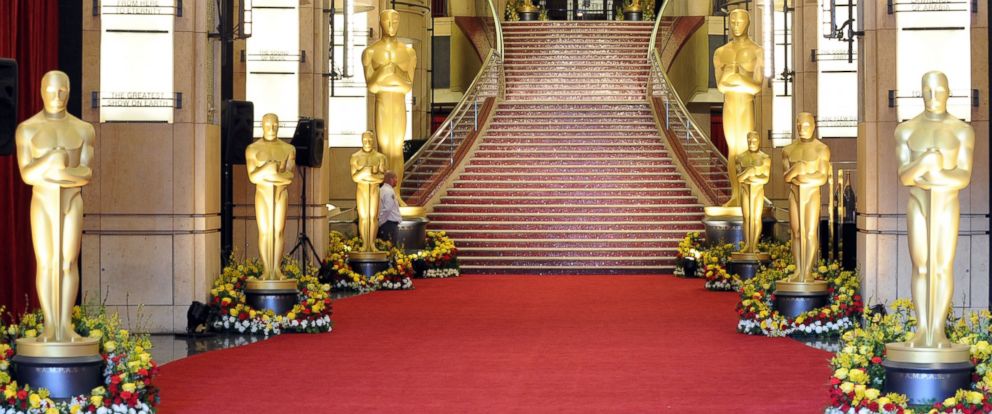
Watching the spectacle that is the Oscars leads one to wonder about the emphasis placed and the money spent on these extravaganzas, and postulate that perhaps the emphasis on sport and entertainment, which seems to me to be more prolific in the US than anywhere else in the world, was originally a means of providing the working classes with either relief or distraction from their industrialized working conditions.   The first theme park, for example, was built on Coney Island in 1896.  The North American Baseball League and the American Baseball Association were started in 1876 and 1882 respectively.  The first professional basketball league was formed in 1898, the NHL in 1917 and the NFL in the 1920’s.  This was the same period of the first black-and-white movies while the first feature film presented as a talkie was The Jazz Singer, released in 1927.

Nor was this confined to the USA.  In England the National Football (ie. soccer) League was founded in 1888.

In other words organized mass entertainment evolved at the same time as the bleak social consequences of the Industrial Revolution became increasingly evident.  Is this purely coincidental? 

And then there is the question of financial rewards as a reflection of societal values.  For example, the contract signed by Joe Flacco after the Baltimore Ravens won the Super Bowl in 2012 is more than 300 times greater than the President of the United States earns in the same period and 2400 times greater than the income of the average teacher, policeman or fireman, who in my opinion are the real heroes.  We no longer question a typical movie budget of $200 million while myriads of American children live in poverty. 

Listening to the interviews with movie stars on the ‘red carpet’ of the Oscars provokes the question as to why we give their pronouncements so much weight – after all they are very good at reading and performing lines and roles written by somebody else, so is it surprising that what many say is inane – and why we place so much emphasis on what they wear, considering that they are invariably dressed by someone else?

I’m not a late night owl but stayed up one night to watch the late night talk shows, all  in the interests of research, you understand!   The overwhelming majority of guests are actors, musicians, athletes.  Is that all we have to talk to and about? 

My experience in local classrooms (for many years I observed and mentored college students who were doing their ‘student practice semester’ as the last requirement before graduation) stressed the emphasis on obedience and compliance.  There is a game that we learn to play in school – “What does teacher want?”  One route to a good grade is figuring out what sir or ma’am likes, and students are good at responding appropriately.  In other words, they are satisfying an external authority who will tell them how good their work is and ideas are, rather than referring to their own judgments and satisfaction. 

In my college classes the students were offered a choice at the beginning of the semester.  There is much evidence to suggest that stress promotes short term memorization at the expense of long term learning, and that quizzes, tests and exams cause the most stress.   So the choice was either regular quizzes and tests with a final exam, or a major, open-ended project in which the students were required to apply the material we were covering in class.  (I should say that I was teaching a class on western civilization – the second option would not work in say a math or language class where constant reinforcement is necessary.  And I would not want my doctor or airplane pilot to have classes taught only by me!)  Eventually every class chose the project option but there was always a group of nay-sayers who argued for tests and exams because it was a game they knew how to play and they could track their grade as the months progressed – stress and a grade trumped higher order thinking skills and long term learning.

So, how does this apply to beekeepers?  Professional sports and entertainment set unrealistic expectations.  We know that less than 1% of those who set out to make football or baseball or music their career will succeed.  Rather we become passive spectators of TV or the movies – our involvement is vicarious, experienced second hand. 

Beekeeping is not a passive activity.  Success requires a combination of knowledge and action, and even then things might not go well.  Nor is it an activity of compliance; ultimately every successful beekeeper has to take responsibility for the management of his or her hives, has to take the data and develop a personal management style.  It is similar to an open, on-going project rather than a series of quizzes and tests.  And of course the ultimate satisfaction comes from goals that one sets for oneself, not from pleasing the President of the local bee club. 

In his delightful monthly column in Bee Culture, Ed Colby comments (November, 2017) that we don’t need more beekeepers so much as better beekeeping, and we don’t need more bees so much as more healthy bees. Which begs the question, how do we make new beekeepers aware of the realities, the commitment and knowledge required to start down the road of better beekeeping without dampening their enthusiasm?  One doesn’t fear the rain once one is wet. We need to be clear up front.  Those who are truly committed will accept the challenge gladly and be excited by the passion exhibited by proven beekeepers; the others will shy away from something they should not have started in the first place, which is fortunate for the health of the honey bees.  

A Jar of Honey 

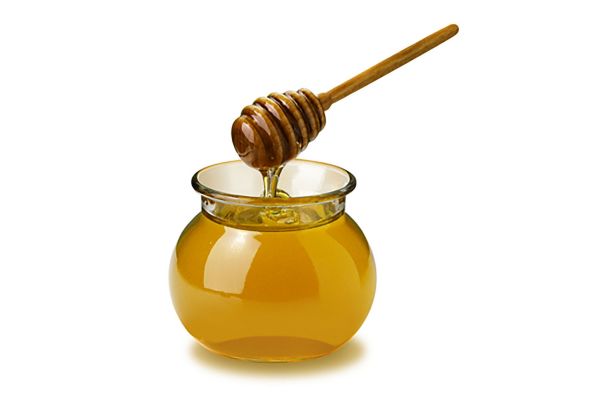
Most new beekeepers believe they can cover their start up and maintenance costs from the sale of honey.  Not only have I never achieved that but I’m increasingly convinced that it is near impossible for a beekeeper, commercial or otherwise, to make a living from honey sales alone.

The  current price of a one pound jar of local honey in Pennsylvania averages about $8, and my guess is that some of us feel a little hesitant asking even this price, especially when a customer states that he or she has seen honey in the supermarket for less than $5.  This leads to the inevitable discussion about local, verifiable, authentic honey with it’s own terroir (to use a French term) and we might even throw in the word ‘organic’ as compared to honey of unknown origins with undisclosed chemical components and which might have been heated and strained. 

“I want to support local beekeepers,” replies the customer,  “but it’s just too expensive.”

The beekeeper responds with the bit about bees flying 54 000 miles to collect the nectar to make the honey in the jar, and visiting somewhere between two and three million flowers.  We seldom include the cost of the beekeeper’s time, skills and labor but we might explain that one bee makes 1/12th of a teaspoon of honey in her lifetime and that this jar represents the life work of some 600 bees. 

The customer nods as the beekeeper continues.  Worker bees are foragers for the last two weeks of their lives and let’s presume that half of them are collecting nectar, the other half pollen.  So if they work 8 hours a day a week and we had to pay each bee the current minimum wage, each forager would earn $392 per week.

We know it takes twelve bees to collect sufficient nectar to make one teaspoon of honey.  So  $392 x 12 means that, using minimum wage as a measure, a teaspoon of honey costs $4704.   It takes 50 teaspoons to fill a one pound jar (yes, I counted) so the cost of a jar of honey is $235 200 … and that is for the nectar collection only. 

I have no idea how to calculate the amount of time spent on reducing the moisture content of the stored nectar nor for producing the wax and capping each cell, yet it is safe to say that, at these rates, we would be paying the bees in excess of $500 000 for each one pound jar of honey.

$8.00 a pound is an absolute bargain.  

The customer is still not convinced so the beekeeper keeps going.   If a forager averages 30 flights a day for two weeks, averaging one mile from the hive, the total distance she will fly is  840 miles, which is a little further than the distance from  Pittsburgh to Wichita, KS,  or from Philadelphia to Tallahassee, FL.  And the end result of all that flying,  besides the pollination that she does, is enough nectar to make one twelfth of a teaspoon of honey. 

“So to collect enough nectar to make the teaspoon of honey that you will put in your tea every morning,” the beekeeper concludes,  “the bees fly 5040 miles, which if they went east from here would take them to Madrid, Spain, and if they went west, almost to Hawaii.” 

At this point our customer buys one jar, not because he or she is convinced but partly out of a sense of guilt and partly to end the broadside. The same customer will not question the asking price of a Ford Mustang, or a luxury hotel charging $500 for a night’s stay, or a Rolex that keeps the same time as a $5 wristwatch, or a $150 pair of sneakers, or a 55” TV screen.  Incidentally, have you tried to get rid of a five year old TV set, or lap top computer recently?  It’s  hard to so much as give them away.  And I have to mention an advertisement that appeared in the local commercial gazette for four weeks : ”Thick book on history, $5.”!  

We have been conditioned to expect cheap food to the point that we minimize the connection between price and quality.  We forget that most food in the supermarket is discounted by government subsidies and that the bigger the farm the bigger the subsidy.  We don’t ask how many thousands of  miles the food had to travel to get to the supermarket, nor do we place freshness and quality above price, yet believe we can make up for any deficiencies with cheap supplements that are often unproven and unregulated.

Those who lament the loss of local farm land to residential development or the closure of a commercial bee yard don’t necessarily make the connection between  their buying habits and the decline of the country life that they profess to admire. 

Perhaps our argument would be more effective if we challenged our customers to spend a year maintaining a colony of bees, harvest the honey, factor in their expenses, add a modest profit margin, and then sell the honey. I did this exercise for myself.  I won’t bore you with the math, but the expense side of the balance sheet is based on maintenance costs for the year 2015 (no packages or nucs purchased, no new hardware, no new queens bought that year,)  five hours of management per hive per year, which is conventional wisdom but a conservative estimate, and minimum wage for labor costs. 

Based on a harvest of 200 lbs of honey, and  I stress minimum wage rates,  the cost works out at a little under $12 per pound.  With a 20% markup so that I can continue operating next year, each one pound honey jar would cost $14.50.  That’s Economics 101. And if I include ancillary expenses like the cost of the jars and lids, transportation, conferences at which I can improve my knowledge and skills, that figure is closer to $16.00

So $8 for a one pound jar of honey works out, conservatively,  at 50% of my production costs.

I have two things in my favor.  First, I am not in it for the money; keeping bees brings rewards for which there is no monetary value.  And secondly, I can keep the Chairlady of the Family Finance Committee happy by making up the deficit through offering classes, selling the occasional nuc, filling a few small pollination contracts and writing the occasional article for bee journals.

And yet I have to ask, why is it that the public expects beekeepers, and many others involved in the agricultural community, to have to supplement their income because the market will not support a fair price for their products? The solution lies in education –  educating the public that good food, as with everything else, has a price attached, and with the concomitant improvement in public health, that increased outlay is still relatively inexpensive. That implies, correctly, the argument that honey is a health food, a life enhancer, more than it is a commodity, a sweetener, that can be sourced from many places and easily substituted with sugar, corn, rice or agave syrup.  The Europeans understand this and willingly pay more for honey than do North Americans. 

Education, by good and consistent communication, is the only way we can bring others along on the journey, so that they walk beside and not behind us.

Raising Children and Bees

Kellan Borecky, 7 years old, Lancaster Co, PA.

Winter is a thoughtful season for beekeepers if not necessarily for the bees.  We have survived the  brisk energy of spring when the colonies break their cluster for the last time and explore the bouquet of nectar and pollen surrounding them.  We have labored through the summer making splits, checking for mites, moving hives and finally, if all is well, extracting honey.  And we have fed the colonies through the fall as temperatures cooled and changing foliage transformed the landscape. 

Cold days and long nights are the time to think, to imagine.  ‘Next year will be better’ is the beekeeper’s mantra; we are perpetually hopeful people and, by the very nature of our avocation, are invariably looking forward to the next season.

Not all of those thoughts are reverent.  It occurred to me, for instance, that keeping bees is much like raising children. Although a little intelligence goes a  long way, one does not have to be a genius to do either.  And thank goodness for that. Imagine if one had to achieve a GPA of 4.0 in a BCR  (Bachelor of Child Rearing) before one could have children. Instead it’s amazing how many successful people have come from humble, even deprived, families. Similarly at every bee meeting I am struck by the wide range of backgrounds and professions evident in those who attend.  And none of those backgrounds make one a better beekeeper than anyone else.  Bees, like children, are great levelers.  

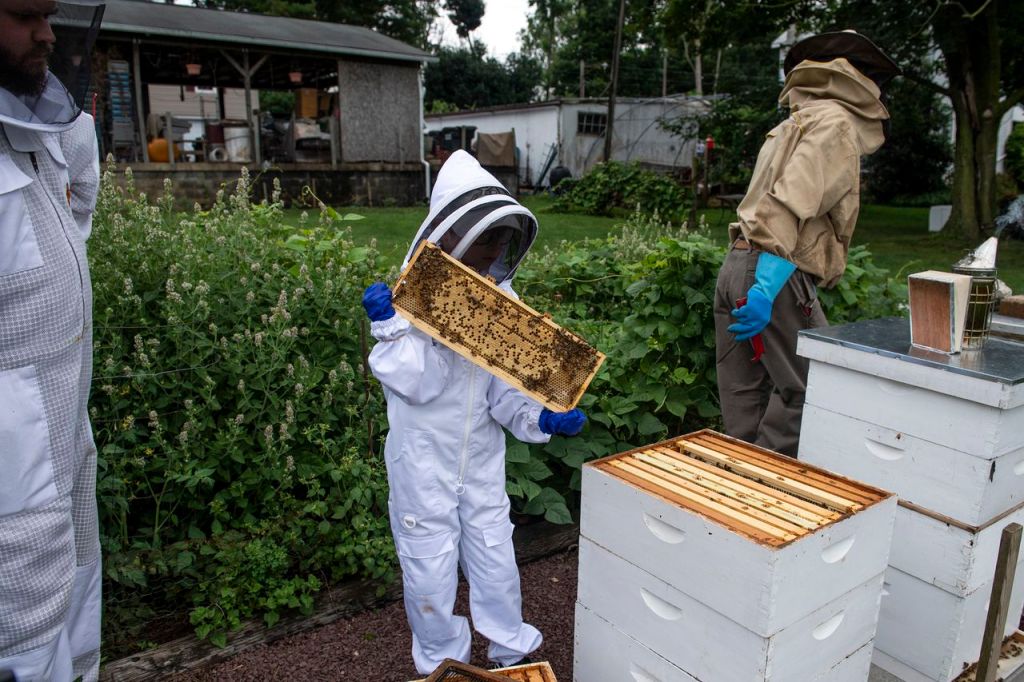
Children learn to walk and talk by never-ending practice, by consistent trial and error, by falling down and getting up again.  All too often, later in life, if something doesn’t work the first time we give up on it.  Beekeeping too is about getting one’s hands dirty, about never-ending practice, about persistence.  In both cases there are mentors, examples to inspire and follow, but in the apiary no matter how much one has read, ultimately one has to get over that initial fear so that one can start to ‘see’ what is really happening on the comb.  Some give up when their romantic expectations are not met; others persevere, accepting trial and error as a necessary part of the process and realizing that the bees are remarkably tolerant of our mistakes, as were our parents.

With both bees and children the act of stewardship can be so engrossing that years fly by imprinted with certain landmarks – the first tooth, the first swarm, the soccer lesson, the new queen, the prom, a successful nuc. Both pursuits are things one has to do in order to appreciate how challenging but  also how incredibly rewarding they can be. Only other people who are parents or beekeepers want to hear about one’s various struggles and triumphs.   I am often asked “How are the bees this year?” and the last thing the questioner wants is a detailed response.  He or she hopes for a quick, positive affirmation that will absolve them for feeling responsible for or concerned about the news they hear of bees ‘disappearing.’ Their eyes glaze over as we tell stories about winter losses, mites and failing queens. It’s the same glassy stare that one receives as one proudly describes the newly acquired hand-to mouth cup-handling skills of one’s youthful pride and joy.

And with children, as with bees, one has to be vigilant.  Just as one thinks one has everything covered along comes the unexpected.  The three year old who slams his fingers in the car door (as my grandson did) or the colony that, without warning,  absconds half way through the fall with no  chance of survival in the big outdoors (as one of mine did in September.) 

You can do everything right and still end up with less-than-ideal results, or you can screw up right royally and end up with a successful product.  I shudder at some of the things I did in my early years of beekeeping and yet the girls seemed not to mind; by comparison I felt that my colonies went into the winter of 2017 stronger and more healthy than at any previous time, and yet I had had higher losses early in the spring of 2018 than ever before. Similarly it’s astounding how children from the same parents, like  two neighboring hives, can have very different temperaments.  I like to think that my occasional successes as a grandparent and beekeeper are due to skill, loving attention  and untiring efforts, yet I suspect it’s really a matter of dumb luck. 

No matter how hard one works, as a parent or as a beekeeper, one is never really finished, either in the ‘doing’ sense or in terms of learning.  The failures can be heart-breaking, like that first dead-out in the spring, and the rewards are sweeter than nectar.  The only ones who think that either task is easy are inexperienced, lucky or suffering from dementia. 

How to Go Broke Keeping Honey Bees

with acknowledgments to How to Grow Broke Farming, as issued by the Division of Extension, University of Tennessee, in 1922 

  1. Recognize that the needs of the beekeeper are clearly paramount to those of the bees.  
  2. Treat all of your colonies the same – after all, they’re only bees. 
  3. Don’t plan the operations in your apiary – thinking is hard work. 
  4. Eliminate all ‘competitive’ species in the nearby environment,  eg. feral bees, solitary bees, bumble and carpenter bees.
  5. Use herbicides to create a ‘perfect’ lawn
  6. Cut down all trees, especially those that are dead, and plant either a maintenance-free green hedge or a mono-crop like corn.  
  7. Ignore the bees except for the annual extraction of all of their honey; after all they are there to serve us. 
  8. Insist that if the methods used by your grandfather were good enough for him, they are good enough for you. 
  9. Be independent; don’t consult with the local beekeepers, don’t contribute to your local beekeeper association, and don’t read the research of so-called experts.  
  10. When a colony fails, rather than analyze the reasons (again, too much thinking involved) simply replace it with a package from somewhere with a sub-tropical climate, using the money you would otherwise spend on your family if you had followed a good system of beekeeping. 

The Quality of Our Bees

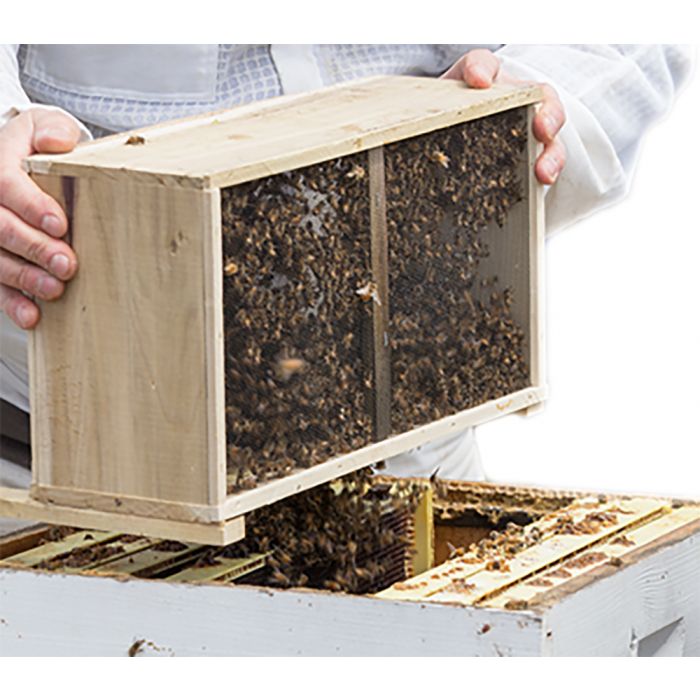
Adding a 3 pound package of bees to a hive

When potential beekeepers enquire about the potential costs of starting a hive, the response includes the expense of the woodenware, protective gear, smoker and the bees themselves.  It is not unusual to qualify this by suggesting that,  after getting the first colony, one should never have to buy bees again.  What this suggests is that capturing swarms and making splits from strong colonies is a matter of basic management strategy.  For the new beekeeper, however, terms like nucs, splits and queen rearing have a mystique that can be scary.  Add to that the advertisements for packages of bees brought in from warmer climes, the promotion of imported nucs over-wintered in temperate zones, and the full-page color pages in the journals for all kinds of patties and supplements, and the impression is readily created that someone else knows best and that buying bees from commercial sources is the right and easy way to go. 

An argument can be made, first, that it is not necessarily the right way to go, nor, in the long run, the least expensive, and secondly, where patties and supplements are involved, commercial suppliers may have their own agenda which may not be relevant or appropriate to locally-based beekeeping. 

Packages have their place.  Their advantages are that one gets three pounds of bees and a queen, they are easy to insert into a hive box, and they are normally available early in the season.  However, there are downsides : there is an assumption that the queen and the workers have ‘gotten acquainted’ during their travels, the bees need to be fed heavily once they are colonized, the queen may not be adapted to winter survival, and the cost of  packages continues to increase. In addition, there is no history of the bees or their queen so the beekeeper does not know if packaged bees have been treated nor if there were disease issues in the colonies.

Buying an imported nuc is also expensive, but one does get bees on the frame usually with some pollen and nectar, and they are easy to hive.  Again, the beekeeper often has no knowledge of the history of the bees or the heritage of the queen, and it is recommended that every nuc (and package) be tested as soon as possible for diseases and pathogens. 

Another aspect, seldom mentioned, is described by Tom Steely in Honeybee Ecology. The annual cycle of brood rearing is partly determined by  genetics and partly by the local environment. In a French experiment, colonies which were moved north and south kept their distinctive brood rearing cycles in their new environment. ie. those moved south started raising brood relatively late in the winter, and those moved north relatively early.   And in an experiment in New York, imported colonies had a decreased probability of surviving the winter.

It seems logical, therefore, that here in the northern US, bees  imported from the south are likely to have a brood rearing cycle more adapted to Georgia than Pennsylvania, at least for the first year, and that the probability that a locally raised, or second year,  colony will survive the winter is greater than that of a new colony which is in its first year in the north.

At the 2015 Pennsylvania State Beekeepers’  conference, every speaker, without exception and to various degrees of emphasis, referred to the value of locally adapted bees bred from survivor stock, with the occasional importation of new queens to diversify the gene pool.  The assumption is that  every beekeeper can be his or her own breeder of bees.  Some will graft and raise queens from strong, over-wintered, local larvae, selling queen cells, virgin or mated queens.  Grafting might not be for everyone (I don’t suggest we go as far as Denmark where apparently the introductory class for new beekeepers involves grafting the larvae that will become the queen for his or her first colony!) but making a split and raising a nuc is certainly within the skill range of all beekeepers. 

One of the questions, given a frame of larvae of suitable age,  is do the bees make random choices in choosing which ones to develop into queens (as we do when we graft) or is there a reason for their choices?  A remarkable paper was published in Naturwissenschaften (2005) by Robin F. A. Moritz et al, titled Rare Royal Families in Honeybees.  The authors genotyped worker brood and determined the number of patrilines in the colony (ie. the number of drones represented in the queen’s spermatheca). They then removed the queens to stimulate queen cell construction and genotyped the resulting queen pupae. One would predict that the number of patrilines would be the same between the two groups, but surprisingly some patrilines were over-represented in the queens and very rare in the workers. Thus, it seems that these rare “royal” patrilines are preferred by nurse bees. 

This suggests that workers express choice in rearing queens, although it does not answer whether those queens perform better. Do worker-selected queens (vs. beekeeper-selected via grafting) head colonies that are more fit?

Joe Lewis, in an article in the American Bee Journal, Dec 2013, argues that beekeepers need to make a five frame nuc for every two hives in the apiary – what he calls 2.5 Beekeeping. The pros, besides the unbeatable price,  include multiple data points for comparative purposes in an apiary, a source of brood when needed, especially to make emergency queens for queen-less hives, back-up queens to replace failing queens, and the fact that the beekeeper has some control over the qualities of bees in his or her bee yards. The cons include the extra time required compared to buying a package, and that nucs may not build up fast enough in the spring to meet the demands of pollinator contracts.

To avoid excessive in-breeding it is important occasionally to introduce new genetics into an apiary, which involves either buying or exchanging queens with fellow beekeepers whose management policies one respects.  This has become even easier in Pennsylvania with the Queen Improvement Project run in conjunction with an eight state group known as Heartland Honey Bee Breeders Cooperative, the goal of which is to develop honey bees that are resistant to varroa mites and brood disease, have at least an 80% overwintering survival rate, are gentle, and are good honey producers. A number of beekeepers and queen-producers, with the help of Pennsylvania State University  and USDA Sustainable Agriculture grants, are evaluating different genetic stocks in terms of the above criteria and the resulting queens are available to local associations for breeding purposes or to queen breeders from which to develop stock for local distribution. 

And increasingly at the club level, small groups of interested beekeepers are  meeting  regularly throughout a year to share queen rearing techniques, discuss traits to breed for and how to evaluate them, trade queens and eggs, build equipment and develop a drone yard project.

The issues surrounding packages, nucs and raising bees from local survivor stock is one that can be addressed by each local association.  Whereas none of us can dictate what other beekeepers should do, it is important to include making splits and nucs in beginning beekeeping classes and to offer hands-on workshops for local beekeepers at which they can explore the different ways of making splits and thus remove the mystery and nervousness that often surround this process.  Not only does this provide local beekeepers with more options for the long term survival of his or her colonies but also contributes towards the overall quality of honey bees in one’s neighborhood.  

Finding Order in Chaos

The Japanese Earthquake and Tsunami, 2011

Intense tropical storms, originating in the heat of the Sahara Desert and tracking across the Atlantic, are bad enough,  but what happens when they combine with another major natural event? In the US the answer came in 2012 when, in the space of three stressful weeks, an earthquake,  a hurricane, intense rain and severe flooding piled on top of one another with only a few days between each in which to catch our collective breath. 

It is difficult to plan for events that one does not want to imagine happening but these are precisely the events that must be taken into account in a realistic assessment of risk.  The Richter Scale is geometric in its progression, not arithmetic, which means that the Japanese earthquake of March 2011 was 3300 times more powerful than the Californian earthquake of 2010.  Yet in the US we assume that our nuclear plants are safe and so far we have gotten away with it.  The Japanese have not. The Fukushima Daiichi power station was designed to withstand a powerful earthquake and to resist a tsunami, but not to have to cope with a combination of the two, even though it is earthquakes that cause tsunamis. 

The American agricultural model is based on an immense industrial chemical monocultures that presume the continued presence of major pollinators, whether they be bees, birds and butterflies, or the wind.   We pretend that we are not facing a major food crisis in coming years as our prime source of pollination for fruit and vegetables, the honey bee, declines. I

The movie, Vanishing of the Bees,  stresses that honey bees are symptomatic of a bigger challenge, but if we study the bees in isolation we are missing the big picture.  Other major species are in decline (frogs, fish, butterflies, birds, bats …) and there is the potential for further crises to hasten their demise.  We like to pretend that our future food sources are safe because we cannot imagine an alternative nor do we want to change the behaviors that caused the potential crisis in the first place.  So far we have gotten away with that too.  Ultimately we may not. 

Rebuilding after major disasters is possible.  When an earthquake leveled the city of Kobe in Japan, which at the time was the sixth largest trading port in the world,  6400 people died, 300 000 were homeless, the damage was estimated at $100 billion and the prediction was that it would take decades for Japan to recover. Yet within fifteen months manufacturing was at 98% of pre-quake levels.  Similarly after the Northridge earthquake in 1994, the economy of southern California grew faster than it had before the disaster, and after Hurricane Hugo in 1989, Charleston outpaced growth predictions in seven of the following ten quarters. Initial reckoning suggested that Fukushima in Japan recovered faster than did New Orleans after Katrina.  Indeed the Japanese Prime Minister resigned under mounting public criticism for not having done enough and not having done it more quickly.  

So recovery is possible even if the toll on human life is enormous.   And in those recoveries huge amounts of capital are either lost or redistributed.  In earthquakes, for example, money is redistributed from taxpayers to construction workers, from insurance companies to homeowners, from those one once lived in a destroyed city to those who replace them.

No one changes because it’s Tuesday.  Sometimes it takes a life-threatening occurrence to change abusive or self-destructive behavior, although none of us would argue in favor of a disaster on the basis of the potential for a favorable long term outcome, especially a disaster that, unlike an earthquake or a tsunami, we have the power to prevent.  

But what is it going to take to mount a sense of outrage at what is happening in our own backyards?   How many setbacks do we have to experience before we begin to accept responsibility not only for the causes but also for the solutions? How many  cataclysmic events will it take before we act proactively rather than reactively? 

Sadly the history of responses to increased gun violence in the US is not encouraging. The British journalist, Dan Hodges wrote in 2015, three years after twenty children and six adults were shot and killed by a twenty year old male at Sandy Hook Elementary School in Connecticut, “In retrospect Sandy Hook marked the end of the US gun control debate.  Once America decided killing children was bearable, it was over.”  The students in Parkwood, Florida, who have marshaled national, perhaps even international, attention after seventeen of their colleagues were killed at Marjory Stoneman Douglas High School in February, 2018, might change that. As one of the student banners held aloft during the March on Washington said, “We are not anti-gun; we are pro-life.”

Beekeeping offers some reprise to the confusion and despair. One of the challenges  of the beekeeper is unveiling the order behind the apparent chaos of a hive.   Every bee in a hive has a purpose  and what initially appears to be confusion is in fact highly organized and purposeful activity.  After a while one feels like Napoleon surveying the battlefield of Austerlitz, or Peyton Manning looking downfield as the New England Patriots advance, Kevin de Bruyne making one of those incisive passes for Manchester City that splits the defense wide open (I confess to being a City fan,) or Lionel Messi sliding gracefully through the French defense in the final of the World Cup in Qatar in 2022. Each has the ability to read the play (or in the beekeeper’s case, a frame) to see patterns in the  disorder and to make the appropriate calls. 

Is there a pattern behind the increasing number of global natural disasters and are we the honey bee, caught up in the action and focused on one specific task, or the experienced beekeeper, standing back and see the bigger picture?   And if the latter, where do we move our troops or to whom do we pass the ball so that we can emerge victorious?

Bees and Boats

Oxford Cambridge Boat Race, 2022

In his 2013 book, The Boys in the Boat, Daniel Brown describes the epic quest of nine Americans for an olympic gold medal at the 1936 Berlin Olympics.  Each chapter begins with a citation from George Yeomans Pocock who, besides being a skilled builder of wooden racing shells and an innovative oarsman, was also a significant influence on the promotion and philosophy of rowing as a sport. 

George came from a long line of boatbuilders.  Born at Kingston Upon Thames in 1891, his father built racing shells for Eton College where, at the age of 15, he and his brother apprenticed, laboring with hand  tools to maintain and add to the school’s prodigious fleet of boats.

In 1910, George’s father abruptly lost his job at Eton because “… he had developed a reputation for being too easy on the men who worked for him,” and began casting around on the London waterfront for boat building opportunities.  His two sons, not wanting to be a burden on their father, abruptly emigrated to western Canada where, in circumstances of significant hardship, they gradually developed a reputation, first in Washington State and then on the west coast, and eventually nationally, for their craftsmanship and the quality of their product. 

In the early twentieth century the Intercollegiate Rowing Association’s regatta at Poughkeepsie, NY, was a storied institution with up to 100 000 spectators and radio coverage that rivaled the Kentucky Derby, the Rose Bowl and the World Series.   Indeed, in the 1950’s in Southern Rhodesia, I recall vividly my father sitting in front of the old valve radio one weekend each March, listening to the Oxford/Cambridge Boat Race on the Thames.  I had no visual images to refer to but his passion was contagious, and my heart would swell with pride when the boats went under Barnes Bridge!

Much of what George Pocock wrote about rowing applies equally to beekeeping, especially if one replaces words like shell, oarsman and crew with hive, beekeeper and colony, viz : 

Having kept bees myself since a tender age and having been around bees ever since, I believe I can speak authoritatively on what we may call the unseen values of beekeeping –  the social, moral and spiritual values of this oldest of chronicled activities in the world.  No didactic teaching will place these values in a young man’s soul.  He  has to get them by how own observation and lessons. 

These giants of the insect world are something to behold. Some have been in existence for a thousand years, and each colony contains its own story of the centuries’ long struggle for survival. 

Every good mentor, in his/her own way, imparts the kind of self-discipline required to achieve the ultimate from mind, heart and body.  Which is why most beekeepers will tell you they learned more fundamentally important lessons in the apiary than in the classroom. 

Keeping bees is an art, not a frantic scramble.  They must be managed with head power as well as hand power … Your thoughts must be directed to you and the bees, always positive, never negative. 

A colony is a sensitive thing … and if it isn’t let go free, it doesn’t work for you.

Just as the skilled rider is said to become part of his horse, the skilled beekeeper must become part of the bees. 

Why are the two disciplines so readily transferable?  Surely there are many reasons but two come to mind immediately.  The first is dedication.  Just as the oarsmen, coach and boat builder were fully dedicated to an ultimate goal, in this case an Olympic gold medal, so are the bees dedicated to one paramount objective : the long term survival of the colony, and thus the species, in as healthy a form as possible. 

The second is trust.   A critical turning point for the main character in the story, Joe Rantz, is when he learns to trust his team mates utterly and completely.  Only then can the team row in complete harmony, as one unit, perhaps as a superorganism.  George wrote that “When you get the rhythm in an eight (ie. eight man boat)  it is pure pleasure to be in it. It’s not hard work when the rhythm comes.” Joe remembered it as the boat literally flying across the water and at the end feeling energized rather than exhausted.  Bees too seem to trust each other as well as the greater whole.  They trust each bee to fulfill her designated function, and they trust the needs and consensus of the colony as communicated through pheromones. 

Daniel Brown, paraphrasing a conversation between George Pocock and Joe Rantz, describes the craft of boat building as like a religion. It is not enough to master the technical details; one has to give oneself up to it spiritually, to surrender completely.  When one is done there is a feeling that one has left a piece of oneself behind, a bit of one’s heart. “Rowing is like that,” George said. “A  lot of life is like that too, the parts that really matter anyway.” 

The Chilean Mine Disaster

On Wednesday, October 13, 2010, much of the world was riveted to the TV screen watching the amazing, tearful, joyful  scene as one Bolivian  and thirty two Chilean miners were brought to the surface after 69 days entombed in the bowels of the earth. Each miner climbing out of the capsule was mindful of a young worker bee emerging from her cell after twelve days as a pupa, except of course that the fuzzy bees emerge into the darkness of a hive.

Why was that scene in Chile so captivating?  Perhaps we are desperate for good news, for success stories.  Perhaps we enjoy seeing technology used for such dramatic and humane ends, or global expertise joining hands for the common good. And perhaps this was an authentic reality show in which everyone won because it was based on cooperation rather than ruthless competition, on partnership and trust in the face of fear, on power with rather than power over and on team work and creativity.

Is that what we secretly yearn for?

A bee hive is just that – cooperation in the interests of community and survival, interdependence rather than competition and independence, benefits for all rather than for a few, the nurturing of all, interconnectedness as part of a larger universe, a living organism in which every bee has an  important role to play.

There was another aspect to the rescue mission.  How often do we give more than a passing thought as to where the metals that we use every day come from?  And yet on that dramatic day in October these forgotten people, the miners,  were given human faces, with families and dreams, hopes and fears, wives and girl friends (in one case, both of the latter at the same time!)

Similarly I suspect that few Americans give much thought as to where the food they eat comes from, or to the many processes that have to happen, from soil preparation to pollination to irrigation to harvesting and transporting, before they can take it off the shelf in the super market or buy it over the counter at a fast food store.  The oft-told story may be apocryphal but it contains a germ of truth.  “Where do green beans come from?” “From aisle 8 at the grocery store.”

Successful beekeeping requires that one becomes more observant, more aware, of the seasonal changes, of temperatures, of nectar flows and what’s in bloom and what pesticides and herbicides are being sprayed where.  Perhaps it is the way that people were before mass urbanization followed the industrial revolution, when most of us lived close to the land and were more interactive with the world beyond our doorstep.  

The myriad of tunnels in that disastrous mine below Camp Hope was mindful of looking into a hive, filled with wonder as to what the bees do to create a working environment in which they can prosper, procreate and progress.  Comb in a natural space is a marvelous combination of fluidity and precision. There is a hypothesis that bees use bee-chains to measure a space before building comb, that they can start on different walls of a cavity and meet perfectly in the middle without so much as a seam in the wax.   Similarly at Camp Hope computers on the surface were used to direct the drills with amazing precision deep into the earth.

The Constitution of 1776 was a landmark document of the Enlightenment.  It was devised at a time when individuals were subservient to a privileged elite based on birth, to superstition and to the dictates of a monolithic religion.  Perhaps, ten generations later, it is time to take a page  from the play book of the bee hive and recognize that with independence comes an inherent self-centeredness and a preoccupation with individual rights that can be damaging.   Maybe it is time for a Declaration of Interdependence and a Bill of Responsibilities.