You May Be a Beekeeper If  …

You’d rather assemble frames than go shopping

Your favorite flower is the dandelion

You call a friend in the middle of winter, bursting with excitement because your bees are making cleansing flights

You tell your troubles to the bees

You read the latest bee journal from cover to cover before you get from the mail box to the house

You have propolis under your fingernails

You’d rather read a Bee Catalog than a good book

You turn the hose on the clover after a rain storm to make sure it has enough water

You grow a plant you don’t really like because someone told you the bees like it

You’ve been kissed by the bees and gone to town with pollen on your nose 

Looking and Seeing

Last December Mary had to have some laser surgery after having had cataracts removed earlier in the year.  She liked the ophthalmologist she had consulted with- apparently he is a man big not so much in size as in character and personality, hyperactive and warm,  interactive and genuinely caring.  Waiting for the surgery she mentioned that her right eye watered more than the left.  “Let me look at you” he offered, and very quickly said, “You right eye does not close as tightly as the left one, and there is a slight droop in the eyelid.” 

Mary, herself a retired family physician, had not noticed this, nor had I, and even knowing it I find it difficult to see.     On recollection, Mary recalled that twelve years ago she had Lyme’s Disease with the consequent Bell’s Palsey-like drooping of the right side of her face, before it was rectified with medication. The current condition of her right eye was clearly a long term consequence of that disease.

Fast forward a few weeks as, on Christmas Eve, we prepared a treasure trail for three of the grandchildren.  You know the kind of thing.  Each starts with a card on which is a drawing or a phrase, which leads them to where the second card is hidden, and so on until the final card reveals the treasure – in this case, their Christmas gifts.  The youngest had five such cards, all with pictures; the older two had semi-cryptic clues.  Thus Owen’s first card read, “Cluck,cluck, this is egg-citing “ and steered him to the chicken coop. 

In all three cases the path to say, the third clue,  led them very close to where the fifth and eight clues were placed: all of the clues were visible if one chose to look.  Despite my anxiety, the cards were found in order. The children were so focused on the clue-in-hand that  none of them saw the other signs and tip-offs as they ran passed them.

Finally, as the first snow storm of the year approached in January, two good friends and I were discussing jigsaw puzzles as a source of stimulation when one is confined indoors.  We agreed how, the more one works on a puzzle, the more one chooses pieces by shape rather than by color. In other words, one sees the parts of the puzzle from a different vantage point.  

Clearly there are different kinds of looking.  The ophthalmologist was hyper-busy when viewed from the outside, yet had the ability to focus intently when required with the experience to make significant deductions from a minute discrepancy.  A phrase I heard recently was ‘the ability to see the world through a small window.’ Puzzlers, quiet and centered,  find themselves acutely aware of another dimension to small details, whereas the grandchildren, excited and flowing with adrenalin, were so focused on a preconceived, distant goal that they were unaware of the details around them.

These experiences prompted some reflections on how we as beekeepers look at frames of honey bees, and how we see differently.  For a new beekeeper a busy frame of bees is  confusing, even intimidating.  In many cases, the instructor has described what they need to look for, and the students bravely look for the presence of eggs, pollen and honey, and of course they want actually to see the queen rather than be satisfied by signs of her presence and activity.  They are exhilarated when someone points out say a queen cell hanging off of the bottom of the frame, or if the instructor uses a finger gently to move a few bees so that larvae are revealed in the bottoms of a few adjacent cells. 

The more experienced beekeeper takes this in with a glance, to the point that he or she will often spot the queen without actually looking for her : it is not the queen herself that stands out but the behavior of the surrounding bees, or the difference in her movement compared to the workers in the retinue.   A personal benchmark was spotting a queen who was in the act of laying, her abdomen buried in the cells, even though I was not looking for her. 

What that experienced beekeeper notices is something out of the ordinary, something that is unexpected, that breaks the anticipated pattern, that has a distinctive if unexpected shape. It may be  a few cells of exposed pupae in otherwise capped worker brood, or a bee with deformed wings, or the movement of a small hive beetle scuttling to safety, or more than one egg in the bottom of a cell, or a degree of alarm in the movement of the bees suggesting the loss of their queen, or …    You know the scenario. 

So the first question is, how do we move from the first scenario, akin to the grandchildren and their predetermined goal set by an outside authority, to the more sentient scenarios akin to the ophthalmologist and his ability to detect the unexpected in what was otherwise normal, or puzzlers making choices based on minute differences in configuration?   My guess is that time,  perseverance  and experience are the only teachers.  Like swimming, if one is to stay afloat one has first to jump into the water, get wet, splash around a lot, practice, get some well-timed direction, and practice some more.  One cannot learn to swim only by reading a book or looking at pictures, no matter how good they might be. 

The second question is, when you look, how much do you see?  `

The Simple Life

Although she denied it, my mother lived a fascinating life.  In 1940, at the age of 16, she experienced the London Blitz and nine years later, with her husband and two young children, moved to a remote corner of southern Africa.  Initially she hated it, not least the loneliness, but came to love it and ultimately became private secretary to the Prime Minister, accompanying him to international conferences in Geneva and London.  Despite my pleas she never wrote anything down.  I have so many questions to ask and now it is too late.

Recently I was communing with my good friend and fellow beekeeper, David Papke, at our regular haunt (I would like to say ‘alehouse’ a la Benjamin Franklin, but it is nothing so romantic) about the heritage we leave our children.  We each resolved to record some personal memories in the event they might one day be of some interest to future generations at a time when we are no longer here to answer questions directly.  I decided not to follow a timeline so much as to record  memories as they occurred; one memory led to another and before along I had covered 20 pages.  At our next coffee conversation David and I wondered why some memories remain over intervening decades while others are lost, and I realized that for me those recollections are tied to feelings.  It may be that the combination of event and feelings stores those incidents more effectively in the memory bank, or perhaps an emotion today triggers a memory of an event that originally had similar sentiments attached, but speaking personally  there are three general areas of feelings that are involved – painful  feelings, like shame, embarrassment and guilt; romantic feelings tied to those one has loved; and feelings of serenity   

The memories evoked by painful feelings significantly outnumber the other two categories combined, and I wonder if my commitment to beekeeping is a subconscious effort to balance the pain by committing to something that involves love and serenity as well as symbolizing a perennial life style that was more simple, more genuine, perhaps even more authentic.

From Socrates to Thoreau, from the Buddha to Wendell Berry, a simple life has been equated with a good life. Magazines encourage us to feng shui our homes and our lives; we receive unsolicited articles in our in-boxes offering simple solutions to what are assumed to be our problems;  guests on talk show programs promote the Slow Food Movement which, beginning in Italy, advocates for a return to pre-industrial basics and has adherents  across continents; and the shelves of book shops are filled with commentaries on issues such as Buddhist mindfulness and recipes for rediscovering joy and happiness. 

In his book,  The Wisdom of Frugality , Emrys Westacott argues that through much of civilization frugal simplicity was not a choice but a necessity, and precisely because it was necessary it was deemed a moral virtue. In the last two hundred years, which is 2% of our civilized existence, the advent of industrial capitalism and a consumer society has instilled the idea of relentless growth and, with it, a population that is encouraged to buy stuff that previously was judged to be surplus to requirements or confined to the trappings of a privileged few.  And even for the elite, wealth was flimsy protection against misfortunes such as war, famine and disease.  As for the vast majority – slaves, serfs, peasants and laborers – there was virtually no prospect of accumulating even modest wealth.  Just making it through a long life without excessive suffering counted as doing pretty well.

Since the advent of machine-based agriculture, representative democracy, civil rights, antibiotics and cyber-space, people expect (and can usually have) a good deal more. Living simply now strikes many people as simply boring.  The result is a disconnect between our inherited traditional values and the consumerist imperatives preached by contemporary culture.

There does appear to be a growing interest in rediscovering the benefits of simple living, especially among millennials.  Some of this might reflect a nostalgia for the pre-consumerist world, a relief from the stresses of a constant cyber society, or a sympathy for the moral argument that living in a simple manner with traits such as frugality, resilience, peace of mind and independence, makes one both a better and  a happier person.  It might also reflect a feeling of separation from the natural world and a yearning to live closer to mother earth. 

And at the same time there are millions who continue to live on the fast track, working long hours, racking up debt and striving to ascend the  bureaucratic ladder.  Hypocritically, we applaud the frugality and moral integrity of say Mother Teresa, the Dalai Lama  and Pope Francis, while at the same time working extra hours so we can afford a bigger house, a newer car and pay down our debts. Similarly we condemn extravagance that is wasteful and yet witness the tour coaches lining up every day outside the gates of the Forbidden City in Beijing and the palace at Versailles, or the 5000 passengers disembarking from a cruise ship at a port in the Caribbean. The truth is that much of what we call ‘culture’ is fueled by forms of extravagance.

The arguments for living simply were most persuasive when most people had little choice; they are less persuasive when a frugal life style is a choice.

That might be about to change. Economically, in times of recession we find ourselves in circumstances where frugality once again becomes a necessity and the value of its associated virtues is rediscovered. Currently in the United States the distance between the ‘have lots’ and the ‘have nots’ is greater than at any previous time, provoking an increased critique of extravagance and waste. With so many people living below the poverty line there is something unseemly about indelicate displays of opulence and luxury. And according to Maslow’s hierarchy of needs, one can live perfectly well provided certain basic needs are satisfied which, at least in one estimate, requires an annual family income of $70 000.  Anything in excess of that, some argue,  is best used to ensure that everyone has the basics – food, housing, healthcare, education, utilities and public transport – rather than funneling into the pockets of a few, where noblesse oblige is pitted against self-interest.  

Prior to 1800 one is unlikely to have heard an argument for the simple life in terms of environmentalism. Two centuries of industrialisation, population growth, pollution,  deforestation, climate change and the extinction of plant and animal species, suggest that the values and lifestyle of conscious simplicity might be our best hope for reversing these trends and preserving our planet’s fragile ecosystems.

The scuttlebutt in Pennsylvania is that the honey bees have had a very difficult winter, with significant numbers of dead-outs which were the result of neither cold nor starvation so much as something else as yet unknown. My sense is that it reflects a change in the environmental, probably chemically induced,  and the spartan wintering habits of the bees, honed over millions of years, were not enough to enable them to survive. As the environment changes they  are victims of a situation not of their causing.  Unlike the bees, we do have a choice,  and if we opt not to be more ecologically wise, frugality might be forced upon us. An honored tradition that bespoke a  moral virtue would become a respected life choice out of the necessity of survival. 

The Peace of Wild Things

When despair for the world grows in me

  and I wake in the night at the least sound

  in fear of what my life and my children’s lives may be,

  I go and lie down where the wood drake

rests in his beauty on the water, and the great heron feeds.

  I come into the peace of wild things

  who do not tax their lives with forethought

  of grief. I come into the presence of still water.

  And I feel above me the day-blind stars

  waiting with their light. For a time

  I rest in the grace of the world, and am free.

Wendell Berry

Animal School

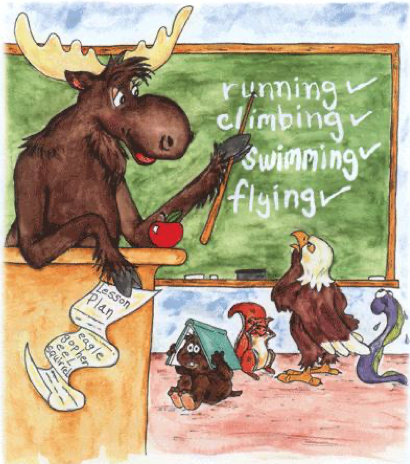
A fable written by George Reavis, then Assistant Superintendent of the Cincinnati Public Schools, almost 80 years ago, was  up-dated in Steven Covey’s Seven Habits of Highly Effective People, first published in 1989.  It describes how the animals in the Great Forest, rather than give parents the responsibility of teaching their children the skills they needed to know, decided the young ‘uns should  learn from professional teachers. So they organized a school and hired staff. 

They opted for  a standardized educational curriculum with an activity-based syllabus consisting of swimming, running, flying, and climbing. All the animals took all the subjects – it was very important that no child be left behind. Standardized achievement tests were administered to all students to ensure they were progressing satisfactorily,

The ducks were excellent in swimming; in fact, the ducks were better than their teacher. But some of the ducks made only passing grades in flying and all of them were very poor in running, and thus  were required to stay after school for remedial running practice, to the point that they had to drop swimming in order to practice running. This was kept up until their webbed feet were very sore and they were so tired that soon they were only average in swimming. But average was acceptable in school, so nobody worried about that – except the ducks. 

The  rabbits started at the top of the class in running but did very poorly in swimming. Also, the rabbits insisted on hopping, and the teachers, concerned about their hyperactivity,  made them walk everywhere instead of allowing them to run or hop. The rabbits had to come in early every day for special swimming class to the point that some of the younger rabbits developed severe fur problems from spending so much time in the pool. 

The squirrels were excellent in climbing and running; in  fact, the squirrels were the best students at climbing the standardized tree. But they wanted to fly by first climbing the tree, then spreading their paws and gliding to the ground. But in flying class their teacher made them take off from the ground with the other students, and clearly the squirrels were not mastering the course material. So every day the squirrels had therapy – a flying therapist took the squirrels into the gym and made them do front-paw exercises to strengthen their muscles so they could learn to fly the right way. The squirrels’ paws hurt so much from this overexertion that some of them only got a C in climbing; two even failed climbing altogether. 

The eagles were problem children. In climbing class they beat all the others to the top of the tree but they insisted on using their own way to get there and were quite stubborn about it. They said that clearly it was the goal that mattered and that it was quite right for them to get to the treetop by flying. The school psychologist diagnosed them as having oppositional-defiant disorder and developed a strict behavior modification plan for the wayward birds.

At the end of the year, an abnormal eel that could swim exceedingly well and also could run, climb and fly a little, had the highest average and was the valedictorian. The prairie dogs stayed out of school and fought against the tax levy because the administration would not add digging and burrowing to the curriculum,.  They apprenticed to the badger and later joined the groundhogs to start a private school. 

In some schools today, outside of the forest, we still make squirrel children try to learn to fly by flapping their paws and we punish eagles for being defiant about their right to be themselves. In other schools, fortunately,  we enjoy all children for themselves. Each squirrel is a perfectly wonderful squirrel. Each rabbit a lovely rabbit whether or not it chooses to hop, skip, roll or walk. Each eagle is allowed to be an eagle and we encourage each duck to swim rather than worrying about learning to run. 

Honey bees balance their behaviors between the needs of the community and their state of maturity, beginning with new-borns cleaning out the cells from which they have just emerged and ending with the collection of resources needed for the continuation of the species.  Whereas there are certain broad principles within which they operate,  the bees are more adaptable  than we initially realized, and will change their behaviors (the equivalent of swimming, running, climbing and flying) depending on the signals they receive from their nest mates. 

Beekeepers, and beekeeping classes, are not always as flexible, and may be dogmatic in what they determine is the ‘right’ way to keep honey bees.  Certainly nu-bees need assurance and direction, yet never to the point that they are submitted to standardized achievement tests, or accept average as OK,  or are subject to behavior modification plans, whether self or externally imposed,  to the point that they lose that vital enthusiasm and sense of awe that keeps many of us involved.   

Covey argues that driving forces (eg. the ability and desire to fly, swim, run or fly) are positive, motivate growth and change, and keep us engaged, while restraining forces are negative. Valuing differences, especially our  mental, emotional and psychological differences, is the essence of synergy, and it is synergy which best describes the activities of a bee hive.  To develop the empathy that allows us to welcome and respect differences, we first have to realize that people tend to see the world not as it is but as they are – we each visualize it through the prism of our own experiences – and the good instructor or mentor evokes and utilizes those perceptions.  The word ‘education’ is derived from the Latin educare, meaning to draw out, not to pour forth.  

An effective beekeeping instructor or mentor has the humility and reverence to recognize his or her own perceptual limitations and to harness the rich resources made available through interaction with the hearts and minds of nu-bees, not least their curiosity, enthusiasm and burgeoning passion.   He or she cannot see honey bees as they do, nor can he or she bring to the class the life experiences that each of the class members has; rather, opening up to their perspicuity adds to the knowledge, the  understanding of reality, of everyone in the apiary.  To return to the jigsaw analogy, perhaps it is the instructor’s job to put the corner pieces in place, to help the new beekeeper complete the connections between them which  outlines the puzzle, and then to step back as he or she fills in the individual pieces.  Because the final picture is not uniform – the colors, the shapes and the images are unique to each one of us. 

The alternative, as George Reeves articulated  in the 1940’s, is that we try to make everybody the same, and no-one is happy. People get hurt and their best gifts go to waste. 

World Hunger

Two articles in the May, 2018, issues of the leading national bee journals have a common motif.  In an otherwise excellent article on pollination,  Rusty Burlew writes in Bee Culture : “Modern farms are the antithesis of natural environments.  But far from being a bad thing, modern farms are necessary to feed burgeoning populations of humans.”  And in a surprisingly emotive piece of writing in the American Bee Journal, Jessica Louque defends the use of neonicotinoids on the grounds of cost effectiveness, suggesting that “If neonics are banned from the US, it’s going to be financially more difficult for everyone but the chemical companies.”  

I am not convinced that modern farming techniques are the long term answer to population growth, nor do I believe that funding issues should determine environmental health and policy. It seems short-sighted to allow our planet to degrade further on the grounds that it is too expensive to fix it. 

First, In 1985, in the executive summary of it’s  Farming Systems Trial, the Rodale Institute asserted that  “Organic farming is far superior to conventional systems when it comes to building, maintaining and replenishing the health of the soil. For soil health alone, organic agriculture is more sustainable than conventional. When one also considers yields, economic viability, energy usage, and human health, it’s clear that organic farming is sustainable, while current conventional practices are not.  As we face uncertain and extreme weather patterns, growing scarcity and expense of oil, lack of water, and a growing population, we will require farming systems that can adapt, withstand or even mitigate these problems while producing healthy, nourishing food.”

More recently, two of the leaders of the Regenerative Agriculture movement,   Gabe Brown and Dr. Jonathan Lundgren, in North Dakota and Kansas respectively, have shown practically and persuasively that moving beyond sustainable to regenerative  agriculture can significantly increase yields without the use of chemicals.  Both men are also beekeepers, and the honey bees are integral parts of their system of rejuvenation which focuses on  increased biodiversity,  soil enrichment, improvement of watersheds and enhancement of ecosystem services. 

Secondly, feeding an increasing population is much more complex than simply increasing food supplies; indeed the latter may work for 2050  when the world population is estimated to be 9.1 billion people, a 34% increase over the current figure, most of which will occur in less developed countries. But should we not be thinking further down the road than simply one generation?  A long term solution which integrates a healthy planet with a well fed population requires more elaborate solutions. 

There is an immense amount of material available on possible solutions, stemming from research papers, national conferences and international agencies, and what follows is but the tip of the iceberg, enough hopefully to increase awareness as to what lies below the surface.  The Agricultural Policy Analysis Centre, for example, points out that since 1974, agricultural production has been increasing at a higher rate than population growth. The number of hungry people, however, has not decreased; on the contrary, that number has increased steadily since 2000. 

Such hunger is not due to a shortage of food – the world has enough resources to feed, clothe, house, and employ the entire world. The problem isn’t a lack of resources so much as social inequality (both within and between countries) and inequitable distribution. By some estimates, stopping the waste of food after harvest due to poor storage or transport infrastructure, as well as in our own kitchens, could free up half of all food grown.  Providing the additional calories needed by the 13% of the world’s population facing hunger would require just 1% of the current global food supply. That such redistribution has not already taken place is shameful; there is no valid excuse for so many people to die daily in avoidable agony.

International aid, important as it is, is no longer the main story.   As in the ‘give-a-man-a-fish’ adage, the long term need is to provide  small agricultural producers with the research, extension and credit that will enable them to feed themselves and their families. The governments of Ghana and Brazil have taken the lead in doing jus that, whereas  many  countries like India, growing at 8% a year and with a mushrooming middle class, need to take greater responsibility for their hungry masses, both in the short term through effective social services and in the long term via nurturing small scale growers, including urban farming.  

Less than 1% of what the world spends every year on weapons is needed to place every child into school. Increased access to education means not only increased opportunities for income and food, but it also allows for the empowerment of women, including the provision of access to contraceptives that allows for family planning and greater economic choices.  

One of the enduring consequences of colonialism is that more people are eating a diet heavy in meat, dairy and eggs. The issue is that the standard Western diet is extremely resource intensive;  we currently produce enough calories to feed 11 billion people worldwide, but the majority of this food goes to feed livestock. One estimate is that those who eat beef use 160 times more land, water and fuel resources  to sustain their diets than their plant-based counterparts.  With the provision of fresh water becoming a significant  issue, we cannot ignore that 70% of our domestic freshwater goes directly to animal agriculture and that one acre of land can produce 250 pounds of beef ,  50,000 pounds of tomatoes or 53,000 pounds of potatoes.

Then there are the global impacts of war and climate change. For millions of people in Africa, Asia and Latin America, the latter means more frequent and intense floods, droughts and storms, accounting for up to 90% of all natural disasters annually, and which can quickly spiral into full-blown food and nutrition crises. The push in Europe and north America to reduce dependence on imported oil and gas has led to the introduction of targets and subsidies for biofuels, which compete directly with endowments for food production and result in  increased food prices for the poor. Greenhouse gas emissions in wealthy countries drive climate change at a pace that outstrips even the most pessimistic projections of the climate modelers, and there are few signs of governments agreeing to the kinds of reductions needed to avoid catastrophic temperature rises that will harm tropical agriculture in particular, thus countermanding the efforts towards small scale sustainable farming. 

Globally, social and political instability are on the rise. Since 2010, state-based conflict has increased by 60% and armed conflict within countries has increased by 125%. More than half of the food-insecure people identified in the U.N. report (489 million out of 815 million) live in countries with ongoing violence; more than three-quarters of the world’s chronically malnourished children (122 million of 155 million) live in conflict-affected regions.

The number of refugees and internally displaced persons doubled between 2008 and 2016. Of the estimated 64 million people who are currently displaced, more than 15 million are linked to one of the world’s most severe conflict-related food crises in Syria, Yemen, Iraq, South Sudan, Nigeria, northern Kenya and Somalia. While migration is itself uncertain and difficult, those with the fewest resources may not even have that option. Research from at the University of Minnesota shows that the most vulnerable populations may be trapped in place, without the resources to migrate.

War makes the poor poorer in many ways. It’s the working-class, who struggle to feed, clothe, and house themselves and their families in the best of times,  who pay for the war, both financially and with their lives. Violent disruptions to food systems and economies spill over to countries bordering such conflicts. Refugees might devastate livestock, trees, and other natural resources as they move. Once forcibly settled or self-settled, they compete for land and resources and affect local markets for food and livestock. Their additional demand creates scarcities that drive up prices, while their need for cash drives down prices of livestock and other assets when they enter markets to sell them to get the money to buy food. Such distortions interfere with local coping mechanisms that ordinarily allow people to respond effectively to drought and avoid destitution, and turn food shortage into famine, as is painfully evident in much of the Middle East and North Africa today. 

If we are sincere in our determination to resolve world hunger in a growing global population, surely we would focus as much on working for international peace and justice, the reversal of climate change, building and protecting reliable lines of communication and distribution, universal economic growth, better diets, the revival of small scale agriculture, and increased educational opportunities, as we do on providing food for the hungry at the  expense of the health and longevity of our own resources. Hunger is both a cause and a symptom of poverty and, like so much else, it is underscored by issues of power, control,  money and self-interest.  According to recent data from the UN, some 850 million people (one in eight of the world’s population) go to bed hungry every night. Many of them are children, for whom malnourishment leaves a lifelong legacy of cognitive and physical impairment. Damaged bodies and brains are a moral scandal most of all, as well as a tragic waste of economic potential. 

We work hard to provide for the nutritional well-being and longevity of our bees, and pride ourselves on acknowledging and absorbing the complexity of their society.  We admire their constant business and their long term objective of the continued survival of the species in as strong and as healthy a form as possible.   When we fail to challenge simplistic statements that eschew such complexity in our own world, not least when they emanate from organizations that have a financial stake in obscuring the deeper issues,  we  deny extending to our fellow beings the courtesies we offer to our charges in the hive. 
You Are an Apiholic if …

you mow around the dandelions in your lawn

when you get stung, you blame yourself and hold a quick memorial service for the bee

driving with a bee in the car does not distract you

no trip to the grocery store is complete without a twenty five pound bag of sugar

you let out a whoop when the weatherman announces a high pollen day in the forecast

you keep a bag of clover seeds in the car and toss handfuls out of the window into vacant median strips

you deliberately misspell words like beeautiful and beehave,  and end a conversation with bee careful

both the 911 Center and the post office have you on speed dial

you have to explain in detail when people hear that you made splits, that your Russian girls are hot, and that you have a nuc in your backyard 

you not only know what propolis and the waggle dance are, but you are quick to demonstrate the latter at every opportunity

your neighbors call to ask you to remove a yellow jackets’ nest, and are appalled when you say that you do not intend to capture and re-hive them 

you ask your spouse if he/she will change the date of your wedding anniversary because it occurs at honey harvest time

you know more about the origin of your queens than you do about the origins of your spouse

your first pound of honey cost $800.

Adapted from an on-line posting, author unknown. 

Cross-Fertilization in Community

Growing up I believed that my future would be spent in the country of my youth, surrounded by friends and family.  Fate intervened in the form of a civil war and gradually our community dispersed to the point that at one point my brother, sisters and I lived on four different continents while most of my school colleagues and friends spread themselves between South Africa, Australia and England, with none that I know of moving to the United States. 

I guess we absconded.

Mary, by contrast, is still in contact with many of her schoolgirl friends, one of whom, Maggie, flew in from Portland, OR, for the annual family vacation on the eastern shore.  Maggie’s beloved partner died a year ago and she described the feeling of loss that still remains.  Despite having a  wide circle of caring friends, good neighbors and two sons with delightful grandchildren, what Maggie misses desperately, especially in the afternoons and evenings, is the physical presence of that special someone with whom to talk things over, to share plans and ideas, dreams and disappointments. 

As best I recall it was the paleoanthropologist, Richard Leakey,  who first promoted the idea that mankind developed because we learned to cooperate, rather than because we became efficient killers. It is a theme that is summarized in his final published work, The Origin of Humankind –  the power of numbers, working in unison, not only proved to be transformative but led to features such as social organization, the development of language, art and culture, and human consciousness.  

It is a story of man the communicator rather than man the murderer. Cooperation was more potent than competition, Leakey argued, even as collaboration and teamwork made mankind more competitive.  

It is not a hypothesis that is universally accepted, yet we can agree that communities, by their very nature, contain a diversity of opinion, ideas, and knowledge that an individual does not encounter alone. The synergy that evolves amid a tumult of ideas can be an inspiration as well as a challenge to reconsider what one knows and to think creatively.  It feels good to participate positively in a group and to be acknowledged as a valuable societal member, recognizing that everyone benefits from worthwhile contributions.  One can share skills, gain from the experiences of others, and in those inevitable  difficult times, be surrounded by others who recognize what one is feeling.

In the essay, Apples and Honey, published in Listening to the Bees, (2018) Mark Winston, after explaining why it is important that many different species of wild bees participate in apple pollination besides honey bees, writes, “It is similar with human societies : it’s through the cross-fertilization of ideas and talents that we express our best communal selves.  We derive strength and wisdom from our mutual visions, just as the apples are improved by the visits of diverse bees to set fruit.”  This notion of ‘our best communal selves’ is something I get to experience at our local monthly  bee meetings and at the annual state conference in State College. 

Ronnie Janoff-Bulman, writing in Shattered Assumptions, (1992) argues that there are three beliefs essential for a healthy core self : the world is meaningful, society is benevolent, and the self is worthy.   To reach our highest cultural potential, he suggests, we need to believe that the world is a good place, that we ourselves are virtuous, and that our lives make sense somehow.  We do not simply exist in arbitrary and random chaos; rather when we come together in shared community, united by a common passion, we are incentivized by the feeling that we are  doing something honorable and decent, both individually and collectively, that makes the world a better place. 

The original human groups, perhaps some 60 000 years ago, were concerned primarily with enhancing their chances of survival.  The men would coordinate to  protect the tribe  from carnivores and would allocate roles when hunting for meat; the women would stay in the camp, raising the next generation and providing the emotional and nutritional needs of the family, in all probability inventing agriculture along the way.  “It takes a village …”    

In the space of 2500 years our progressive civilization witnessed stimulating communities ranging from the peripatetic gatherings of ancient Greek philosophers, the French salons of the Enlightenment, and the many groups today that gather to discuss a shared passion, such as managing honey bees. My guess is that most of us have experienced the affirmation, if not joy, that comes from associating with ‘cool beekeepers’ at a local or state meeting, and whereas we might attend initially out of curiosity, many of us consciously commit to becoming an integral part of this community of shared energy and enthusiasm, with both the individual and communal rewards, not to mention enjoyment and sense of fun that results from collaboration, clear communication, a strong work ethic and social responsibility … as in a bee hive. 

Honey bees are superb collaborators, which does not mean passivity.  They delegate to individuals the duty to defend the community, and it appears that most of the bees in the hive will take their turn at doing so, but their role is one of defense rather than of aggression.  Incidentally, a recent observation  is that those bees we see apparently resting in a hive are in fact a reserve militia, held in waiting in the event of a major catastrophe, such as a beekeeper removing the outer cover of a hive without fair warning to the bees!  I have often wondered why, if the guard bees are at the entrance of the hive, so many seem waiting for me in the upper box, and suspected it was more than worker bees suddenly assuming the role of protectors of the hive in response to precipitous exposure. 

Important as community is, it cannot compensate for the intimacy that comes with sharing one’s life for many years with a beloved. It’s a complex interaction. Just as a honey bee cannot survive for more than 24 hours without her community, so we need the balance between personal endearment and the support and stimulation of a wider fraternity. 

I have known a number of people, friends and family alike, who were left bereaved, and my hope for them was that they would recover gradually and gently from the unimaginable grief.  I did not understand the on-going loneliness that say, my step-mother endured after the death of my father, and because I did not understand it (nor was she able to speak of it, although in retrospect there were hints) I did little to ease it.  Perhaps if we as a species had not lost our sensitivity to pheromones we would not rely as much on words, or the absence thereof, to convey our feelings and needs. 

In this coming year I wish for you the joy and benevolence of a caring community, the serenity and tenderness that come from loving relationships, and the compassion and empathy that you can offer to those who are hurting. 

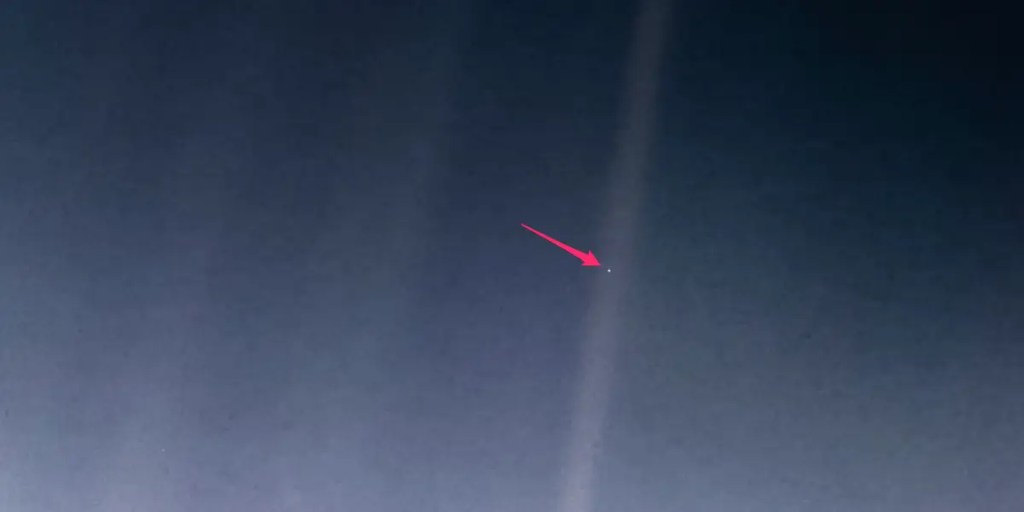
A Pale Blue Dot

A NASA photo of our planet

On February 14, 1990,  as the spacecraft Voyager 1 raced towards  the fringes of our  solar system,  the engineers turned the  cameras around for one last look at its home planet some 4 billion miles away.  Earth appeared as a tiny point of light, 0.12 pixels in size, inspiring these words from Carl Sagan : 

“Look again at that dot. That’s here. That’s home. That’s us. On it everyone you love, everyone you know, everyone you ever heard of, every human being who ever was, lived out their lives. The aggregate of our joy and suffering, thousands of confident religions, ideologies, and economic doctrines, every hunter and forager, every hero and coward, every creator and destroyer of civilization, every king and peasant, every young couple in love, every mother and father, hopeful child, inventor and explorer, every teacher of morals, every corrupt politician, every “superstar,” every “supreme leader,” every saint and sinner in the history of our species lived there–on a mote of dust suspended in a sunbeam.

“The Earth is a very small stage in a vast cosmic arena. Think of the rivers of blood spilled by all those generals and emperors so that, in glory and triumph, they could become the momentary masters of a fraction of a dot. Think of the endless cruelties visited by the inhabitants of one corner of this pixel on the scarcely distinguishable inhabitants of some other corner, how frequent their misunderstandings, how eager they are to kill one another, how fervent their hatreds.

“Our posturings, our imagined self-importance, the delusion that we have some privileged position in the Universe, are challenged by this point of pale light. Our planet is a lonely speck in the great enveloping cosmic dark. In our obscurity, in all this vastness, there is no hint that help will come from elsewhere to save us from ourselves.

“The Earth is the only world known so far to harbor life. There is nowhere else, at least in the near future, to which our species could migrate. Visit, yes. Settle, not yet. Like it or not, for the moment the Earth is where we make our stand.

“It has been said that astronomy is a humbling and character-building experience. There is perhaps no better demonstration of the folly of human conceits than this distant image of our tiny world. To me, it underscores our responsibility to deal more kindly with one another, and to preserve and cherish the pale blue dot, the only home we’ve ever known.”

Fiddling While Rome Burns

Starting on November 26, 2017, major broadcast networks and 50 major newspapers in the US carried statements from the major tobacco companies saying, for example, “Smoking kills on average 1200 Americans. Every day” and “More people die every year from smoking than from murder, AIDS, suicide, drugs, car crashes and alcohol, combined.”

At the same time these companies continue to  spend roughly $1 million per hour in America on advertisements for tobacco products in convenience stores, wholesalers and adult entertainment venues, offering  discounts and coupons.  These are the same products that are responsible for the deaths from tobacco-related diseases of about 480,000 Americans each year in a country where  lung cancer is the leading cause of cancer death for both men and women. More people die each year of lung cancer than die of breast, colon and prostate cancer combined.

The “corrective statements” are part of a 2006 judgment in federal court which found that companies such as RJ Reynolds and Philip Morris broke anti-racketeering laws, lied about how cigarettes harmed public health and denied their efforts to market cigarettes to children.  US district judge Gladys Kessler  wrote in a 1 683 page opinion in 2006 that the companies caused “a staggering number of deaths per year, an immeasurable amount of human suffering and economic loss, and a profound burden on our national health care system”.

For eleven years after the judgment these companies appealed over details of the statements; thus they do not have to air these statements on ‘the new media’ (40% of Americans now get news online) and unlike in much of Europe, American cigarettes do not have to display graphic warnings on packs following appeals by the tobacco companies and delays from the US Food and Drug Administration.

“The tobacco companies’ basic strategy for everything,”  said Stan Glantz from the University of California San Francisco,  “whether its science or regulation or litigation, is delay.  They have used a lot of arguing about what in terms of the real world are trivial issues, to delay having to make these statements for 11 years – but it is what the tobacco companies do.” 

Documents show that these companies knew as early as the 1960’s that there was a strong correlation between tobacco use and certain types of cancer and that they either suppressed that research in the interests of their own bottom lines or employed ‘biostitutes’ to sow doubt in the public arena.  Biostitutes were scientists who were funded by the tobacco companies and given extensive resources and considerable latitude as to their research provided that occasionally they would write articles not disproving the tobacco/cancer connection but questioning the validity of the research of those who did, thus sowing doubt in the minds of the  public. 

The culminating action came from two sources.  The first was the concept of second hand smoking, by which the public realized that one person’s decision to smoke, say cigarettes, exposed others in the vicinity to risk of cancer.  The second, inspired by the above, was the decision of the man and woman in the street to vote with their wallets and their feet.  They simply declined to patronize facilities that allowed smoking in public.  Restaurants were the first to feel the impact and other institutions quickly followed suit.  It was in effect a revolution, a sea change, to the point that whereas smoking was common place and unquestioned (by news anchors on TV, for example) it is now a rare sight in public  and mostly confined to private or separated areas.  It was a revolution that came from informed consumers rather than from political authorities, many of whom were heavily influenced by lobbyists and financial support from the tobacco industry (which incidentally has now turned its despicable attention to Asia, not least the children, where there are less regulations and less public awareness.)

It is my hope that the same process will apply to the quality of the food that we eat, the water we drink and the air we breath. There is good reason to believe that the environmental agencies, as well as the legislative authorities, are aware of the realities of climate change and the dangers to insect, bird, fish, animal  and human health posed by the omnipresent danger of the chemical cocktails used in our environment (with the emphasis on our.)  I look forward to the day when an informed public will pay attention to labels that are inclusive and transparent, when price will not be the prime issue in choosing what to drink and eat, when public pressure will encourage a better use of resources for the benefit of all life on this planet, and when, despite their continued denials and political influence, the agrochemical companies will be held responsible for the damage they have done and the pain they have caused. 

There are reasons for hope.  The Quebec government, for example, has banned for personal use the five most dangerous pesticides: Atrazine, Chlorpyrifos and three neonicotinoids as well as treated seeds.   Agricultural producers will be allowed to purchase these pesticides only if it is justified by an agronomist with the Ordre des agronomes du Quebec. Philip and Mary Landrigan, co-authors of the new book, Children & Environmental Toxins: What Everyone Needs to Know, connect the dots between rising rates of childhood asthma, learning problems, cancer and toxic chemicals; most of the latter are never tested for safety before they’re sold. And if there is a silver lining to the depressing cloud of opiate addiction it is the light being shone on the manufacturers and distributors of the drugs and the increasing demand that they be held accountable. 

To repeat Stan Glantz, we should expect “… a lot of arguing about what in terms of the real world are trivial issues,” but the recurring deaths of honey bees and the increased prevalence of varroa mites as the bees’ immune systems are compromised by  chemicals are not trivial.  The bees are the tip of the iceberg and we, their minders, need to be speaking out, not least because they cannot represent themselves.  Nor can any other living forms on this precious planet, ourselves excepted, but our future is more closely inter-twined with theirs than most of us realize. 

Behavioral Plasticity

One of humankind’s greatest attributes, and the one that explains much of our success over the past millennia, is behavioral plasticity.  The term was first used by psychologist William James more than a hundred years ago to describe our ability to change habits almost as a matter of course – we change careers, diets, religions, locations, each of which requires that we make choices and adopt new behaviors. This plasticity is the defining feature of our transformation from anatomically modern Homo sapiens to behaviorally modern Homo sapiens sapiens

Neuroscientists are currently trying to explain how this plasticity developed; contemporary thinking is that it is genetic, that particular genes give us a neurotic sensitivity to the environment (witness, for example, the hectic energy as big storms approach, even from those not in harms way, or our preoccupation with the weather channels on TV) and a heightened ability to adapt to new situations. 

Other animals and insects do not display the same levels of plasticity.  A honey bee and her colony are elaborate, finely tuned  mechanisms but they are fixed, as if in amber, in the loops of their DNA, and as such are incapable of fundamental change.  The minority number of drones in a hive, focused on mating with a queen, will never acquire new responsibilities; the queen will always be an efficient ovipositor without developing any maternal instincts; forager bees will always dance in predefined patterns and other worker bees will respond in predetermined ways.

And the behavior of individuals is reflected in their societies.  Some species of bees and some of ants have complex societies with elaborately coded behavior.  E.O.Wilson described leaf-cutter colonies as “Earth’s ultimate superorganisms” but they are incapable of fundamental change.  Certainly by luck or superior adaptation a few species manage to escape their limits, at least for a while (think of the changing resistance of varroa mites to  various chemicals introduced into the hive) but rather than being conscious choices these are normally genetic mutations that enable the species to survive in the face of new environmental stressors. 

Human societies are of course far more varied than their insect cousins, and it is continued plasticity which has enabled us to move into every corner of the earth and to control what we find there.  By many accounts that plasticity faces a new and vital challenge. 

The bees, the bats and butterflies and fish and birds, cannot adapt to a rapidly changing environment and they die or ‘disappear.’  Beekeepers are frequently asked, “Are the bees recovering?” and the longer response attempts to explain that the bees exist in an environment that we have largely created; that rather than look for quick fixes for the bees we need to think about redefining our concepts of standards of living and quality of life so that we can rebuild an environment that is hospitable to all species.  With plasticity comes a responsibility for life greater than simply our own, and in this case it might mean voluntary restraint which, because it pushes against the natural biological hierarchy, is the highest order of behaviors.

The biologist, the late Lynn Margulis, argued that “The fate of every successful species is to wipe itself out.”  We have got a lot of things right, most recently the end of slavery, the emancipation and gradual empowerment of women, and the endorsement and validation of civil rights, and it is depressing to think that we could be successful in so many areas yet get this one wrong.  We can land the robot ‘Curiosity’ on Mars but fail to pay attention to Earth.  To have the potential and not to use it makes us worse than the bees; they at least do not have the privilege and the responsibility of freedom of choice.