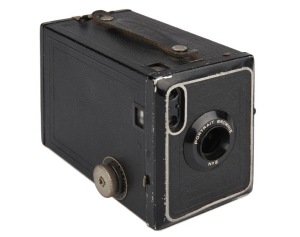
Taking photos on my phone is a challenge.
The first camera I owned, some 70 years ago, was the Kodak Brownie box version. It used a spool of eight pictures, purchased from the pharmacist, which had to be loaded in the dark. I chose with care the subject for each of those eight pictures and, once taken, had no knowledge of their success or otherwise. That had to wait until the spool was completed, returned to the pharmacy and picked up two weeks later.
Many of you surely had the same experience. The next advance was the polaroid, where one could get an almost immediate image, in color, but at the expense of quality.
Those traits – austerity combined with a good deal of patience and an uncertain end product – created habits that are not only entrenched but are also irrationally constraining. The idea of pointing the camera at short notice at almost anything and clicking away remorselessly, is still anathema to me. It feels like waste. I don’t even attempt it, and I need to be careful about judging those who can, which seems to be everyone else. The up-side of the box camera was that each successful photograph was carefully preserved in albums, one of which I still have. Most photos today seem to be stored in perpetuity on the camera (or, more accurately, in the Cloud) without editing, are looked at once or twice … and I wonder where they will be in 70 years time. A certain relative of mine, who shall remain nameless for the sake of my longevity and on-going health, has almost 30 000 photos on her phone. Certainly they are easy to access and replicate, yet I wonder when, if ever, she will have time to look closely at them.
Apparently, with the preeminence of GPS, the old map-reading skills have all but gone the way of the dodo. I wonder, with the urge to take photos constantly, if we are losing some of the basic observation skills that we used to take for granted. It is difficult to observe closely while reaching for the camera and peering through its lens, nor is there time to observe before pressing the shutter again.
On a different scale altogether, Jeff Bezos has channeled much of his personal fortune into his spaceflight startup, Blue Origin, on the grounds that small, nimble companies can do better than large, slow, inefficient governments. Paul Kingsnorth, writing in Against the Machine, outlines Bezos’s argument : we use ever-expanding amounts of energy to the point that we will soon need to cover the entire surface of the earth in solar cells to supply our energy needs. Ergo, we will have to leave this planet; indeed there is room for a trillion humans in our solar system, which will mean a thousand new Einsteins and a thousand new Beethovens.
In comparison with this progress-obsessed optimism, for at least 35 million years and probably much longer, honey bees have been absorbed with a life style that allows for the long term continuity of the species in as strong a form as possible. This means working with and consolidating what they have, with the occasional impetus of a nature-based advance such as a genetic mutation that is tested through its contribution to their prolonged health and survival. Without our intervention they reach a state of stasis between what they need and what they offer. What they lack is ego, greed, cultural parameters designed by Google-based algorithms, and advertising designed to generate perpetual dissatisfaction with one’s current status.
How might the sages in the hive respond to the assumptions that progress is inevitable, even desirable, that growth is necessarily an improvement, that we can trust people like Bezos, who has made an immense fortune often at the expense of others, that a trillion people is somehow better than the eight billion, and that all of them want a capitalist lifestyle? And just how much classical music do we need? My guess is that they would iterate the astrophysicist, Neil deGrasse Tyson, who suggests that the billions of dollars involved in Blue Origin might better be spent improving conditions here on earth so that there is no need to leave, either by choice or by force. And he was not alone in this suggestion. Before Bezos went on his solo journey into space, a petition was circulated suggesting that his return to earth should be prevented. It attracted more than 200 000 signatures!

“Progress was all right,” observed James Thurber, “only it went on too long.” As David Papke writes in his Bee Observant column this month, “Change is inevitable; how one6responds to change is a choice… (W)hen technology’s assessment overrides the beekeeper’s nuanced judgement and contextual awareness, something valuable is lost or at least missing.”
Sometimes less really is more.

 Our Green Cathedral