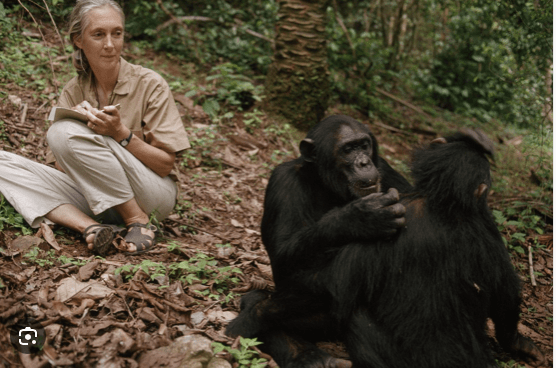
On October 1, 2025, Jane Goodall died of natural causes while on a speaking trip in California. Even at the advanced age of 91, she was traveling the world non-stop, speaking up for the voiceless and speaking out against the forces destroying them, from climate change to illegal wildlife trade to micro plastics, as eulogized by the wildlife biologist and television host, Jeff Corwin.
She was universally beloved, and seems to have touched in some way everyone who knew, saw or heard her, not least because of her intense compassion. Initially she was condemned by anthropologists because she did not start her research with a PhD – Jane took a secretarial course after high school, which explains in part her meticulous note taking . She recorded even the tiniest interaction she witnessed, every hoot and shriek, and every reaction to her, this strange white ape who somehow had what Corwin describes as ‘a stupendous supply of bananas.’ She proved that one does not need degrees and publications and prestige to make lasting discoveries; first and foremost one needs to care. She worked in the field rather than in the laboratory, with humility, curiosity and an extraordinary sense of observation.
Jane used patience, not force, to build trust. We forget that when she first met a group of chimpanzees at the Gombe Stream National Park in Tanzania, they rejected her. She sat with them, from sun-up til sun-down, every day for nine months, until they showed signs of acceptance. It was a male chimp in this group, David Greybeard, whom she eventually recorded using a tool to gather termites, an observation that was to change the world of ethology forever.
And at a time when her peers prized objectivity, distance and detachment, she chose subjectivity, empathy and connection. Thus she gave her chimpanzees names, not the traditional numbers. They were individuals, with personalities.
At the same time as we celebrate her legacy, a sense of despair looms. Our climate is warming, rainforests are being decimated, species are vanishing by the hours and micro plastics permeate our very being. Jane showed us the beauty and the humanity we stand to lose, even as those with the traditional power appear to be blind, deaf and dumb, choosing to accept money from those who drill deeper, burn hotter and exploit further, all in the name of greed and progress. What does it say about a society that reduces nature to the profit motive, buys and sells our fellow animals, and auctions off our natural heritage to the highest bidder?
Most beekeepers do not start with a degree in biology or entomology; instead we are driven by a combined sense of curiosity and caring that drives us to do something practical for our shared environs. We start in the field and learn by experience. As modeled by Jane, we talk of the need for patience and the power of observation, of the need for working with the bees rather than trying to impose ourselves on them, and we marvel at the feelings of connection with the natural world that the bees can provoke in us. Like Jane, we realize the extent to which everything is connected, and invariably we come to care for the bees more than we initially anticipated.
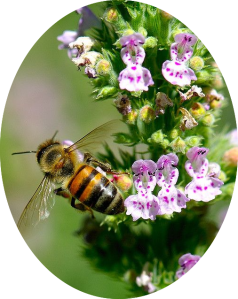
As research moves significantly towards genetics, which involves working with dead, crushed bees, Jane’s work is a reminder not to neglect the observation of the working, living biome in all its complexity. As such, she shared the elite air breathed by the likes of Karl von Frisch and Tom Seeley.
As with David Greybeard fishing for termites with a stick, it is often an unexpected observation of the bees that truly excites us, to the point that we choose to become an activist for the fragile beauty that Jane Goodall helped us see. She exemplified how empathy can save a life, and perhaps even change the world. As with Rachel Carson and Diane Fossey, this is her legacy.

 Our Green Cathedral