In his book, The Five Invitations, Frank Ostaseski describes the different roles we play throughout our lives. Some are sequential, others might be multi-faceted. For example, we might move through the progression of daughter, mother and grandmother. Or we might be a husband, a father, a neighbor, a customer, a teacher and, to our doctor, a patient, all at the same time. Essentially, for the first half of our lives, we are concerned with creating an identity, developing a career with its personal achievements, building a family and forging the structures we need to survive and succeed in a complicated world. These roles can be conflictual, such as a single mother who struggles to balance full-time work and parenting, or exclusive, such as the young man who may chooses to give up a traditional education and social life for the rigorous life of a professional athlete, or even reversed, when a daughter becomes the caretaker for a mother with Alzheimer’s.
For many of us, those initial skills do not alone prove fulfilling for the second part of our journey. If we have the courage, the inspiration and a role model, we may turn inward, exploring issues like the meaning of life, what makes us happy, the rewards that come from profound relationships, the embracing of mystery and the cultivation of wisdom, all in a more relaxed form of striving. Joseph Campbell described this as ‘the hero’s journey.’
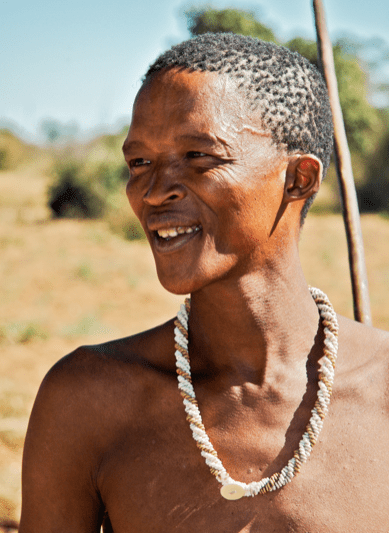
Laurence van der Post, describing his experiences among the Bushmen of southern Africa (more correctly called the Khoisan people,) wrote that they speak of two kinds of hunger. The Little Hunger is for food, for the fire in one’s body that must be fed to stay alive. And then there is the Great Hunger, the hunger for meaning, the hunger that lives deeper than the stomach, in ‘the silence behind the eyes,’ as described by the tribesmen. Happiness is fleeting, they argue, while meaning is enduring. Once one is doing something that really matters to one’s soul, it doesn’t matter whether or not one feels good all of the time. Rather one feels connected to something bigger than one’s self, that we are not just bodies to be fed but spirits to be fulfilled.
Rachel Naomi Remen, a pediatrician and author who councils people with chronic and terminal illness, describing how life asks that we continually adapt, suggests that “The ultimate purpose of every life is to grow in wisdom and to learn to love better.”
In Buddhist lore, “when the student is ready, the teacher will appear.” One explanation might be that the hunger for meaning was never modeled for us when we were young, neither at home nor at school, nor among our elders. The poet Robert Bly describes young men who grow up with the model of John Wayne as the ideal male, and then, in their 40’s suddenly find it no longer works (referring to John Wayne as a model example dates both Robert Bly and myself!) But when one is receptive, those teachers can come from surprising sources. Thus Novak Djokovic, interviewed during the Wimbledon Tennis Championship in July, was asked why he gives advice so freely to younger players who later may be his rival on court. His response was even though he himself never received such encouragement from older players, it is an integral part of him and he cannot be authentic to himself by not doing so.
His use of the word authentic struck a chord; perhaps that is what the Great Hunger is all about. I know that I enjoy spending time with others who are searching for authenticity, who want to deepen relationships, explore mystery and cultivate wisdom in a relaxed setting.
And we used to have our grandparents, not least when extended families lived, if not together at least in the same town or village. They would model those more quiet, more reflective values while the parents were preoccupied with the Little Hunger as they built a life for their new family.
Several questions arise. If education is supposed to prepare us for the ‘real’ world, should we not educate for the second half of life, as well as the first? And is so, how do we do it? I don’t think there is a curriculum for it (although I am reminded of the famous curriculum at Harrow in England titled “From the Sperm to the Worm,”) but perhaps each school might include on its faculty some older men and women whose prime responsibility is to teach the regular curriculum but with the benefit of the wisdom that comes with age and experience. Hence, in the absence of grandparents, the power of role-modeling. The students may neither value nor recognize it as such at the time, but it would be available to them when they needed it later in their lives.
I was fortunate to have an uncle who was a RAF spitfire pilot in Britain in the 1940’s. When the war ended he returned to his town on the south west coast of England, never again to leave. He declined to learn to drive a car (even though he had been a fighter pilot!) and spent his leisure hours fishing in the local river. When I first met him he was in his late 50’s and I, an ambitious young educator, was in my mid 30’s, I knew immediately that here was a man who was perfectly content, and I was envious. Similarly, another uncle, a tail gunner in a Lancaster bomber in the war, spent several years in a German prison-of-war camp (he was part of the ‘Great Escape’ story from Stalag Luft III in 1944) and he too had neither need nor want for material possessions, although he was great company to be with.
In writing this I realize how the aptly the word ‘authentic’ describes both men.
Secondly, for those of us who do believe we are in transition – I use the present tense because, once started, it is a constant process – the question becomes, what was the trigger? Seldom is it planned, nor is it necessarily as dramatic as a world war. In most cases it involves an unforeseen event that touches something deep within us and leads to a confrontation or a crisis. One theory is that we are reaching back to the very first years of our lives when we were authentic and before we were shaped by parental and societal into what they thought we should be. Whatever the provocation, only with hindsight can we look back and realize what it was and its profound impact on our lives. As David Papke observed when I ask him to review the first draft of this essay, “It strikes me that although our eyesight and hearing diminishes with age, in many ways we see and hear things more clearly.”
That stimulus for me was the movie Dances with Wolves. The Kevin Costner character is strongly and traditionally male – the warrior – yet in ‘the interior’ he meets both the natural world, symbolized particularly by the wolf, and the strong feminine in the form of Stands with a Fist. Eventually, having to make a choice, he decides to ride with the Native American clan rather than return to ‘civilization’ with its more traditional expectations of the role he should play. The movie touched me deeply, and it took a little while to understand that it both characterized a deep disconnect within myself and offered a way forward.
This in turn gives rise to two further questions. First, are the various, sequential roles that honey bees fill in their short lives an example of this kind of adaptation? The answer is largely no, in that these changes are genetically inspired rather than conscious choices made by each bee, even as environmental changes, such as a surplus of available nectar compared to pollen, may prompt a foraging bee to change from pollen to nectar collection.
The second question is, does this explain why many people turn to beekeeping later rather than earlier in life? It might. Once one’s family obligations have essentially ended, as we are established in our careers and preparing to be grand parents (an interesting term), as retirement edges closer with its challenges and uncertainties, we might give more conscious consideration to what makes us happy, in particular deepened relationships, what our life has meant and how we intend to spend the rest of it. There is often a sense of accumulated wisdom as we age, with which we can investigate some of the mysteries we encountered earlier in our life but didn’t have the time to probe deeply.
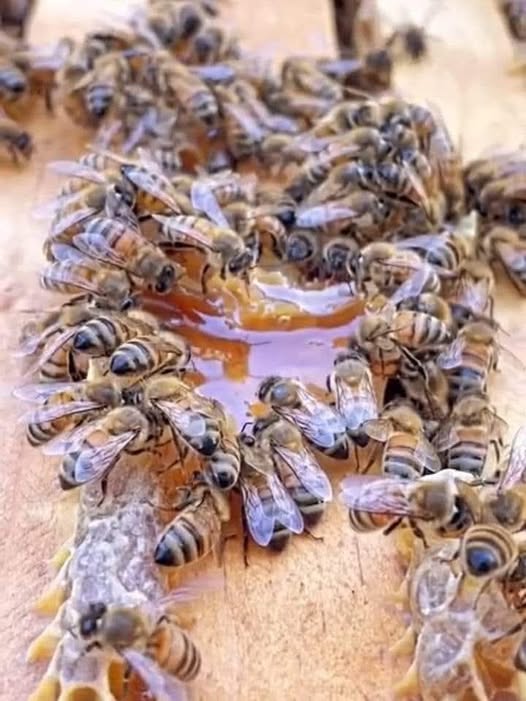
Many activities can claim our attention, often with no connection to our professional selves – gardening, wine-making, art, travel, wood working, community involvement, learning a new language – one of which is beekeeping, with its particular management challenges as well as insights into effective communal relationships in an untamed natural world. The bees, for their part, don’t care a whit as to who we are, where we sent to school or what we did to make a living. They offer themselves up for our edification, as mysteries to be explored and as a portal into a natural world to which we are eager to feel reconnected. As the Khoisan people knew, by so doing we feel connected to something bigger than ourselves, that beyond the Little Hunger we are spirits to be fulfilled. For some, honey bees are an integral part of the Great Hunger as we strive to grow in wisdom and learn to love better.

 Our Green Cathedral