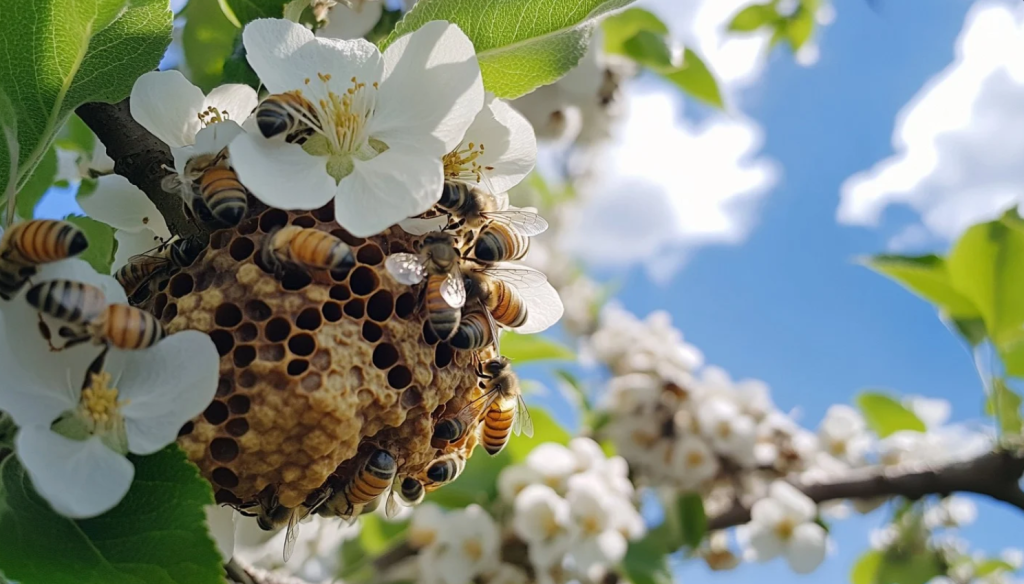
This is the fourth and final episode in a series focusing on the brain on the honey bee
Honey bees are insects and have been so since their appearance in their present form some 30 million years ago. In the mid 19th century Johannes Mehring, who was the first to produce wax foundation using a metal roller, equated a bee colony with a vertebrate animal. The queen and drones, for example, represent the female and male genital organs, while the workers represent those organs necessary for maintenance and digestion. In Germany this led to the term bien, whereby a colony was seen as a single living organism in which the whole was greater than any of the parts. It was an American biologist, William Wheeler, who, in 1911, coined the term superorganism.
Of late it has become popular to compare a honey bee colony not just with vertebrates but with mammals in particular. For example, both have very low rates of reproduction (recognizing that a colony reproduces itself annually as a swarm;) mammalian milk is compared to royal jelly as a source of nourishment, brood comb is equivalent to the uterus of a mammal, both have body temperatures of between 96 and 98 degrees F, and both have developed a high capacity for learning.
The reason for these characteristics, as described by Jurgen Tautz in The Buzz About Bees : Biology of a Superorganism, is that by freeing themselves from the dictates of the environment, whether it be the weather or fluctuating sources of energy and nourishment, organisms can afford to have fewer progeny who are stable in numbers, well prepared for their environment and carefully protected.
This process is carefully controlled (homeostasis) by a complex system of constant feedback loops. Ask a member of the public who is the brains behind this, and the response invariably is ‘the queen.’ This misconception dates back 400 years when Charles Butler named her as such – hardly surprising in that it was the decade following the first Elizabethan era where one strong woman, supposedly a virgin, had ruled a burgeoning empire without much competition. We know today, of course, that the queen bee does not rule; rather she is a superb ovipositor who is the servant of the worker bees. The one exception might be her release of the queen substance which is distribute by trophallaxis to all the bees in the hive, which prevents the ovaries of the bees from developing and gives the queen reproductive dominance.
It seems to me that the question is not what part of a superorganism constitutes the brain; the superorganism itself is the brain.
There are many definitions of the term brain. The American Heritage Dictionary of the English Language, for example, defines it as “The primary center for the regulation and control of bodily activities, receiving and interpreting sensory impulses, and transmitting information to the muscles and body organs. It is also the seat of consciousness, thought, memory, and emotion.” We have previously acknowledged, to repeat Randy Oliver from last month’s column, that honey
bees do not have a developed capacity for deep analysis and thinking, much less human concepts of morality, but, to paraphrase both Keith Delaplane and Tom Seeley, in both the superorganism and our own brains there are multiple evidence collecting units – call them bees or call them neurons – applying information and choosing among alternatives.
Consider that worker bees of every age seem to know what has to be done, when to do it and where it is to be done. Colonies are not hierarchies; rather each bee behaves as though she herself has come to a decision. The result is small, local changes in the colony which in turn act as stimulators for other bees to adjust to the new situation and make their own decisions. Micro decisions by the individuals result in macro-behaviors for the colony, such as swarming (especially nest selection) and comb building. Another example is what Keith Delaplane describes as progressive provisioning – nurse bees control the quantity of food given to larvae, as well as the ratio of its constituents, which together dictate a larva’s metabolic fate toward queen-like or worker-like development.
It is a bottom up, or emergent, process, rather than top down, and is termed either collective intelligence or the hive mind.
This is not to deny the astonishing ability of individual bees to learn and to remember in both the short and long terms – they are not mere automatons. They can recognize and remember colors, patterns and scents. They can count, add and subtract, combine concepts they have learned, understand abstract concepts, and convert angles on a dark dance floor from gravity to the sun in relation to the horizon. After all, whether in a hive or in a floral landscape that is constantly changing, they have to be adaptable problem solvers.
“Demonstrating how nature has converged upon similar answers for similar problems,” writes Keith Delplane in Honey Bee Social Evolution, “even across such phylogenetically distant animals as honey bees and humans, is one of the most exciting ways entomology, and the superorganism concept, is informing all of biology today. It’s a beautiful example of the unitive quality of all nature.”
Workers, drones and their queen are members of a team that is committed to the survival of a colony over the seasonal rhythms of the year. This community of individuals solves problems by working-sharing and communicative exchanges that single individuals could not achieve on their own. Is this the ultimate message of the bees? As long as all care for one another, each will themselves be cared for? A society in which the Golden Rule – do unto others as you would would want them to do unto you – is a lived reality? Honey bees not only bring us joy; they also give us hope by providing a living example of cooperation in action in a world that is increasingly fractured though ever-increasing egotism, greed, self-interest and loneliness.

 Our Green Cathedral