In a tribute to the late T.J.Carr, published in the ABJ of May, 2024, Amy Owen cites him as saying that “The best part of beekeeping is the people you meet.”
Consider two scenarios. In the first, eyes are clouded by smoke and a veil, ears are awash with the complex sounds produced by thousands of little bodies in action, nostrils flood with complex odors and pheromones, and limbs and neck wrestle with boxes and frames glued together by propolis, not to mention the sheer weight of a super of honey.
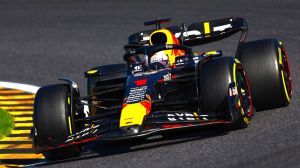
In the second, eyes are blinded by a blend of floodlights and blurry bodywork, eardrums are drenched in the whirring noise of 1,000 mechanical horses, nostrils are stained with the stench of burning brake ducts, and limbs and neck wrestle relentlessly with immense gravitational force.
The first is obvious; the second describes a Formula 1 car driver at full throttle, an intense sensory experience during which a driver can suffer motion sickness, light-headedness, vision glitches, and can lose up to 6 pounds in two hours of split- making decision making behind the wheel. Both experiences are physically draining and emotionally; both are intense in their own particular ways.
Unlike many beekeepers, a F1 driver never races alone. He or she is constantly accompanied by the guidance of a softly-spoken ally at the other end of the team radio system, aiming to maximize the team’s final outcome.
That voice belongs to the race engineer.
Weather changes, tyre wear, gear shift advice and details about rivals’ tactics – such are the technical information passed from the race engineer to the driver. But most important are the human-centered skills by which the engineer quells the driver’s concerns and emotions so that both are free to operate entirely in the present, to the point that their faith and trust in each other develops into one the most intimate relationships in professional sport.
There is almost always at least one generation between a driver and his race engineer; they often come from completely different parts of the world and do not share a first language. A big effort to understand each other’s backgrounds, personalities and motivations is key to building a successful relationship. Usually this mutuality develops in a series of meetings in a non-professional environment in which each shares the normal things in life – hobbies, family, education – so as to better understand each other’s lives, values and culture, and thus develop elevated levels of empathy and emotional intelligence. After all, drivers literally put their lives in the hands of their race engineers whenever they take to the track.
Yet they don’t always have the luxury of a full winter of interaction and preparation. When now-triple world champion Max Verstappen was first promoted to the Red Bull team mid-season in 2016, race engineer Gianpiero Lambiase had only a few days notice to mould an 18-year-old who combined supreme talent with a blunt disposition. Their relationship was an immediate success (the fact that Lambiase had experience working with multiple drivers before Max was a critical factor) and Verstappen became the youngest race winner in Formula 1 history, finishing first on his debut at the Spanish Grand Prix.
The role of the race engineer is one of mentor, with high stakes in times of incredible pressure, all under public scrutiny. The stakes of mentoring are not normally so high, nor the scrutiny so public. The five year old granddaughter of a friend, for example, spent five days at home with her teacher-to-be before she started her first year at a local Montessori school, such was the school’s recognition that understanding “each other’s backgrounds, personalities and motivations is key to building a successful relationship.” In the Montessori system, because the teacher had class advance together, that relationship stretched over eight years.
Over some 42 years in the classroom I learned that time spent developing relationships was never wasted. With experience and confidence, I spent the first week getting to know the students a little better, and encouraging them to get to know me. My colleagues often felt that a busy curriculum did not allow them such a luxury; in my experience, the quality of the learning that followed more than compensated for the loss of formal teaching time. Curiously it is something that teachers of younger grades do really well, yet decreases as students age, even though the latter are dealing desperately with issues of identity and are searching, even if unconsciously, for some kind of mentorship.
Clearly there are different ways of mentoring a new beekeeper. Some may choose consciously to develop a relationship early in the process, perhaps by initiating an e-mail conversation enquiring as to how the mentee became interested in managing honey bees, what his or her objectives are, are there any other related hobbies or interests, is there a spouse or children who might be interested, what is he or she most fearful of and most excited about? Others may recognize and celebrate the relationship as it develops, or even suggest a different mentor if one feels that the absence of affinity is hindering the learning process. In the words of the 13th century Persian poet, Rumi, “The amount of light in a room depends on the number of windows.”
And clearly one can survive without such a relationship – neither the instructor of the first bee class I took nor my first mentor would list either communication or empathy among their strong suits – yet I survived, partly because I had both passion and persistence and took responsibility for my own learning. I have also been a mentor to a few beekeepers in which we developed a relationship that went beyond the how’s and to’s of bee management; it became a mutually beneficial interaction, despite the generation gap, and I got as much out of it as I was able to offer.
Besides our name, our personal story is the most individual thing we possess. Both symbolize our uniqueness and our humanity, and we are more open and vulnerable to those who recognize this, whether by listening or by asking the right questions. In the words of one successful race engineer : “Increasingly you realize that it is the human side where most of the competitive edges come from in Formula 1. You realize it is all about the people.” And as expressed by another engineer, “In Formula 1, as in all our lives, the magic of the most special relationships will always remain unique.”
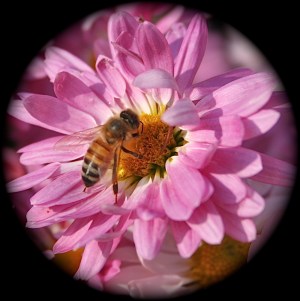
In the July, 2024, issue of Bee Culture, Diane Wellons describes how bees and beekeepers helped her though several years of major health challenges. “Each season presents a new circle of friends to mix with the old circle,” she writes, “and my circle just keeps growing. There is a richness of heart to this hobby, this association, that I did not anticipate.”
Surely T.J. Carr would have agreed.

 Our Green Cathedral