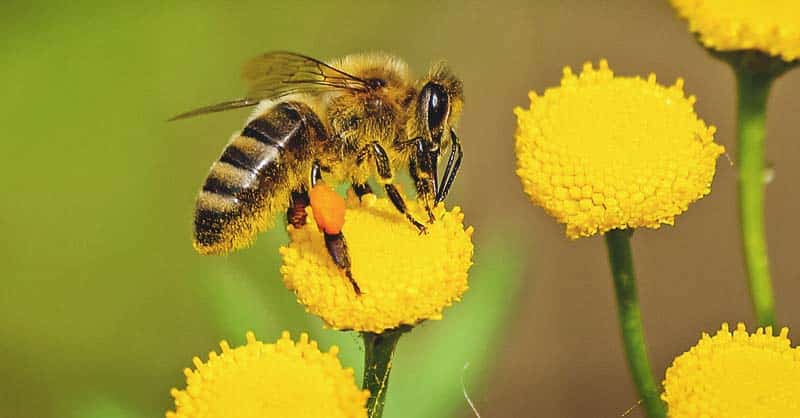
A friend and colleague was verbally assaulted recently when, at a social gathering, she mentioned being a beekeeper. The accusation was that, by keeping honey bees, a non-native species, she was depriving other native pollinators from access to increasingly limited natural resources.
Honey bees, because they are ‘managed’, are easy targets for which a distinct minority of Americans (0.4 per cent of the population) can be held responsible. Indeed there is a growing public movement against honey bees, possibly a swing of the pendulum after the media attention provoked by CCD. It seems this antagonism was prompted in part by a misinterpretation of the mission of the Xerces Society – that the society’s focus on native bees and pollinators is seen as an attack on honey bees, with the assumption that the latter impact the health and habitat of the former. An example is the website of a company called MeliBio, which promotes the new product called “Mellody, a plant based honey made without bees.” The company claims that “the commercial production of honey is destroying the biodiversity of our planet and wiping out the native bee population.” Their solution to this blatantly fear-based accusation is a man-made mixture of fructose, glucose, water and glycolic acid, together with plant extracts and flavorings. Incidentally, according to an article by James Naeger in the March issue of ABJ, which I strongly recommend, the cost of a 12 ounce jar of Mellody honey, including shipping, was $43.
Certainly, in a world of dwindling natural resources, competition between honey and feral bees is real. It is also much disputed. There is research which suggests that, under certain conditions, in deprived habitats in particular, honey bees may reduce available forage for native pollinators, with implications for the health and viability of the latter. There is also compelling evidence to show that honey and native bees can thrive together, or that there is no observable impact of honey bees on other pollinators. When asked this question directly at EAS in Ithaca in 2021, David Tarpy ’s response was that in a healthy environment, honey bees can co-exist with other pollinators to the mutual benefit of all. For example, Ross Conrad, writing in the February issue of Bee Culture, points out that many of our native pollinators will forage in weather that otherwise keeps honey bees in their hives, and that the different lengths of the proboscises of pollinators (those of the honey bee are relatively short) causes them to work different flower sources.
Rather than eliminating or proscribing certain pollinators, the focus, as is so often the case, needs to be on the environment. After all, as Becky Masterman and Bridget Mendel write in the same issue of Bee Culture, the nectar and pollen-bearing flowers that are not available to honey bees are also missing for native bees.
Pollinators, any and all of them, are simply the messengers. For example, one consequence of the dominant use of pesticides and fossil fuels in the US is demonstrated by Masterman and Mendel in a graph that plots US honey production v total honey imported (Bee Culture, Feb 2024.) Between 1991 and 2021, American honey production declined by 41 per cent. Imported honey, by comparison rose by 520 per cent. In 2021, the amount of imported honey was four times greater than that produced internally, compared to 1991 when imported honey was less then half of that produced locally. This dramatic change cannot be explained solely by honey bees, who have been on this continent for some 400 years while the decline in native pollinators is a more recent phenomenon coinciding with the significant loss of a wide variety of insect pollinators across the globe.
Similarly, Ron Phipps, in the March issue of American Bee Journal, describes how, between 2020 and 2022, US honey production declined by 15%, the number of colonies declined by 9 per cent, and productivity per hive decline from 54 to 47 lbs/hive. A recent report in the American Honey Producers Association newsletter indicated that honey yields in the US have been declining since the 1990’s and found that, besides climate change, the decline was “connected with herbicide application and land use changes which result in fewer conservation programs which support pollinators.” Not just honey bees, note, but all pollinators.
To cite Ross Conrad again, “The real source of the decline in native pollinators is you and I. Between our use of pesticides like neonicotinoids, and our addiction to fossil fuels … it is humankind that is the actual cause of the decline in native pollinators, not the honey bee.” To put it bluntly, the human species is the most successful invasive species our planet has ever seen. Habitat loss is the prime driver of the loss of pollinator species (cutting down trees to build a housing complex and then naming the streets after the trees that have disappeared, doesn’t cut it!) and all pollinators are negatively affected by pesticide, herbicide and fungicide use, pollution, climate change, diseases and parasites.
Instead of focusing on unsubstantiated competition between pollinators, our focus needs to be on a healthy environmental policy together with improved agricultural practices which promote new and improved habitat that benefit all pollinators. A vital concept in this scenario is that of regenerative agriculture, whereby focusing first and foremost on the quality of the soil, a system’s capacity to support all life is increased. And it was this panorama which inspired the term regenerative beekeeping.
So what can we do at a local level?
First, it is important that our associations are seen to be inclusive rather than exclusive. This can as simple as making certain that the names of our clubs, as well as the stated aims, include all bees, if not all pollinators. Hence the “Punxsutawney Beekeepers Club” rather than “Punxsutawney Honey Bee Club” which aims to support and promote either all bees, or, even better, all pollinators. And our members need to be acutely aware of the reasoning behind the language. After all, we refer to ourselves as ‘beekeepers’ rather than ‘honey bee keepers,’ with the implication that we have an interest in and commitment to bees (and pollination) in general.
Secondly, we need to organize presentations to our members about the diverse relationships between honey bees and other pollinators, as well as the vital importance of pollination per se.
Thirdly we need to support, not least financially, those organizations that are working to improve habitat for all pollinators. Some are well represented in Pennsylvania, eg. The Bee and Butterfly Habitat Fund www.beeandbutterflyfund.org and the Pollinator Stewardship Council @pollinatorstewardshipcouncil. Both will provide speakers for meetings, if not in person then by Zoom, and the former offers free or greatly reduced seed mixes for landowners to plant high-quality pollinator habitat on 2 or more acres of land. There are many other such organizations that individual bee clubs can research for themselves.
And of course, in combination with their hives, we can encourage our members to build or establish suitable habitat for all bees, bats, moths and butterflies including, for example, allowing the leaves of Fall to remain in place over winter in that they create a superb environment for a range of native pollinators. The argument that garden beds ‘look nice’ without the leaves puts appearance above habitat, as does the use of chemicals in gardens to green up the lawns and kill ‘weeds.’
Again, in the March issue of ABJ, and describing the potential competition evoked by holding the annual conference for the American Beekeeping Federation and the North American Honey Bee Expo at the same time of year, Tina Sebestyen cites a friend as responding that ‘the two conferences serve different types of beekeepers who are attending for different purposes, and both are needed.’ Whence goeth the beekeepers, so goeth the bees.
.

 Our Green Cathedral