I began keeping honey bees in 2004, two years before the discovery of Colony Collapse Disorder. I recall vividly Dave Hackenberg describing, at a PSBA conference, his discovery of dead-outs in his Florida apiaries, and how later meetings were preoccupied with news of the latest losses and potential causes.
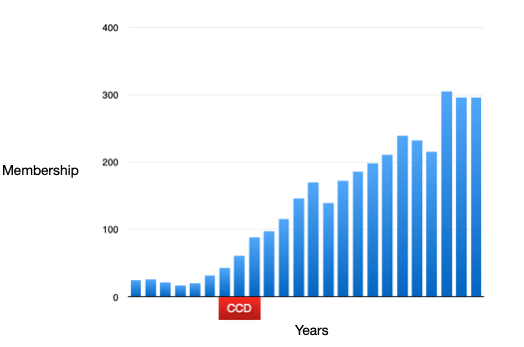
With the benefit of hindsight this was the start of the ‘Save the Honey Bees’ campaign as the public responded enthusiastically to a media barrage based on a mixture of fact, fiction and scare tactics, labelled by one writer as ‘bee wash.’ Always willing to help in a crisis, individuals assumed that the best way to help the bees was to start some hives, and they did so in ever increasing numbers, as seen, for example, in the membership of the York County Beekeepers’ Association from 2000 to 2023 (by comparison, the average membership for the twentieth century was 35.) My guess is that most beekeeping organizations show a similar trend.
Synchronistically, three articles made their way to print in the last week of August this year – one in The New Yorker, one in Beekeeping (a British publication) and one in the New York Times. Their theme is the same: not only have many people bought bees without the knowledge to look after them (the prime example was an e-mail I received several years ago from a lady explaining that she had just purchased a honey bee queen on e-bay and asking “What do I do now?”) but the numbers of managed bees has risen to a level that threatens wild pollinators, which are equally important to a healthy, balanced environment. Essentially, we can intervene to house, feed and reproduce the former whereas the latter depend on natural forage and habitat for their survival.
Urban areas in particular have been promoted as a ‘safe haven’ for honey bees with varied year-round forage and fewer pesticides than in rural areas with its industrialized agriculture. It is not that simple. For example, according to Richard Glassborow, Chair of Greater London BKA, in London, England, where colony numbers have doubled in the last 10 years, there is an impressive 47% of green space, but it is mainly grass. There are 3.8 million gardens, many of which are hard surfaced. GLBKA’s research indicates that in an urban area like London, 3 colonies per square kilometer is reasonable in relation to the needs of other pollinators (which coverts to 8 colonies per square mile, or one colony per 80 acres,) but problems of forage availability are exacerbated by the uneven distribution of those colonies – some areas are densely populated with 50 colonies per square km. Consequently, London bees are fed sugar syrup all year around, which equates to factory farming. Congestion not only brings problems of disease spread but also raises the ethical question of just what is in that very expensive honey sold and served in London shops and restaurants.
The desire to help honey bees by starting a hive is well-intentioned but misguided; we need a more balanced message to encourage a focus on measures that support the welfare of all pollinators. To turn this tide requires a change of narrative.
In 2016 Mary and I met Gorazd Trusnovec, in Ljubljana, the capital of Slovenia. As the founder and sole employee of an organization which translates as “Rent-a-Hive,” he places bee hives in available spaces, including on hotel roofs, which is where we met him. In the last seven years his sales pitch has changed : “If you overcrowd any space with honey bees there is a competition for natural resources, and since bees have the largest numbers they push out other pollinators, which actually harms biodiversity. I would say that the best thing you could do for honey bees right now is not take up beekeeping.”
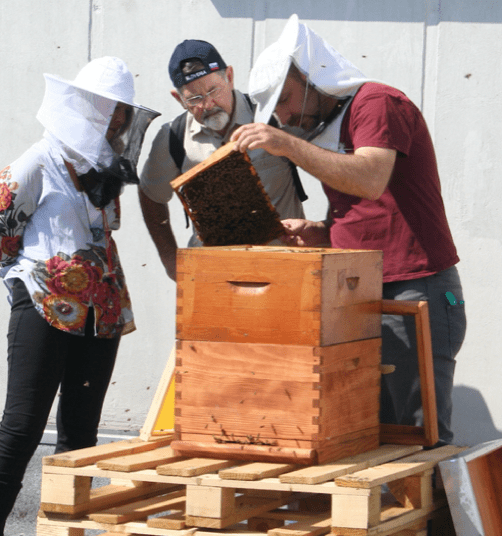
Self with Gorazd Trusnovec (right) on the roof of the Hotel Park, Ljubljana, 2016
That’s a jarring message, not least because of the widespread and now deeply rooted belief that the global population of honey bees has been running dangerously low for more than a decade. “(CCD) was the first time that a large number of people started talking about pollinators, which was great,” says Scott Hoffman Black, executive director of the Xerces Society for Invertebrate Conservation in Portland, Oregon. “The downside was that there was no nuance. All anyone heard was that bees were declining, and so I should get a hive.” The fact is that there are now more honey bees on the planet than there have ever been in human history. Figures from the Food and Agriculture Organization of the United Nations show that the number of bee hives around the world has risen by 26 percent in the last decade, from 81 million to 102 million, but other pollinators are declining. The decline in the US, from almost 6 million hives in 1940 to less than 3 million today, is explained in part by the unique emphasis on commercial operations : there is a shortage of beekeepers willing to replace the large producers as they retire.
Still, the save-the-bees narrative persists, its longevity stemming from confusion about what kind of bees actually need to be rescued. There are more than 20,000 species of wild bees in the world, and most people remain unaware of their existence and importance, in part because they don’t produce honey and in part because they are all but invisible, living in ground nests and cavities like hollow tree trunks. But they are indispensable pollinators of plants, flowers and crops, in particular those that are not cultivated; for example, the many species of indigenous trees that are vital in moderating climate change.
Asking people to dial down their enthusiasm isn’t easy. Honey bees are the celebrities of the insect world, a source of fascination since ancient times, admired for their efficient social structure and referenced in nearly every world religion. Yet there are ways in which it can be done and the time might be ripe for action. As a matter of necessity rather than of choice, we are in the process of reacquainting ourselves with nature. The current global climate crisis is increasing our awareness of the importance, fragility and power of the natural world, which in turn provides an opportunity to promote more accurate information about pollinators and pollination in general.
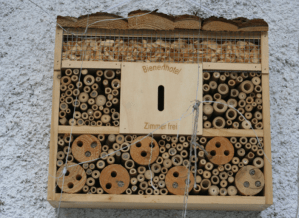
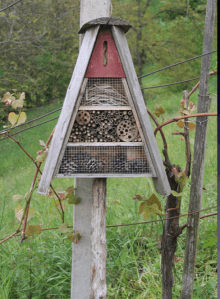
To help the bees one does not have to start a hive so much as plant a pollinator-friendly garden which, besides deliberate plant choices, is less reliant on chemicals and includes ‘pollinator hotels’ for non honey bee species.
And those who do decide to start a colony might be encouraged to investigate the concept of Natural, Darwinian or Regenerative beekeeping, which has an increasing number of proponents. Gareth John, a retired agricultural ecologist in Oxford, England, argues that natural beekeepers are the radical dissenters of apiculture. They believe that mainstream beekeeping, like most human-centered interactions with the natural world, has lost its way, and that an alternative path requires the unlearning and dismantling of almost two centuries of bee husbandry, invoking resistance from those who are invested in the current system.
Natural beekeepers, in their enthusiasm if not sense of self-righteousness, are akin to the first owners of a Toyota Prius almost twenty years ago (of which I was one.) Not only do they treasure the bees for their own sake—like a goldfinch that nests in the yard—but, like many visionaries, they have an evangelical spirit, as if they have stumbled on a great secret. They defer to the bees for guidance and often speak of the colony in somewhat spiritual tones, as a single, sentient organism that has evolved in parallel to mammals like us. Yet their fervor and ardor should not impede the veracity of their message.
In the words of Roger Patterson, who maintains dave-cushman.net, one of the better sources of apiculture information, “Lots of things are changing. People are changing. The bees are changing. The environment’s changing.” If nothing else, I would hope that, in the coming year, the challenges and opportunities presented by these changes are the topic of an on-going conversation at every level of local state and national beekeeping organizations, and that we can promote a new vision with a new media onslaught to which the public can respond as enthusiastically as it did to CCD seventeen years ago.

 Our Green Cathedral