
At the University of Burlington, VT, one of the science professors was renowned for his emphasis on the importance of observation. Story has it that he would walk into the first class of the semester carrying a jar of yellow liquid, turn to the students banked in rows before him, and announce that “The only way to find out if this is indeed urine is to smell and taste it,” upon which he put his nose close to the rim of the jar, dipped a finger into the liquid, and then licked his finger.
“You all have to test and decide for yourself,” he would say, and when they protested he alleged that this was a pass/fail part of the course. When they had all hesitantly smelled, dipped and licked, he would explain, “If you had been observant, you would have noticed that I dipped my second finger into the liquid, and licked my third finger.”
This past winter ten beekeepers from the local association decided to meet once a month for four months to discuss a previously-chosen book. The only caveat was that this was not a ‘how to keep bees’ session so much as to reflect on some of the issues bees represent, the feelings they evoke and the challenges they face.
The first book we chose was Mark Winston’s Bee Time (which ended up taking two months to discuss;) the second was Dave Goulson’s The Insect Apocalypse, and the third was Richard Taylor’s The Joys of Beekeeping, most of which consists of the columns titled ‘Bee Talk’ that he wrote for Gleanings in Bee Culture in the 1970’s.
One of the questions posed was, “What part of honey bees and beekeeping has most influenced you?” The answers included an increased awareness of the natural world, of the meaning of each season, of plant species and their presence, and of the variety of pollinators. Taylor himself wrote, ”I shall never understand nature, this earth, the bees – all the myriad forms. No one ever will. I have no need to. I gaze in unuttered reverence, and I am fulfilled.”
My responses were two-fold. Having grown up in a competitive culture, I am constantly affirmed by witnessing a cooperative environment in which there is no designated leader and a commitment to the common good. The second response related to the subtle changes in my skills of observation. I have written before about spending my youth on Murahwa’s Hill, an uninhabited outcrop close to the house in which I spent my teenage years. On one occasion, walking over a granite exposure on the hillside, I saw, out of the corner of my eye, something twitch. When I stopped, and turned a troop of chacma baboons burst into life accompanied by a vociferous chorus. On the one hand I had been unaware of their presence while they remained quiet in the trees, which was a lack of observation on my part; on the other hand I picked up the smallest movement in my peripheral vision, and knew enough not to ignore it.
Some years later I was fortunate to spend time in the company of skilled African game guides as they searched for wild life in the veldt. Initially I would look in the light, open, sunny places, expecting to see impala, warthogs, kudu, whatever, staring back at me. The guides explained that most animals have predators, and those that survive have learned to stay within the boundaries of their natural camouflage, which means the periphery, the shade, the tree line. Learning to look differently, namely to avoid the obvious areas and rather look with a broad, generalized gaze not for a specific animal so much as an unusual shape, the twitch of an ear, or something that for whatever reason felt out of place, dramatically changed my observation skills.
I can recall, as a young teacher, being asked to state the eye color of each student in the room, with the suggestion that if I could not do it I had never really looked at them. And on patrol as a platoon during the Rhodesian Civil War, we made a habit of not only looking ahead and to the side, but also above and behind. My guess is that GI’s in places like Vietnam, Afghanistan, and Kuwait learned the same habits, out of necessity.
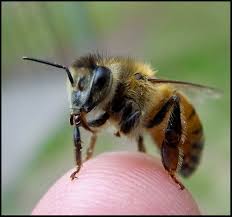
After my first five years of beekeeping, during which time a frame of bees seemed to be mysterious and confusing, I gradually developed a protocol for a colonial inspection that involves both specific and broad observation. The first step is to look, really look, at what is on the ground in front of at the hive as well as what was happening at the hive entrance. No expectations – just look. Incidentally, I place old carpet in front of each hive, underside up : not only does it suppress weed growth but it also provides a background on which dead bees are more visible. Secondly, I look closely at the top of the frames after the inner cover is removed. In part, one develops a sense (sight, sound and smell) of what is normal, and without focusing on any one bee, one comes to recognize instinctively when something is out of the ordinary. Thirdly, as each frame is removed, I cast a broad eye over each side, trusting that I will absorb what is important. With time, rather than an unholy mess of activity, patterns became evident to even the quickest of glances. Many ask how to find the queen, even as that is seldom necessary – it is more important to see evidence of the quality of her activity. If I do need to find her she will normally make herself evident at the first, broad glance because of her distinct shape and the behavior of the bees around her. Finally, I choose to look closely at one frame – after examining some individual bees for signs of say, DWV, I shake off the bees into the box (putting aside some for a mite check) and, without the impediment of little furry bodies, look specifically into a number of cells.
This practice, which continues to improve every year, has converted into the wider world. Driving, I am instinctively looking to the sides and behind, and am quicker to see a red tailed hawk on a telephone line, or white tailed deer beside the road, or a couple of hives in a backyard that had previously been vacant. I am more aware of what has been planted in the fields adjoining the road, or what is in bloom. Consequently I enjoy driving on smaller side roads rather than main highways even though the former may take longer; sometimes time is not the most important criteria. Walking, I look up and behind as much as forward, and my vision is generic and yet quick to see unusual details. I am mindful of the comment from Tom Seeley that with the current spotlight on genetics we are in danger of losing an appreciation of observational research, which, time consuming as it is, has been the basis of honey bee discoveries for thousands of years.
So this is how beekeeping has influenced me, with one caveat – should I be on the phone, my observational skills literally disappear!
As for the Burlington professor, was it really urine? I don’t know, but one of those students, more than thirty years later, says it is a lesson he has never forgotten.
“The same life that pulsates in us, the same yearning and striving, the same love of existence, fills everything around us, “wrote Richard Taylor in a chapter entitled Friends. “These things are not foreign; they belong to us and we to them. It is not our role as human beings to conquer, exploit and destroy, but to build up, protect and love in the spirit of acceptance the natural order into which we have been placed.”

 Our Green Cathedral