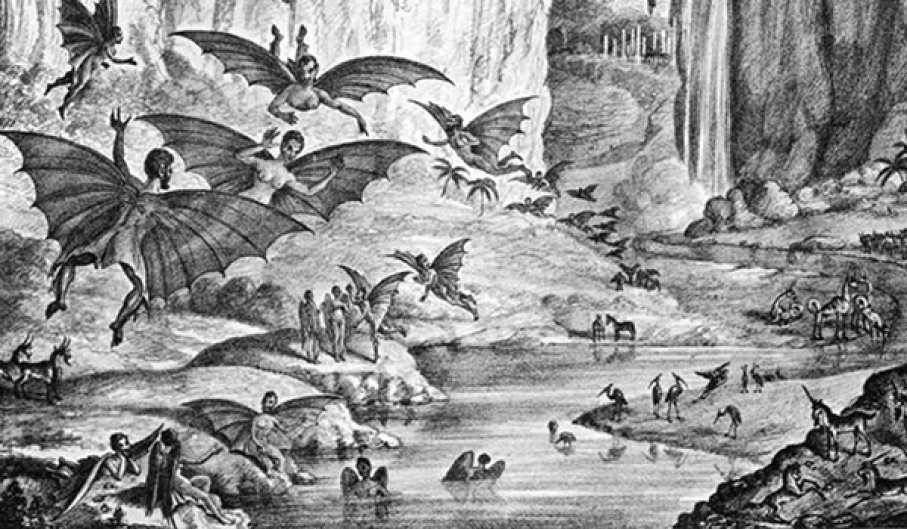
In 1835, the New York Sun printed a report attributed to the Edinburgh Journal of Science which reputedly had been submitted from a remote part of South Africa by the famous astronomer, Sir John Herschel. In it he described how, after focusing a remarkable new telescope on the moon, he had seen unicorns, beavers walking on their hind legs, and four foot, naked ‘man bats’ that copulated in public and were given the genus vespertilio homo. (The use of the term vespertilio was clever in that it is the oldest accepted genus name for bats, which Carl Linnaeus grouped with the primates due to certain characteristics that bats seemed to share with actual primates.)
The Sun, published by Benjamin Day with Richard Locke as editor, was one of the new ‘penny papers’ that were commonly available, compared to the more established papers which required a subscription that made it accessible primarily to the elite. The six consequent articles enlarging on this remarkable discovery produced a public sensation to the point that The Sun was, for a time, the most widely read newspaper in the world.
The articles were not intended as a hoax so much as satire, and the reasons it was not read as such were twofold. First, New York was deeply divided on the issue of slavery, and those opposing abolition believed that the remedy was to re-settle on the moon. Secondly, what has been labelled as ‘astro-religion’ was increasingly popular in the early nineteenth century, namely the belief that all of the heavenly bodies were populated because God would not have created them without also creating intelligence beings to appreciate them. Indeed Thomas Dick, the most popular astronomer of the time, calculated that the population of the moon was in excess of four million beings, and religious groups outdid themselves raising funds to purchase bibles which would be sent up to them.
Richard Locke, the editor of the Sun, thought this was preposterous, not least the idea of superimposing religion on science. “I will give you man bats on the moon,” he wrote, “written in high falutin’ rhetoric, just to expose your ideas.” What he did not anticipate was that even though the Edinburgh Journal of Science had never published any such article, and even though Sir John Herschel had never sent such a report, so many people were so deeply schooled in the ideas of astro-religion that they simply believed it to be true.
Locke was deeply concerned as his intended lampoon was taken literally, but the publisher, Benjamin Day, wanted to milk it as much as he could because of the revenue from increased sales, to the extent that he hired an artist to produce a lithograph based on Herschel’s description, versions of which were re-published world wide, invariably with highly imaginative additions. Readers seemingly felt no need to investigate their authenticity for themselves, to check the sources or to question their assumptions.
The point is that an idea, an organization, even a person, no matter what its validity, can be misinterpreted through public fervor or ignorance. And the point of this Corner is that I see something similar in the relationship between commercial and small scale beekeepers.
This is not in any way meant to criticize commercial beekeepers who are a particularly North American phenomenon in size and number, and are outnumbered by smaller beekeepers at a ratio of 99:1, even though they operate more than 95% of colonies in the US As Al Avitabile wrote in a letter to Bee Culture, December 2022, commercial beekeepers “care and tend to their bees more so than many small size beekeepers, for after all, bees are their livelihood. We … are all members of the beekeeping family. Commercial beekeepers make any honest living transporting their bees to assist in pollinating monoculture crops (without which) our crops would be far less productive and their cost to the consumer would be prohibitive. The commercial beekeepers did not create monoculture farming. However by providing pollinators for these crops they assist in sustaining this form of agriculture.”
What is important is that the objectives of commercial beekeepers are different to those of small scale beekeepers, as Charles Lindner makes abundantly clear in his on-going series in ABJ, A Year as a Commercial Beekeeper. In the second installment, November 2022, he wrote, “One of the keys to successful commercial beekeeping is understanding the business. It is not so much about the bees as it is the logistics.”
It is easy for smaller beekeepers, especially those newer to the craft, to believe that their big brothers have all of the answers simply based on the magnitude of their operations, even though their objectives are so different. For example, after the Second World War when honey was expensive and sugar was cheap, some commercial beekeepers (I believe initially in Canada) realized it was more profitable to remove all of the honey from their colonies and substitute it with sugar syrup for purposes of winter survival. It was purely profit driven and had nothing to do with the health of the bees.
Today we regard it almost as a necessity to feed the bees with sugar syrup, sugar cakes, pollen patties and a whole lot of other supplements promoted in the journals, all of which would be provided by honey and pollen if there were sufficient quantities available to the bees. Nor do we question the effect of such feeding on the health of the bees – replacing the complexity of honey and pollen with simple sugars and yeasts – even as research increasingly shows the questionable value of supplements and additives. More bees may overwinter this way but it is increasingly apparent they are smaller in size, lighter in weight, and have their immune systems compromised, thus (ironically) making them more vulnerable to the 4 P’s, including varroa.
It is easy to equate size with expertise. Commercial practices, made necessary by the need for profits, are now accepted as a vital part of small scale practices, not least because some journal articles are written by commercial beekeepers and much of the advertising is directed at them. Charles Lindner, for example, orders 20 000 new frames at a time, and how many side-liners need a 32 frame extractor at a cost of several thousands of dollars, or are interested in buying 8 frame hives once the almond season is over with a minimum purchase of 50?

It does strike me every month that the voice of the hobbyist beekeeper is missing on the Ask Three Beekeepers panel in this publication, even as the majority of the readers are presumably hobbyists. The responses of Mark, Steve and Charlie are considered and experienced, avoid hoax and satire as well as the inane kind of fabled reports attributed to Sir John Herschel. There is much that the smaller beekeeper (and I count myself as one) can learn from them provided we realize that the objectives of large scale beekeeping are different to those of the hobbyist, that objectives drive management decisions, and that hobbyist beekeepers have aspirations, practices and end goals of their own, equally valid as those of our commercial bretheren. The lesson therefore, as a beekeeper, is to be clear on one’s objectives and manage the bees accordingly. The moon – man bats and all – is an intriguing distraction (pie in the sky?) but we all have compelling alternatives here on mother earth.

 Our Green Cathedral