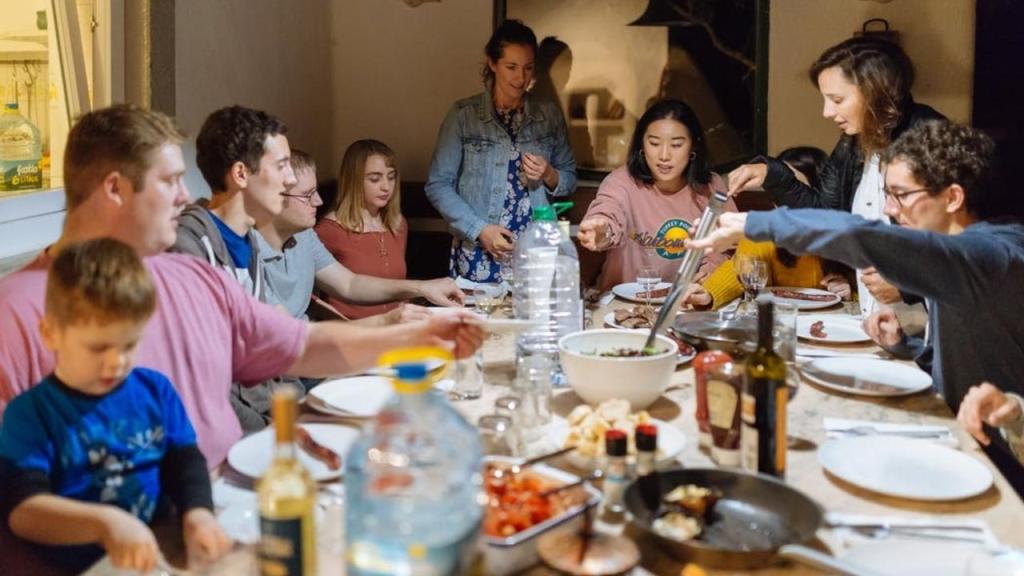
In June Mary and I attended a family wedding in a Redwood forest south of San Francisco, and treated ourselves to three days on the Monterey peninsular beforehand. We drove down the spectacular highway alongside the Big Sur and, at a lunch stop overlooking the ocean, Mary observed that the bride-to-be had been fortunate to grow up in an area that was beautiful and healthy, and in a family that was functional.
We tried to take a break from politics but could not avoid references to the increasing levels of anger and division in the American populace, divided as it is along political lines. My sense is that those tenacious feelings are fueled by what is perceived to be the hypocrisy and self interest of our elected representatives, the discord between their words and actions, between their stated values and manifest practices, not least at the national level.
We know only too well how crucial a healthy environment is to the vigor, fitness and survival of a colony of honey bees. I would suggest too that a colony is a functional family. According to James Bradshaw, the characteristics of such a family include the desire to cooperate and to fight fair so that differences can be negotiated; the clear communication which reflects a mutual respect for the dignity of others; levels of trust which are created by honesty; the recognition of differences and the uniqueness of each person; roles that are open and flexible, allowing for spontaneity without shame or judgement; ensuring that the needs of all are met; and working communally to resolve problems.
It is not difficult to see these traits in a healthy honey bee colony. The swarming process, for example, demonstrates the ability of the bees to negotiate differences in terms of finding a new nest site, and to do so under the life-threatening pressures of time and weather, and perhaps even of humans who feel sufficiently threatened by this natural process to arm themselves with a spray can filled with chemicals designed to kill wasps. And the scout bees seem not have an ego – if their choice of nest site is not strongly supported by their colleagues, they investigate instead those sites that do have greater endorsement, thus stream-lining the process. Forager bees communicate physically in ways we know only too well, but so do the retinue of worker bees surrounding the queens, as does the larvae, emitting pheromones when they need to be fed or capped. The roles filled by a honey bee in her short life time are flexible, depending on the needs of the community and the available resources, and each individual seems to understand that there is dignity in work and that ultimately it is the survival of the colony which is the highest priority.
A functional family does not mean that there are no strong emotions; rather that they are expressed constructively and with mutual respect. The bees can be angry and defensive when their home and children are threatened, as would we, and which is appropriate. The little book, “At the Hive Entrance,” by Professor H. Storch, first published in German in 1985, describes how much a beekeeper can learn by observing the bees on the landing board and listening to the different sounds coming from the hive, to the point that in many cases it is not necessary to open the hive to discover what is happening inside.
Beginning in the eighteenth century we believed that we can, and that we have, surmounted the rules of nature. The bees remind us what we lost and what we have yet still to learn, not only in terms of our contact with the real world but also in terms of our effectiveness in a close communal setting. As a reminder, Bradshaw asserts that 98 per cent of American families are dysfunctional … and the other 2 per cent are liars!
Growing up I believed that my future life would be spent in the country of my youth, surrounded by friends and family. Fate intervened in the form of a civil war and gradually our community dispersed to the point that today my sisters and brother live on different continents, and most of my school colleagues and friends live in South Africa, Australia and England, with none that I know of here in the United States.
I guess we absconded.
Mary, by contrast, is still in contact with many of her school-girl friends, and in July she visited one of them, Maggie, from her high school days, when the latter came from Portland, OR, for the annual family vacation on the eastern shore. Maggie’s beloved partner died a year ago and she described to Mary the feeling of loss that still remains. She has a wide circle of caring friends, two sons with grandchildren, good neighbors, but what she desperately misses, especially in the afternoons and evenings, is the physical presence of that special someone with whom to talk things over, to share plans and ideas with, dreams and disappointments.
As best I recall it was the paleoanthropologist, Richard Leakey, who best promoted the idea that mankind developed because we learned to cooperate, rather than because we became efficient killers. It is a theme that runs through much of his writing and is summarized in his final published work, The Origin of Humankind – the power of numbers, working in unison, not only proved transformative, but led to features such as social organization, the development of language, art and culture, and human consciousness.
It is a story of man the communicator rather than man the murderer. Cooperation was more potent than competition, Leakey argued, even as collaboration and teamwork made mankind more competitive.
It is not a hypothesis that is universally accepted, yet we can agree that communities, by their very nature, contain a diversity of opinion, ideas, and knowledge that an individual does not encounter alone. The synergy that evolves amid a tumult of ideas can be inspirational as well as a challenge to reconsider what one knows and to think creatively. It feels good to contribute positively to a group, and to be acknowledged as a valuable societal member, recognizing that everyone benefits from worthwhile contributions. One can share skills, gain from the skills of others, and in those inevitable difficult times, be surrounded by others who understand what you are feeling.
In the essay, Apples and Honey, published in Listening to the Bees, (2018) Mark Winston, after explaining why it is important that many different species of wild bee participate in apple pollination, besides honey bees, writes, “It is similar with human societies : it’s through the cross-fertilization of ideas and talents that we express our best communal selves. We derive strength and wisdom from our mutual visions, just as the applies are improved by the visits of diverse bees to set fruit.”
Ronnie Janoff-Bulman, writing in Shattered Assumptions, (1992) argues that there are three beliefs essential for a healthy core self : the world is benevolent, the world is meaningful, and the self is worthy. Too reach our highest cultural potential, he suggests, we need to believe that the world is a good place, that we ourselves are good, and that our lives make sense somehow, that they are not just random chaos. I would add that these necessary convictions are more sustainable in shared community.
The original human groups, perhaps some 60 000 years ago, were concerned primarily with enhancing their chances of survival. The men would coordinate to protect the tribe from carnivores and would allocate roles when hunting for meat; the women would stay in the camp, raising the next generation and providing the emotional and nutritional needs of the family. “It takes a village …”
A progressive civilization witnessed the peripatetic gatherings of ancient Greek philosophers, the French salons of the Enlightenment, and the groups that gather to discuss a shared passion, such as managing honey bees. My guess is that most of us have experienced the affirmation, if not joy, that can come from associating with ‘cool beekeepers’ at a local or state meeting, and whereas we might attend initially out of a sense of curiosity, many of us consciously commit to becoming an integral part of this community of shared energy and enthusiasm, with both the individual and communal rewards, not to mention enjoyment and sense of fun that results from collaboration, clear communication, a strong work ethic and social responsibility … as in a bee hive.
I have known a number of people, friends and family alike, who were left bereaved, and my hope for them was that they would recover gradually and gently from the unimaginable grief. I did not understand the on-going loneliness that say, my step-mother endured after the death of my father, and because I did not understand it (nor was she able to speak of it, although in retrospect there were hints,) I did nothing to ease it. Although no words can take away the pain, saying nothing at all makes it worse.

Important as community is, it cannot compensate for the intimacy that comes with sharing one’s life for many years with a beloved. It’s a complex interaction. Just as a honey bee cannot survive for more than 24 hours without her community, so we need the balance between personal endearment and the support and stimulation of a wider fraternity.

 Our Green Cathedral