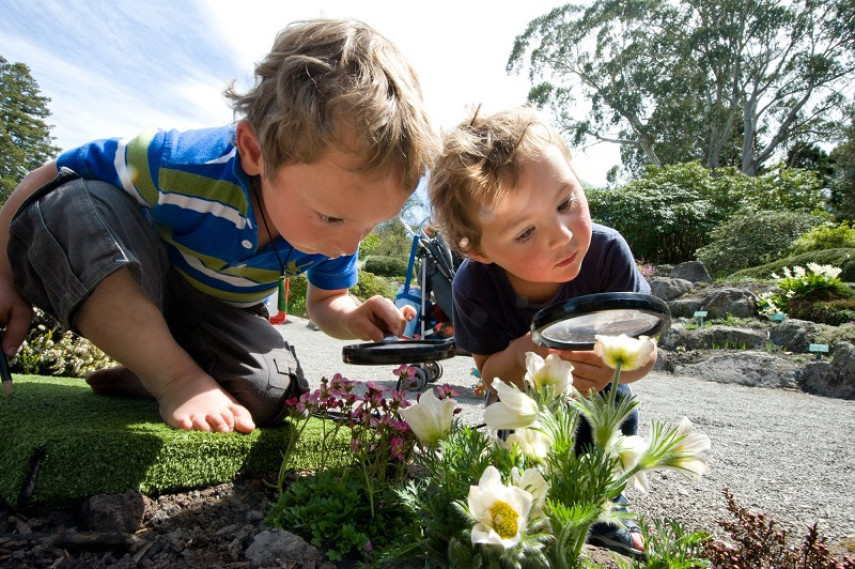
Last December Mary had to have some laser surgery after having had cataracts removed earlier in the year. She liked the ophthalmologist she had consulted with- apparently he is a man big not so much in size as in character and personality, hyperactive and warm, interactive and genuinely caring. Waiting for the surgery she mentioned that her right eye watered more than the left. “Let me look at you” he offered, and very quickly said, “You right eye does not close as tightly as the left one, and there is a slight droop in the eyelid.”
Mary, herself a retired family physician, had not noticed this, nor had I, and even knowing it I find it difficult to see. On recollection, Mary recalled that twelve years ago she had Lyme’s Disease with the consequent Bell’s Palsey-like drooping of the right side of her face, before it was rectified with medication. The current condition of her right eye was clearly a long term consequence of that disease.
Fast forward a few weeks as, on Christmas Eve, we prepared a treasure trail for three of the grandchildren. You know the kind of thing. Each starts with a card on which is a drawing or a phrase, which leads them to where the second card is hidden, and so on until the final card reveals the treasure – in this case, their Christmas gifts. The youngest had five such cards, all with pictures; the older two had semi-cryptic clues. Thus Owen’s first card read, “Cluck,cluck, this is egg-citing “ and steered him to the chicken coop.
In all three cases the path to say, the third clue, led them very close to where the fifth and eight clues were placed: all of the clues were visible if one chose to look. Despite my anxiety, the cards were found in order. The children were so focused on the clue-in-hand that none of them saw the other signs and tip-offs as they ran passed them.
Finally, as the first snow storm of the year approached in January, two good friends and I were discussing jigsaw puzzles as a source of stimulation when one is confined indoors. We agreed how, the more one works on a puzzle, the more one chooses pieces by shape rather than by color. In other words, one sees the parts of the puzzle from a different vantage point.
Clearly there are different kinds of looking. The ophthalmologist was hyper-busy when viewed from the outside, yet had the ability to focus intently when required with the experience to make significant deductions from a minute discrepancy. A phrase I heard recently was ‘the ability to see the world through a small window.’ Puzzlers, quiet and centered, find themselves acutely aware of another dimension to small details, whereas the grandchildren, excited and flowing with adrenalin, were so focused on a preconceived, distant goal that they were unaware of the details around them.
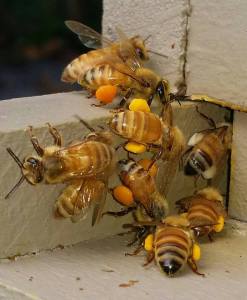
These experiences prompted some reflections on how we as beekeepers look at frames of honey bees, and how we see differently. For a new beekeeper a busy frame of bees is confusing, even intimidating. In many cases, the instructor has described what they need to look for, and the students bravely look for the presence of eggs, pollen and honey, and of course they want actually to see the queen rather than be satisfied by signs of her presence and activity. They are exhilarated when someone points out say a queen cell hanging off of the bottom of the frame, or if the instructor uses a finger gently to move a few bees so that larvae are revealed in the bottoms of a few adjacent cells.
The more experienced beekeeper takes this in with a glance, to the point that he or she will often spot the queen without actually looking for her : it is not the queen herself that stands out but the behavior of the surrounding bees, or the difference in her movement compared to the workers in the retinue. A personal benchmark was spotting a queen who was in the act of laying, her abdomen buried in the cells, even though I was not looking for her.
What that experienced beekeeper notices is something out of the ordinary, something that is unexpected, that breaks the anticipated pattern, that has a distinctive if unexpected shape. It may be a few cells of exposed pupae in otherwise capped worker brood, or a bee with deformed wings, or the movement of a small hive beetle scuttling to safety, or more than one egg in the bottom of a cell, or a degree of alarm in the movement of the bees suggesting the loss of their queen, or … You know the scenario.
So the first question is, how do we move from the first scenario, akin to the grandchildren and their predetermined goal set by an outside authority, to the more sentient scenarios akin to the ophthalmologist and his ability to detect the unexpected in what was otherwise normal, or puzzlers making choices based on minute differences in configuration? My guess is that time, perseverance and experience are the only teachers. Like swimming, if one is to stay afloat one has first to jump into the water, get wet, splash around a lot, practice, get some well-timed direction, and practice some more. One cannot learn to swim only by reading a book or looking at pictures, no matter how good they might be.
The second question is, when you look, how much do you see? `

 Our Green Cathedral