In the light of Mark Winston’s challenge to come up with some Audacious Ideas for the Future of Beekeeping, here are two ideas involving rodents and soldiers with PTSD that relate to the big (VERY big) picture.
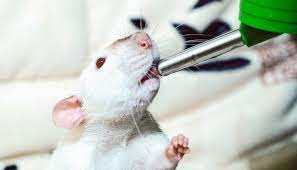
If a rat in a small cage is given two water bottles – one with just water, the other with water laced with morphine, heroin or cocaine – the rat will almost always prefer the drugged water even though it leads to its own demise.
This was the prevalent theory of addiction : drug dependency is a moral failing and we are inherently hedonists who party too hard until the brain is hijacked.
In 1981 Canadian psychologist Bruce K.Alexander and his colleagues at Simon Fraser University in British Columbia, asked if the choice was a reflection of living conditions rather than the addictive properties of the drugs. To test their hypothesis they built a kind of rat heaven : a colony two hundred times the floor area of a standard laboratory cage with 16–20 rats of both sexes in residence, food, balls and wheels for play, and enough space for mating. Everything a rat might want.
They also provided both water bottles – the contaminated and the normal water. Fascinatingly, in this environment, the rats chose the latter. To generalize the overall finding of some complex experiments, few of the rats overdosed and few developed a behavior that looked like compulsion or addiction.
Alexander argues that addiction is caused not by morality nor by our brains, but by our ‘cage.’ Addiction, he argued, is an adaptation to our environment. Large numbers of us cannot be present in our lives without some form of drug. We have created a hyper-individualist, hyper-consumerist, isolated world whereas what we yearn for is connection with people, self worth and dignity. This is contrary to the prevailing message that skillfully trains us from a young age to focus our hopes, dreams and ambitions on things we can buy and consume. A dependence on money has replaced our relationships with one another and nature, and not only do we use money as the measure of our accomplishments but we relinquish control of our lives to institutions that control our access to money.
It is important to say that the findings remain controversial. The results have been difficult to replicate and it appears there might be a genetic component to the behaviors.
Driving home from one of our beekeeper meeting, I listened to On Point on the car radio, specifically an interview with Sebastian Junger, the author of Tribe: On Homecoming and Belonging. He described how, after months of combat during which “soldiers all but ignore differences of race, religion and politics within their platoon,” they return to the United States to find “a society that is basically at war with itself. People speak with incredible contempt about — depending on their views — the rich, the poor, the educated, the foreign-born, the president or the entire U.S. government.”
It’s a formula for deep despair. “Today’s veterans often come home to find that, although they’re willing to die for their country,” he said, “they’re not sure how to live for it.”
The premise is clear. Modern civilization may provide us with unimaginable autonomy and material bounty but it has also deprived us of the psychologically invaluable sense of community and interdependence that hominids enjoyed for several million years. It is only during moments of great adversity that we come together and enjoy that kind of fellowship, which may explain why, paradoxically, we thrive during those moments. In the six months after Sept. 11, Mr. Junger observed, the murder rate in New York dropped by 40%, and the suicide rate by 20%
War, too, for all of its brutality and ugliness, satisfies some of our deepest evolutionary yearnings for connectedness. Soldiers have a chance to demonstrate their valor and loyalty, to work cooperatively, to show utter selflessness. Platoons are like tribes.
Back home we have ‘detribalized’. Our personal loyalties have shrunk to a universe the size of our homes (our immediate families, maybe a few friends;) we have little regard for what’s collectively ours – we litter, we fudge on our taxes, medical providers defraud Medicare, bankers perform sleights of hand with the markets and destroy the commonweal.
Mr. Junger’s asked why roughly 50% of our Iraq and Afghanistan veterans apply for permanent PTSD disability when only 10 percent of them saw combat. “The problem doesn’t seem to be trauma on the battlefield,” he concluded, “so much as re-entry into society.” Soldiers go from a world in which they’ are united, interconnected and indispensable to one in which they’re isolated, without purpose, and bombarded with images of politicians and civilians screaming at one another on TV.
Is there any relevance for what we see in the behaviors of honey bees?
First, let’s think of the cage analogy as the roughly 20 000 acres within which a colony of bees will forage. We know only too well that the gasses developed to kill people in the First World War (and they were damn good at it) were later adapted to kill insects. Arsenic and salts were replaced by organochlorines like DDT in the 50’s, by organophosphates in the 70’s, pyrethroids in the 80’s and neonicotinoids in the 90’s. These were massively applied to the monocultures which replaced smaller diversified farms (in 2017 it is estimated that 40 acres of family farmland is lost to corporate agriculture every hour) at the same time as new parasites and pathogens from Asia and Africa were introduced and the world climate reacted to the environmental abuses of the Industrial Revolution.
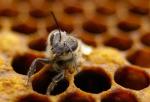
And what if we shrink the dimensions of the cage to that of a beehive? Wax absorbs impurities from the atmosphere, much as our kidneys do on our bodies. Research at Penn State demonstrated that forager bees bring back to the hive an average of six different pesticides on the pollen they collect. Nurse bees use this pollen to make beebread and royal jelly, which they then feed to larvae. Over and above this are the chemicals that beekeepers themselves introduce into the colony.
So is the current behavior of the bees an unhealthy response to their macro and micro environments to the point that they are no longer capable of choosing the ‘clean water’ when it is available to them?
Bees also have some kind of long term memory which we improperly understand. For example, how do bees know to prepare for a winter when none of them, except possibly the queen, has lived through a full year? Is it only a genetic response to changing daylight hours? And Tom Seeley demonstrates how, given choices, scout bees will unerringly choose the ideal dimensions for a future home. The means that those bees, who have never experienced any other abode, somehow know what the requirements are for sustainable living in terms of volume, height above ground, size of entrance, which direction it faces and ability to withstand moisture. How do they know this? Is it some kind of genetic long term memory?
Is it possible that honey bees can compare the ideal with reality, not least when we as beekeepers, apparently in the bees’ interests, tear the roof of the house, fill it with smoke, separate the different stories, pull out the room dividers, turn the bees upside down (literally) and then reassemble that house often in a different order? Perhaps the problem is that the bees, after having fought a war with the environment, have trouble reentering their own society. Are we witnessing PTSD at an insect level?

 Our Green Cathedral