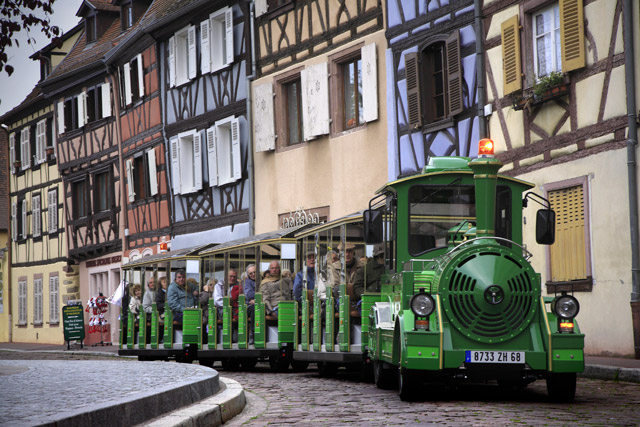
In August, 2013, Mary and I were in Alsace, France, for a family wedding and had the opportunity to take a guided tour of the medieval center of the city of Colmar. It involved a small locomotive with three open carriages and attached to each seat was a headset. There were fourteen languages one could choose from, with English third on the list behind French and German. There was Chinese and Japanese but no Arabic or Balkan languages. It was a truly multi-ethnic group of passengers and Mary observed how everyone was dressed so similarly, the result no doubt of the outsourcing of the clothing industry to Asian factories where it is mass produced and then shipped back to the US, Europe, the Middle East, Asia …
In 1995, in a small rural town in Zimbabwe, there was only one general store and it stocked almost everything in a quaint yet orderly way, including a shelf of school bags above and behind the storekeeper, each with the logo of the Chicago Bulls imprinted on it. Michael Jordan in rural Zimbabwe, where very few houses had electricity, never mind television? To the school children it was an intriguing but meaningless design.
In the same year a BBC film crew was anxious to document the effect of the war in Rwanda on the gorilla population and, because of the turmoil in East Africa, it had to approach from the west, which meant a week long trip by boat up the Congo river followed by several more days in canoes beyond the Stanley Falls. One night they stopped at a camp of pygmies, probably of the Mbuti clan, in a quest to find guides who could lead them through the forests to the northern edge of the Mitambu mountains in Kivu province where the great apes could be found. As the camera panned over the camp fire in this remotest of areas, a woman came into the picture. It was difficult to assess her age because, being small of stature anyway, the T-shirt she was wearing swept to the ground. On the orange T, in large black letters, was inscribed “FREE OJ.”
The theme running through these experiences is the unintended effects of globalization. As writers like Wendell Berry, Michael Pollen and Bill Cronon point out repeatedly, most of us have become very good at doing or producing one particular thing and at consuming everything else. Ironically, the further one gets from the actual product the greater the chance of economic success; one has to think only of the extravagant wages of many CEO’s compared to those on the shop floor, even though ironically the latter probably have the practical skills to survive without the former, but not vice-versa.
It is painful that the millions of American workers laid off in the recent recession are desperately seeking re-training so that they can re-enter the job market. Their previous experience and expertise appear to have no value of their own. And that initial expertise was the result of choices we made, often unwittingly, at a young age that determined much of the rest of our lives. I can recall vividly, in the 1960’s, a wise man predicting to a group of assembled high school boys that two thirds of the jobs that we would end up doing as adults did not then exist. We scoffed, and yet today I would estimate that two thirds was a conservative estimate. I recall too the adage that if there had been a computer in New York City in 1900 to predict what the city would look like in the year 2000, the answer might have been, “Six feet deep in horse manure.‘
This firewalls between labor pools can make us despair of ever changing the way we live. It is easy to feel that change can only come from outside, perhaps proactively from a higher authority like government or reactively after some kind of disaster, because we no longer feel we can effect significant change ourselves.
Part of the frustration is that in this new outsourced economy it is difficult to know how things are grown or made, and to relate to those who grow and make them. Beekeeping, like gardening, cannot be outsourced. Putting aside queens and drones, who together make up about 3% of a colony in the summer, bees are not specialists. Each worker bee undertakes a series of tasks during her brief life, starting with cleaning the cell from which she emerged and ending as a forager. Each worker bee gets to experience almost all of the functions of a hive; all are multi-skilled generalists and none is a specialist.
Many of us are finding relief from this feeling of dependence on people and events outside of ourselves by turning to activities which show that we can still self-provide, we can still create, manage and control a mini ecosystem. Gardening is one such activity; beekeeping is another. As Al Summers said in an interview with Boulder’s Daily Camera newspaper, “Bees are a portal to a much wider view of the environment. Much as I like bees, and they do have a nostalgic appeal, that’s not my dominant reason for beekeeping. It’s my style of being environmentally responsible.”
Being attentive to the needs of the bees leads to greater appreciation of the intricate work and interactions that makes life possible, an awareness of the complexity of the many systems involved in producing say, an apple for the table, water from the faucets or a teaspoon of honey for our morning cup of tea. This in turn changes our relationship to the environment, both immediate and wide spread, and renews our appreciation for the people who provide what we otherwise accept unthinkingly as the necessities of life.


 Our Green Cathedral