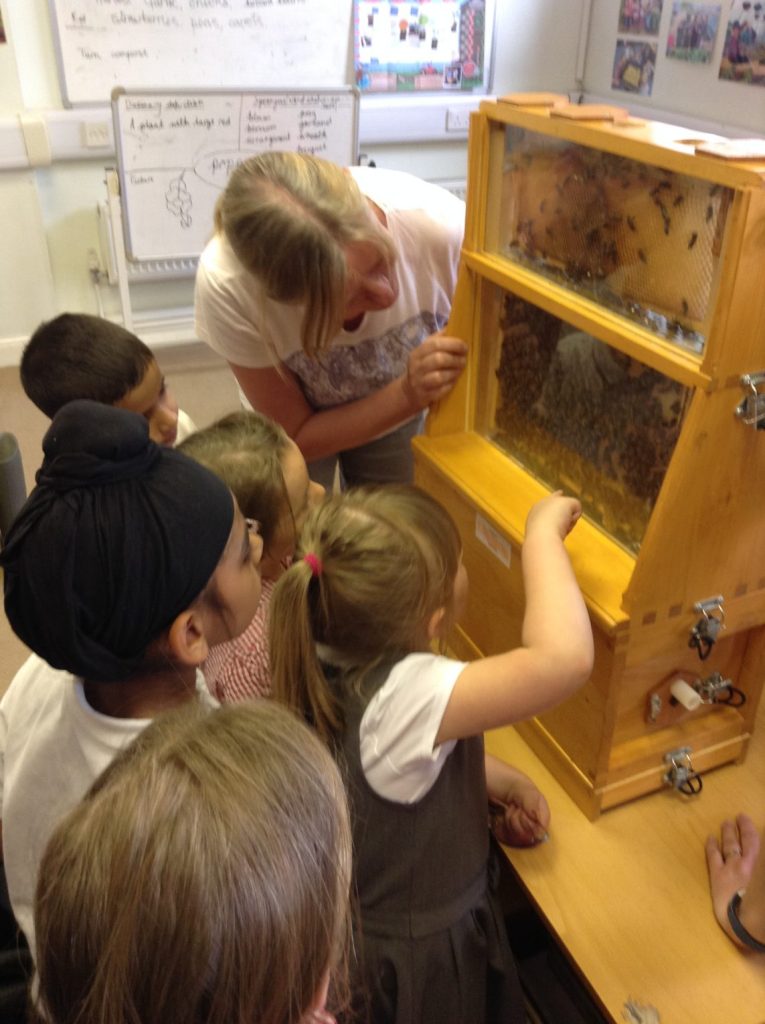
The observation hive on my desk, with access for the bees to the outside, provided countless hours of pleasure, instruction and amazement, not least by contemplating the combination of even-temperedness and sense of purpose exhibited by the bees despite the constant presence and pressure of their peers. All day and night there are bees going over, under, around and on top of each other, yet there are no signs of frustration (what would ‘road rage’ in a honey bee look like?) Rather the colony seems to find comfort, support and reassurance in the constant presence of others of its kind.
The closest I have come to experiencing this kind of pressure was at Apimondia in 2009 at Montpellier, France, as we pushed and struggled and grappled and wriggled in columns of six deep trying to get to see the hundreds of vendors in the short intervals between presentations. If this is ‘bee space’ it is much too confining for my liking.
Much has been written about bees as a superorganism, not least by Jurgen Tautz, and many of William Longgood’s essays as collected in The Queen Must Die stress how each bee exists primarily for the good and survival of the larger community. In his book, Bee Time : Lessons from the Hive, Mark Winston writes that “Underlying all the physical sensations are collaboration and order, communication and common purpose, each bee submerging her individual nature for the colony.”
We used to be like that. There was a time when we got to know people because we had both to ask for and to offer help. In the absence of a health system, unemployment insurance and public housing, charity was an integral part of life and indeed was central to all of the world’s major religions. And yet today how many of us, when approached by the sick, the frail, the homeless or the confused, choose to look the other way, or cross the street, or say “He will only spend it on drugs,” or blame the individual for his or her predicament. “If only they would work harder …”
My guess is that this is especially evident in the USA because the country chose to pass on the social revolution of C19th and C20th Europe, which means that the sick, the hurting and the disadvantaged of this society depend all too often on random acts of kindness. Yes, we are still warm hearted, well meaning and generous, but to preserve a sense of balance we either turn our metaphorical backs on, or put fences between, the millions of human beings who are all around us all of the time, whether needy or not. The public spaces in which we are forced to rub shoulders with our many neighbors – busses, lifts, pavements, shopping malls, restaurants – throw us into the mix in a way that denies our individuality and can make us feel insignificant, trivial, if not irrelevant.
If one wants to start a commotion, try starting a conversation with a stranger in an elevator!
Honey bees go into a cell occasionally for a little privacy, a little sleep, whereas we retreat increasingly into our private cocoons to retain our dignity and our sanity. And technology has provided us with plenty of recesses in which to hide – our cars, our computers, buying with a credit card over the internet, Facebook, detached houses with fences … And, as a general rule, the wealthier we are the more easy it is to be isolated with bigger houses and taller fences. Sealed away it is easy to forget or deny the inherent worth and dignity of every individual in the face of a media that emphasizes the murderers and swindlers and unethical politicians and vain celebrities and abusive pedophiles.
Honey bees have been living a life virtually unchanged for millions of years, a life style that is now being threatened by the technology we espouse so loudly. A pertinent example was the 2010 ban on honey bees being imported from Australia to the almond trees of California because of the mites and diseases that might come with them on the Boeing 707, or indeed the debate in Britain about the risks of small hive beetle inherent in imported bees or the Asian hornet crossing the Channel
Do I want to live like a bee? Could I survive in the organized chaos of a bee hive? Absolutely not. But I do want to keep the ‘virtues ‘ of technology in perspective. A poignant reminder is the technology available to the world’s great teachers compared to the power and longevity of their messages.
A popular analogy argues that people can be viewed either as butterflies – beautiful, and sitting in the sun with their wings spread as others gather around them – or bees, out in the garden cross-pollinating. I know that I need meaningful interactions face-to-face, emotion-to-emotion, with other people, those foragers who are out collecting nectar and pollen and then coming back to tell us where the good stuff is. And, even as a drone, I need to feel that, to paraphrase Mark Winston, I am collaborating and communicating our common purpose, although fortunately, and unlike the bee, I don’t have to submerge my individual nature to do so.

 Our Green Cathedral