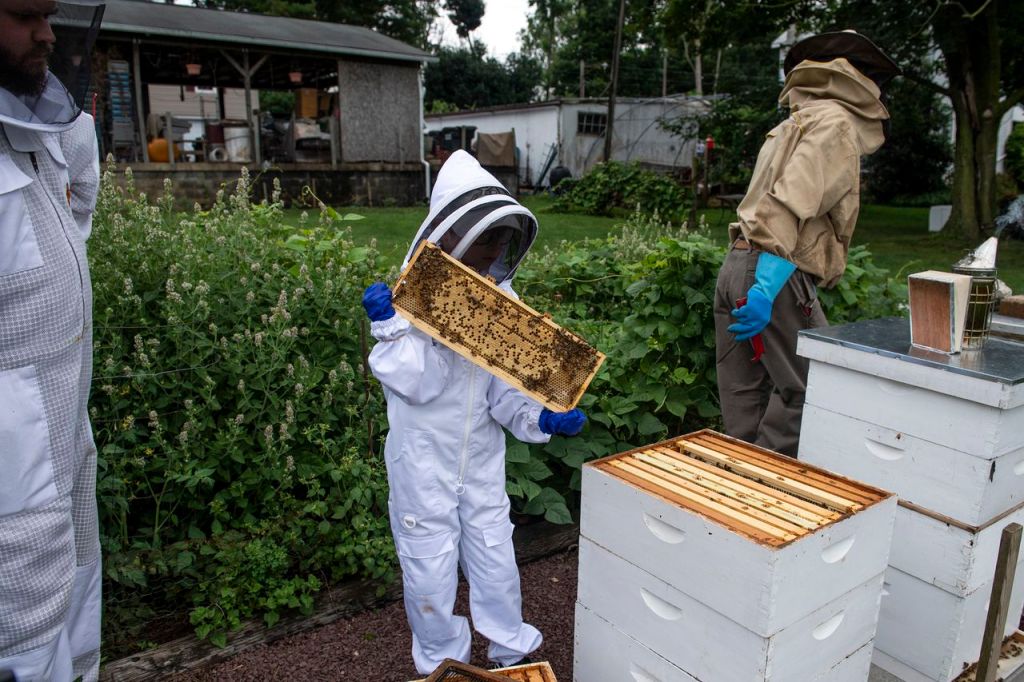
Winter is a thoughtful season for beekeepers if not necessarily for the bees. We have survived the brisk energy of spring when the colonies break their cluster for the last time and explore the bouquet of nectar and pollen surrounding them. We have labored through the summer making splits, checking for mites, moving hives and finally, if all is well, extracting honey. And we have fed the colonies through the fall as temperatures cooled and changing foliage transformed the landscape.
Cold days and long nights are the time to think, to imagine. ‘Next year will be better’ is the beekeeper’s mantra; we are perpetually hopeful people and, by the very nature of our avocation, are invariably looking forward to the next season.
Not all of those thoughts are reverent. It occurred to me, for instance, that keeping bees is much like raising children. Although a little intelligence goes a long way, one does not have to be a genius to do either. And thank goodness for that. Imagine if one had to achieve a GPA of 4.0 in a BCR (Bachelor of Child Rearing) before one could have children. Instead it’s amazing how many successful people have come from humble, even deprived, families. Similarly at every bee meeting I am struck by the wide range of backgrounds and professions evident in those who attend. And none of those backgrounds make one a better beekeeper than anyone else. Bees, like children, are great levelers.
Children learn to walk and talk by never-ending practice, by consistent trial and error, by falling down and getting up again. All too often, later in life, if something doesn’t work the first time we give up on it. Beekeeping too is about getting one’s hands dirty, about never-ending practice, about persistence. In both cases there are mentors, examples to inspire and follow, but in the apiary no matter how much one has read, ultimately one has to get over that initial fear so that one can start to ‘see’ what is really happening on the comb. Some give up when their romantic expectations are not met; others persevere, accepting trial and error as a necessary part of the process and realizing that the bees are remarkably tolerant of our mistakes, as were our parents.
With both bees and children the act of stewardship can be so engrossing that years fly by imprinted with certain landmarks – the first tooth, the first swarm, the soccer lesson, the new queen, the prom, a successful nuc. Both pursuits are things one has to do in order to appreciate how challenging but also how incredibly rewarding they can be. Only other people who are parents or beekeepers want to hear about one’s various struggles and triumphs. I am often asked “How are the bees this year?” and the last thing the questioner wants is a detailed response. He or she hopes for a quick, positive affirmation that will absolve them for feeling responsible for or concerned about the news they hear of bees ‘disappearing.’ Their eyes glaze over as we tell stories about winter losses, mites and failing queens. It’s the same glassy stare that one receives as one proudly describes the newly acquired hand-to mouth cup-handling skills of one’s youthful pride and joy.
And with children, as with bees, one has to be vigilant. Just as one thinks one has everything covered along comes the unexpected. The three year old who slams his fingers in the car door (as my grandson did) or the colony that, without warning, absconds half way through the fall with no chance of survival in the big outdoors (as one of mine did in September.)
You can do everything right and still end up with less-than-ideal results, or you can screw up right royally and end up with a successful product. I shudder at some of the things I did in my early years of beekeeping and yet the girls seemed not to mind; by comparison I felt that my colonies went into the winter of 2017 stronger and more healthy than at any previous time, and yet I had had higher losses early in the spring of 2018 than ever before. Similarly it’s astounding how children from the same parents, like two neighboring hives, can have very different temperaments. I like to think that my occasional successes as a grandparent and beekeeper are due to skill, loving attention and untiring efforts, yet I suspect it’s really a matter of dumb luck.
No matter how hard one works, as a parent or as a beekeeper, one is never really finished, either in the ‘doing’ sense or in terms of learning. The failures can be heart-breaking, like that first dead-out in the spring, and the rewards are sweeter than nectar. The only ones who think that either task is easy are inexperienced, lucky or suffering from dementia.

 Our Green Cathedral