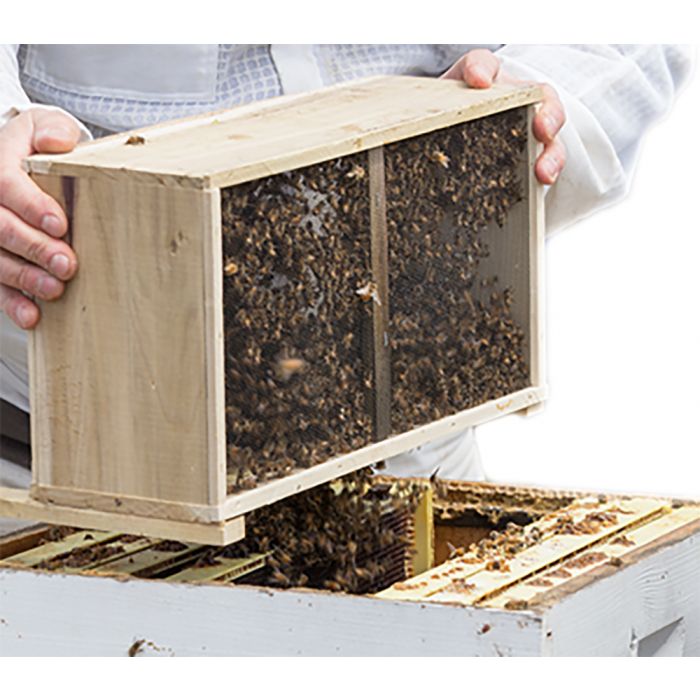
When potential beekeepers enquire about the potential costs of starting a hive, the response includes the expense of the woodenware, protective gear, smoker and the bees themselves. It is not unusual to qualify this by suggesting that, after getting the first colony, one should never have to buy bees again. What this suggests is that capturing swarms and making splits from strong colonies is a matter of basic management strategy. For the new beekeeper, however, terms like nucs, splits and queen rearing have a mystique that can be scary. Add to that the advertisements for packages of bees brought in from warmer climes, the promotion of imported nucs over-wintered in temperate zones, and the full-page color pages in the journals for all kinds of patties and supplements, and the impression is readily created that someone else knows best and that buying bees from commercial sources is the right and easy way to go.
An argument can be made, first, that it is not necessarily the right way to go, nor, in the long run, the least expensive, and secondly, where patties and supplements are involved, commercial suppliers may have their own agenda which may not be relevant or appropriate to locally-based beekeeping.
Packages have their place. Their advantages are that one gets three pounds of bees and a queen, they are easy to insert into a hive box, and they are normally available early in the season. However, there are downsides : there is an assumption that the queen and the workers have ‘gotten acquainted’ during their travels, the bees need to be fed heavily once they are colonized, the queen may not be adapted to winter survival, and the cost of packages continues to increase. In addition, there is no history of the bees or their queen so the beekeeper does not know if packaged bees have been treated nor if there were disease issues in the colonies.
Buying an imported nuc is also expensive, but one does get bees on the frame usually with some pollen and nectar, and they are easy to hive. Again, the beekeeper often has no knowledge of the history of the bees or the heritage of the queen, and it is recommended that every nuc (and package) be tested as soon as possible for diseases and pathogens.
Another aspect, seldom mentioned, is described by Tom Steely in Honeybee Ecology. The annual cycle of brood rearing is partly determined by genetics and partly by the local environment. In a French experiment, colonies which were moved north and south kept their distinctive brood rearing cycles in their new environment. ie. those moved south started raising brood relatively late in the winter, and those moved north relatively early. And in an experiment in New York, imported colonies had a decreased probability of surviving the winter.
It seems logical, therefore, that here in the northern US, bees imported from the south are likely to have a brood rearing cycle more adapted to Georgia than Pennsylvania, at least for the first year, and that the probability that a locally raised, or second year, colony will survive the winter is greater than that of a new colony which is in its first year in the north.
At the 2015 Pennsylvania State Beekeepers’ conference, every speaker, without exception and to various degrees of emphasis, referred to the value of locally adapted bees bred from survivor stock, with the occasional importation of new queens to diversify the gene pool. The assumption is that every beekeeper can be his or her own breeder of bees. Some will graft and raise queens from strong, over-wintered, local larvae, selling queen cells, virgin or mated queens. Grafting might not be for everyone (I don’t suggest we go as far as Denmark where apparently the introductory class for new beekeepers involves grafting the larvae that will become the queen for his or her first colony!) but making a split and raising a nuc is certainly within the skill range of all beekeepers.
One of the questions, given a frame of larvae of suitable age, is do the bees make random choices in choosing which ones to develop into queens (as we do when we graft) or is there a reason for their choices? A remarkable paper was published in Naturwissenschaften (2005) by Robin F. A. Moritz et al, titled Rare Royal Families in Honeybees. The authors genotyped worker brood and determined the number of patrilines in the colony (ie. the number of drones represented in the queen’s spermatheca). They then removed the queens to stimulate queen cell construction and genotyped the resulting queen pupae. One would predict that the number of patrilines would be the same between the two groups, but surprisingly some patrilines were over-represented in the queens and very rare in the workers. Thus, it seems that these rare “royal” patrilines are preferred by nurse bees.
This suggests that workers express choice in rearing queens, although it does not answer whether those queens perform better. Do worker-selected queens (vs. beekeeper-selected via grafting) head colonies that are more fit?
Joe Lewis, in an article in the American Bee Journal, Dec 2013, argues that beekeepers need to make a five frame nuc for every two hives in the apiary – what he calls 2.5 Beekeeping. The pros, besides the unbeatable price, include multiple data points for comparative purposes in an apiary, a source of brood when needed, especially to make emergency queens for queen-less hives, back-up queens to replace failing queens, and the fact that the beekeeper has some control over the qualities of bees in his or her bee yards. The cons include the extra time required compared to buying a package, and that nucs may not build up fast enough in the spring to meet the demands of pollinator contracts.
To avoid excessive in-breeding it is important occasionally to introduce new genetics into an apiary, which involves either buying or exchanging queens with fellow beekeepers whose management policies one respects. This has become even easier in Pennsylvania with the Queen Improvement Project run in conjunction with an eight state group known as Heartland Honey Bee Breeders Cooperative, the goal of which is to develop honey bees that are resistant to varroa mites and brood disease, have at least an 80% overwintering survival rate, are gentle, and are good honey producers. A number of beekeepers and queen-producers, with the help of Pennsylvania State University and USDA Sustainable Agriculture grants, are evaluating different genetic stocks in terms of the above criteria and the resulting queens are available to local associations for breeding purposes or to queen breeders from which to develop stock for local distribution.
And increasingly at the club level, small groups of interested beekeepers are meeting regularly throughout a year to share queen rearing techniques, discuss traits to breed for and how to evaluate them, trade queens and eggs, build equipment and develop a drone yard project.
The issues surrounding packages, nucs and raising bees from local survivor stock is one that can be addressed by each local association. Whereas none of us can dictate what other beekeepers should do, it is important to include making splits and nucs in beginning beekeeping classes and to offer hands-on workshops for local beekeepers at which they can explore the different ways of making splits and thus remove the mystery and nervousness that often surround this process. Not only does this provide local beekeepers with more options for the long term survival of his or her colonies but also contributes towards the overall quality of honey bees in one’s neighborhood.

 Our Green Cathedral