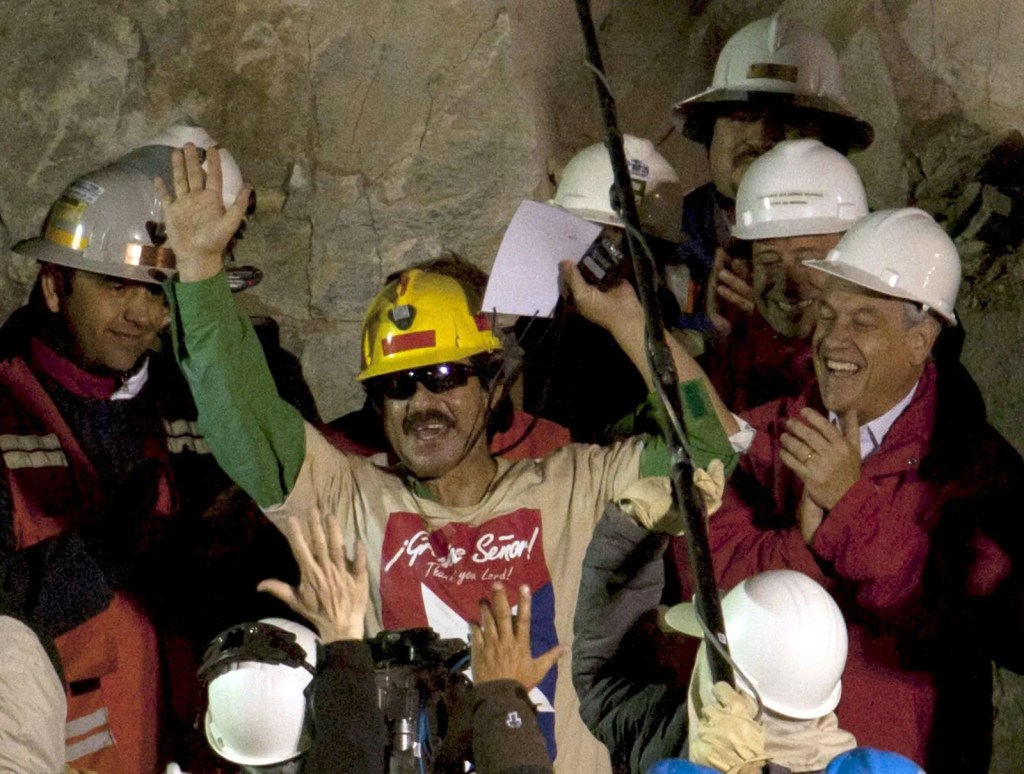
On Wednesday, October 13, 2010, much of the world was riveted to the TV screen watching the amazing, tearful, joyful scene as one Bolivian and thirty two Chilean miners were brought to the surface after 69 days entombed in the bowels of the earth. Each miner climbing out of the capsule was mindful of a young worker bee emerging from her cell after twelve days as a pupa, except of course that the fuzzy bees emerge into the darkness of a hive.
Why was that scene in Chile so captivating? Perhaps we are desperate for good news, for success stories. Perhaps we enjoy seeing technology used for such dramatic and humane ends, or global expertise joining hands for the common good. And perhaps this was an authentic reality show in which everyone won because it was based on cooperation rather than ruthless competition, on partnership and trust in the face of fear, on power with rather than power over and on team work and creativity.
Is that what we secretly yearn for?
A bee hive is just that – cooperation in the interests of community and survival, interdependence rather than competition and independence, benefits for all rather than for a few, the nurturing of all, interconnectedness as part of a larger universe, a living organism in which every bee has an important role to play.
There was another aspect to the rescue mission. How often do we give more than a passing thought as to where the metals that we use every day come from? And yet on that dramatic day in October these forgotten people, the miners, were given human faces, with families and dreams, hopes and fears, wives and girl friends (in one case, both of the latter at the same time!)
Similarly I suspect that few Americans give much thought as to where the food they eat comes from, or to the many processes that have to happen, from soil preparation to pollination to irrigation to harvesting and transporting, before they can take it off the shelf in the super market or buy it over the counter at a fast food store. The oft-told story may be apocryphal but it contains a germ of truth. “Where do green beans come from?” “From aisle 8 at the grocery store.”
Successful beekeeping requires that one becomes more observant, more aware, of the seasonal changes, of temperatures, of nectar flows and what’s in bloom and what pesticides and herbicides are being sprayed where. Perhaps it is the way that people were before mass urbanization followed the industrial revolution, when most of us lived close to the land and were more interactive with the world beyond our doorstep.
The myriad of tunnels in that disastrous mine below Camp Hope was mindful of looking into a hive, filled with wonder as to what the bees do to create a working environment in which they can prosper, procreate and progress. Comb in a natural space is a marvelous combination of fluidity and precision. There is a hypothesis that bees use bee-chains to measure a space before building comb, that they can start on different walls of a cavity and meet perfectly in the middle without so much as a seam in the wax. Similarly at Camp Hope computers on the surface were used to direct the drills with amazing precision deep into the earth.
The Constitution of 1776 was a landmark document of the Enlightenment. It was devised at a time when individuals were subservient to a privileged elite based on birth, to superstition and to the dictates of a monolithic religion. Perhaps, ten generations later, it is time to take a page from the play book of the bee hive and recognize that with independence comes an inherent self-centeredness and a preoccupation with individual rights that can be damaging. Maybe it is time for a Declaration of Interdependence and a Bill of Responsibilities.


 Our Green Cathedral