
“A series of psychological studies over the past twenty years,” Nicholas Carr writes In his book, The Shallows : What the Internet is Doing to our Brains, “has revealed that after spending time in a quiet rural setting, close to nature, people exhibit greater attentiveness, stronger memory and generally improved cognition.” The reason, he argues, is that when our brains are not being bombarded by external stimuli, not least in the form of rapid sound bytes from electronic media, they can relax.
In 2008 a team of University of Michigan researchers subjected some three dozen people to a rigorous series of tests designed to measure memory and the ability to stay focused. Half of the testees then spent an hour walking through a woodland park while the rest walked through a busy downtown street after which both groups were re-tested. The first group significantly improved their performance in both areas – recall and attentiveness – while the second group showed no change. The experiment was repeated with a second group of subjects using photographs of either calm rural scenes or busy urban ones, with the same results. “Spending time in the natural world,” wrote the researchers, “seems to be of vital importance … to effective cognitive functioning.”
And it’s not only deep thinking that requires a calm, attentive mind. It’s also empathy and compassion. As Antonio Damasio, the director of USC’s Brain and Creativity Institute explains, our higher emotions emerge from processes that are inherently slow. Our brains react quickly to physical pain but the more sophisticated mental processes of empathizing with physical suffering unfold much more slowly. The price we pay for the power of technology is alienation, and the more distracted we become the less we are able to experience the more noble emotions like empathy and compassion. Everything happens so fast that there is no time for reflection.
A biology professor at the University of Vermont at Burlington was renown for his emphasis on the importance of observation in the scientific process. Apparently, for the first class of a semester, he would bring into the lecture hall a large container of yellow liquid. “This looks like urine,” he said, “but we won’t really know until we have observed it closely,” after which he made a great show first, of smelling the liquid and secondly, of dipping a finger into it and tasting it. The class was aghast, but even more so when he insisted that they all do the same before rendering a verdict. After some pressure (“This is pass/fail” he insisted) they trooped down, and after the last one had returned to her seat, the professor said, “If you had observed closely, you would have noticed that I put my second finger into the liquid but put my third finger into my mouth.”
Lesson learned.
There have been some great observers of honey bees. The Swiss naturalist, François Huber, was only fifteen years old when he began to suffer from a disease which gradually resulted in total blindness; but, with the aid of his wife, Marie Aimée Lullin, and his servant, François Burrens, he carried out investigations that laid the scientific foundations of the life history of the honey bee.
Karl von Frisch was an Austrian ethologist who received the Nobel Prize in Physiology or Medicine in 1973 for his investigation of the sensory perceptions of the honey bee and in particular his decoding of the meaning of the waggle dance.
And then there is Dr. Tom Seeley of Cornell University whose prime focus has been on understanding the phenomenon of swarm intelligence, culminating in the superb publication, Honey Bee Democracy. More recently he has been the inspiration for and part of the team that developed, the Honey Bee Algorithm which uses observations of honey bee foraging behavior to allocate shared web servers to internet traffic.
Dr. Seeley has commented that with the emphasis on molecular biology and genetic-based research we are in danger of losing the focus on observation, which for centuries has been the basis of scientific discovery and of which, of course, he is a spectacular example. Observation takes time, not only to survey but also to reflect, and the collection of data is onerous. Behavior, a vital aspect of any life form (think waggle dance, swarming, the queen’s retinue) cannot be measured in the DNA. This is not to deride molecular biology; it is a plea for balance and in particular the peacefulness and restfulness that sophisticated mental processes require.
I was fortunate to attend the Third International Conference on Pollinator Biology, Health and Policy, held at State College in July of 2016, and it was noticeable how the honey bee genome featured in almost all of the presentations. My scientific background is limited at best, and what I do know is dated. Much of what I heard was over my head, and certainly it was challenging to decipher and understand the different graphs that were flashed on the screen. The culminating key note was by Gene Robinson, someone I have long wanted to hear, and although I understood very little of his key-note address (“Understanding the Relationship Between Genes and Social Behavior”) I was caught up by the quality of the presentation. By contrast, I was fascinated by Lucy King’s observations of elephant behavior when confronted with log hives suspended by wires around a crop field.
In the early nineteenth century the German philosopher, Georg Hegel, developed his dialectic. He argued that an idea or proposition (later called a thesis) invokes a response in the form of its contradiction (antithesis.) The dialogue between the two results in a higher level of truth (synthesis) which in turn becomes a new proposition (thesis.) Thus we progress by compromising between apparent opposites or contradictions.It is one of the bases for democracy : in Britain the party out of power is called “Her Majesty’s Loyal Opposition” in that it is their duty to oppose anything that the governing party proposes, in the belief that out of that dialogue a synthesis of the best of both sides will emerge.
So the question is what will result from the synthesis of observation and genomics? Genomics is clearly a fast moving development and its easy to feel overwhelmed by the technology and the associated terminology. Observation takes considerable time and patience, and the results cannot always be objectively proven, yet there is frequently a relationship that develops during that long process between the observer and the bees, and even between observers as they analyze the results of their surveillance with all of the subjectivity that is missing when working with genes from bees mashed in a petri dish.
Increasingly cyber technology is making it’s way into the apiary. An example is the Beetight system which involves an app for an iPhone, iPod and Android by which one can upload photos, view apiaries on a map and identify hives by scanning barcodes, all while working in the apiary. It works even without a network connection, synchronizing when one is next online. Jim Bobb’s response was that the result of using an app in an apiary is a smart phone covered with propolis.
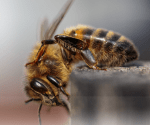
Clearly there are few if any tranquil spots on the internet where observation and contemplation can work their magic. If we are not to become the victims of frenzied technology we need to preserve those ‘sleepy hollows’ which provoke the meditative thinking which Martin Heidegger describes as ‘the very essence of our humanity.’ For me that place is the apiary. It is where time stands still. I can get lost among the bees, observing, thinking, meditating and, most importantly, finding the peace and quiet to balance the clamor of a tumultuous world. The last thing I want to do is to bring electronic technology into the apiary. Hopefully I provide something of value to the bees; they in turn give me more than they will ever know.

 Our Green Cathedral