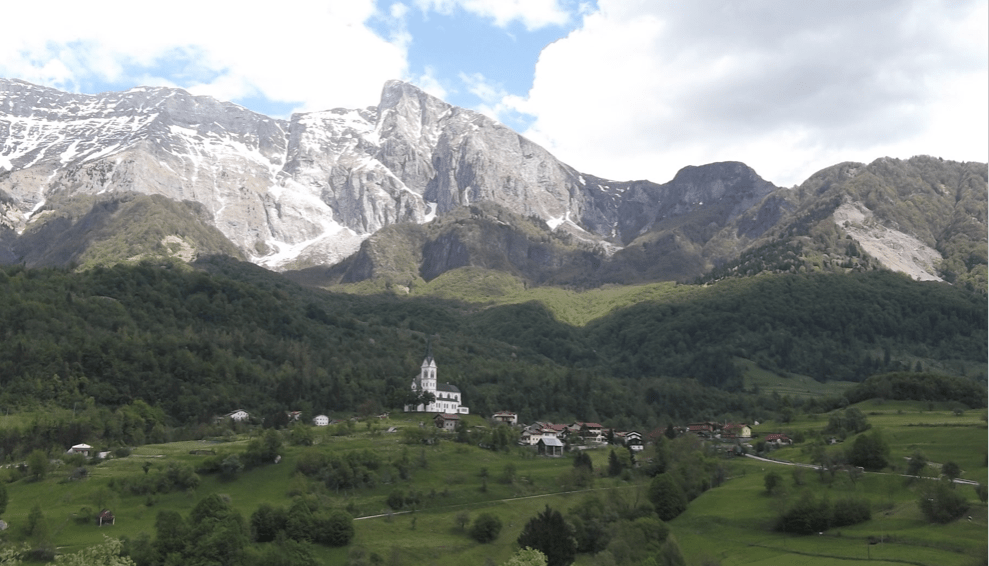
For my 70th birthday I got to choose where we would vacation and decided on Slovenia, in part because it has an ancient tradition of beekeeping and in part because it has the highest ratio of beekeepers per population of any county in the world. One out of every 210 Slovenians is a beekeeper, compared to 1:3250 in the US and 1:4100 in Pennsylvania. In other words the density of beekeepers is almost sixteen times greater in Slovenia than in the US, and beekeeping is an integral part of both the landscape and the culture. This was made evident by an area map at a bus stop in a small village in the foothills of the Alps, the legend of which included a symbol to show where local beekeepers and their products could be found within a twenty kilometer radius of the hamlet. One of the reasons offered as explanation is that the Austro-Hungarian Empire, of which Slovenia was a part (or the Duchy of Carniola as it was then known) was never a colonial power, never had sugar plantations nor a cheap supply of sugar, and so preserved a long relationship with honey.
We spent a morning with Marija Sivez and her husband Dusan Zunke who, between them, run 500 colonies (or ‘families’ as they are called in Slovenia.) Over a delightful lunch that she had prepared for us, Marija explained a little of the country’s recent history in the following way : her grandparents were born in the Austro-Hungarian Empire and her parents in the new Yugoslavia that was created after the First World War. She and Dusan were born in the Second World War when Yugoslavia was occupied by the Axis powers, and because she was born in the western region, and he in the east, she had to learn Italian and acquire an Italian name, and he similarly but in German. Her children were born in communist Yugoslavia, ruled by Josep Tito, and her grandchildren in the new independent republic of Slovenia created in 1993 which, in 2004, became part of the European Union.
So it is not all that rare for an elderly Slovenian to have lived in six different countries in his or her lifetime without every having to leave the village of his or her birth.
Incidentally, at the Slovenian Beekeeping Center, the Secretary General, Anton Tometz, described with much pride how, despite the turmoil of the past century, beekeepers had kept in constant contact with their colleagues throughout Europe.
Two of the intriguing concepts were bee-air therapy and apitourism. The first is the belief that the environment produced in a bee hive is therapeutic and can be accessed via a variety of devices by which one can inhale the emissions of a colony. Certainly, one of our traveling companions, after only a few minutes of such intake, awoke next morning to find that, for the first time on the trip, her sinuses were clear. One of the missions of Franz Sivic, perhaps the leading apitherapist researcher in both Italy and Slovenia, is to find scientific support for these phenomena, beginning with having all experiments and operations monitored by medical doctors who administer both pre and post tests.
The second involves using beekeeping and the products of the hive to promote tourism. The beautiful painted bee houses (cebeljnaks, pronounced chebelnyaks) ) were omnipresent, as were road side signs selling med (ie. honey) and attractive displays in stores promoting honey bee products, including medica (fortified mead, pronounced medusa.)
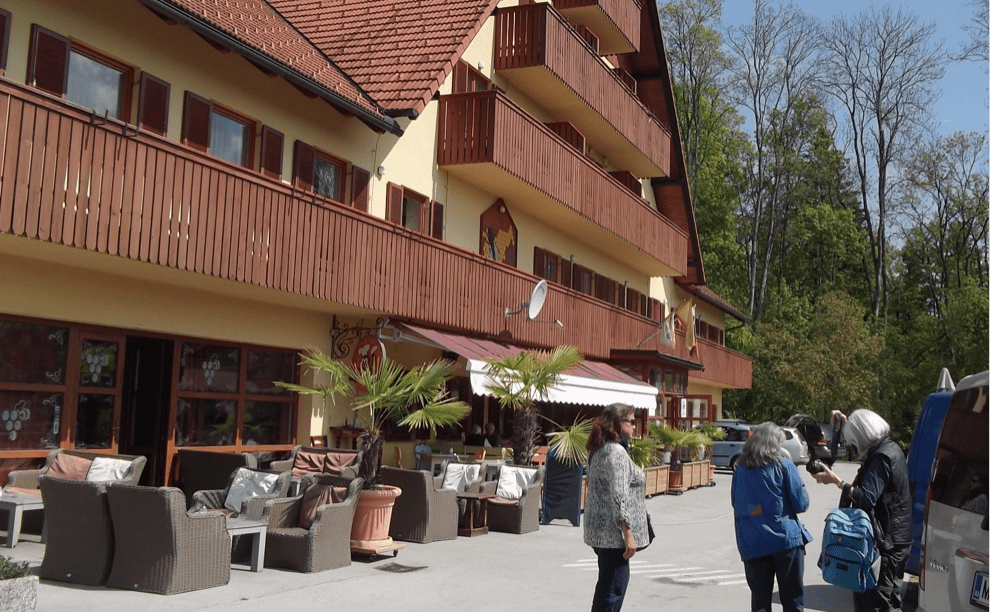
The focus of much of this activity is the Čebelarska zveza Slovenije, or Slovenian Beekeeping Association, a comprehensive organization centered in an impressive four story building alongside one of the major highways east of the capital, Ljubjlana. There are 16 employees, three of whom are full time – the President, Vice-President and Secretary General. It was the latter, Anton Tometz, who gave up his morning for us, sharing his knowledge and passion for Carniolan bees through the good auspices of our guide and translator, Janez (pronounced Janie) Strasizar.
The first records of beekeeping in the Duchy of Carniola, now Slovenia, go back to the 10th century, the national current organization was founded in 1873 and the new headquarters were opened in 2008. The 5000 square meter, three story building sits on the hilltop of a large acreage with gardens that demonstrate active hives as well as bee forage. The library, with its 3500 books and journals, all of which were donated and most are digitalized, as well as the restaurant, beekeeping shop, reception area and office space, were 80% self-funded, primarily by dues from membership – annual dues are 40€ per annum, which is about $45. To put this in perspective, the average annual income in Slovenia is the equivalent of $20 000, less than half of that of the USA. The state helps with maintenance and running costs of the property in return for a share of the nectar flow information which comes from the more than 40 stations based in apiaries throughout the country.
The objectives, as described by Secretary General Tometz, (and I’m relying on Mary’s notes here because the web page is not available in English) are to advise and educate Slovenian beekeepers and to promote positive public relations for beekeeping, not least through apitourism and apitherapy. The challenges facing the association are no different to those in the US : declining natural resources as the number of bees increase, varroa and it’s associated pathogens and diseases, and the effect of toxic sprays on honey bees.

There are 400 native bees and 325 bumble bee species in Slovenia, and the emphasis is on preserving the integrity of Kranjska Cebela – the Carniolan, or grey, or silver honey bee, which is native to the area and is the second most popular bee in the world, second to Italians. It is the only bee that Slovenian beekeepers are allowed to keep, nor is any other type of bee allowed into the country. This leads to interesting dilemmas. One beekeeper we visited has a major apiary in the foothills of the Alps, very close to the Italian border. Her queens are open-mated and she cannot control where they fly, nor are they respectful of international borders. So progeny that have a light appearance are sold in Italy, and those with the Carniolan darker features go to Slovenian or German beekeepers!

The average age of a beekeeper in Slovenia is 58, compared to a national average age of 51, but Anton stressed that a number of younger Slovenians were getting involved in leadership roles. And there are plenty of such roles available with 207 local beekeeping organizations (literally one per town) in a country the size of New Jersey and a total population of only 2.1 million. There are about ten commercial beekeepers, two of whom are women (‘commercial’ meaning having more than 150 hives) and the largest operation is some 2500 hives. These figures might be misleading in that the registration of hives is mandatory but free, and there is a tax of 2.50€ on every colony after the first 40, so beekeepers register any colonies over 40 with neighbors and family so as to avoid the taxes.
The cost of a Carniolan queen is similar to the price of a queen in Pennsylvania, the average honey production is about 40 pounds per colony, but the price of honey is only about half of what we get in the US.
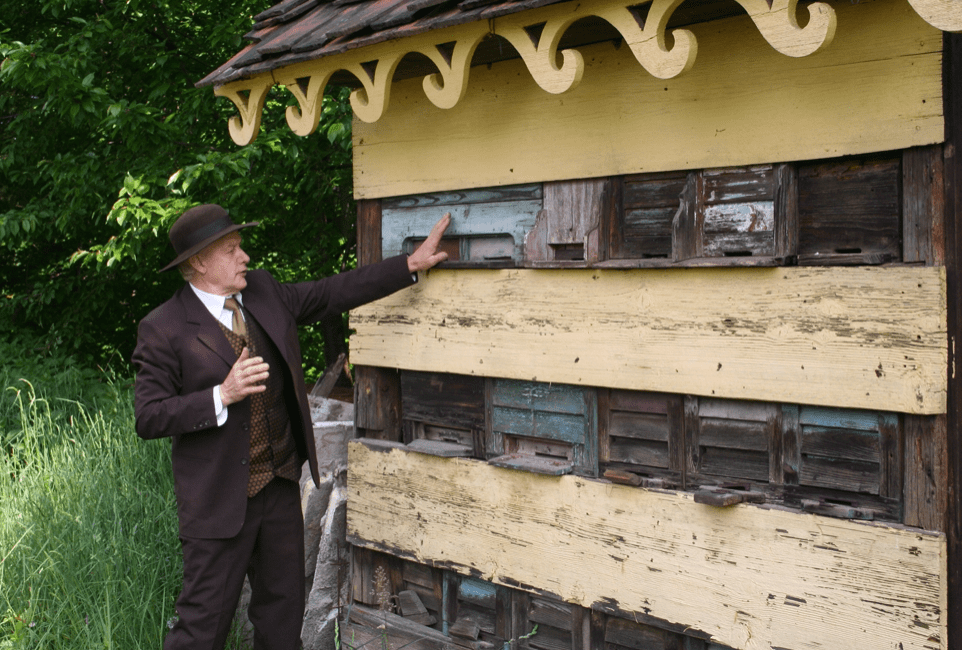
Also impressive was the strong focus on children. The Beekeeping Association offers three day beekeeping camps throughout the summer, which attract some 2500 children every year. Over those three days they study pollinator plants, paint the attractive front boards that distinguish each hive, and make products from wax and propolis.
The energy and enthusiasm in that building was evident and contagious, as was the professional level of leadership, and my recurring thought was, how can a country that is so relatively small, with a population equivalent to that of New Hampshire, think so big? And this is despite the traumatic, unsettled history of the last century. It is no coincidence that a study out of Yale placed Slovenia in the top five environmentally successful countries in the world, and the capital, Ljubjlana, was the green capital of Europe in 2016.
If they can do it – apitherapy, apitourism, extensive beekeeping, professional organization, education of the young – with relatively limited resources, why can’t we, who have so much by comparison? Perhaps it says something about the priority they place on the environment, the bees, and honey as a food source, as well as their pride in their agricultural traditions and in being self-sufficient (almost every urban home we walked past had a vegetable garden and chickens.)
Perhaps their philosophy is summed up in one delightful tradition. Slovenia is home of the famous Lippizaner horses, and every time a foal is born a tree is planted. In this modest way the cycles and interdependence of life are honored.
Despite this turbulent past, or perhaps because of it, we found the people of this beautiful country to be proud, gentle, kind and generous to a fault. It is almost as if the present age of peace and relative prosperity is appreciated all the more because of the tumultuous times that preceded it. And this is expressed in the absolute cleanliness and quietness of the countryside, qualities that were reinforced on a walk along a gravel path to a waterfall when I saw a discarded cigarette butt and found myself feeling outraged, even violated.
Like many millions of people I have had my fair share of pain, failure and losses in my life. As a twenty year old I imagined working, retiring, and eventually dying, in the country in which I had grown up. I did not anticipate, for example, having to leave in the middle of a civil war and eventually working in five countries on three different continents. But I did, and in retrospect I see it as a rare opportunity. Like many Slovenians, I now treasure and seek kindness, gentility and generosity in contrast to the turmoil and upheaval of earlier life events.
In his book, Second Wind : Navigating the Passage to a Slower, Deeper and More Connected Life, Dr. Bill Thomas draws a distinction between adulthood and elderhood. In contrast to “the mania for adultish independence and achievement,” elders have a life experience and an awareness of their own mortality that provides wisdom, serenity and an ability not only to be at peace with themselves but also the skill to be peacemakers among others.
Thomas suggests there are three perspectives as one approaches the end of adulthood. The first, and most vociferous, are the Deniers who proudly reject the changes that come with aging and posit a future where one can be forever young. Secondly are the Realists who admit they are changing but dislike the process and are committed to resisting them. The third and smallest group are the Enthusiasts who openly acknowledge the difficulties that lie ahead but are eager to explore the new opportunities for growth that the passage of time provides.
Can this perspectives apply to a country and to honey bees? If so, perhaps what Mary and I experienced in Slovenia was a culture of Enthusiasm in which the painful past is accepted, current difficulties are accepted and there is an excitement about the future. And without wanting to be overly anthropomorphic, my guess is that most animals, insects and birds, including honey bees, live fully in the present (it has been suggested, for example, that for a dog there is no such thing as a good or a bad walk) and in so doing nourish the longevity of the species.
Certainly the three perspectives – Denial, Realism and Enthusiasm – provide the necessary paradigms as I start my eighth decade of life, together with a determination to be consciously more of a grateful Enthusiast. The honey bees are an essential part of that determination, whether as an example, a comfort or an inspiration.

 Our Green Cathedral