
In 1924, when Stéphane Hessel was seven years old, his father moved his family west across the Rhine river from Berlin to Paris. The family’s literary milieu was shattered by the German invasion of 1940 and Stéphane, by then a member of the French army, became a POW. He escaped and, outraged by Marshall Petain’s decision to collaborate with the German occupation in the form of Vichy France, joined General de Gaulle’s Resistance movement in London where he found the inspiration that was to excite the rest of his life. It came in the form of the program of the National Council of the Resistance which looked beyond the defeat of the Axis powers to ‘a true economic and social democracy.’
In 1944 he parachuted into France ahead of the Allied invasion to organize resistance networks. Captured by the Gestapo he was subject to the equivalent of water boarding and was sent to Buchenwald concentration camp, surviving only by switching identities with an inmate who had already died. While being transferred to Bergen-Belsen he escaped.
With the war over Stéphane, aged 28, was sent to the United Nations in New York where he joined Eleanor Roosevelt in drafting the Universal Declaration of Human Rights and found his life work in the promotion of what he called ‘a culture of human rights,’ whether it be between Israelis and Palestinians, illegal immigrants anywhere in the world, or the withdrawal of social rights in many countries in Europe which he described as ‘a rejection of the gift of the wartime generation’s legacy.’
In 2010, aged 93, Stéphane published a 30 page pamphlet which became an over night sensation. Titled Indignez-Vous, or Get Outraged, he exhorts his readers to “find a reason to be indignant. This is a priceless act, because when something makes us indignant we become activists, we feel committed and our force becomes irresistible … I would like everyone of us to find his or her own reason to cry out. That is a precious gift. When something makes you want to cry out, as I cried out against Nazism, you become a militant, tough and committed. You become part of the great stream of history.”
His words describe the feelings many experience as they stagger from one crisis to another, battered by financial catastrophes and inundated with recurring messages of disaster from across the globe. It’s easy to feel helpless, to collude with the perceived enemy, as some Frenchmen did under Petain, or to get involved on the basis that, as Gandhi described, one has to become the change one wishes to see in the world.
So, what are you outraged about (there are more than enough choices) and how does it translate into action? What is your equivalent of the Second World War – that period of loss, confusion and turmoil in which lay the germ of an idea that was to become a focus of your life? For me it was the credibility gap between what we say and what we do, between principles and practice, either individually or as a nation.
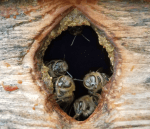
And in the midst of this I found the bees, or perhaps they found me, and a passion and a sense of outrage came together. The bees invited me to walk the walk and gradually I became the activist that Stéphane Hessel describes, striving for “… ethics, justice and a sustainable balance” in the belief that commitment is irresistible, peaceful insurrection is inevitable, and the bees, our environment, and the next generation will be the beneficiaries.
Stéphane died in February, 2013, aged 95, and even in the tenth decade of life his conscience was outraged whenever the post-war world betrayed the program he had fought for. He often found himself in a minority, yet speaking in London in 2010 he said that of the long and arduous journey that had been his life, “something clearly emerged : the need to give a sense to my life by defending the values that the Nazis had scorned.”
“The worst of all attitudes,” wrote Stéphane, “is indifference.” Or as Charles de Gaulle said in 1940 after having been driven from France by the invading German armies, perhaps his darkest hour, “Must hope disappear? Is defeat final? No!”

 Our Green Cathedral