Twenty years ago, when a college class was given an essay to research and write, the presumption was that the students would go to the library and, by searching among the index cards and shelves of books, get to see the topic in a larger context. Who knows, they might even be positively side tracked by something unexpected. In more recent years the presumption is that the student will go back to his or her dorm room, open a lap top or smart phone, google the topic and be taken straight to the material without any awareness of (and often not any curiosity for) the larger surrounds.
Students are getting better at writing good papers on specific topics without an awareness of the larger context. Or in terms of the old adage, they know more and more about less and less until they know everything about nothing.
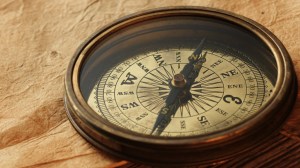
Something similar happens with maps v GPS. Maps present the larger view, the bigger surrounds, with the potential to discover a lake that lies just over the hill, or a spectacular view at the end of an unmarked lane. Because maps have to be read in conjunction with the surrounding physical environment, whether it is as simple as reading a sign or as challenging as looking at the contours to determine the degree of a slope, we are engaged with the environment, with the habitat, which creates both memories and knowledge.
This became clear when talking with a recent visitor about his journey from Philadelphia. He asked where York County began and I mentioned the Susquehanna River, once a frontier with ‘Indian country’ in the days of the thirteen colonies, crossed today by a bridge that is almost a mile long. “Yes,” he said, “I do seem to remember crossing a bridge somewhere.” Because it was not mentioned by the GPS voice, it made little impression on him.
Some years ago Mary and I were driving up Rte 1 in Oregon State and Mary noticed on the map a potentially interesting monument only a short distance off of the highway. It led us to a redwood tree and a beautiful story. In 1944 a Japanese submarine surfaced at night off of the Pacific coast, a sea plane was assembled in the water and a young Japanese pilot strapped his family’s samurai sword around his waist, tied a Japanese flag around his head, and flew over the Oregon forests, dropping two fire bombs. The intent was obvious. One of the bombs was ineffective and the fire caused by the second was quickly extinguished.
Fifty years later an elderly Japanese man walked into the museum at Portland, Oregon, to donate his family’s samurai sword, where it is presently on display, and then drove into the forest to the site where his second bomb had fallen and planted a redwood tree.
He died shortly thereafter.
The point is that this little side adventure would have been unlikely were we following directions on GPS. Maps open the world, they engage us, whereas GPS narrows our view, removes our choices and often misdirects us without our knowledge. A GPS system is a dictator; a map is a guide. The former is a partner to our intellect, not a replacement for it.
For all of the above reasons I like maps and have declined to get a GPS for my vehicle. I will concede that for some it is very useful, those undertaking frequent deliveries, for example, but I want to keep thinking, rather than have technology do the thinking for me. And as a curmudgeony admission, I’ll acknowledge not having a smart phone. Perhaps I’m intimidated by the rapid advances of technology but people who would never dream of coming to one’s house unannounced think nothing of calling or sending a text and expecting it to be picked up or read immediately.
The May, 2015, edition of Orion listed some of the words that were removed from the Oxford Junior Dictionary. They include acorn, bluebell, cowslip, fern, hazel, heather, dandelion, heron, ivy, mistletoe, nectar, newt, otter and pasture – all words concerned with nature. The words introduced included attachment, blog, broadband, bullet-point, chatroom, cut-and-paste and voice-mail. Are these latter words important in a technological society? Absolutely yes. The tragedy is that they replace, rather than interact with, words from nature.
I received a phone call earlier this year from a person who had purchased a queen bee on Craig’s List and wanted to know what she had to do to start beekeeping. Numerous e-mails from ‘wannabees’ state they have decided to keep honey bees and ask where they can buy the necessary equipment. How is it that we have come to believe that working with nature is so easy, requires so little knowledge or preparation? Yes, sites on YouTube have good (and bad) visual examples of techniques like installing a package but beekeeping is an art as much as a science, it requires perseverance, commitment and patience, and false expectations created by technology in isolation explain in part why more than half of new beekeepers give up within the first year.
Consider the new Flow Hive, hyped as the biggest technological breakthrough in hive design in the last 150 years. The impression created is that one sets it up in the backyard, installs bees, waits a few weeks, and then turns the tap to get honey straight from the colony. Many don’t realize that one still has to do brood inspections, deal with mites and diseases and hive moths and small hive beetle and swarming, remove it for successful over-wintering, and know how to ‘read‘ a colony, not least the health of the queen. No doubt the Flow Hive has value in the right hands; my fear is that many potential new beekeepers will spend a lot of money to purchase one and the heightened expectations will quickly lead to the trough of disillusionment.
As we become more detached from our surroundings, the honey bee remains intimately connected to the environment; indeed, her survival and those of the colony depend on it. Ours does too, but we are still at the stage of paying lip service to that interdependence rather than demonstrating the actions and behaviors that are the root cause of meaningful change.

 Our Green Cathedral