An Exercise in Empathy
Popular wisdom has it that the real work of a conference happens around the water cooler and the coffee urn. Add to that list the breakfast table.
Early one morning in November, 2010, I joined Maryann and Jim Frazier for breakfast at the annual Pennsylvania State Beekeepers’ meeting in Lewisberg as the conversation turned to their recent trip to Kenya. During her presentation at the Eastern Apicultural Society meeting in Boone, NC, Maryann had expressed the possibility of US beekeeper associations forming a partnership with their Kenyan counterparts and my ears pricked up. I had been fortunate to live in southern Africa until 1991 although I had not been back since 1997 nor had I any experience with Africanized bees aside from throwing myself flat on the ground in the middle of a cricket match as a swarm flew 4’ overhead.
The end result was an invitation to join Maryann’s team in Kenya in June, 2011, and evaluate the possibility of meaningful interaction with local beekeepers. As a show of support a number of local beekeepers contributed hive tools, veils, smokers, gloves and dollars which were mailed to Nairobi ahead of the visit, although they were not to arrive until sometime after we had returned home.
There were three broad components to the project. In terms of research, varroa is relatively new to Kenya (it is similar in appearance to the bee louse, which is prevalent in East Africa and initially local beekeepers did not distinguish between the two.) Could East African beekeepers be persuaded to forego the use of chemical? In South Africa the decision to go chemical-free had, within the space of six years, resulted in bees that were tolerant of the mites. Heaven only knows the extent to which chemicals are mis-used by beekeepers in the USA; what are the risks of traditional beekeepers using such potent treatments, no matter how carefully it is done?
From the US point of view, the number of mites infesting African colonies tends to be smaller then the those in European colonies, possibly because of the smaller average size of African colonies, their tendency to abscond and thus frequently start new colonies, or a hygienic trait which allows workers to detect mites behind capped cells and remove them. If there is a genetic basis for these behaviors, is there relevance for the development of mite resistant European bees?
In terms of the second component, education, whereas the biology of African and European bees is the same, management is different. The majority of Kenyan beekeepers are subsistence farmers who rely on sales of honey to supplement their meager income. Could an increase in both honey production and pollination quantifiably improve the quality of life in impoverished rural areas, not least for women?
To this end Maryann and Dr. Elliud Muli of the South Eastern University College (SEUCO) and the International Center of Insect Physiology and Ecology (ICIPE) in Kenya, facilitated a three day workshop in Nairobi with 16 attendees drawn from East Africa, each of whom has influence with beekeepers in their respective areas.
The third component is one of on-going support. In an article on professional cycling in Rwanda printed in the New Yorker, Philip Gourevitch wrote that “Muzungus tended to come, create excitement, make promises, and disappear.” Correctly the plural of muzungu, or white person, is wazungu and originally it meant someone who wanders without purpose or is constantly on the move. It has come to be applied to all white people in East Africa as most were encountered as traders, visiting colonial officials or tourists.
What can we wazungu do to stay engaged? How can we assist and encourage Kenyan beekeepers in a way that is mutually beneficial?
We arrived in Nairobi in the second week of June, ie. the Kenyan ‘winter’ with day time temperatures in the 80’s dropping into the 40’s at night. Kenya, which is similar to Alaska in size, is bisected by the equator (which means that in Nairobi the sun rises and sets at the same times throughout the year) and has distinct geographical areas rising from the wet coastal lowlands in the east to the highlands in the west (Nairobi is at the same altitude as Boulder, CO) which are dissected by the Rift Valley, as is the arid northern area. Evidence of the severe drought which had afflicted East Africa that year was painfully apparent.
The population is estimated at 38 million (the most populous state in the US is California with about 37 million residents) of whom 75% are subsistence farmers. Recent data suggest that life expectancy is 48, the unemployment rate is 40% with consequent high crime rates, and that more than 50% of the population live below the poverty level. .
We spent our first week working at ICIPE in Nairobi, a large, sprawling city, and the second week at Mtwapa based at a beautiful beach front hotel north of Mombasa. ICIPE, a large, gated, very comfortable community has a research apiary attached, whereas on the coast we visited a number of local apiaries, some of which contained hives specifically moved there from the highlands for research purposes.
One of the challenges was to approach Kenyan beekeeping with empathy cognizant of conditions of the ground rather than to impose our ideas, our methods, our preconceptions onto them. Four examples will suffice.
Many traditional farmers make charcoal (called makaa in kiSwahili ) as a cash crop to supplement their meager income, but this involves burning wood in a country that is blighted by deforestation. A common sight along the roadside is bags of makaa waiting be picked up and taken to the nearest urban center.; there seems to be absolute trust that those bags will not be stolen or misused. Could honey and bees wax become an alternative source of cash, with the advantage of perceiving trees as a resource at the same time as pollination improved agricultural production and thus cash flow? You might recall the late Wangari Maathai, founder of the Green Belt Movement, who was awarded the 2004 Nobel Peace Prize in recognition of her work to restore trees to deforested landscapes in Kenya.
Bees wax is an unappreciated resource in East Africa. We had assumed it was chemical-free (analysis two years later showed regrettably this was not the case) and the extraction process of a log hive means that all of the comb is removed and, once the honey has been squeezed out of it, buried. When it was suggested that bees wax is a marketable commodity, one of the beekeepers at the workshop immediately said that he could arrange for it’s collection in his area, which was western Kenya. Beekeepers only had to know that it has value.
Secondly, the boost in elephant numbers over the past 20 years is heralded as a conservation success story but elephants frequently raid farms searching for food such as tomatoes, potatoes and corn prompting farmers to use poison, guns or even bows and arrows to protect their crops. In July of 2011 a report in the African Journal of Ecology reports that beehives suspended on wires between posts turned away elephants from crops in 97% of their attempted raids. (Bees cannot sting through elephant hide, but they can and do sting around their eyes and inside trunks.) And the income from honey production has incentivised farmers to maintain the fences.
Thirdly, it is easy for wazungu to suggest not treating varroa with chemicals and letting a more resistant bee emerge from the heavy losses that would result. But can one realistically expect a traditional beekeeper, struggling to survive as it is, to stand back and let his colonies die, and with it his source of income, for indeterminate long term benefits?
Finally, a traditional hive is literally a log about 5’ in length with the center hollowed out and suspended in a tree. Data gathered by ICIPE in 2007 suggests that 95% of Kenyan beekeepers work traditional log hives, 3% top bar hives, and 2% Langstroth. The average honey production of log hives is low (18 lbs per annum compared to 44 – 55 lbs for Langstroth) and it involves removing the bees and destroying the comb to extract that honey. Empty equipment is reoccupied quickly because of the high absconding and swarming behaviors and thus the destructive nature of the honey extraction is not seen as an obstacle. Moreover, according to Mama Kasika, a beekeeper can make three traditional hives per day at a cost of US$3 each, whereas a top bar hive and a Langstroth deep cost her US$55 and US$70 respectively.
What quickly became apparent is that no serious study has been done of the advantages of log hives in east equatorial Africa. Are there reasons that the overwhelming majority of beekeepers stick with log hives, besides the obvious one of cost? (These hives need to be suspended by wires from tree branches so as to deny access to the honey badger, described as, pound for pound, the most fearsome animal in the world.) Is there something about the African bee, about wax moths or varroa in log hives, of which we are unaware? As Muli said very clearly, “You are not going to change Kenyan beekeeping.”. We can only build on what is already there.
As the team developed and practiced a protocol for collecting the necessary data I was introduced to two impressive beekeepers – James Kimani, aka Ngash, the head apiarist, and Joseph Kilonzo, aka Wamba, his assistant. It was quickly evident that these two men were adept at working African bees, were knowledgeable, observant and very competent. And clearly both were proteges of Muli, whom they addressed affectionately as “Doc.”
We measured frames of brood, honey, pollen and adult bees, as well as hive weight, varroa levels, growth rates of brood and average cell sizes. We tested for hygienic behavior using liquid nitrogen as well as varroa infestation of drone v worker brood at the purple-eyed stage of pupae development, the reproductive success of varroa by visually determining whether a foundress mite had offspring, grooming behavior using sticky boards, developmental rates for worker bees from egg to larva to pupa to hatching, and for levels of aggression by putting alarm pheromone on a leather ball suspended in front of the hive for 30 seconds and then counting the number of stings.
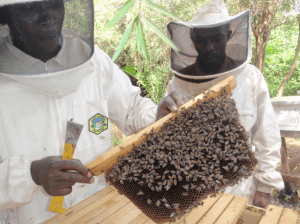
The data was meticulously collected by Sara Ashcraft, a lab technician from PSU, to be later processed both at Penn State and ICIPE. The story of Sara’s birthday cake is described elsewhere in this publication, stressing the traditional African custom of sharing what one has with the community.
What can US beekeepers offer? Whatever it is it needs to be a mutually beneficial arrangement, one that is neither paternalistic nor prescriptive. For example, the primitive smokers used to calm bees before extracting leave a sooty residue in the hive which often finds it’s way into the honey. So good quality smokers are valued, as is foundation – those few beekeepers with Langstroth or Top Bar hives put a thin strip of foundation along the top of a frame (which are locally made and irregular) and the bees build on to and below it. We could send foundation (which carries with it the risk of exporting contaminants and diseases) and smokers in return for wax, or we could help Kenyans devise and build smokers and foundation rollers that are effective, inexpensive, and comprised of local materials.
At EAS 2011 in Rhode Island in August, Wally Bloom offered to sponsor the purchase of a solar wax melter that would be shipped to Kenya as a prototype and which Muli would use as a template to have some built locally. Several beekeepers in the US would later sponsor more wax melters, expecting to receive the first rendition of wax in lieu of reimbursement, a reward that did not materialize after chemicals were found in Kenyan wax.
Although the biology of the European and African bee is the same, management needs are different based on disparate behavioral traits. For example, African bees are active year round, make a lot of honey and disperse readily. I for one now have a better idea of what kind of journal articles may be of value to Kenyan beekeepers and perhaps they could be copied and sent via ICIPE on a regular basis. Cell phones are omnipresent in Kenya – indeed the phone companies have pioneered methods of transferring money by cell phone, which makes sense when there is a significant urbanization movement and townsfolk need to send money home despite the lack of bank branches. So everyone texts and it’s relatively inexpensive. Could we provide a resource by which we respond to text messages from Kenyan beekeepers who needed an outside opinion or a fresh pair of eyes on issues that are common both sides of the Atlantic ocean?
A beekeeping primer entitled Bees Are Wealth written by Dr. I. Mann and first published in 1953 with a second edition in 1976, is unusual in that it is printed in alternating pages of English and KiSwahili. Could we up-date the content of the English pages, translate it into KiSwahili and distribute it to East African beekeepers?
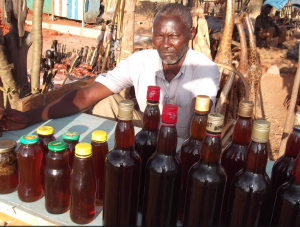
It is common to find Kenyan beekeepers selling their honey alongside the road, packed in almost any available glass container with no label. And yet in the arrival hall of the hotel in Mtwapa there was an impressive display of wines, mostly South African in origin. Why not local honey as well? Could traditional farmers be encouraged to package and market their honey to the British, German and Italian tourists who flock to the beautiful east coast beaches? They do not have the means to print labels, but we do. A grocery stall in a mall outside of Mombasa had eight shelves of honey, neatly packaged from central distributors in Nairobi selling at about $US3 per pound. How much better could the traditional beekeeper do with some direct marketing?
There is apparently a Kenyan Beekeepers’ Association but it exists primarily on paper. I was peppered with questions as to how we in York County organize and the services we provide to members. One of our drivers, after such a conversation, checked the York County Beekeepers’ Association website overnight and returned the next morning with more questions. One of the beekeepers in Maryann’s workshop, a dignified man recently retired from some 38 years service in the Kenyan Army, including time as a peace keeper in Eritrea, had been chairman of his local water authority and immediately saw a way of transferring that knowledge and skill to local beekeepers, not least in collecting wax. How can we assist those who would like to organize?
And Maryann, ever brimful with ideas, came up with the concept of a “Beekeeper Safari,” involving US beekeepers traveling to Kenya, the first of which took place in February, 2018. A developed and proven model is Apitourism in Slovenia, more about which later.
Yes, we worked hard, and none worked harder than Maryann Frazier. Normally ready to leave for the beeyard by 8 o‘clock in the morning, we would break for lunch and finish up in the late afternoon. But it was not all work. For example, on the drive to Mombasa, after a charming lunch hosted by Muli’s mother at her family farm, we spent the night at Lion Hill Camp in Tsavo National Park and next morning had two game drives through the nature reserve which is renowned for it’s elephants, although our sitings included lions, a hyena nursing cubs, giraffe, numerous antelope, warthog, buffalo, a jackal and some magnificent birds. We got to see the Gede Ruins (the remains of a fifteenth century Muslim trading center which co-existed with Great Zimbabwe of the Mwenemutapa empire further south) and walked a trail over the mangrove swamps, returning in dug-out canoes singing Kenyan patriotic songs.
Nor were we confined to honey bees. First at the Kwetu Training Center for Sustainable Development and later at Mama Kasika’s cooperative, we saw stingless bees kept in Langstroth deeps. Stingless bees store their honey in pots and although the amount of honey is limited (about 1 1/2 quarts per year, according to Alice Kasika) the value is twice that of regular honey (about US$6 per pound) because of its presumed medical qualities. When opening the hive the aroma of the smaller species was a little acrid, but the larger stingless bee hive emitted a sweet smell with a distinct mango influence.
The impressions of this vibrant country are many. School uniforms, the colorful dresses of the women, long unemployment lines, unruly traffic and overly busy roads, road side stalls packed with fresh mangoes and paw paws, a lack of ATMs and limited use of credit cards, gated communities and security guards, fresh juices for breakfast, Jambo and asante sana and karibu, (Hello, thank you and you’re welcome,) Muli’s laughter, being hassled by ‘beach boys’ on the sands of Mombasa, the startling trees and beautiful colors of the tropical flowers, lone elephant bulls, vervet monkeys bathed in the morning sun and lion spoor in the road outside of our camp, seemingly endless herds of goats, and of course Mkokotenis – large hand carts that are pushed on or alongside the road, often filled with yellow jugs containing fresh water, bags of cement, building lumber,- and matatus – ten to twelve seater vans which act as colorfully painted private taxis that can be hailed at any time, are invariably over-crowed and are notoriously reckless on the road. The name derives from tatu, or three in KiSwahili, which was the original fare in shillings.
As an educator I was particularly interested in, and impressed by, the schooling system in Kenya. Muli explained that education is seen by Kenyans as the way out of poverty, that it is the largest segment of the national budget, that the first eight years of schooling are free and that teachers are viewed as the leaders of community opinion in the rural areas. Small schools are omnipresent so that no child has too far to walk but it also means that there are a large number of teachers required to fill the classrooms and the starting salary for a high school teacher is in the region of US$150 per month.
One evening I crossed the road from a rural apiary to look more closely at a four room school consisting of mud walls under thatch. The physical surrounds were spartan but the daily schedule ran from 8:15 to 4:30 five days a week and included subjects like English, History, Current Affairs and Religion. And this was for 5 year olds! Also the level of conceptualization as expressed by words on the chalkboard was impressive particularly when contrasted with the bleak surroundings. The level of instruction from Std 1 is English. Muli explained that his two children speak three languages besides English – the native languages of each of their parents and KiSwahili which is taught in school.
On the one hand the level of poverty, not least in the urban slums, was heart-breaking; on the other hand Kenya was energizing. I couldn’t wait to get going in the morning, to open another hive, to talk with local Kenyans, to ask questions of our patient hosts. I learned far more than I might have offered and I returned to the US a much better beekeeper because of the experience.

 Our Green Cathedral