Arguably there have been four major upheavals in the western world in the preceding five hundred years with another one underway. The first four did not specifically involve beekeepers but the fifth most definitely does.
The first was a challenge to the religious order which began in October, 1517, when Martin Luther nailed his 95 Theses on the door of the church at Wittenburg. He was not the first to protest against the Catholic Church, nor did he want to start a revolution so much as a reformation, but his remonstration coincided with the invention of movable type, the development of better quality paper and ink and the growth of a body of experienced craftsmen, which meant that pamphlets, and thus ideas, could be produced quickly, in quantity and cheaply. Luther translated the Bible into German in the belief that if people read it for themselves (which they could not do as long as it was in Latin) they would understand the significance of his ideas. The Bible thus moved from the pulpit into the home where, for hundreds of years, it served as the source for family records, family prayers, grace before meals and readings before sleep, and thus a center for ideas that were common to most western people. Today it has been replaced by the Smart Phone!
There were other consequences as well. The diversity of faith and opinions increased as Luther was followed by Calvin and Zwingli in central Europe and Henry VIII in England, even if the latter was for personal rather than doctrinal reasons. New feelings of nationhood were aroused as countries identified either with the Catholic faith or those of the new Protestants (ie. those who protested) and the west lost it’s ancestral feelings of unity and common descent.
The second insurgence, which challenged the right of divine kings and thus the right of government by an elite, witnessed the Civil War in England, notably the execution of Charles I in 1649, the American revolution in 1776 which was followed six years later by the French Revolution, notably the execution of Louis XVIII in 1793, and in the early twentieth century, the Russian Revolution and the execution of Tsar Nicholas and his family.
The Catholic Church responded to Lutheranism with the Counter Reformation, which battened down the hatches, while the Protestant off-shoot continued to divide to the point where there are an estimated 39 000 Christian sects today. In France the democratic uprising was followed by the austere Napoleonic regime, which in turn was followed by an interlude of three monarchies until the brief four year Second Republic in 1848. In Russia the revolution was followed by a communist regime more stark than anything the Tsarist regimes could invent. By contrast to these republics the British system lurched towards a constitutional monarchy, perhaps the biggest single step being the succession of the Hanoverian King, George I, in 1714 who spoke only German which provided considerable latitude to his ministers.
The pendulum, it seems, needed to swing to the other extreme before it could settle somewhere in the middle.
The third metamorphosis, beginning in France in the 1840’s, was a social uprising focused on the relationship between the needs of the individual and the role of government and in particular the movement towards economic and social equality. Known originally as social democracy, it argued that the means of production, distribution, and exchange should be owned or regulated by the community as a whole, with the proceeds being returned to the community in the form of subsidized housing, education, elderly care and health benefits. A country where this innovation never took hold is the United States and one result is that the discrepancy between the so-called haves and the have-nots in the USA is greater than in any other country in the western world. Americans chose to equate free enterprise with freedom and it was unusual to have an avowed socialist as one of the candidates in the 2016 Presidential election.
A cousin of socialism is communalism, defined as communal ownership in localized independent communities, and which was evident in many traditional societies, not least native American and unpretentious African tribal groups.
The fourth upheaval was one of social engineering, whether it was Nazism, which argued that one race had the right to set the rules based on genetic purity; Communism, not least in Russia and China, in which a supposedly temporary elite ruthlessly set the rules for the eventual benefit of all; or Fascism in Italy and Spain which lacked the theoretical component of the first two and were more exercises in personal power and ego. All argued that society needed to be forced into a new order for which it would later be grateful. The guards at the various Nazi prison camps, for example, kept meticulous records of the atrocities they committed, in the belief that later generations would see them in heroic terms for having pruned and created a more perfect society.
The fifth sea change (both literally and figuratively) is global in impact and may be labeled environmental. As Diane Ackerman writes in The Human Age, “… our world dramatically changed around the year 1800. That’s when the Industrial Revolution, powered by an over-arching use of fossil fuels, led to rising carbon dioxide levels.” Other effects include massive urbanization, the conversion of ecosystems from mostly wild to mostly human centered, and the mechanization of agriculture and mining giants with extensive use of chemical fertilizers and the production of air born pollution. “That is when,” according to Ackerman, “we first began adapting the planet to us on a large scale – changing the climate, changing the oceans, changing the evolution of plants and animals.”
Every six years the United Nations Panel on Climate Change issues a report. In September, 2013, the panel of 209 lead scientists and 600 contributing scientists from 39 nations citing 9200 scientific publications concluded that global warming is unequivocal but we can slow the process of change if we begin at once.
Honey bees and beekeepers have been an integral if unwitting part in giving environmental change the public face that is necessary if the process of change is to be effective. CCD caught the collective imagination – how many times are we asked at public demonstrations, “Is it true that the bees are disappearing, and what is the cause”? How many of our hobbyists began keeping bees as a response to this publicity and the perceived need for their involvement? How many honey bee related news programs, videos and DVD’s have been produced in the last eight years compared to the preceding decades?
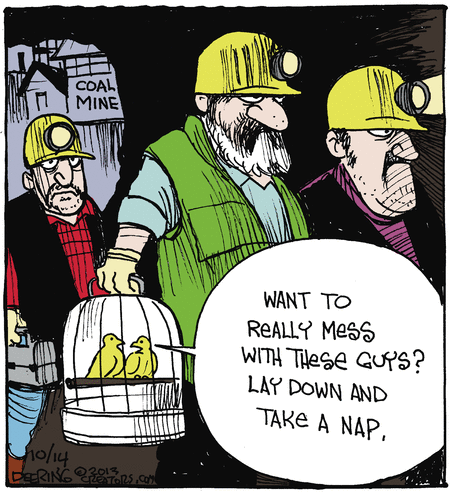
Honey bees represent the traditional canary in the coal mine, and now the canary is dying before it so much as gets to the mine. For the last few years, here in Pennsylvania, there has been a significant increase in the number of colonies absconding in the fall. The current explanation is that they are finding conditions in the hive so toxic, including high varroa numbers, that they risk everything and leave rather than stay and face certain death. Meanwhile we think we can give the canary a gas mask, find a better canary, or move the canary further from the mine … anything but deal with the actual cause. Europeans in general tend to to work with nature rather than fight it, as evidenced by the actions taken against potentially synergistic pesticides, fungicides and herbicides. Our belief, that we can continue to manage nature to serve human prosperity, is proving unsustainable.
The religious, governmental, social and economic revolutions that shaped western civilization may well come to naught if we do not deal promptly and appropriately with environmental degradation, and in future years we may look back at the lowly honey bee as providing a vital stimulus. Unlike them we cannot simply abscond.

 Our Green Cathedral