
I am blessed with beautiful and inquisitive grandchildren, as no doubt are many of you, and fortunately they live close enough that we often get to spend time with them. Shortly before Christmas, 2011, I was babysitting my eldest granddaughter in the play area of her home, watching as she drew on the chalkboard (her grandmother has been determined to introduce Nora to art from the very outset) when she drew my attention to a gap between the board and the easel and explained that that is where she swipes her credit card, which she duly demonstrated using a sheet of paper.
Two weeks later I watched as, with supreme confidence, she manipulated the photographs on her father’s cell phone. When I or my children were 3 years old neither cell phones nor credit cards existed, and now both are integrated into the play of a pre-schooler.
Grand-parenting does not make me feel old; it does make me feel special. I feel responsible for introducing Nora and her siblings to a love of and respect for the environment and cannot wait to introduce them to the honey bees. Is a fourth birthday too early to gift a bee suit?
Joel Salatin, in his book Folks, This Ain’t Normal, argues that no civilization has been in our current state of environmental ignorance. In previous eras survival meant that one had to be intimately aware of one’s surroundings and viscerally involved in the rearing and preparing of food for the table. But in recent decades putting food on the table does not require any knowledge of or involvement in the agricultural process, except how to scan a credit card, open a plastic bag and nuke it in the microwave. No previous civilization has been able to be this disconnected from its ecological umbilical cord and survive.
Today we can live a lifetime without thinking about air, soil, water, lumber and energy. If we do think about them it is often in the abstract – we don’t have a deep-rooted relationship with these vital resources. Most indigenous cultures believed that the landscape was alive, that it was sacred. The Irish writer, the late John O’Donohue, suggests first, that when you bring your body into the natural world you are bringing it home, where it belongs. Secondly, the outer landscape is a metaphor for the unknown inner landscape. By implication, as we loose contact with the outer world so too does the inner world feel empty and deserted, a hole we vainly try to fill with ‘things,’ which may include alcohol, drugs and sex, which become addictive as we realize the more we imbibe the greater the hole expands and so does the feeling of emptiness.
For most of my life I have been an educator, which has been both immensely rewarding and deeply frustrating. Teaching is a huge exercise in trust in that one never really knows what is happening in the minds of one’s students. Perhaps only in prayer is there less direct connection between input and output than in teaching! One has to trust that if one is truly present, with passion and integrity, the right things will happen for each student, and any wisdom in the lesson will be available to the student when he or she needs it later in their life time.
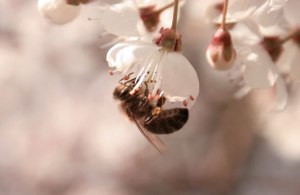
Teachers seldom get to experience the tangible, long term outcomes of their commitment whereas, after spending time with the bees, I feel that something has changed because of my involvement – I can witness it, even measure it – and it is deeply satisfying. I am not in control (we are dealing with insects after all,) but I have been working in rhythm and harmony with the natural world, and what we have done together has hopefully improved not only the bee’s world but mine as well.

 Our Green Cathedral