
It’s difficult to think in terms of geological time. For example, if we could condense the earth’s estimated 4.54 billion year history into a movie lasting 24 hours, the first honey bee would appear 30 seconds before the end of the movie and the first upright primate (australopithecus) one-and-a-half seconds from the end. Civilized man would flash so fast across the screen as to be invisible to the viewer.
The last ten minutes of the movie begin with the appearance of the first plants – ferns, conifers and cycads – that were dependent on the wind for pollination. It’s an inefficient and wasteful system of transfer; the chances that the pollen of one pine cone will be blown by the wind to another pine cone is about 1 : 1 000 000.
This was also the age of amphibians, insects and animals. Dinosaurs, birds and insects existed at least 100 million years without seeing a flower or fruit as we know them.
In the last minute a lot happens, not least the angiosperm explosion when, for reasons that have not been adequately explained, flowering plants erupted and insects developed a taste for their protein-rich pollen but they simply devoured the anthers, as rose beetles still do, and the transfer of pollen was accidental.
Gradually insects began to deliver pollen to an adjacent flower which meant that plants could develop fewer and more complex grains of pollen and these sperm-bearing capsules could be protected in a hard casing and relocated to shielded interiors within the flower to safeguard them from wind and devastation.
It was still inefficient in that these insects visited a wide variety of plants and much of the pollen that was dusted off was incompatible and wasted. As Rowan Jacobsen describes so poetically in Fruitless Fall, the problem was that for millions of years plants had discouraged insects from eating them; now these plants wanted to be noticed. To do that they used scent, color, shape and, eventually, nectar.
80 million years ago, or 30 seconds from the end of our movie, some species of wasps became vegetarian and were, in effect, the first bees. They grew hairs on their exoskeleton which meant that pollen would stick to their outer body; they developed panniers on their rear legs, carried a minute negative electric charge so that pollen, which is positively charged, could ‘jump’ on them as they passed, and their superb antennae and compound eyes were finely tuned to scent, color and shape.
As both flowers and these new ‘wasps’ multiplied in numbers and variety, flowers used nectar as an extra attraction for the right customers. Nectar was initially a waste product from photosynthesis but unlike pollen, which is a protein and expensive to manufacture, it is a carbohydrate rich in vitamins and amino acids, and amazingly economic to develop. Placed at the base of the flower, the bees had to brush past the stamens and stigma to get to it.
Sometime in the last 60 million years these insects, now recognizable as honey bees, made two remarkable discoveries. The first was that if they reduced the moisture content of nectar to about 18% and covered it with a layer of wax, the resulting honey could energize the colony through the winter and feed the brood in the early spring. Secondly, they learned to communicate through dance and thus coordinate and concentrate their foraging to maximize efficiency. In other words, they specialized their services so as to enhance production. Talk about flower power!
All this using a brain the size of a sesame seed.
North America has in excess of 20,000 species of insect pollinators and at least 4000 species of native bees, but their solitary habits, often irascible temperament and preference for a narrow range of plant species are a poor fit in an intensive agricultural system. Hence Apis mellifera was introduced to this continent in the early 17th century, first from Germany and later from Italy, by colonists who valued these relatively docile, collaborative and communal insects for the array of crops they pollinated and the honey they produced (cane sugar was not used as a popular sweetener until later in the same century and beet sugar only in the C19th.) Honey bees not only had a long and tried history in Europe, they also had a mystical and spiritual significance : because queens appeared to lay eggs without any signs of mating, bees became symbols of chastity, moral purity and the Virgin Mary. This sexual purity made beeswax candles suitable for religious ceremonies, honey was used to make mead as a communion wine and, together with propolis, was used for healing purposes in the infirmary.
390 years is a mere nano-second in evolutionary time. Honey bees have not had time to adapt to conditions in the Americas (for example, they have not learned how to work tomatoes, a New World plant) and thus rely on the beekeeper to provide the management and the sustenance in times of dearth which are essential to their survival. In return they offer the gifts of honey and pollination.
Fast forward now to the 20th century (or less than 1 millionth of a second in our movie) and what President Eisenhower famously called the Military Industrial Complex as diversified family farms made way to huge conglomerates producing a single crop over thousands of acres and using heavy machinery to spray noxious combinations of insecticides, herbicides and fungicides, many of which were bi-products of toxins developed in the First and Second World Wars.
What we use today to kill insects originated from combinations of chemicals designed to kill people, and kill them in mass numbers at that. They did so very effectively.
For honey bees, these consortia of industrial farms, mechanization and chemicals invoked a different dance, one that involved the placement of enough colonies in the right place at the right time before applying the insecticide treatments that would otherwise kill them. Hence the growth of commercial migratory beekeepers.
Simultaneously northern beekeepers came to rely on large southern operations for mail-order packages and queens delivered in time to expand their apiaries or to replace winter losses so that robust colonies might be established before the spring nectar flow. But in each of the last four years winter die-offs and colony collapse have destroyed as much as 30% of the nation’s colonies, leading to a new emphasis on raising queens from proven genetic stock that are acclimatized to local conditions.
When millions of Americans moved to the cities in the first half of the C20th they left their colonies behind, and with the destruction of natural habitat those bees diminished. The solution certainly includes science but it might also include once again the concept of the backyard hive and not only in the less built up areas. It is, after all, the urban areas that have the greatest variety of flora and the least use of chemicals in domestic gardens, even allowing for those we put on our lawns. Some cities are leading the way – Vienna, Austria, has an average of 34 hives per square mile within the city limits, the hives on the roof of the Paris Opera are legendary, and the boxes on the lawns of the White House have attracted considerable attention. Other towns, sadly, suffer from restrictive ordinances which equate bees with livestock or are based more on ignorance and fear than on an enlightened and intimate view of the natural world.
Before we ‘improved’ the world, the bees had figured out a way not only to do the amazing things that they do but also how to take care of the neighborhood that’s going to take care of their offspring, which means having their genetic material endure for multi-generations. And that means that we have to find new ways to do what we do without destroying what gives the bees, and us, life and sustenance.
There are two sides to this. The first is an issue of time : things are moving so fast that the equivalent of what took a hundred years to develop in the sixteenth century now happens in 6 months. Put another way, the Stone Age lasted an estimated 2.5 million years, the Agricultural Age about 8000 years, the Industrial Age 200 years, the Nuclear Age 50 years … and the Post-Nuclear Age?
The second is more positive – information as a global currency. When William Shakespeare was alive probably not more than a few hundred people could recognize him in the streets of Stratford-on-Avon or London. Today mention ‘Shakespeare’ and a universal image flashes across the minds of almost every English-speaking person. It may not be a close resemblance but it is what we all think he looked like.
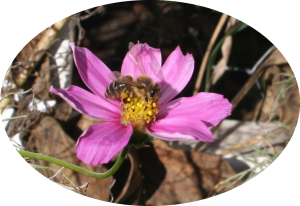
We are in this together, and like a colony of honey bees, everyone has a role to play and the means of sharing their visions and their discoveries. ‘Everyone’ includes the bees themselves : there are millions of little geniuses willing to gift us with their best ideas. Lets include them in the conversation because the next millisecond of our movie might well determine what happens in the following 24 hours.

 Our Green Cathedral