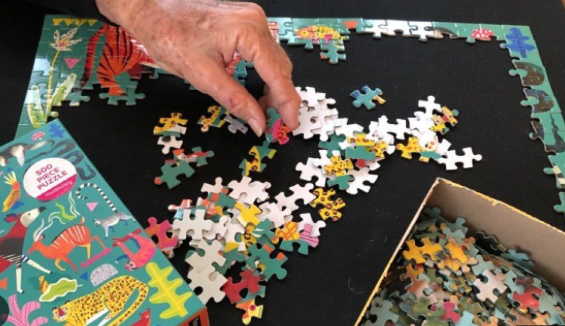
In my younger days I enjoyed doing jigsaws puzzles. Indeed, in moments of supreme but misplaced self–confidence I would ask my mother to remove the lid of the box so that I could not see the big picture before starting to assemble the pieces.
The assembly process is revealing. First, identify the four corner pieces followed by the straight edges, and then find similarities and patterns in the individual pieces as they began to fit together. And finally that wonderful moment of sitting back and admiring the completed puzzle, hoping it will remain undamaged and unbroken for at least a little while.
Generally speaking we don’t teach this way, either in the classroom or to new beekeepers. We tend to work through the syllabus, which is a conglomerate of little pieces, and assume that each student will find for him/herself the ‘corner’ pieces and will eventually stumble on the big picture. I suspect that many never do, especially when we add the stressors of tests, quizzes and exams with an emphasis on short term memory rather than long term learning.
For example, how long would it take you to memorize the following, and for how long could you retain it?
JmFtMwAtMfJsJsAmStOwNtDf
My guess is that some considerable effort is required to memorize this apparently senseless jumble of letters, nor would you retain it for long unless you used it regularly. But what if there is a pattern to the above? What if you could understand the reasoning behind it and recall it at will? *
There are inspirational examples of starting with the big picture. Typically, the first year of medical school begins with classes in anatomy, with students being introduced to patients only in year 3. But at McGill University in Montreal students are introduced to patients on day one, in the belief that they should see them first and foremost as functional human beings, a superorganism if you will, rather than as a conglomeration of anatomical organs.
For a second example, I think back to the ‘O’ level history syllabus we taught in Rhodesia, in the 60’s and 70’s, that began with the French Revolution. We examined the causes, followed by each event from the meeting of the States General in May, 1789, to the Whiff of Grapeshot in October 1795, and then moved on to Napoleon Bonaparte. In retrospect, it is only too clear that Rhodesia at the time, and many countries today, are mirroring those same causes and events (an elite minority imposing it’s will on a majority for personal benefit) but few realized or acknowledged it at the time. It took me years to stand back and see those events in France in a bigger context, and if I couldn’t do it certainly generations of students are unlikely to have done so, immersed as they were in memorizing the details of events that might appear on a test.
So what if we started with the big beekeeping picture and asked questions such as, what are the corner pieces of beekeeping,? ie. the fundamentals that hold everything else in place and that are vital to seeing where the pieces fall together? What are the parameters, and, if we’ve seen a ‘picture’ of keeping honey bees before we start, how realistic is that image? Indeed, are we all making the same jigsaw?
In terms of the bees, Randy Oliver stresses that they need three essential corner pieces : a dry, safe cavity, reliable resources (nectar, pollen, propolis and water) and defense against diseases, viruses and parasites.
In terms of new beekeepers, the corner pieces might be
- the biology of the honey bee;
- the differing flows of nectar and pollen throughout the year;
- parasites and pathogens to which the bees are exposed;
- the functions of the beekeeper.
Every day, as I inspect the hives, read the journals and talk to colleagues, more pieces of the puzzle fall into place, more connections are made and patterns are continued, making the bigger picture more intricate, more complete, more fascinating than initially imagined. For example, I recall vividly the realization that honey bees are one of the very few species of insects that survive the winter as a community, and they can do this because millions of years ago they ‘realized’ that if they reduce the moisture content of nectar it will survive in near perfect condition as honey which not only is a winter food source but also a vital stimulant early in the spring.
How did this ‘realization occur? I have no idea (does anyone?) but an associated piece of the puzzle is a bee’s brain which is the size of a sesame seed yet is packed with more than one million neurons, a density equivalent to our human brains.
What are your corner stones as a beekeeper? Sometimes they can be revealed in an AHA! moment when you say “Now I get it. I wish someone had explained this to me earlier.” I recall coming to the understanding that honey bees are defensive rather than aggressive, that they will protect their home and children against attack, as will we all, but beyond that they are gentle and pre-occupied. This realization radically changed the way in which I relate to each colony.

And what are your corner stones as an individual? Mine include authenticity, fellowship, beauty, empathy and curiosity (my jigsaw has five corners!) and certainly they have changed over time.
My current bee puzzle has 1000 pieces and counting, and there are still large empty spaces. But the big picture, both of honey bees and of life, even if incomplete, is beautiful, amazing and awe inspiring, every time I care to step back and take a look.
* It is the initial letter of each month of the year followed by the initial letter of the days of the week. Ie. January monday February tuesday … etc.

 Our Green Cathedral